

turboplanner
-
Posts
24,360 -
Joined
-
Last visited
-
Days Won
159
Content Type
Profiles
Forums
Gallery
Downloads
Blogs
Events
Store
Aircraft
Resources
Tutorials
Articles
Classifieds
Movies
Books
Community Map
Quizzes
Videos Directory
Posts posted by turboplanner
-
-
Well actually I'm talking about the law. RAA aircraft are deemed to be unregistered.
CIVIL AVIATION SAFETY REGULATIONS 1998 - REG 200.025
Flying unregistered aircraft
For paragraph 20AB(1)(a) of the Act, a person is taken to hold a civil aviation authorisation that is in force and authorises the person to perform a duty that is essential to the operation of an unregistered Australian aircraft during flight time if:
(a) the person holds a pilot certificate granted by a sport aviation body that administers aviation activities in the aircraft; and
(b) the person operates the aircraft in accordance with the sport aviation body's operations manual.
And
CIVIL AVIATION SAFETY REGULATIONS 1998 - REG 200.030
Flying unregistered aircraft--offence
A person commits an offence if:
(a) the person pilots an unregistered Australian aircraft; and
(b) a sport aviation body administers aviation activities in the aircraft; and
© the person does not:
(i) hold a pilot certificate granted by the sport aviation body; and
(ii) operate the aircraft in accordance with the sport aviation body's operations manual.
So RPC holders fly unregistered aircraft.
We got there in the end; when you are issued with a Recreational Pilot Certificate you are authorised to fly a Recreational Aircraft which has some numbers on it.
OK but what do the Sports Aviation Branch people actually do? After several years they still haven't determined the ELAAA application and took over 3 decades to produce the piece of crap that is CASR 149.1. They administer SAOs
2. I mentioned a possible solution for ELAAA a couple of days ago; we don't know who said what several years ago, but I would suggest there is no reason for a GA pilot who is managed by CASA in a prescriptive way to want to pay a fee to an outside supplier when he is self contained within CASA, and the same thing for his aircraft, and it doesn't make any sense for CASA, which manages VH aircraft in a prescriptive way (the same as the State road authorities) to mix aircraft under prescriptive legislation with aircraft under self administration.
3. CASR 149 probably looks like crap to someone looking at it as prescriptive legislation.
-
 1
1
-
-
Civil Aviation Safety Regulations 1998 - REG 1.003 Harmonisation with FARs
Key words are:
"certain parts"
"as in force on 1 January 1971"
"modify"
It would make sense that where Australia, and the USA were updating to a common ICAO regulation they would both use the ICAO wording.
-
After pushing the nose over, there is going to be at least 5 seconds lost while you figure out "WTF is happening"
The multi-second delay is before you lower the nose, unless it's done every time subconsciously. At one stage we had about two people per years killed becaise they did nothing and the aircraft just dropped from their flight altitude, sometimes over 1000' usually going into a spin. It's after you reach a stable glide that you can choose some deviation.
-
Licences are issued by governments or their delegates. RPC's are not issued by CASA or anybody holding a CASA delegation. Another example, I may been trained to use earthmoving equipment and issued a certificate of competence by the vendor of the equipment but unless I have the little piece of plastic issued by a government authority or its delegate and have an accident on a worksite I and my employer are done for.
RAA aircraft are on a register held by RAAus. They are not on the Australian Register of Aircraft and thus, at law, they are not registered.
Regional airlines operate out of many airports that are used by RAA aircraft. Have a look at the ATSB occurrence register to see the occasional interactions
I doubt that this claim can be substantiated. Did you know that SA has never had a High Court Judge? Maybe SA's legal fraternity are not thought of highly enough.
I hope I am not around to see this piece of bureaucratic legal thinking prove wrong in a significant case. Remember when CASA approves documents it assumes liability to some extent.
We're in a time warp distance with the above. You're talking about the prescriptive era.
GA has Compliance and Enforcement people and most of 600+kg fliers never interact with them.Correct, and that's the ideal, CASA have also adopted an audit method of management such as ramp checks and that also is better than the old days.
As for the claim that risk of collisions of aircraft will be exponentially higher without RAA type organisations, there is simply no basis for the claim.I said without Compliance and Performance people, not without RAA type organisations.
It's the compliance and performance people who manage the vital ingredient of behaviour and performance.
-
Well there you go, I didn't listen to myself and would have screwed up big time!
-
My instructor of 50 years flying experience at I think about 500 ft AGL (I think?) in still air nil wind, on the upwind climb, simulated engine failure, then put it into a steep banked (~45-60 deg) descending turn , and put it back down on the strip (downwind) ... It was an aggressive but smooth maneuver, Not once in the maneuver did the airspeed drop below about 70 kts (flaps up, Vstall=45 kts@MW).
Then he told me- while it is possible with much experience of flying and the plane, do not do this ! always choose a less hazardous option , for example if there are flat fields of Canola available....than this one.
What would have been the result if, instead of starting to react when he did, he sat there and counted six seconds and then tried to complete it?
The difficulty with EFATO practice, and forced landings as well is that we know we are going to do one. Usually the Instructor tells us he is going to give us a few today, and we are primed up and ready with a 50/100 sec reaction. If we are going out to practice ourselves, recation time might even be 25/100 sec. Even if we decide to set a random alarm to give ourselves a surprise we are still ready.
However, when the engine starts to die on a perfectly normal operation, unless you've built a subconscious process, the mind starts to analyse what is happening and you go from hundredths of a second to multiple seconds. On one occasion when the front rod end snapped on my race car I watched the wheel try to pass the car as I accelerated, and go backwards when I lifted my foot, and it was maybe 10 seconds or more before I woke up that I could be thrown into the air, and slowly bled off speed.
It's that time-delay factor that leads to the policy of landing straight ahead with no more than 30 degree deviation no matter what you're going to hit. That's where the optium percentages are.
We've had several threads on this subject over the years where someone has come up with a theory and practiced it from x height being able to achieve a landing every time, but the engine doesn't give you a textbook place, time or duration to stop.
-
2
-
 3
3
-
-
So... now that I can do W&B in my head in inches or mm or chains and grains
I've run some spreadsheets (and making more) on various aircraft. I can run many load scenarios and see 'what happens', and how tolerant various aircraft are to loading variations.
One thing owners of J230s in schools say they dont like them in school service so much because they can "run out of elevator" in a flare .
And the W&B calcs show that while the J230 CoG range is very broad, with medium fuel, and two POB, the airplane will be nose heavy - it is almost at the forward limit end of the range ..
Which might tell us why they are short on elevator.
Needs power to get elevator airflow at low speeds due to the amount of downforce required being nose heavy. (I think- I am not an aeronautical engineer but I do understand wings and math)
The calcs show that J230s with only pilots in the front seats need a bag of concrete in the back of the baggage area to bring the CoG at least back to the middle of the range.
Is this other's observation ?
It's great to see someone being analytical and being able to get results. Looks like you may have found a J170 advantage ofver a J230 for some applications without spending a cent.
I've done about 8,000 to 10,000 truck analyses and the overriding lesson to that for me is "Never try to visualise the result" When you calculate the moments you know to whatever measurement standard you want even if that's tenths of a mm, and you can replicate that on the weighbridge.
-
The apathy of the membership is relied upon by CASA in its SAO arrangements. It makes it easier for CASA to heavy the organisations as the they (the organisations) know that if push comes to shove and they make a stand they may find that they have no support.
I find it incredible that a country with 12 times the population (USA) with magnitudes more aviation activity and a wider variety of challenges (terrain, weather etc) can have a regulatory system that does not require membership of any organisation.
If that's the case, it's the choice of the US Government, but as a matter of interest, a year or so I went through six feet of USEPA documents trying to find their prescribed maximum level of dioxins in soil. Dioxin is the most dangerous chemical ever synthesised by man, and after a dioxin spil in the town of Times Beach Missouri, the people were evacuated and rehoused elsewhere, the town disincorporated and the dioxin excavated and incinerated. The USEPA used to have a maximum limit, but then it was decreased, by trillions, and today they don't have a limit. If you're an operator who produces dioxins you have to ensure every person in the local population or passing through has a dixoin level in their body of no more than X. So it's a neat result, the family of the deceased sue you and there's a specific autopsy figure which determines whether you pay or not.
It is even more incredible when you discover that our regulatory system is supposed to be harmonised with the US FAA system by LAW!I haven't seen that anywhere, but what is happening is that both Australia and the US FAA have been modifying their regulations to conform with ICAO standards, and the FAA rules are not as easy as they used to be. It's hard to keep up with because it seems to be happening as a moving target.
-
But for some reason CASA refuses to institute the same system for RPC's. Maybe just to protect the interests of the incumbent SAO's?
I don't have any inside information on how CASA makes its decisions, but if I was in CASA's shoes I would make the exact same split on liability grounds.
I really am surprised you haven't researched this by now since SA was the state that kicked off the move of governments away from presecriptive control in the 1980s, and the SA lawyers were the best and toughest in the land.
The question of CASA that should be asked by our parliamentarians is "why are CASA letting unlicenced pilots flying unregistered planes fly in the same airspace as our airliners?"The RA pilots are trained to a certain standard and given a Certificate, so I wouldn't call them unlicenced.
Their aircraft are registered, so I wouldn't call them unregistered.
They operate in a window which, with a few excpetions has them flying in different airspace to airliners.
There are some, with suitable equipment, and extra pilot training operate into locations alongside airliners - but the qualifications are equivalent to airliners. (which is why I'm disappointed to see silly threads on CTA and Flight Plans inferring any fool can wander in, say "G'day mate can you show me how I can land/get through here." and expect Airservices not to send them back to where they came from.
before a mid-air between a regional airliner carrying 20 constituents and SAO registered aircraft.Without Compliance and Enforcement people the operations will become more defacto GA and that collision is exponentially more likely; It's up to the SAO to be alert to drifts like that or they, as managers, will be paying the price.
-
What I'd suggest is people stop posting things they do and refer the people who are just starting out to the relevant regulations. These regulations are not difficult to understand and quite straightforward. To a degree Airservices have to take some of the blame for any confusion by existing pilots by just allowing Rafferty's rules. One day it could get someone in deep trouble if there's an accident due to a PIC not understanding his obligations and being in the wrong spot at the wrong time.
-
1
-
-
I was under the impression that any aircraft being hired would also need to be on a maintenance program such as would apply to a flying school and be a 23/24 registered aircraft. Also bearing in mind insurance issues.
Yes, you put your aircraft on the flightline with a Flying School/Club, they hire it out and take care of the legals.
-
........no good trying Honoruru again; maybe we copy China and rower prices, and ..........
-
And whether it was taking off?
-
Great subject.
What are the reasons why we don't lodge a flightplan each and every time we take to the air (excepting CCTS)?
You're only required to lodge a flight plan for certain flights.
Preparing/doing a flight plan involves things like fuel burn, weight and balance, route, altitudes, frequencies, NOTAMS, etc - like a checklist.
It's a lot easier to do it at home than try to work out what to do in the air when the tank starts to run dry, or what frequency, or where an alternative is if you are caught by time or weather, calms the cockpit down a lot on a long flight where the weather is not going your way.
I never took anything with me when flying in the training area, because nothing ever happend out there and anyway I knew the way home; just follow the coast. Then I read two incident reports; one about a pilot who took off in good weather and fog unexpectedly rolled in, and he landed on a partly completed freeway. The other was a pilotcalling inbound at Moorabbin and being told it was closed due to weather. He was short on fuel and didn't know where else to go so he turned around looking for an airfield, but visibility closed down even more and he was pretty much on empty, so he turned back to Morrabin, told the tower controller to get stuffed and landed in what vis was available.
-
Bruce you 100% correct.
Turbo needs to take a refresher on bureaucrat behaviour and the art of.
KP
Those comments from the two of you probably sum up the problem.
Bruce it has nothing to do with going political; the politicians are likely to be told by CASA it doesn't legally fit.
Keith, please correct me if I'm wrong but as far as I can remember you set up a Limited company to administer RA airctarft+some VH Aircraft + some VH Helicopters.
You could have set up an Incorporated Association to handle RA aircraft as a start, but also fitting into the accepted SAO policy were:
ABF
APF
ASA
ASRA
GFA
HGFA
MAAA
And you still could.
In going for a mix of RA where the liability rests with RA plus two classes where the liability and control rests with CASA, I don't believe it is possible to have a company or association doing both.
No one in any field of business is likely to give away control of an operation while retaining liability for its mistakes.
It would be interesting to see how fast things moved if you put up a proposal for an Incorporated Association handling RA only.
If that was accepted and you got some time under your belt, the potential numbers are huge, and when the numbers are huge, the costs come down.
-
.......in favour because he'd promised to bring Cappy the newspapers every morning and check the polls and....
-
.....support Cappy and put some life into the campaign. Turbo suggested adding the word "come" and wrote a song "Y,all Come" and the did, millions of them demanding polling booths so they could vote early. Cappy rapidly passed old Snoozer Joe, then Don Trump himself and was on the way to the White House when...................
Cappy in his singing outfit
[sPECIAL NOTE TO NES READERS IN THE USA; THIS IS JUST PRETEND, DO NOT CAST A VOTE FOR CAPTAIN COOK IN THE ELECTION; THIS IS JUST MAKE BELIEVE]
-
People probably aren't aware that Cappy flew to the US a couple of weeks ago to put some spit and polish on Donald Trumps campaign. "You're about the same age as Biden" said Don, "so we need to appeal to the oldies" and before he knew it, Cappy was standing out the front of the White House next to the latest press secretary Posey Stripper who after doing an LGBTI segment handed over to a rather shaken Cappy, who for a time lapsed into a confused silence. As we've seen from his post after #14372, he's ready for bed and affecting a queensland accent after a short few sentences, but soon, in a Texas drawl he'd practiced for many years in case someone picked him up for a part as a cowhand in Dallas, he began to speak, saying "Y'all ................
-
How many pilots have been saved because they have submitted a NAIPS??? I am tipping almost no one.
"Submitting a NAIPS" isn't something I've heard before, and there's a difference between preparing a flight plan and submitting a flight plan.
Having said that, pilots saved by preparing a flight plan would probably run into hundreds over the years.
-
2
-
-
........been walking downriver and noticed what at first looked like stinging nettles growing amongst the vines. Stinging nettles are a noxious weed so he set fire to them and couldn't find his way home.
Turbo and Cappy met up with him a few weeks later at the Boundary Bend Fly in.
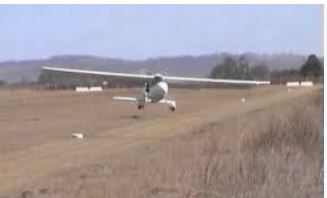
Not many people know that Cappy actually built a recreational aircraft a few years ago. He'd seen an Ad, headed Barn Find. Knowing there were no barns in Australia he thought he would get it cheap from an obvious wood duck, and he did. It was a facet Sapphire; and by the time he'd sanded all the rust off it he was left with a serial plate which was attached to a stubborn lump of pigeon poo, but he persisted and in time he had a classic aircraft and is shown below landing it.
He said he'd flown it from Kapoo, his home airstrip, also claimed by the ADF to Boundary Bend, but Turbo has a photo of it strapped down to the top of a B Double Tautliner headed from Sydney to Adelaide.
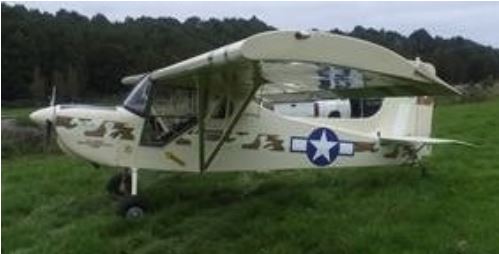
Salty had rebuilt a Protech PT2, and had very carefully selected a different engine from it, because he was the Forced Landing champion of RAA. His aircraft is shown at the fly in.
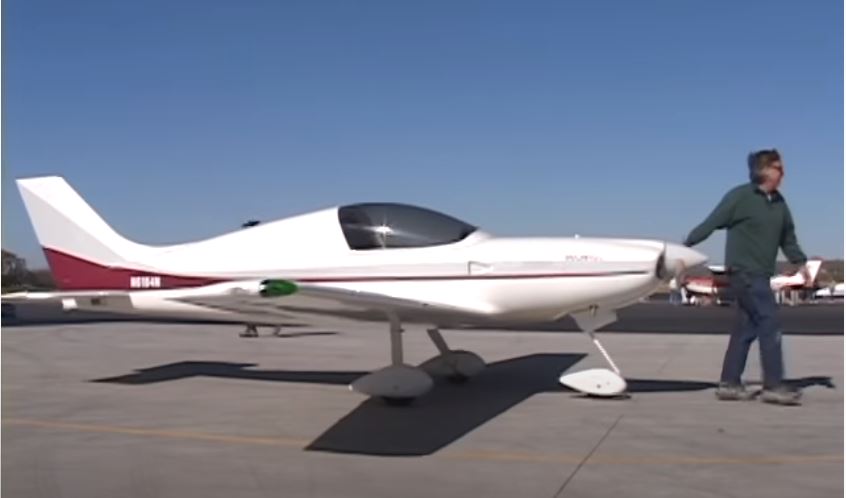
Turbo had found a Pulsar in disrepair which had been a school project dreamt up by a Lesbian teacher who campaigned relentlessly for equal rights to women and had tasked the Year 12 girls to building it. The school was Deniliquin, foundation home of the BNS Ball, Holden Sandman and Ute and Mattress. NES readers could draw the conclusion that (a) not much work would be done and (b) the builders would be distracted by other matters. We'll say no more, but Turbo was going to have a massive job rebuilding it. Two weeks later he'd finished, throwing the engine on the tip and building up a Honda 500/4 with titanium head and block, Mikuni fuel injection, tuned pipes, overtimed cam and CDI system that would zap a fly at ten paces. It produced 187 horsepower on the dyno. He'd done away with most of the frame and had managed to achieve 170 kts IAS so far. Turbo is shown in the bottom photo easily towing the Pulsar along the apron with one hand.
The fly in was a huge success with 70 aircraft showing up. Cappy asked Turbo why he had gone to such trouble to build what was an unknown quantity. "Why do you want to fly so fast?" he asked. "Well I want to fly Bass Strait and go to New Zealand and sh!t" said Turbo. "But it hasn't got any instruments" wailed Cappy.
"EEB, Cappy" said Turbo "Eye, ear and bum is all I need"
"But how will you navigate over the sea" asked Cappy. "I'll fly round the beach" replied Turbo.
Also at the fly in were ...................................

-
1
-
-
.....socks. The NES readers were unsure why Cappy had capitaled Bull; could it be that..........
-
The big black one turned out very well, with a Museum attached.
-
I wonder if the drop in interest in building is related to increasing regulation of recreational aircraft and that in turn is related to a drop in interest in the forums.
BTW, I have noticed an increase in discussions about regulations in a lot of the threads I read, but that is just anecdotal evidence not backed by any statistical analysis.
From the time Recreational Aviation escaped the 300' ceiling and border fences thanks to exemptions allowed by CASA, there hasn't been the huge increase in regulations that some people claim, but mainly detail changes where liability has been moved from the Federal Government to the pilots, and where changes have been made to comply with ICAO procedures.
If you fly from a country strip where most of the day there is no one else and the circuit and you fly locally around your airport, I doubt you would really notice the changes.
Similarly in the automotive world in Victoria we had the Motor Car Act 1958 which was very simple and easy to understand, but since then supplementary Acts have been introduced for much the same reasons, so a licence test is harder and you have to do 120 hours training to get a licence. Car driving and ownership is not dropping because and while there might be some forums, people don't usually spend time debating the latest changes, and carmera fines have removed the friction between the drivers and police.
What has changed radically in RA in the last decade or so is the shift in RA aircraft specifications, into a GA type aircraft, resulting in a desire to do what GA aircraft do - travel long distances. Ramp checks and fines suddenly made people aware that they had more obligations than to learn to manipulate the controls of an aircraft and happily just fly out in the country where no one else came. Suddenly they've been faced with a massive number of regulations by comparison to what they previously had to deal with around the paddocks. Even this year I've noticed some posters were not aware of the other regulators besides CASA; Airservices Australia and ATSB. Faced by that and after a scare of two flying long trips where some have had fuel exhaustions and many have had forced landings or weather delays, it's not surprising that they have drifted off to other recreational pastimes.
Certainly this site is dominated by discussions related to GA type aircraft and GA type flying, but last time I saw some figures RAA were quoting 12,000 RA members, so an increase rather than a decrease.
Building is slow with many problems that have to be solved, but the Savannah threads seem to have succeeded over the years and produced a lot of results in the form of fininshed aircraft, with lots of photos of fly ins.
To the people doing the building, those forums will be their lifeblood, but the threads are always going to be small.
-
2
-
-
I've driven old Cats where the throttle was on the right, and it was pulled back towards you to gain revs - but now I've got a Cat where the throttle is on the left, and it's pushed forward to gain revs!
I've had the same with dozers and tractors, rotary hoes, and rough country 4WD throttles and boats, so in my case I wouldn't be referring to a "tractor throttle" as such, so it's hard to understand what this "tractor throttle" really means, unless it's referring to setting the rpm for individual stages of flight. The only time the throttles on any of those items needs some care in design is in high powered boats where it pays to have the throttle opening to the bow. If its opening to the stern and, say your about to take off with a 150 hp outboard and a skiier behind, if you pull back on the throttle the acceleration is going to try to force you back and could lead to the trottle being opened more than you intended, and make it harder to recover, whereas if you push the throttle forward by power and you're caught by the g force and keep hanging on to the throttle you'll slow it down and your body will be returned to the upright easier.
-
1
-
2020 raus elections
in Governing Bodies
Posted
We don't have to try and out think them or trap them on some theory, we just have to fly to current regulations.