


turboplanner
-
Posts
24,360 -
Joined
-
Last visited
-
Days Won
159
Content Type
Profiles
Forums
Gallery
Downloads
Blogs
Events
Store
Aircraft
Resources
Tutorials
Articles
Classifieds
Movies
Books
Community Map
Quizzes
Videos Directory
Posts posted by turboplanner
-
-
........appendix where it curled round and round like an archery target..........................
-
24 minutes ago, onetrack said:
However, the Japanese appear to be concentrating on hydrogen fuel cell technology as the primary method of hydrogen use,
Probably because they've had fuel cell production cars, buses and trucks since around 2005, and the only issue seems to be cost, at present about 3 times a petrol powered identical car, so a killer until some breakthroughs.
-
 1
1
-
 1
1
-
-
Future Fuels – Hydrogen
CO2 is not measured on Australian vehicles because exhaust emission of CO2 is dependent on the standard of the fuel and diesel is under threat because it is part refined and relatively dirty.
However, CO2 and Global warming are not the only reason we should be looking for alternative fuel. Since 1979 fuel costs have risen way beyond the CPI to the point where long distance travel for holidays is less affordable than it was in the 70s. This in turn has lowered the income of many country towns which in the 70s had thriving tourism facilities.
So cost reduction is right up near the top of the list of reasons for finding a different fuel.
Some fuels which may produce less CO2 will be knocked out by this factor.
Car Manufacturers have handled the cost increase by selling excitement and allowing more applications in SUV and these are now market leaders, while non-towing cars have become lighter, retained low initial costs and are starting to achieve highway fuel consumption of around 4 litres/100 km.
The truck industry has been able to take another path by increasing the volume of freight carried be changing maximum length and height dimensions and reducing fuel consumption.
A B Double today with one driver and one Prime Mover carries as much volume as three semi trailers of the 1970s, and this has allowed companies to survive in applications where Prime Movers consume massive amounts of fuel per year.
When we look at future fuels we have to match them to the applications people want to operate in.
Hence, EV so far is not much use to the No1 sector of the car market because of towing power demand and long distances at high speed, and with trucks required to keep within maximum dimension and weight limits, so aside from the proposed fuel working or not working in an engine there are the practical limits which must be met for long term success.
The attached story from the Age yesterday is about the first Hydrogen Supply Station in Australia which is being built at Truganina in Melbourne. This is for Hydrogen Gas to be burnt by an ICE engine (as against a hydrogen fuel cell vehicle with electric wheel motors). Some people have said Hydrogen will make EVs obsolete.
Truganina is an industrial zone west of Melbourne and an ideal B Double departure point for Sydney, Brisbane, Adelaide, Darwin and Perth.
My job is to design trucks which can be ordered, delivered within about six weeks and go straight into service for their lifetime which is about 3 million km, so I was casually looking at what would be required for a hydrogen truck (leaving the engine to be designed and built by engine manufacturers).
The current extremes with diesel fuel for a Prime Mover are customers who believe their business is carrying freight, not fuel so buy their fuel enroute and set a maximum fuel tank capacity at 800 litres. Offsetting them are customers who believe they get ripped off by service stations so do a bulk deal with an oil company and carry enough fuel for the trip. They require a minimum 2500 litres. If you thought W&B was hard with an aircraft try getting these extremes within the wheelbase and meeting maximum axle loadings. The 2500 litres required square aluminium tanks which produce maximum volume per metre of length, jamming the front tank within about 50 mm of the steer tyre and the rear tank about the same to the drive tyre, the outer face at the legal truck width limit and the inner face allowing a tiny space for the prop shaft.
So can hydrogen fit into this? Well we don’t know, because the fuel vessel has to be decided. LNG trucks required a heavy steel tank with fuel at 2000 psi; will hydrogen require a similar heavy tank. What will be the fuel consumption of hydrogen compared to diesel? Well we don’t know that yet.
What we do know is that with only one refuelling point, the first trucks at least will have to carry enough hydrogen to make the round trip Melbourne-Brisbane-Melbourne etc, or limit their operations until other supply stations can be built, and these look like very expensive stations, not just stations with holding tanks like petrol and diesel with a tanker delivering the product.
Unless the engine burns a lot less hydrogen than diesel on the same task or unless we can carry the fuel at low pressure within about a t6 mm skin, then we are not going to be able to enter the market with these trucks until there are hydrogen supply stations within our range, because we have no legal space.
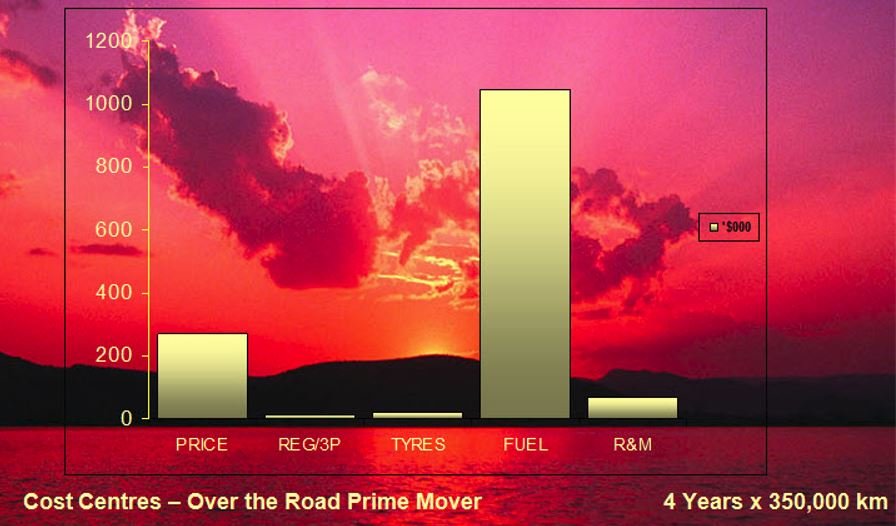
Before the customer makes a hydrogen commitment, he’s going to be looking at the cost of hydrogen and the consumption per kilometre. Take a look at the attached graph and you can see why – his fuel bill for diesel exceeds the cost of the Prime Mover in about 12 months, and he’s paying more than a million dollars every four years!
If we look at hydrogen for aircraft, the size and weight of the fuel tank will also be a critical factor in deciding whether to switch.

-
1
-
 2
2
-
-
5 hours ago, APenNameAndThatA said:
No one said civilisation was about to end (straw man).
No they didn't, but you misquoted me. I said "civilisation as we know it."
-
7 minutes ago, Captain said:
..... he broke a tooth on the purple ear tag from .....
....a Brahman from Rocky. NES readers are warned that Rockhampton has the toughest steaks in the whole of Australia. Turbo bought a couple in town and took them back to the caravan park. Eventually he made them edible by putting them on the driveway and driving backwards and forwards over them for 15 minutes. After that they were quite good to eat if you disregarded the gravel. In cappy's case the broken tooth didn't make much difference, so he continued on ..................
-
 1
1
-
-
.............the letter of the law, ensuring the gherkin went down whether it wanted to or not.
Cappy had just taken a bite out of a Big Angus Burger when .................
-
......Macca's at the Temple of Doom.
It was at this Macca's that the notoroius .......................
[What Cappy neglected to say in the post above was that the bottom, rather ragged clown was him]
-
22 minutes ago, Bruce Tuncks said:
Turbs, you conveniently forgot about the thousands of birds which use that low airspace.
Well I'll conveniently say that millions of birds use that same airspace, and I use that airspace.
-
5 minutes ago, Bruce Tuncks said:
I just don't understand their motives... they are clearly trying to kill me, but why?
They have a track record of killing people by causing them to fly into the ground, now we find that the rest of us are to be restricted to flying under 3000 ft!
3000ft is less than the start height for gliders in the bad old days... it is VERY low. The first thermal on track to get you up and going was the most important thermal of the day.
Kingsford Smith said that the only time you have too much altitude is when you are on fire. Every foot above 3000 ft is useful. It gives you time and distance in the event of an engine failure. AND there are tens of thousands of soaring birds in that airspace..
How come this was put in? What history is there of midairs over 3000 ft enroute?
I do have to admire their rat cunning though.... the layman is afraid of falling, so it appears to him that lower=safer.
Now I am faced with an awful choice... fly dangerously low or fly illegally.
You're not faced with an awful choice; you're part of an organisation that obtained permission to fly without the costly training and expensive equiment on GA aircraft. To do that you had to stay away from airfields and stay below 300 feet. That's the AUF/RAA history, so you're way ahead today.
Sometimes what you learn in gliding is complimentary, other times it doesn't fit but clearly stick in your brain as an impediment. In a glider you have a wonderful glide ration, but you can never apply power to climb if the weather doesn't co operate. You don't have that issue with a powered aircraft so the equivalent of the glider minimum you quote would be the minimum 500 feet in a powered aircraft which offers plenty of height to organise a landing, but you will be sinking at a faster rate.
When your flying in GA airspace which RAA does these days you can face GA pilots training under the hood for IFR practice, people stuck on theoretical GPS routes and all sorts of odd things. When you get a fatal crash at a lonely airport like Mangalore that should send a message that separation rules are there to protect you and the people who fly near you.
-
...portion of a skeleton under the other arm. Things didn't look good and then Cappy noticed the three vultures sitting on a nearby tree. Across the paddock, straighth for Cappy came four black horses galloping with thundering hooves; it was the four horsemen of the Apocalypse. Cappy thought he would have preferred an Ambulance, but out of the corner of his eye he saw ....................
-
1 hour ago, aro said:
The amount of fossil fuels being burned and the rate of change has increased markedly in the last 50 years. So it doesn't matter whether you pick a baseline of 50 years ago or 250 years ago, the change is very similar because most of it occurred in the last 50 years.
But when you are telling the world civilisation as we know it is about to end you use the same baseline and you show the progression year by year.
However, when you set the baseline, report the alarming increase on that baseline, and then just five years later push the baseline backwards by 215 years you are changing the gradient, doctoring the figures; your believability goes out the window.
-
1
-
-
20 minutes ago, Ian said:
The view that climate change is wrong is slowly being crushed by real science, because the issue appears to be real. Doing a little bit of "reading" rather than opining you might find that the IPCC was created by the US Government's lobbying to counter the impact of the unrestrained views and opinions of independent scientists allowing a political component to the views.
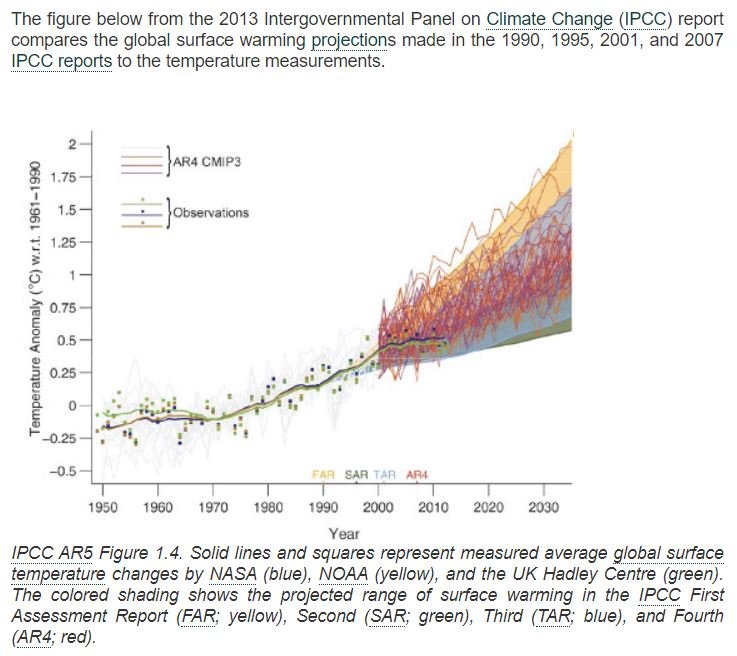
The NASA graph you posted earlier shows climate at zero/baseline as late as the mid 1970's rising 1 degree by 2020; an increase of 1 degree in 45 years.
In the 2018 Summary for Policymakers [countries, including Australia] the IPCC said "Human activities are estimated to have caused approximately 1.0 deg C of global warmimg above pre-industrial levels [1760].........global warming is likely to reach 1.5 deg C between 2020 and 2052 if is continues to increase at the current rate. [their 1 degree having been changed from their earlier report which was similar to NASA to 1 degree in 258 years.
There's no opining here, the sources have been posted earlier.
How do you explain this discrepancy?
-
........Board Member from RAA [averef], and the strip number was odd - 666, the devil's airstrip [scaryavref], but Cappy just closed his eyes and opened the throttle.
With the benefit of hindsight, it might have been better if Cappy hadn't closed his eyes before taking off because ..................
-
38 minutes ago, Ian said:
The IPCC document is one of the most heavily politicized documents on the planet and has upset numerous scientific contributors in relation to the watering down of their research and comments.
Every single version has undergone significant watering down of the projections. Never once has it gone up. However slowly the message has been getting stronger.
Fundamentally this is because the message significantly impacts the bottom line of large polluters who have large budgets. One of the key tools that police use when investigating crime is simply to follow the money, people lie however money finds the shortest path.
Who do you trust, the dirt farmer or the city salesman, because the city sales guy is the one getting the cash.
I was only interested in a simple comparison of a NASA projection vs an IPCC projection, altered very substantially from an earlier IPCC projection.
-
10 minutes ago, Ian said:
On my trust scale I generally trust people in NASA when they publish things. I used to work in CSIRO a long time ago and I generally trust the people there.
Just taking your trust in NASA, the graph you posted shows climate at zero/baseline as late as the mid 1970's rising 1 degree by 2020; an increase of 1 degree in 45 years.
In the 2018 Summary for Policymakers [countries, including Australia] the IPCC said "Human activities are estimated to have caused approximately 1.0 deg C of global warmimg above pre-industrial levels [1760].........global warming is likely to reach 1.5 deg C between 2020 and 2052 if is continues to increase at the current rate. [their 1 degree having been changed from their earlier report which was similar to NASA to 1 degree in 258 years.
Given that countries are still basing their actions on IPCC pronouncements, that differential, I would say, is alarming.
-
7 hours ago, Ian said:
My baseline assumption is that that the price of fossil fuel will be the base cost plus the cost of extraction of that much CO2 from the air and convert it into a stable long term solid or liquid. Most transport will go the way of electric vehicles, those that can't will continue to use liquid fuels at a higher cost.
At that price premium some other fuels that don't have to pay the extraction tax will start to look attractive. Hopefully there will be a degree of innovation which facilitates lower costs in this area. I don't know however it will put a floor under oil crops.
You're right about production areas and hopefully there'll be enough very cheap electricity to produce it via another mechanism however the processes at the moment are pretty expensive. Basically there'll be a small pool of liquid fuel otherwise.
I think that if the whole greenhouse gas issue was going away it would have done so by now instead of slowly gathering momentum. You have some of the biggest industries and budgets on the planet trying to stop it and they've failed, however they did slow the process down an awful lot.
While you seem to demonize city dwellers, I just prefer intelligent rational individuals and would like to demonize stupidity and people who believe in magic over maths. Basically I'm happy to let you believe whatever you want as long as I don't have to pay for it.
For the anti-vaxers out there I'd like to see the people being hospitalized having to pay their own medical bills.
The anti-vaxxers are already wedged; locked out of most retail outlets and businesses so they can't sue the owners for allowing them to be infected and in Voctoria dying at a rate which is about four times the road toll, so auto-managed. It won't be a long financial drain.
We've been talking theory about alternative fuels and there's nothing wrong with that, but someone has to take the theory and produce a viable product, and that's not so easy, especially in this case the product not only has to be made available where it was needed. AdBlue (Urea) did it; I researched availability of AdBlue on all highways of Australia within the fairly short range of a particular interstate prime mover and found the supply network was covering the whole country with the exception of a section between Mount Isa and Darwin, and recommened carrying two small cans the get through this, and we had a practical prime mover not restricted in any way from moving on.
Electric is not new; Melbourne has the biggest electric tram network in the world, and we once had electric buses, and fleets of electric delivery trucks, it's just that no one has invented a power grid capable of accelerating from Base Load to Peak Demand.
However, you can split that into two sections: Industries which can operate on a fixed sipply load, and the rest of the country which creates Peak Demand. So, for example the processing of seed to oil might be a fit for renewable power supply, independent from the veriable grids.
There are solutions, but in some cases inventions have to occur, and alternative incomes have to be found.
The growing question is the validity of global warming itself:
Would it really be an issue if we do reach the magic 1.5 degree increase in temperature?
Would we be worried if Melbourne gets the average temperature of Sydney, Sydney gets the averaage temperature of Brisbane and large areas of norther deserts become tropical and available for living and farming?
What are your thoughts on these two publications by the IPCC; the exponential upward curve forecasts from 1990 to 2007, and then the 1.5 degree armageddon being backdated to a start in 1760 by the IPCC in 2018?
-
12 minutes ago, Ian said:
Agriculture is a business just like selling derivatives.
The Chicago Mercantile Exchange was set up to sell futures to enable US farners and livestock producers to complete a sell of their products for a set price at the end of their growing season. That at least gave them some certainty that after investing in machinery, seed, fuel and wages, there would be a return at the end. The fluctuations in buy and sell prices these days are based on fear and greed and primarily conducted by city dwellers, but you certainly can buy a contract for grain or cattle, and if you don't cancel the order, receive a delivery, but the fluctuations I was talking about were the natural farmer induced fluctuations. Nevertheless there is a Net end result with graphs on supply and price fluctuating within a minimum-maximum bracket in the short to medium term so an annual volue available and a price available for seeds.
Where I think use of something like Canola for fuel would be difficult is availability of land. Our petrol and diesel consumption per DAY is in telephone book numbers with availability in every town and many roadsides. The question is whether seed production could ever be brought to that volume.
Around the time of the 1979 fuel crisis I was asked to take part in a Vicroads think tank on what their roads task would be in 2050. Naturally one of the primary subjects was availability of car fuel since we had been told the world was running out. Vicroads had done an analysis on road ownership and found the road authorities were the biggest landowners in Australia, and each road had vegetated verges so they could become the biggest farmers in Australia and grow crops to produce ethanol. A couple of South American countries had already committed to pure ethanol cars. We worked on it collectively for a few hours and were able to solve most of the potential issues of producing the crops, but we never got arund to look at the actual volume required because magically petrol became available again, albeit at a much higher price.
-
.....a ride in the Tyro, but Cappy just wiped him off; didn't even give him an autograph, and the farmer was a pumpkin farmer too!
Just in front of him a black cat streaked from left to right, and the bell in the local church for no apparent reason tolled 13 times, and ............
-
........he continued to taxi along the ruts but the drooping Tyro wing was knocking over spud bags which meant thousands of dollars worth of spuds would rot. The farmer met him at the end of the row with an under and over and 48 pellets of hot swan shot.......
-
3 minutes ago, red750 said:
I am watching less and less TV because I can't hear it. It's like I have earmuffs on under a full face bike helmet.
Tried teletext?
-
11 hours ago, red750 said:
CommBank issued my wife a replacement Mastercard on 8/11. Still not here.
I ordered a small car part from Michigan, USA on November 16, got it in Melbourne November 29
-
8 hours ago, Ian said:
Your conflating unrelated issues, farmer grow crops for money. If there's more money in fuel they'll grow fuel. Agricultural goods have been driven to very low prices historically and may rise. This is a good thing for agricultural producers and exporters and may lead to people not feeding grain to cattle. Currently about 36% of grain production goes to animal feed with only 55% used as human food.
If you suspect it do some research using government sites, your suspicions are just plain wrong and yes they account for all the things you mention. The term that you're looking for is Net Energy Balance or NEB, here's a link
Canola crops aren't irrigated, have low use of pesticides and don't always need them. Yes palm oil plantations have been very environmentally unsound however that's just one third world data point.
Another data point is that famines don't occur in countries with a free press so if you're concerned about people not starving make sure that countries have independent media rather than worrying about hypothetical fuel food congestion.
Office Agriculture has brought many people undone over the years. Agribusiness is a complex one because the markets, like the stock exchange are uncontrolled. City people might remember the stratospheric fruit and vegetable prices during the recent drought in parts of the country. The larger part still produced its annual crops, and incurred costs which were no different from any other year so rorted the customers because they could. So the first hurdle you have to overcome is unstable pricing. You want people to do reseach using government sites, but we'd go broke oing that, the data is always out of date, however here's a first hand report from actual invoice prices. In 2017/18 I was buying feed oats for $12.00 per bag; when the drought hit, the same suppliers in the same district, which was not affected by drought lifted their prices to $17.00 per bag - a 41% increase, and because people paid it, that's now the going rate. In the large scale agribusiness industries this wild west pricing produces serious cost fluctuation pressures; a friend of mine who grows millions of chickens in one year was faced with an $8 million increase in his grain bill. Australian gouging cost us our tin industry and our wool industry which was replaced by the nore stable oil industry. The second agribusiness factor is the grass; it's always greener over the fence, so when a farmer finds a way to get an edge and drives to town in an upmarket car because he switched from canola to cotton or wool to prime lambs, it's not long before the whole district is producing cotton or fat lambs. If the successful farmer has switched from dairy cattle to beef, everyone climbs into beef, so to a large extent Australian agribusiness is nomadic, so if you wanted to buy canola oil from them, for example you might do well in supplying service stations for three years, then you have no supply because they've all gone to beef - in other words its a free market, and a dangerous one for the inexperienced. When you're costing agribusiness products, your scenario was also a little too simplistic, it's easy to knock someone down because he referred to pesticides, but ther are also weeds to control, or floods, or droughts.
Bearing all this in mind, if you could find a way to geberate the huge production required, and find a stable farmgate price, you're over the first hurdle then into a myriad of oncosts from storage to transport to any refining necessary to testing for and resolving any going compliance issues, to testing the product in hundreds of engines so ensure compatible lifetimes and power outputs.
Cross those hurdles and sell the product for less than petrol or diesel and you'll wear diamonds. The transport inndustry which included cars trucks and buses is waiting and always open to trialling better ways of transporting, but what we've seen since the fuel crisis of 1979 is incessant chatter about but the breakthroughs haven't stacked up in service.
-
........a Tyro onto a two acre potato paddock, neatly placing the wheels in the tractor tracks.[nostalgic avref from Bone].
Cappy is cunning; cunning enough to go for a week without gin, by which time the shakes were all gone, the eyes were blue, and people he met imagined him (from the unending self-history) to be a former Spitfar pilot.
A potato paddock was chosen on a dau when there was a raging 30 knot crosswind, and the Tyro pulled out of the shed. At first it didn't look like the bet was going to be settled. Like a runaway milking cow the Tyro blew down to the far ffence and had to be dragged back by three people who almost took off with the aircraft after there was a lull in the wind and Cappy pulled the cord, jumped in, gave it full throttle before anyone could catch their breath. It was a master stroke, but .......................................
-
8 hours ago, Ian said:
I'm happy to take a bet on this fantasy if you wish. In Norway 80% of vehicles are now electric, in Europe 20% of sales are now electric, Australia's stance is an outlier however we're being dragged into a carbon market. Now I own a petrol burning vehicle however I accept that at some point fossil fuels are going to be taxed like buggery and the tax breaks for electric will be pretty compelling, either that or biofuels.
Norway is used universally as an example of EV success
Its population is only 5.379 million - about the same as Melbourne
Its area is only 385,207 square kilometres compared to Vic 227,444, NSW 801150, SA 983,482, Qld 1.853 million.
It's rich in hydro power to the extent that the UK, which has run out of power before EV starts to demand more, is building a line to Norway and will be buying its power from Norway.
So when you do the analysis, Norway is an obvious fit for EV.
The news media may have been saying Australia's stance is an outlier, but when it comes to putting a new vehicle on the road, the law of physics applies.
Australia EV exponents have narrowed the magnifying glass down to the capital cities and in particular commuters who just want to drive to the local train station, or on a short commute, coming back home for a single phase overnight charge. Nothing wrong with that for EV.
However, that's not Australia's transport task.
Take a look at our current market share - dominated by high power consuming requirements like towing heavy trailers,long distance trips. Then the commercial requirements PUD (Pick up and delivery) trucks starting in country towns in the morning and dropping off at the airport for night overnight express. Sales people in the car for six or eight hours per day. A business trip or delivery from Rockhampton to Longreach at 100 km/hr cruise speed, 110 km/hr cruise in some states/territories. Regional travel with its long distances at 100 km/hr, power consuming all the way. Light trucks which operate in Japan and Europe with 60 kW, requiring 100 to 145 kW to be viable in Australia. So far the EV exponents simply write off regional Australia as too hard, but if you went down the path of banning ICE you finish up with a massive political problem which would require a reversal until EV could meet the power/range combination each specific application and area requires, and we know that very well, and we factor that in when we set up a vehicle for an application, so to encapsulate all that in the comment that "Australia is an outlier" is standing on a bar of slippery soap, hence the government stance.
A few months ago we were discussing engines and I figured that if Rotax was going to be affected it was best to do some research on the pressure Austria faced, Europe being an EV leader, with EV market share like the 20% you quote. At the time the Australian EV market share had dropped back from about 1.5% to about 1% and several states had approved EV road taxes to cover road construction and maintenance like all other road users. I was stunned to find EV market share in Austria wasn't much better than Australia, and they had started to cheat, incorporating Hybrids as EVs. I think the total market share was around 5.9%, where 5% is usually where people in the industry are fired. I'm not saying all of Europe is fudging the fihure by including CO2 producing hybrids, just that if anyone wants to quote "Europe" better to do the research on which Europe.
-
2
-
1
-
1
-
The Never Ending Story
in Aviation Laughter
Posted
.....it became obvious that the tattoo was of a Dragon because just as bull bent closer to see what breed of dragon it was, it belched a cloud of smoke and fire, singing his hair and nearly choking him with its smell. bull reeled back but was a fraction too late becaise the aftershock, so to speak caught him in the face again and he looked like a cooked lobster discoloured by .....................