


turboplanner
-
Posts
24,359 -
Joined
-
Last visited
-
Days Won
159
Content Type
Profiles
Forums
Gallery
Downloads
Blogs
Events
Store
Aircraft
Resources
Tutorials
Articles
Classifieds
Movies
Books
Community Map
Quizzes
Videos Directory
Posts posted by turboplanner
-
-
.......finding out what Cappy had recorded. When fleeting shots which Cappy had accidentally caught showed him in a compromising position in Pakistan, somewhere near the President's Palace, she spat the dummy in the dirt, and Cappy ran for the Drifter, but he was a second too late, and she managed to grab his orchestra ..........
-
...fetlocks. What Cappy didn't know was that Mavis had been recording him on her phone.
At the next CWA committee meeting she presented ................
-
....."what's it like to play cricket with two bullets through your leg?" and "Does it hurt", Imram answered them all with a smile and then asked Cappy how much an electric Drifter with a 20 mm cannon would cost. Cappy, being an experienced International businessman, trained in Guinea-Bissau and currently acting as adviser to the King of Liechtenstein, already had a quotation prepared, which Imram signed on the spot, and appearing happy, asked absentmindedly "Have you seen my wife anywhere?" Sometimes one could wish Cappy had a little better understanding of diplomacy because he dobbed Turbo right in the camel dung, and ............
-
 2
2
-
-
 and then realised his mistake and pretended to cough and cough and cough, but ...........................
-
28 minutes ago, octave said:
Conveniently this is a software update and can be done over the air.
They have another poblem in the US where a minor electrical circuit problem cut the power.
to some of the systems including the throttle which failed at it's existing cruise speed. The driver managed to stop the car by overpowering the motors with brakes.
This is not taking a shot at EV, just pointing out that people who tell us EV are maintenance-free don't know what they are talking about.
28 minutes ago, octave said:Those who don't trust the technology are not being compelled at least in the foreseeable future to buy an EV.
That's true for most companies, but the UK has banned ICE from 2030 while only achieving 2021 full year BEV market share of 7.2 and the UK is short of power. Hybrid (PHEV) in May 22 figures had declined by 25.5%.
The ACT has banned ICE after 2035.
You can call Norway as a success with 64.5% BEV
Norway has almost unlimited Power generation from hydro and is a very small country, so no range issues, so suited to BEV. Other Scandinavian Countries haven't achieved the same success with Denmark on 21.8% and Finland on 17.07%.
Volvo is a manufacturer induced ban, now committed to 100% EV, despite having had ICE customers in many countries. Volvo is owned by Zhejiang Hangzon, China.
28 minutes ago, octave said:Most car companies have announced plans to cease ICE production in around 10 years. Most people here will be able to buy a shiny new ICE vehicle maintain it in to the future.
The UK manufacturers will legally have to cease domestic sales in 2030.
Volvo as we saw are one company.
However:
11 Countries are not reporting any new BEV, most after going down the route of a Government buy of a big batch of EV and trialling them., so they will need EV
Around 20 Countries are Spinning; not reporting any sales through the normal auto channels, but talking up "EV expected to break new records this year" etc. with no results to show year after year.
It's a good bet they will need ICE.
Realistically most of the remainder of the 238 Countries I moniter will not be able to produce enough power by 10 years, and they will need ICE.
28 minutes ago, octave said:As I have mentioned before I produce around 2 MWh of excess electricity from my roof. I could buy a house battery or I could put that money towards an EV with V2L which could act as a house battery.
Aside from overnight top ups by short commuters which can use the house single phase, if you need to be out all day/highway travelling at 100 km/hr etc. to get a faster rate depends on whether your home has 3 phase power (several thousand dollars, some quoted $7,500) the street has the capacity, the nearest transformer has the capacity. There are now some reasonable figures quoted in kWH requirements for time from zero to full charge, 80% to full charge, top up etc. so at least people know when the vehicle is going to be immobile from 5 to 20 hours.
Rooftop solar needs to be compatible with the demand. Hopefully your figures and system may offer all round charging flexibility without too much change.
28 minutes ago, octave said:Our adoption of EVs in this country is one of the slowest in the word for various reasons.
It was this parroted statement that caused me to set up and industry standard benchmark and see for myself; it's BS. I'd put Australia around the middle, but so many lies are being told that it's not worth extracting the figures.
28 minutes ago, octave said:If EVs are a ridiculous failure then they will begin to decline in those countries that have the highest percentage of EVs like Norway.
No, I've given an example of the EV Trucks I put into service 17 years ago which are still operating because they were correct for their application, as is Norway with hydro power and 385,000 square kilometres area vs Australia 7.6 million Km2, USA 9 .148 million, China 9.597 million.
28 minutes ago, octave said:The prediction is that we have 47 years of oil reserves (at current consumption). One way or the other petrol/diesel/jet fuel will run out.
That's what people, maybe Fuel Scientists even said in 1979 and it triggered off a panic, the end of which was massive damage to the industry around the world, production of small cars that were rejected and a price that knocked out most of Australia's inland caravan trade. It was orchstrated by a few clever people, and no one did their research.
These days an ICE uses a fraction of the fuel per kilometre the 1979 models used, and while we passed Peak Oil around 2000 we found a lot more we didn't know about, so we can now go until someone does come up with a working, economic alternative.
-
1
-
-
49 minutes ago, Ian said:
Hi Turbs, I agree that maintenance remains a significant factor with all vehicles, even my pushbike requires regular work. Personally I think that BEVs suck in many way compared to the convenience of liquid fuels and ICE however times are a changing. However if someone cracks the solar fuel cell which efficiently makes butanol or other liquid fuel all bets are off.
I think that Toyota will struggle for the same reason that numerous companies went under when the line shaft went out of fashion. https://en.wikipedia.org/wiki/Line_shaft
It took 30 or so years after electrical engines became commonly available before people realised that electrical engines enabled the factory layout to be tailored to the workflow rather than the other way around. Numerous companies didn't grasp the significance of the change and sank.
Line shaft is still used in many shearing sheds where 240 volt power is not available but the downshafts each have a 240 volt motor where it is.
In any generational shift there are early adopters and late adopters.
Sometimes the early adopters get a big financial edge, sometimes its the last adopters, sometimes neither.
International Harvester Coompany was one of the first adopters of robotics, then found in a massive market downturn that you can't lay off robots, you have to keep paying them off. Australian early adopters of the supermarket concept, and fast food outlet went broke because the customers were still looking to be served, and so on.
The world's first electric car was designed in 1832 in Australia. We had fleets of electric buses in the 1950's and '60's. Electric Forklift trucks were being production-line built in Adelaide in the early 60s. Regenerative braking was invented by American Motors (Willys, Jeep, Hudson, Nash, Rambler) for their electric car in 1967. Peak Market Share in Australia was around the end of the 1960s with big fleets of electric bread vans and milk vans, operating the ideal applications; short back to base delivery runs, overnight/downtime charging. These were the early adopters.
EV has been given a lot of years. In the 80s its proponents were belting us with "People resisted shifting from the horse and cart to the automobile too" and "Costs will come down over time". By the late '90s the solar component was dropped and that saved around $100,000.00 but we still don't have the range and we still don't have the price.
49 minutes ago, Ian said:When you look at Tesla compared to a Toyota BEV the comparisons from a technology point of view are stark. Toyota remains a car company, buying technology components from third parties whereas the Tesla is an integrated whole and software and electronic are seen as core to the vehicle and done in house. When you sit in a Toyota you can see how the modular discrete electronics and associated software have come in a box and are plugged in. Many people might think that this is a subtle distinction however I think that overcoming this divide will be a decade or more struggle for Toyota. My gut feeling is that Toyota reliability engineering and build quality far exceed what Tesla can do however I still think that this philosophical divide will crush them. It's not that they can't adapt, from a management perspective they don't want to.
I am on the record in a speech about the loss of Australia's vehicle manufacturing business as saying it is likely to come back in a modular plug and play configuration so don't knock that. Current Australian Service rates are well past $100.00/hr making plug and play a distinct advantage.
Tesla announced a power steering Recall this morning, so they are not immune from things going wrong, and there way of building the Tesla S produced on of the longest production delays in the Industry, and they've just announced they aren't going to be able to finish this year's production. Wild gyrations like that have a terrible financial cost. I'm all for a seamless design, but when you're aiming for a 4 hour per car build a push and bang with a fist wins.
-
1
-
 1
1
-
-
5 hours ago, danny_galaga said:
Thanks for posting. We still won't know for a year or so of course but certainly leans towards him not being some sort of 'cowboy'. Makes me more inclined to think there was a problem with the aircraft else he himself had a medical emergency.
A heart attack is a good possibility, would account for the trajectory.
I had a driver die beside me on a race track. His head had dropped, so he had gone but luckily his foot didn't fall on the accelerator pedal, and he just arced into the infield.
-
2
-
2
-
-
4 hours ago, Ian said:
The reason why an EV vehicles fluids last is that the environment is less polluting and corrosive.
The EV does have brake fluid, but it's water absorbtion that requires regu;ar brake fluid maintenance and changeovers.
4 hours ago, Ian said:The structure is simpler because things like the drive train is simpler.
The EV doesn't have a transmission, but ICE transmissions these days as someone mentioned are usually fully sealed and go the the crusher still in working order.
The EV doesn't have a differential which usually makes the tip, but in some cases leaks, fails or requires oil.
The EV doesn't have prop shafts, so no bearing maintenance and replacement.
Driveline resistance is part of the equation when deciding whether a vehicle suits an application, so wheel motors require less power to do the same job.
In an ICE vehicle the driveline resistance factor in the equation is usually around 0.86 compared with the road surface factor of 1.5 bitumen, 4% soft dirt, 10% loose sand.
So the EV benefits with some reduction in Net power required, but still has some of this factor in wheel bearings and tyres.
The EV puts its wheel motors in water and the firing line for stone damage, so there is maintenance there.
The EV still requires suspension maintenance, the models I've seen using exactly the same design as ICE which means a big maintenance cost over 100,00 km replacing all the rubbers and torsion bar blocks, and the car still starting to knock from as early as 40,000 km.
The EV does have wheels, so requires wheel bearing servicing.
and so on.
-
1
-
-
........fell for the bait offering each one a job as manager of one of the restaurants in his new Phat Kat Chicks retaurants. The main product of course was the well known fried feline from the Condobolin Farm, but the name could have meant anything and the product came in purple and yellow wrappers.
The Sarge come up with the idea of sewing 7000 Triple A batteries into the fabric of the Drifter, giving the wings additional stiffness for more carrying capacity and Trans Ocean range. It was a brilliant concept and the batteries would be made in Pakistan. Their cricketers are great, so there were no concerns about quality.
He then turned his attention to .......
-
 2
2
-
-
1 hour ago, Yenn said:
I used to start the Lister engine twice a day for milking and charging the lighting batteries. never a problem to start and that was in the UK. Beautifully reliable. A similar engine was the Petter and I bought one for my 28" yacht, what a heap of shit it was. Nothing like the old motors of the fifties.
As far as starting diesels it is more about technique than strength. I used to hand start an 11 litre AEC engine powering a compressor. Just bounce it backwards and forwards until you get up momentum and then get it over TDC.
I can't remember if the Petter had a manual decompresser or if it had a groove in the flywheel with the decompresser running in it.
There was a knack to everything, particularly on the farm. As you grew up you learnt how to milk a cow, when you had the strength startinf engines, using a crowbar, late teens shearing sheep, throwing hay and grain bags
-
18 minutes ago, facthunter said:
Market share relates a lot to past performance and perceptions and not a reliable predictor of future performance, My original statement was not like assured immediate doom in any way and I stand by it. The Nuclear power station matter in Japan Hit a lot of manufacturing there. Nev
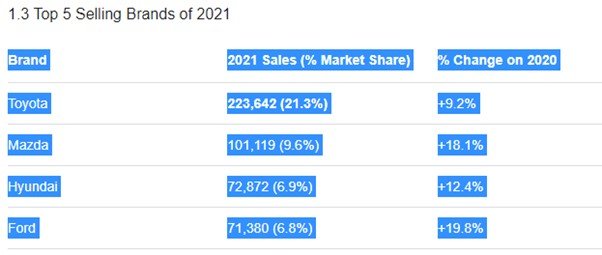
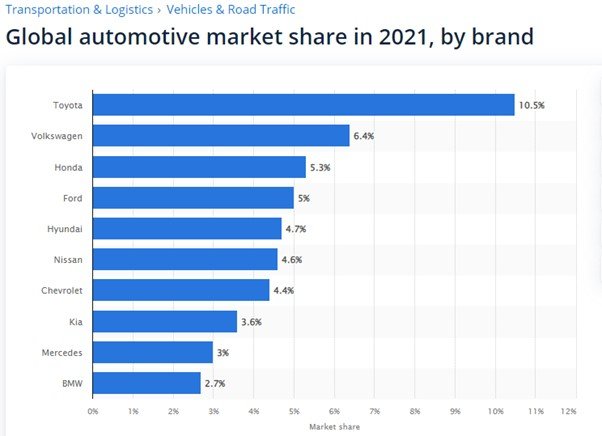
Market share is collated by a neutral industry company every month, dissected down to the last detail supplied by each manufacturer. The collation is sent back to all manufacturers, but sensitive detail is not made available. The press usually get to see summaries montly drilling down to makes and models only. Of course companies plan from the results. I've been in many monthly meetings often from 6 am to 6 pm where we up the workload on postcodes where we are slipping adjust procing or specifications on some models, Plan Advertising Programmes for some States or districts, drop some models, develop other new models; it's very much like a big battle with each manufacturer adjusting its attack. The sale numbers are then measured daily, watching the movement compared with the previous month's market share.
The major manufacturing centre for Australian cars and trucks has been Thailand for decades.
-
1
-
-
39 minutes ago, aro said:
Electric vehicles will be so much cheaper than ICE that no-one will be able to afford to run ICE trucks unless you absolutely can't use electric.
When does that start?
39 minutes ago, aro said:There are electric motors all around us - they are so reliable we forget they are there. At least 10 in most cars I would guess. If you prefer bigger motors, check out the reliability of trains. Electronic controllers will prevent you from burning them out.
I recent years I've replaced 3 starter motors, 2 alternators, 2 air compressor motors, 1 windscreen wiper motor, 1 window motor, and a Fan Motor which took out the head gasket of a perfectly good half life car engine.
I made it clear when I showed the Cost Centre Charts that R&M is not guessed about but reported as it happens. The history clears up some amazing BS stories about how good or bad a product is.
39 minutes ago, aro said:$100,000 for a battery reflects the cost to dig the materials out of the ground. But at the end of it's life, the battery still contains all the materials to make a $100,000 battery. By that time there should be large scale recycling, so the replacement cost will be more like the cost to break it down, separate the chemicals and make them into a new battery. That should be much cheaper than mining raw materials.
We're doing that now with our existing batteries; still paying full proce for new one though.
-
 1
1
-
-
9 minutes ago, facthunter said:
Toyota's have had some problems similar to what Volkswagen did and also with Particulate filters on some models has delayed the introduction of them. This is common knowledge in the Auto world In the Ev-ICE thing the hybrid has a bIt of both worlds and also the cost/ complexities of both.. Could be discussed if someone wishes. I don't personally consider it the answer for most people. The Prius has had its problems too. Nev
Diesel particulate filters are a component, not a car so we can forget the story about Toyotas not being what they used to be on the grounds of theor crushing market share and the fact that the story was about parts.
In 2019 the Federal election focused on the Labor Party's electric car target of 50 % market share by 2030.
Kristina Keneally announced that Toyota would be introducing an electric Land Cruiser in 2022. It was quickly corrected to "Maybe" a hybrid pack from another model and there was an extended debate which pushed the Manufacturers into rushed PR statements that they would be introducing hybrid models from the most expensive makes to the cheapest sh!tboxes in 2022. We'll know how this went when the Full Year 2022 Market shares come out late Jan early Feb, but you should have seen a lot of releases during the year.
I'm monitoring the World market shares on a regular basis, and in several countries Hygrids have peaked and dropped in market share compared to previous years. This has surprised me and I'm not sure of the reason. A cousin has one and has had several years good service out of it.
-
1 hour ago, facthunter said:
Toyota is not quite the company it was. They are having more problems than they used to. Not going electric when many are is definitely a gamble not an argument to use as an example of proof of anything. Nev
What did they do wrong?
ALL BEV market share for Australia for the same 12 months was 1.98%

-
49 minutes ago, Captain said:
...... batteries of the 1st electric Drifter (patent pending), which he had knocked up (mavisref) in his spare time between weedings at the GGLTCs.
This development made the Sgt the "Eveready Bunny" of the aviation world, and he was flattered to be also called Elon Musk II, so Elon-like, the Sgt put in a bid for Marky Z's FaceBook and he also submitted an offer to purchase NASA although many thought that only Turbine Enterprises had the readies to take on the yanks in this way.
The Sgt then sat back to wait for the .......
Turbine put in a sharply increased offer to all the companies. Sgt beat it. Turbine had shorted the market and immediately withdrew their offers
Sgt now could even afford jocks and defaulted and the market crashed. Turbine made another $5 billion and Turbo went to lunch, but the Drifter......
-
55 minutes ago, Ian said:
There are actually real differences in the two types of vehicles which makes EV's more reliable.
The type of load and how power is delivered. Think of the maintenance schedule of a turbofan engine compared to a reciprocating engine. Yes both require maintenance however turbines have longer service intervals, higher lifetimes and lower failures. Similarly EV's components can be expected to have higher lifetimes
The other difference is where you put the engines, the only option for a large ICE is a single power plant centrally located. EVs can put the engine close to where power is needed so the drive chain is much shorter and less failure prone as there are fewer torsional and harmonic issues to deal with. Think of a truck bunnyhopping due to poorly applied power.
Another difference is the environment, ICE are high temperature chemical plants with corrosive gasses so you need to design around this environment. Yes bearings still fail in EVs but a significant number of bearing failures are due to contaminants and seal failure in hostile environments in ICE.
Yet another one which is ignored is the fact that electric engines can start under load. This removes an extremely stressful operation from their operating process.
In my industry you'd be fired for a fairyland maintenance story like that.
Here's one car publication which gives some basic cost information: https://www.fleetmaintenance.com/equipment/battery-and-electrical/article/21250369/breakdown-of-ev-maintenance-expenses
HOWEVER< we wouldn't use that early information.
The charts I showeded earlier were compiled from actual Unit Costing records, i.e. the unit number or registration number of the truck FOR ITS LIFE.
So, without crossing into EV, if we are comparing one make with another, and one takes 60 minutes at $100/hour to get four covers off to service something, and another doesn't need any covers then over 50 services the first one costs $5000.00 more than the second.
In one application when comparing two makes of four cylinder trucks, engines needed to be replaced on one make but not on the other. The fleet cost difference was half a million dollars per year.
EV costs, like ICE costs will be recorded over time. Te reported difficulties and hazards working around the batteries will be recorded and costs, if motors burn out when overloaded trying to get out of bogs, thet will be recorded. If motors just quit as they do that will be recorded, if the car won't go one cold morning, that will be recoreded. All without emotion or hyperbole.
-
1
-
1
-
-
5 hours ago, facthunter said:
Whoever devised the Operational logic didn't carry out a proper risk assessment. Same height and LOW and varying speeds and turn radius. Only a matter of time.Nev
One of the photos shows three bombers in line astern as they used to fly out from England starting to go past the demo area. The fighters used to sit above them and out from them as the first defence. The King Cobra is coming in at a significant angle and down from the fly past - almost like an attack. I guess someone eventually will tell us what was supposedto be happening.
-
 1
1
-
-
.........they had it wrong. Max Smith a Sh!tterditj man suggested that Cook could better be described as an Invading, Colonizing Spiv with a capital S. Alistair Wilson, a proud member of the deadly Rubitmara Aboriginal Land Corporation, suggested his statue should be pulled down and shifted to Fitzroy Street, St Kilda and Auntie Mary Fitzwilliam McLachlan, an Elder in the Bugrup Tribe suggested they get home.
The statue stayed where it was the Sergeant got a job weeding the Gumly Gumly Lawn Tennis Courts, and from there to the stars, and .................
-
4 minutes ago, Thruster88 said:
I see what you did there
They were the first by decades; they started as a result of the 1979 fuel crisis when the world was going to run out of fuel. GM brought the Commodore to Australia, Ford missed the boat and had to stick with the Falcon etc.
I'm not sure how it all worked out , but just checking they are currently the world's second biggest ethanol fuel producer behind the USA.
-
17 minutes ago, Thruster88 said:
One problem with ethanol, made from wheat or corn etc or bio jet fuel, made from canola or soybeans etc is the fuel versus food debate.
A 200ha or 500 acre Australian broad acre crop paddock will yield about 2 tons per ha with canola. A ton of canola seed will yield about 400 litres of oil, the other 60% is a useful high protein animal feed, nothing is wasted. So our 200ha paddock will produce 160,000 litre of jet fuel per year plus the animal feed.
160,000 l is enough fuel for a 17 hour flight in a 777. Do we have enough paddocks?
The answer lies, I think, in Brazil.
-
1
-
-
.........pale blue.
Not many people know that Sergeant C. Cook was a spy in WW2. He had been trained in undercover work by Nancy Wake and came out of it rater battered and bruised, but he persevered, bought himself a pale blue suit and talked his way into being Goering's batman. He would find out when every big raid was leaving Germany and text Douglas Bader, who'd lost his legs in a swimming accident. Douggie would lead the Spitfars in formation and beat the Sh!t out of the Germans, and no one ever knew. Churchill said he should be recognised and wrote a speech about Cappy, "Never in the history of mankind have so many people owed so much to Sergeant Cook" but it was changed by MI5 because .....
-
3 minutes ago, Old Koreelah said:
I totally realise that, which is why I tried to make it easier for local graziers to do it for them.
2 minutes ago, Old Koreelah said:All true Turbs, which is why I suggested making it easier to graze low-traffic rural roadsides. Most local motorists will slow down for cattle. A short 60 zone for a day shouldn’t be much of an inconvenience.
If insurance companies crunched the numbers they might find it more attractive to cover the low risk of a car bumping a cow than pay for a firestorm.
It would centre around what the insurance companies want. I've never had a problem even with a car and caravan threading through a drover's mob of cattle, stopping if the cow did etc; it's never more than a couple of minutes delay but a couple of years ago heard a frantic beeping of a car horn as a car load of young tourists came through at around 80.
On the Hamilton Highway in Corangamite Shire it goes the opposite way when all the land owners, who are the ones that stand to lose their property show up to a burn like hell day along the highway, no doubt followed by a BBQ and party and that works well.
One year we were travelling west of Cunnamulla and for 30 or 40 km the grass had been neatly burnt each side of the road, then there was a black trail out into a 1,000 Ha paddock and it looked like it had burnt out an area half the side of Ireland!
-
2
-
-
2 hours ago, Old Koreelah said:
Interesting. My Croatian brother-in-law expressed amazement at the width of Australia’s road corridors. Too much wasted land for him. Most of our local airport environs are less than 50m wide, but are cropped by Farming for Kids, a group of local farmers and contractors. Not a huge amount of land, but they sure help local schools.
Back in the Old World, many roads are too narrow.
I believe our pioneering road builders allowed enough width for a vehicle pulled by a team of horses to do a U-turn.
There’s lots of room for road-widening, but most roadsides are a mess of weeds, shredded tyre retreads and coke cans.
I have wasted some effort trying to get the authorities to streamline the process of permitting grazing of the long paddock to reduce fire risk. I suspect the well-funded fire organisations are not as interested in prevention as they are in shiny new tools to fight fires.
Grazing is a liability issue because no matter how careful you are one of the flock will find a way out of anything except a boundary fence, and bulls won't even stop there. however quiet a few councils allow hay baling, and this not only saves the council slashing costs, but the farmers, cleaning up the sticks, tyres, and other motorist presents in the early autumn then in season cutting with mowers, raking, and removing the baled hay leave the roadsides looking like manicured parks. It's not unusual to see this for hundreds of kilometres out in western Queensland.
-
1
-
1
-
-
........was trying out a pure white fur seal jacket from that Iconic shopping chain "aNish!"
He came out of the shop looking like .....................
 and then realised his mistake and pretended to cough and cough and cough, but ...........................
The Never Ending Story
in Aviation Laughter
Posted
he had to limp along dragging his foot.
When he jumped into the Drifter and took off, the ball was off centre because f his foot.
This was a minor problem because he hadn't kept his eyes outside, abd the first he knew something was wrong was the smack of the banana tree in the face. He ...........