

turboplanner
-
Posts
24,363 -
Joined
-
Last visited
-
Days Won
159
Content Type
Profiles
Forums
Gallery
Downloads
Blogs
Events
Store
Aircraft
Resources
Tutorials
Articles
Classifieds
Movies
Books
Community Map
Quizzes
Videos Directory
Posts posted by turboplanner
-
-
44 minutes ago, RFguy said:
and a fire in a composite plane is no good... I'm surprised if a well maintained aircraft would catch fire in flight. (not really saying much, I think we'd all be surprised if our aircraft caught fire).
The 120 kts to the ground though isnt all that fast in controlled flight for that aircraft . So I dunno about a fire.....would have though pilot would adopt the inflight fire suggestion in the POH. (which is get down as fast as possible) .
So I am discounting a fire in probability. and that the aircraft looks like it was in one piece when it 'landed' vertically.
Go on ATSB; I can remember several from just leaving the oil cap off, and looking at the wiring of some of the home builds there's room for a few shrts as well. There's a long thread on it here after some fires.
-
.......the time PNG was a German colony?
The answer of course was a definite for the first action which also served to load up Albo with cash for some other wacky folly, perhaps a Referendum for Sufferagetts to have a Voice2 in Parliament. After spending $450 million on Voice1 for 32 Agitators, 8 of which simply Identified as Aborigines, Albo was wiser, and ............
[ Not many people know that the Albo copied The Voice from the Papua New Guinea claim "Him Speaka U" It evolved from a wild night out by 18 Rascals out to make a buck.
The CIA latest overnight briefing shows the Population of PNG at 10,379,895 as of 8/10/23 at 6 pm (This just shows you the accuracy of the CIA satellite cameras, but that's another story) These consist of 312 Tribes speaking 39 languages, compared to Australia's Aborigines with 550 Tribes, 250 languages abd 800 dialects.
Despite this fractured Tribal structure the Rascals formed the Papuan Rascals Corporation, described in their literature passed down from the Elders as having come from the sky in the Dreamtine.
They demanded an apology for the los of six years of their lives during WWII and upkeep for all the Syds, Jacks, Sparkys, Joes, Wallys, Haras, Akios, Hanas and Harukis clogging up the parks of Port Moresby, 68% of the PNG land Mass, and a commission of 87% of the gold.
There were three intruders at the first meeting, three people who could smell a dollar from 50 km,
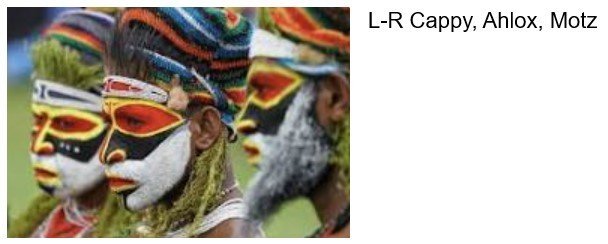
Cappy, who had assumed the name of Youwii, Ahlocks/Gonnes and Motz/Samson
Cappy identified as a member of the Walak tribe (known as Wakkas locally), Ahlocks as Mekwei (a tribe that was forever p!ssing on trails, gardens etc and Motz as a POM, which explains a lot of things.
PNG had copied Australian legislation where identifying carries the same legal weight as 9 generations of the real thing, so they expected to make hundreds of millions of dollars, and set up huge coffee plantations to meet the demands of the Latte set of Melbourne.
Their only mistake was that the first legal Coloniser of Papua New Guinea was Germany, so they had to send their letter of demand there.
Instead of spending $450 million on a Referendum as Albo did, the German Government sent back an email saying "You haf to be Joken, Har Har har har, Ve know nuthink"

-
 2
2
-
-
What is the meaning of QNH?
It is one of the Q Codes developed for Morse Code acronyms in the early 20th century, that all start with “Q” denoting a question.
QNH stands for Question Nil Height (Sea Level)
It’s a measurement of atmospheric pressure, so it falls into MET (Meteorology) training, which usually starts before Navigation Exercises start.
QNH is the Atmospheric Pressure at sea level.
QNH is normally obtains from ATIC at major airfields.
When the QNH is set on the altimeter sub scale it will show the height above sea level.
If you’re at a small country strip and you know the altitude of the strip, you can adjust the sub scale until the altitude is correct and read the QNH in the Kollsman window.
Area QNH is used on cross country flying and in Australia is defined as airspace for which area QNH forecasts are prepared. Zones, boundaries are found on Airservices Australia’s Planning Chart (PCA).
That usually equates to a new Met station every 100 Nm, so on a four hour cross country flight you’ll usually be re-setting your QNH about four times during the flight, hence the benefit of doing a Flight Plan using the correct charts before you leave.
QAA to QNZ were allocated for aeronautical use.
QOA to QNZ were allocated for maritime use.
QRA to QUZ were allocated for all services.
Question?Answer or advice
QAB
May I have clearance (for ____) from ____ (place) to ____ (place) at flight level/altitude ____ ?
You are cleared (or ____ is cleared) by ____ from ____ (place) to ____ (place) at flight level/altitude ____.
QAF
Will you advise me when you are (were) at (over) ____ (place)?
I am (was) at (over) ____ (place) (at ____ hours) at flight level / altitude ____.
QAG
Arrange your flight in order to arrive over ____ (place) at ____ hours.
or
I am arranging my flight in order to arrive over ____ (place) at ____ hours.QAH
What is your height above ____ (datum)?
I am at ____ flight level / altitude ____.
or
Arrange your flight so as to reach flight level / altitude ____ at ____ (hours or place).QAI
What is the essential traffic respecting my aircraft?
The essential traffic respecting your aircraft is ____.
QAK
Is there any risk of collision?
There is risk of collision.
QAL
Are you going to land at ____ (place)?
or
Has aircraft ____ landed at ____ (place)?I am going to land at ____ (place).
or
(You may) land at ____ (place).
or
Aircraft ____ landed at ____ (place).QAM
What is the latest available meteorological observation for ____ (place)?
Meteorological observation made at ____ (place) at ____ hours was as follows ____.[a]
QAN
What is the surface wind direction and speed at ____ (place)?
The surface wind direction and speed at ____ (place) at ____ hours is ____ (direction) ____ (speed).
QAO
What is the wind direction in degrees TRUE and speed at ____ (position or zone/s) at each of the ____ (figures) ____ (units) levels above ____ (datum)?
The wind direction and speed at (position or zone/s) at flight level/altitude ____ is:
____ (vertical distance) ____ degrees TRUE ____ (speed).QAP
Shall I listen for you (or for ____) on ____ kHz (____ MHz)?
Listen for me (or for ____) on ____ kHz (____ MHz).
QAQ
Am I near a prohibited, restricted, or danger area?
or
Am I near area ____ (identification of area)?You are ____ (number) area ____ (identification of area).
1. near
2. flying withinQAR
May I stop listening on the watch frequency for ____ minutes?
You may stop listening on the watch frequency for ____ minutes.
QAU
Where may I jettison fuel?
I am about to jettison fuel.
or
Jettison fuel in ____ (area).QAW
I am about to carry out overshoot procedure.
QAY
Will you advise me when you pass (passed) ____ (place) bearing 090 (270) degrees relative to your heading?
I passed ____ (place) bearing ____ degrees relative to my heading at ____ hours.
QAZ
Are you experiencing communication difficulties through flying in a storm?
I am experiencing communication difficulties through flying in a storm.
QBA
What is the horizontal visibility at ____ (place)?
The horizontal visibility at ____ (place) at ____ hours is ____ (distance figures and units).
QBB
What is the amount, type and height above official aerodrome elevation of the base of the cloud [at ____ (place)]?
The amount, type and height above official aerodrome elevation of the base of the cloud at ____ (place) at ____ hours is:
____ eights (____ type) at ____ (figures and units) height above official aerodrome elevation.QBC
Report meteorological conditions as observed from your aircraft [at ____ (position or zone)] [(at ____ hours)].
The meteorological conditions as observed from my aircraft at ____ (position or zone) at ____ hours at ____ (figures and units) height above ____ (datum) are ____.[b]
QBD
How much fuel have you remaining (expressed as hours and/or minutes of consumption)?
My fuel will endure for ____ (hours and/or minutes).
QBE
I am about to wind in my aerial.
QBF
Are you flying in cloud?
I am flying in cloud at ____ flight level/altitude ____ [and I am ascending (descending) to flight level/altitude ____].
QBG
Are you flying above cloud?
I am flying above cloud and at flight level/altitude ____.
or
Maintain a vertical distance of ____ (figures and units) above clouds, smoke, haze or fog levels.QBH
Are you flying below cloud?
I am flying below cloud and at flight level/altitude ____.
or
Maintain a vertical distance of ____ (figures and units) below cloud.QBI
Is flight under IFR compulsory at ____ (place) [or from ____ to ____ (place)]?
Flight under IFR is compulsory at ____ (place) [or from ____ to ____ (place)].
QBJ
What is the amount, type and height above ____ (datum) of the top of the cloud [at ____ (position or zone)]?
At ____ hours at ____ (position or zone) the top of the cloud is:
amount ____ eights (____ type) at ____ (figures and units) height above ____ (datum).QBK
Are you flying with no cloud in your vicinity?
I am flying with no cloud in my vicinity and at flight level/altitude ____.
QBM
Has ____ sent any messages for me?
Here is the message sent by ____ at ____ hours.
QBN
Are you flying between two layers of cloud?
I am flying between two layers of cloud and at flight level / altitude ____.
QBO
What is the nearest aerodrome at which flight under VFR is permissible and which would be suitable for my landing?
Flying under VFR is permissible at ____ (place) which would be suitable for your landing.
QBP
Are you flying in and out of cloud?
I am flying in and out of cloud and at flight level/altitude ____.
QBS
Ascend (or descend) to ____ (figures and units) height above ____ (datum) before encountering instrument meteorological conditions or if visibility falls below ____ (distance figures and units) and advise.
QBT
What is the runway visual range at ____ (place)?
The runway visual range at ____ (place) at ____ hours is ____ (distance figures and units).
QBV
Have you reached flight level/altitude ____ [or ____ (area or place)]?
I have reached ____ flight level/altitude ____ [or ____ (area or place)].
or
Report reaching flight level/altitude ____ [or ____ (area or place)].QBX
Have you left ____ flight level/altitude ____ [or ____ (area or place)]?
I have left ____ flight level/altitude ____ [or ____ (area or place)].
or
Report leaving flight level/altitude ____ [or ____ (area or place)].QBZ
Report your flying conditions in relation to clouds.
The reply to QBZ ? is given by the appropriate answer form of signals QBF, QBG, QBH, QBK, QBN and QBP.
QCA
May I change my flight level/altitude from ____ to ____ ?
You may change your flight level/altitude from ____ to ____
or
I am changing my flight level/altitude from ____ to ____.QCB
Delay is being caused by ____.
1. you're transmitting out of turn.
2. your slowness in answering.
3. lack of your reply to my ____.QCE
When may I expect approach clearance?
Expect approach clearance at ____ hours.
or
No delay expected.QCF
Delay indefinite. Expect approach clearance not later than ____ hours.
QCH
May I taxi to ____ (place)?
Cleared to taxi to ____ (place).
QCI
Make a 360-degree turn immediately (turning to the ____).
or
I am making a 360-degree turn immediately (turning to the ____).QCS
My reception on ____ frequency has broken down.
QCX
What is your full call sign?
My full call sign is ____ .
or
Use your full call sign until further notice.QCY
I am working on a trailing aerial.
or
Work on a trailing aerial.QDB
Have you sent message ____ to ____ ?
I have sent message ____ to ____.
QDF
What is your D-Value at ____ (position)?
or
What is the D-Value at ____ (place or position) (at ____ hours) for the ____ millibar level?My D-Value at ____ (position) at ____ (figures and units) height above the 1013.2 millibars datum is ____ (D-Value figures and units) ____ (specify plus or minus).
or
The D-Value at ____ (place or position) at ____ hours for the ____ millibar level is (D-Value figures and units) ____ (specify plus or minus).[c]QDL
Do you intend to ask me for a series of bearings?
I intend to ask you for a series of bearings.
QDM
Will you indicate the magnetic heading for me to steer towards you (or ____) with no wind?
The magnetic heading for you to steer to reach me (or ____) with no wind was ____ degrees (at ____ hours).
QDP
Will you accept control (or responsibility) of (for) ____ now (or at ____ hours)?
I will accept control (or responsibility) of (for) ____ now (or at ____ hours).
QDR
What is my magnetic bearing from you (or from ____)?
Your magnetic bearing from me (or from ____) was ____ degrees (at ____ hours).
QDT
Are you flying in visual meteorological condition?
I am flying in visual meteorological condition.
or
You are cleared subject to maintaining own separation and visual meteorological conditions.QDU
Cancelling my IFR flight.
or
IFR flight cancelled at ____ (time).QDV
Are you flying in a flight visibility of less than ____ (figures and units)?
I am flying in a flight visibility of less than ____ (figures and units) at flight level/altitude ____
QEA
May I cross the runway ahead of me?
You may cross the runway ahead of you.
QEB
May I turn at the intersection?
Taxi as follows at the intersection ____.
(straight ahead DRT
turn left LEFT
turn right RIGHT).QEC
May I make a 180-degree turn and return down the runway?
You may make a 180-degree turn and return down the runway.
QED
Shall I follow the pilot vehicle?
Follow the pilot vehicle.
QEF
Have I reached my parking area?
or
Have you reached your parking area?You have reached your parking area.
or
I have reached my parking area.QEG
May I leave the parking area?
or
Have you left the parking area?You may leave the parking area.
or
I have left the parking area.QEH
May I move to the holding position for runway number ____ ?
or
Have you moved to the holding position for runway number ____ ?Cleared to the holding position for runway number ____
or
I have moved to the holding position for runway number ____.QEJ
May I assume position for take-off?
or
Have you assumed position for take-off?Cleared to hold at take-off position for runway number ____.
or
I am assuming take-off position for runway number ____ and am holding.QEK
Are you ready for immediate take-off?
I am ready for immediate take-off.
QEL
May I take-off (and make a ____ hand turn after take-off)?
You are cleared to take-off (turn as follows after take-off ____).
QEM
What is the condition of the landing surface at ____ (place)?
The condition of the landing surface at ____ (place) is ____.[d]
QEN
Shall I hold my position?
Hold your position
QEO
Shall I clear the runway (or landing area)?
or
Have you cleared the runway (or landing area)?Clear the runway (or landing area).
or
I have cleared the runway (or landing area).QES
Is a right-hand circuit in force at ____ (place)?
A right-hand circuit is in force at ____ (place).
QFA
What is the meteorological forecast for ____ (flight, route, section of route or zone) for the period ____ hours until ____ hours?
The meteorological forecast for ____ (flight, route, section of route or zone) for the period ____ hours until ____ hours is ____.
QFB
The ____
1) approach
2) runway
3) approach and runway
lights are out of order.QFC
What is the amount, the type and the height above ____ (datum) of the base of the cloud at ____ (place, position or zone)?
At ____ (place, position or zone) the base of the cloud is ____ eighths ____ type at ____ (figures and units) height above ____ (datum).
QFD
1. Is the ____ visual beacon [at ____ (place)] in operation?
2. Will you switch on the ____ visual beacon [at ____ (place)]?
3. Will you extinguish the aerodrome visual beacon [at ____ (place)] until I have landed?1. The ____ visual beacon [at ____ (place)] is in operation
2. I will extinguish the aerodrome visual beacon [at ____ (place)] until your landing is completed.QFE
What should I set on the subscale of my altimeter so that the instrument would indicate its height above the reference elevation being used?
If you set the subscale of your altimeter to read ____ millibars, the instrument would indicate its height above aerodrome elevation (above threshold, runway number ____).
QFF
[At ____ (place)] what is the present atmospheric pressure converted to mean sea level in accordance with meteorological practice?
At ____ (place) the atmospheric pressure converted to mean sea level in accordance with meteorological practice is (or was determined at ____ hours to be) ____ millibars.
QFG
Am I overhead?
You are overhead.
QFH
May I descend below the clouds?
You may descend below the clouds.
QFI
Are the aerodrome lights lit?
The aerodrome lights are lit.
or
Please light the aerodrome lights.QFL
Will you send up pyrotechnical lights?
I will send up pyrotechnical lights.
QFM
What flight level/altitude ____.
1. should I maintain?
2. are you maintaining?
3. do you intend cruising at?____ ____.
1. Maintain (or fly at) flight level / altitude ____.
2. I am maintaining flight level / altitude ____
3. I intend cruising at flight level/altitude ____.QFO
May I land immediately?
You may land immediately.
QFP
Will you give me the latest information concerning ____ facility [at ____ (place)]?
The latest information concerning ____ facility [at ____ (place)] is as follows ____.[e]
QFQ
Are the approach and runway lights lit?
The approach and runway lights are lit.
or
Please light the approach and runway lights.QFR
Does my landing gear appear damaged?
Your landing gear appears damaged.
QFS
Is the radio facility at ____ (place) in operation?
The radio facility at ____ (place) is in operation (or will be in operation in ____ hours).
or
Please have the ____ radio facility at ____ (place) put in operation.QFT
Between what heights above ____ (datum) has ice formation been observed [at ____ (position or zone)]?
Ice formation has been observed at ____ (position or zone) in the type of ____ and with an accretion rate of ____ between ____ (figures and units) and ____ (figures and units) heights above ____ (datum).
QFU
What is the magnetic direction (or runway number) of the runway to be used?
The magnetic direction (or runway number) of the runway to be used is ____.[f]
QFV
Are the floodlights switched on?
The floodlights are switched on.
or
Please switch on the floodlights.QFW
What is the length of the runway in use in ____ (units)?
The length of runway ____ now in use is ____ (figures and units).
QFX
I am working (or am going to work) on a fixed aerial.
or
Work on a fixed aerial.QFY
Please report the present meteorological landing conditions [at ____ (place)].
The present meteorological landing conditions at ____ (place) are ____.[g]
QFZ
What is the aerodrome meteorological forecast for ____ (place) for the period ____ hours until ____ hours?
The aerodrome meteorological forecast for ____ (place) for the period ____ hours until ____ hours is ____.[h]
QGC
There are obstructions to the ____ of ____ runway ____.
QGD
Are there on my track any obstructions whose elevation equals or exceeds my altitude?
There are obstructions on your track ____ (figures and units) height above ____ (datum).
QGE
What is my distance to your station (or to ____)?
Your distance to my station (or to ____) is ____ (distance figures and units).
QGH
May I land using ____ (procedure or facility)?
You may land using ____ (procedure or facility).
QGK
What track should I make good?
or
What track are you making good?Make good a track from ____ (place) on ____ degrees ____ (true or magnetic).
or
I am making good a track from ____ (place) on ____ degrees ____ (true or magnetic).QGL
May I enter the ____ (control area or zone) at ____ (place)?
You may enter the ____ (control area or zone) at ____ (place).
QGM
Leave the ____ (control area or zone).
QGN
May I be cleared to land [at ____ (place)]?
You are cleared to land [at ____ (place)].
QGO
Landing is prohibited at ____ (place).
QGP
What is my number for landing?
You are number ____ to land.
QGQ
May I hold at ____ (place)?
Hold at ____ (place) at flight level/altitude ____ (datum) and await further clearance.
QGT
Fly for ____ minutes on a heading what will enable you to maintain a track reciprocal to your present one.
QGU
Fly for ____ minutes on a magnetic heading of ____ degrees.
QGV
Do you see me?
or
Can you see the aerodrome?
or
Can you see ____ (aircraft)?I see you at ____ (cardinal or quadrantal point of direction).
or
I can see the aerodrome.
or
I can see ____ (aircraft).QGW
Does my landing gear appear to be down and in place?
Your landing gear appears to be down and in place.
QGZ
Hold on ____ direction of ____ facility.
QHE
Will you inform me when you are on ____ leg of approach?
I am on ____ of approach.
1. cross-wind leg
2. down-wind leg
3. base leg
4. final legQHG
May I enter traffic circuit at flight level/altitude ____?
Cleared to enter traffic circuit at flight level/altitude ____.
QHH
Are you making an emergency landing?
I am making an emergency landing.
or
Emergency landing being made at ____ (place). All aircraft below flight level/altitude ____ and within a distance of ____ (figures and units) leave ____ (place or headings).QHI
Are you [or is ____(place)] ____.
1. waterborne?
2. on land?I am [or ____ (place) is] ____ at ____ hours.
1. waterborne
2. on landQHQ
May I make a ____ approach [at ____ (place)]?
or
Are you making a ____ approach?You may make a ____ approach [at ____ (place)].
or
I am making a ____ approach.QHZ
Shall I circle the aerodrome (or go around)?
Circle the aerodrome (or go around).
QIC
May I establish communication with ____ radio station on ____ kHz (or MHz) [now or at ____ hours]?
Establish communication with ____ radio station on ____ kHz. (or MHz) [now or at ____ hours].
or
I will establish communication with ____ radio station on ____ kHz (or MHz) [now or at ____ hours].QIF
What frequency is ____ using?
____ is using ____ kHz (or MHz).
QJA
Is my ____ reversed?
1. tape
2. mark and spaceYour ____ is reversed.
1. tape
2. mark and spaceQJB
Will you use ____.
1. radio?
2. cable?
3. telegraph?
4. teletypewriter?
5. telephone?
6. receiver?
7. transmitter?
8. reperforator?I will use ____.
1. radio.
2. cable.
3. telegraph.
4. teletypewriter.
5. telephone.
6. receiver.
7. transmitter.
8. reperforator.QJC
Will you check your ____.
1. transmitter distributor?
2. auto-head?
3. perforator?
4. reperforator?
5. printer?
6. printer motor?
7. keyboard?
8. antenna system?I will check my ____.
1. transmitter distributor.
2. auto-head.
3. perforator.
4. reperforator.
5. printer.
6. printer motor.
7. keyboard.
8. antenna system.QJD
Am I transmitting ____.
1. in letters?
2. in figures?You are transmitting ____.
1. in letters
2. in figures.QJE
Is my frequency shift ____.
1. too wide?
2. too narrow?
3. correct?Your frequency shift is ____.
1. too wide.
2. too narrow (by ____ cycles).
3. correct.QJF
My signal as checked by monitor ____ is satisfactory ____.
1. locally.
2. as radiated.QJG
Shall I revert to automatic relay?
Revert to automatic relay.
QJH
Shall I run ____
1. my test tape?
2. a test sentence?Run ____
1. your test tape.
2. a test sentence.QJI
Will you transmit a continuous ____.
1. mark?
2. space?I am transmitting a continuous ____.
1. mark.
2. space.QJK
Are you receiving ____.
1. a continuous mark?
2. a continuous space?
3. a mark bias?
4. a space bias?I am receiving ____.
1. a continuous mark.
2. a continuous space.
3. a mark bias.
4. a space bias.QKC
The sea conditions (at ____ position) ____.
1. permit alighting but not take-off.
2. render alighting extremely hazardous.QKF
May I be relieved (at ____ hours)?
You may expect to be relieved at ____ hours [by ____].
1. aircraft ____ (identification) (type ____)
2. [vessel whose call sign is ____ (call sign)] and / or [whose name is ____ (name)].QKG
Will relief take place when ____ (identification) establishes ____.
1. visual,
2. communications,
contact with survivors?Relief will take place when ____ (identification) establishes ____.
1. visual,
2. communications,
contact with survivors.QKH
Report details of the parallel sweep (track) search being (or to be) conducted?
or
In the parallel sweep (track) search being (or to be) conducted, what is (are) ____.
1. the direction of sweeps,
2. the separation between sweeps,
3. the flight level/altitude ____ employed in the search pattern?The parallel sweep (track) search is being (or to be) conducted ____.
1. with direction of sweeps ____ degrees ____ (true or magnetic).
2. with ____ (distance figures and units) separation between sweeps.
3. at flight level/altitude ____.QKN
Aircraft plotted (believed to be you) in position ____ on track ____ degrees at ____ hours.
QKO
What other units are (or will be) taking part in the operation [____ (identification of operation)]?
In the operation [____ (identification)], the following units are (or will be) taking part ____ (name of units).
or
____ (name) unit is taking part in operation [____ (identification] (with effect from ____ hours).QKP
Which pattern of search is being followed?
The search pattern is ____.
1. parallel sweep.
2. square search.
3. creeping line ahead.
4. track crawl.
5. contour search.
6. combined search by aircraft and ship.
7. ____ (specify).QLB
Will you monitor ____ station and report regarding range, quality, etc.?
I have monitored ____ station and report (briefly) as follows ____.
QLH
Will you use simultaneous keying on ____ frequency and ____ frequency?
I will now key simultaneously on ____ frequency and ____ frequency.
QLV
Is the ____ radio facility still required?
The ____ radio facility is still required.
QMH
Shift to transmit and receive on ____ kHz (or ____ MHz.); if communication is not established within 5 minutes, revert to present frequency.
QMI
Report the vertical distribution of cloud [at ____ (position or zone)] as observed from your aircraft.
The vertical distribution of cloud as observed from my aircraft at ____ hours at ____.(position or zone) is :
lowest layer observed* ____ eights (____ type) with base of ____ (figures and units) and tops of ____ (figures and units)
[*and similarly in sequence for each of the layers observed.]
height above ____ (datum).QMU
What is the surface temperature at ____ (place) and what is the dew point temperature at that place?
The surface temperature at ____ (place) at ____ hours is ____ degrees and the dew point temperature at that time and place is ____ degrees.
QMW
At ____ (position or zone) what is (are) the flight level(s)/altitude(s) ____ of the zero Celsius isotherm(s)?
At ____ (position or zone) the zero Celsius isotherm(s) is (are) at flight level(s)/altitude(s) ____.
QMX
What is the air temperature [at ____ (position or zone)] (at ____ hours) at flight level/altitude ____?
At ____ (position or zone) at ____ hours the air temperature is ____ (degrees and units) at flight level/altitude ____.[i]
QMZ
Have you any amendments to the flight forecast in respect of section of route yet to be traversed?
The following amendment(s) should be made to the flight forecast ____.[j]
QNE
What indication will my altimeter give on landing at ____ (place) at ____ hours, my sub-scale being set to 1013.2 millibars (29.92 inches)?
On landing at ____ (place) at ____ hours, with your sub-scale being set to 1013.2 millibars (29.92 inches), your altimeter will indicate ____ (figures and units).
QNH
What should I set on the subscale of my altimeter so that the instrument would indicate its elevation if my aircraft were on the ground at your station?
If you set the subscale of your altimeter to read ____ millibars, the instrument would indicate its elevation if your aircraft were on the ground at my station at ____ hours.[k]
QNI
Between what heights above ____ (datum) has turbulence been observed at ____ (position or zone)?
Turbulence has been observed at ____ (position or zone) with an intensity of ____ between ____ (figures and units) and ____ (figures and units) heights above ____ (datum).
QNO
I am not equipped to give the information (or provide the facility) requested.
QNR
I am approaching my point of no return.
QNT
What is the maximum speed of the surface wind at ____ (place)?
The maximum speed of the surface wind at ____ (place) at ____ hours is ____ (speed figures and units).
QNY
What is the present weather and the intensity thereof at ____ (place, position or zone)?
The present weather and intensity thereof at ____ (place, position or zone) at ____ hours is ____.[l]
-
 3
3
-
 5
5
-
-
....Turbo himself sliced his hand after pressing the wrong yellow button.
He was carried by Fuzzy Wuzzy (there were still a few left from WW2) down the MacDonald Trail to a village where the hand was rubbed in pig fat and wrapped in banana leaves.
Turbo ordered a helicopter and flew to Port Moresby where ...............
-
.......because he thought it was the headlight of the devil.
The locals were well aware to take any red button out of a vehicle or off a piece of machinery before it went into operation.
This is why, if you choose to go touring in the Highlands you'll see members of the tribe with missing fingers, arms, legs and squashed faces.
You don't see this in the younger ones because TURBINESCO a competitor of UNESCO provides replacement Yellow buttons like the bird of Paradise plume to make machinery stop and to ...........
-
2 hours ago, RFguy said:
any idea how to access the GAF and NOTAM archives ?
You dont depart canberra without talking to ATC on several occassions , would they have had something to say ?
They might; I was warned about a thunderstorm when I called "Ready" at Essendon, and because it was to the south and I was departing to the west I took the take off...........then the Tower directed me into the south for a Medivac aircraft departure..................The air was black and it was also blue - I had the CFI on board, so a few hours extra tuition.
Turbulence is advised on NAIPS and ATC would expect you to know, which is why I keep banging on about getting weather from NAIPS and not just a general app only.
-
2
-
1
-
-
1 minute ago, Markdun said:
There were lenticular clouds over Mt Palerang ( 15nm south) earlier in the morning. My view is that there were two different air masses: lower down light winds from the WNW, unstable and moist; higher up (over 6000’) winds from the SSW and stronger. On my EFIS OAT at 5000’asl was 2C at 11 am.
I’m told that turbo prop commuter services between Canberra and Sydney were stopped because of the severe turbulence.
Would that have been available before he departed, or was it missed?
-
If you go back through the pages of this forum, you'll find the turnback story at regular intervals, at first cautious, recommending never to do it, then the posts saying it can be done if......etc.
Recreational flying lost a lot of pilots to engine failures from about 2010; way more than they should have.
Given the very low stall speed built into RF specifications, there should be virtually no fatalities from an engine failure at 80 km/hr, less if you pull it in to hit the ground tail first in a very low stall. That's assuming you are not flying over a forest you can't possibly survive from.
Some were not turnbacks:
One forum member in a sea plane with its engine high on a pod behind him was too slow to push the nose hard down when thrust quickly turned to drag and the resulting moment, not present with an engine in line with the fuselage ripped the nose up.
A couple just pulled the stick back so they wouldn't go down..........at 1,000 feet, in both cases about landable ground.
Then there were the turn backs.
In several of the discussions, apart from the old theories that you could, if you did this or that were people that went up in their airctaft and practised turn backs, some at normal takeoff heights. Where these people went wrong is that in practice, they knew what they were going to do, they knew when they were going to do it, and it all worked.
We all have a good reaction time when we take a reaction test. For the average person the result is about 50/100 second from the random signal to the person's action. Doing it over and over again will get you in the groove; get you much faster; a Formula 1 Driver will be around 20/100.
That's also when they knew there was a signal coming and they knew how they are going to react.
Even when we practice EFATO and Forced landings, the Instructor tells us he's going to pull the power, or we know he's likely to and when we practice solo, we also have that information.
The real thing is quite different; we are not expecting it; it doesn't happening in a convenient place; we may have no idea of wind direction; we may loose 2 to 3 seconds before the penny drops that we have no power and we have to do something, we may lose a few more seconds checking the controls or trying to restart the engine of just saying "What's Happening", we may just sit there thinking this can't happen, but the usual situation is that instead of the 50/100 second reaction time to get the nose down and start the glide to a landable or near landable space, disregarding potential damage to the aircraft, usually several seconds have elapsed, making the test flights useless. There's a further delay if the pilot starts analysing and trying to work out the wind, when he should do this etc. so by the time he gets the forced landing underway, it's looking nothing like his tests, and he stalls in or lands into trees when he had the potential for an un-injured landing ahead. Trying to save the aircraft at all costs is often the cause of these turnback failures. The belief that you can only land on a runway is another.
Practicing EFATOS with "NOSE DOWN" first, second, third.......before anything else, and then figuring out a drop zone ahead or within 30 degrees either way, and drumming that into your subconscious has better percentages; your hand will start doing what they should be doing in that sub 1 second range. How many student pilots have been suprised to find one day that driving along the road in a crosswind they are actually turning the steering wheel to keep the car in a perfectly straight line; that;s te subconscious working. I watched a video once of a Drifter EFATO. The pilot had a camera looking towards him and when the engine cut he was clearly terrified, unable to process what had just happend, but the nose was pointing down and he was going straight ahead; he made the landing in the paddock but bent the undercarriage in a ditch which was a pity, but as terrified as he was, he was able to get out and walk around.
This story shows that even a top pilot can stuff up if he decides he can beat the averages.
The Turnback story, "Fighter Pilots", Jon E. Lewis
Story by Duncan Grinnell-Milne, training for military service in WW1, in 1915
At the aerodrome a treat was in store for us. A brand-new aeroplane of the most modern type had just arrived on a visit. It was being flown around the country upon a series of test flights by a well-known pilot from the Royal Aircraft Factory at Farnborough, accompanied by a civilian expert.
We gathered in wonder, mindful of the pilot’s request that we should not touch anything......
.....I gazed at the pilot with envy while my imagination soared faster than the swiftest biplane.
Someday I too would wear Flying Corps “Wings” upon the left breast of my tunic, I too would steer a wonderful B.E.2c, and learn to manoeuvre it with graceful ease. I would fly such a machine in France; my wings would darken the skies above the expectant battle-front.......
At lunch in the Mess that day we were very quiet, listening in awed silence to the instructors and the pilot from Farnborough, discussing technicalities almost entirely over our heads.
It was thrilling to hear the names of famous airmen bandied familiarly about , to hear of all the different types of aeroplanes with exaggerated speeds which we might hope to fly, and particularly to hear this so experienced pilot (a test-pilot!) give his views on how to do this and that, how to turn quickly and with almost vertical banking, how to do a spiral glide, how to deal with the ever mysterious “spinning” and so on. It was rumoured that this pilot had frequently looped.
......He decided to leave. We hurried down to the aerodrome to watch him go.
The beautiful machine was wheeled forward, her engine started, warmed up. The test-pilot and his civilian passenger donned much leather flying clothing, climbed into their seats.
The engine having been run up and found satisfactory, the wooden chocks were removed, and the machine turned and taxied out to the far side of the aerodrome. A short pause, and the pilot gave the engine full throttle, taking off obliquely towards the sheds.
Against the wind the machine rose at once and began to climb steeply. The pilot waved farewell as he passed us by, about fifty feet up, heading west into the sunlight.
Against the bright sky the machine was silhouetted, hard to see beyond the end of the sheds. But, as we watched, shading our eyes, there came to us suddenly the spluttering of a starved engine.
The steady roar of the exhaust died down, the nose of the machine dropped.
And now this too expert pilot made his great mistake.
In the course of the short flight, he had attained a height of about one hundred and fifty feet and had crossed the boundary of the aerodrome.
A road, a line of telegraph wires were beneath him, ahead a series of small meadows intersected by ditches. Rough ground, but possible in an emergency, especially as the strong wind against him would make the run on landing exceptionally short.
There was, strictly speaking, no alternative for a safe, a wise pilot.
But this pilot was exceedingly clever, and he wanted to save his beautiful machine from damage. Not that it would have suffered anything worse than a broken under-carriage, possibly a smashed propeller, from the forced landing; he wished to avoid even that much.
And so he tried something which, in this instance, he had not one chance in a thousand of bringing off.
He turned back to the aerodrome.
In the very few seconds that followed I remember feeling, in spite of my utter ignorance of piloting, an intense admiration for the brilliant way in which he handled the machine. Without a moment’s hesitation he turned down wind as quickly and as flatly as possible so as not to lose the little height he had gained, held a straight course for an instant, then over the shed began another sharp turn that, when completed, would bring him into wind with a space of fifty to sixty yards of smooth ground on which to land.
Actually it was just possible of achievement, although as I see it now he was taking a terrible risk; but the whole performance was cut too fine. He failed by much more than inches.
As he came towards the sheds, his speed downwind seemed terrific, yet in trying to maintain his height he had in fact lost the essential flying-speed. He was stalling even as he banked over the sheds. The nose went down with a jerk in the first turn of a spin.
He missed the roof by a miracle, but within a second of the machine’s disappearance behind the shed we were horrified to hear an appalling crash.
Naturally we rushed forward in spite of the first-shouted order that all pupils should stand back – the sight of a probably fatal crash, it was rightly thought, might - we had to see; we ran for it.
Beyond the shed the new aeroplane lay flat on the ground, a mass of wreckage. Both men sat in their smashed cockpits motionless. Unconscious or dead? We were not long in doubt for worse was to follow. As we came nearer the wreck from which mechanics were already trying to extricate pilot and passenger, there was a flicker of flame from beneath the fuselage. And all at once the mechanic sprang back as with a roar a great flame shot up from the burst petrol tank.
It swept back over the passenger; when it reached the pilot he moved uneasily; seemed to shake himself, fumbled with his safety belt, then jumped out just in time, his clothing on fire.
There were cries for extinguishers, for axes to hack through broken wings, for help to pull away the wreckage, for the ambulance – for anything and everything to save the passenger. He was still in the machine and still alive. Mercifully he did not recover consciousness – afterwards it was found that his skull had been fractured in the crash – but he kept moving. And we were powerless. The extinguishers had no effect upon thirty gallons of blazing petrol. The strong wind blew the flames into his face. Before our very eyes he was burnt to death, roasted. It took a long time, it was ghastly.
The fire died down, smouldered awhile, went out. The wind dropped, the sun set and the sky glowed with rare beauty. But we pupils walked back to the Mess in glum silence.
Upon the following morning all officers were summoned to the squadron office. We expected the summons, although I do not quite know what we expected to hear. I suppose that, among other things, we thought to be given news of the pilot in hospital, but possibly to be complimented upon the vain efforts we had made to penetrate the barrier of fire, and upon the sang-froid we had shown afterwards. Perhaps more than anything we hoped to hear that the fire had not been so intense as our eyes had led us to believe, that the unfortunate victim had in some way been protected – by his goggles, by his flying helmet or by his leather clothing – from the devouring fury of the flames, so that there might be a chance of his recovery. Or did we hope to be told that something mysterious had gone wrong with this new aeroplane, something very startling and unusual which could not occur again, that flying was not like this, horrible, cruel?
The Squadron-commander strode into the office, flung his cap upon the table, drew a cane chair forward. Placing one foot upon the chair, he rested an elbow upon his knee.
“With regard to this unfortunate and unnecessary happening” he began harshly, “the first and only thing to do is to find out the causes of the accident, to see where the pilot was to blame so as to learn what lessons we may.
“Now in this particularly stupid case......”
I thought him terribly callous.
“A pilot must never turn down wind at a low altitude when faced with the possibility of a forced landing.
“A pilot in difficulties after leaving the ground must keep straight on.
“A pilot must save himself and his passengers first, not the aeroplane. It is better to smash wheels and propeller than burn a man to death.
“A pilot must take particular care to maintain flying-speed after engine failure....”
Those were the lessons. If the manner of their teaching was hard, it was also effective.
-
4
-
 1
1
-
-
.........fibrousglass.
"This material is of the Devil" said Ipilu Thompson. "Those imitation Dakotas made in Australia from fibrousglass are catching fire all over the place, so we don't want them here. We will consider ..........."
-
4 hours ago, Thruster88 said:
The AOPA safety vid shows a women doing it easily in a 172. I mean no disrespect to women.
We had a guy on the forum who was talking it up, promoting it; he didn't make it when it was his turn; died in the flames.
-
1
-
-
......specialised in what looked like a very risky business, but they also sold to the people who fought with the Europeans so no matter who lost, the Turbine Group won until .....
-
.......cautious. He'd dealt with Europeans before and knew they were like moths; enthusiastically going off in the right direction, then instantly reversing while pointing the blame at the benefactors. A good smack in the teeth usually settled them down again, but you couldn't trust them.
So he .........
-
.......off the ground and this required hours of training developing the necessary skills (TailWheelFree Training (c) TurbineAviation Academy, Inc), but once mastered this added an extra option to the Flight Bag.
You could come in hot, yet .............
-
...spoiled the soggy flying effect that Drifter pilots loved, and flying backwards in a head wind was a hoot, or just dropping out of the ...................
-
..........CT to find a way to make MM starter motors for $30.00.
CT went straight to the Coles DG Supermarket and liquor store and bought himself a dozen flagons of the cheapest wine he could get. The sales assistant sensed there was something wrong and CT burst into tears and told him about the started motors. "That's an opportunity" said the sales assistant. "We call them "Loss Leaders" and we just mark up everything else to compensate."
So CT started advertising Morris Minor starter motors for $29.95, customers poured in and he soon had to expand his workshop, buying the complete Hangar.
Not many people know it was CT from DG who started the Airport DFO business. He sold out to Dick Smith and Dick started his franchises out of the DG Hangar. It was here that Dick developed his love for aviation and became a pilot who succeeded in flying a helicopter around the world. Before that he was a nerd.
The Bluehead continued rattling and was soon down on the ground headed for CT's emporium where .............
-
1
-
-
..........Wing Dan for 'special services' ".
This made the news a couple of days later, not because of any corruption, but because it was another Electric Drifter that had started a fire. What with birning EVs on the streets, burning E-Scooters on the footpaths, burning trucks on the highways, burning E-Vacuum cleaners in Lounge rooms it was getting hard to find an unscarred neighbourhood anywhere in the world. The CO2 cloud these days was visible, and people strated talking about legislation to bring CO2 back to where it was in the old days of the V8 supercar.
CT was sitting quietly in front of a stump, Sako in his arms, waiting for a bunny to lift its head. From the forest came a strange grinding noise ...................
-
1
-
-
...the hangar Non had built to house his ........................................
-
".........New Guinea blood, you are still a Papuan or Torres Strait Islander."
Namatjira Turbine had bought the Island of Saibai in the 1950s for ten bucks after he slipped a dozen Coopers to the Port Moresby Australian Head of Mission, Jack Schitt.
Saibai Island located 3.715 km from the New Guinea coast is in International waters. When costs started to rise Nam did a deal with Queensland which drew a line around it and called it Australian. The Commonwealth chipped in and built an International Airport wich is leased by Nam's son Non on a 99 year lease. He's currently in the process of building a DFO with tenants such as Costco already signed up.
As astute NES readers might realise, anyone wanting to bring exotic product into Australia just had to fly in to Saibai Airport, walk past the empty Customs desk, sign themselve in and then make a local flight to the Australian Mainland. In fact Non is in the process of negotiating a Belts and Roads programme for an elevated highway running from PNG to Australia over Saibai.
Nam was behind the design of the Torres Strait Island flag featuring the rear end of a bull with a star shaped sac. It was done for a joke because Torres Strait Islanders never considered themselves Aboriginal and their DNA shows Papuan origin, not Aboriginal, but he spent most of his later days searching the net to see how far the BullFlag went, and often got a chuckle to see it flying at places like the Tarpeena Shire Council offices, and his people mentioned as the First People, Custodians and Traditional owners of the Council site, despite there never being a record of any TSI person ever setting foot in Tarpeena.
Non Turbine had been impressed by Marky Mark's skilled handling of the Covid crisis, albeit just repeating over and over again to any Easterners "XXXX off, XXXXoff, XXXX off""
Now with this latest statement, Non acted, copyrighting a Saibai flag featuring the front and of a bull with a bird of Paradise on it's horns.
Saibai today flies the Australian Flag, Torres Strait Island bull rear end, Saibai Island bull front end and Papua New Guinea flag.
The names on the map were a good start, but now he could collect from both Australia and PNG governments.
There was only one cloud on the horizon................................
-
3
-
-
.....Chairman Dan was sentenced to 2 years Trail maintenance where he'd have to swim rivers and find his own food. Dan of course was the model for the Pieface Service Stations springing up all over Australia and Pelilok decided to use these images throughout the highlands as a warning to teenages of what they'd look like if they started eating betel nuts.
He was quietly replaced as Chairman, TI by .................
-
......RedShirt.
At this Dan's hackles rose and he went into a Nuclear hissy fit.
"You XXXXXXX XXX" he said to Pelilok "I'm not here to discuss shirts or colour" and continued on for about 30 minutes.
His mistake was that he wasn't dealing with the LBGTIP press of Mebourne, but a Papuan Highlander who still had a taste for the white pork.
Pelilok ...............................
-
..alternative, which after my "Nuclear" blow-up in the Party Room on Wednesday which was about the same as the last shrimp when the Flamingoes arrived.
-
.... and at Dans' first conference as Chairman of TI said "
我不是来谈论被推下楼梯的Wǒ bùshì lái tánlùn bèi tuī xià lóutī de" or "I'm not here to talk about being pushed down stairs, and I'm not......."I
-
WRECK FLYING NEWS
Cappy's report is correct, but please don't tell anyone; this is for members only.
Dan went into surgery at 5 pm Wednesday in preparation for his important mission to China.
There was no time to waste so he learnt the Mandarin language while recovering and here's a photo o Dan ready for his new role.
-
1
-
-
.......aimless space flights. We will price these flights for the PNG masses so eveyone can go up and see space. We might even find where the Silver Bird of Paradise comes from.
In the meantime we have ordered 500 new Elelctric Passenger Drifters so there will be no need for people aimlessly walking along trails any more.
We have also ordered 50 Electric Helicopters for PongPol, to catch the rascals and these will be armed with 20 mm cannons to save the problem of trying to land on trails or when rascals are sliding down hills. This will also save money for our Justice system and ................
The Never Ending Story
in Aviation Laughter
Posted
....one of the cooks (Not THAT Cook).
He was also involved in the Great Gold Heist from Lae, where he flew a ......................