


turboplanner
-
Posts
24,365 -
Joined
-
Last visited
-
Days Won
159
Content Type
Profiles
Forums
Gallery
Downloads
Blogs
Events
Store
Aircraft
Resources
Tutorials
Articles
Classifieds
Movies
Books
Community Map
Quizzes
Videos Directory
Posts posted by turboplanner
-
-
13 minutes ago, Litespeed said:
That how the Sun works , come 7pm it's getting darker
Don't worry it will be back on the morning 🌄
Really?
In that case you didn't read enough to find out the real issue was the ability of Black Coal to ramp up to suit demand.
-
33 minutes ago, facthunter said:
Even The best new design COAL is too expensive apart from putting more CO2 into the atmosphere than any other option. It also can't be ramped up and down without losing efficiency.
The earlier figures I posted for Eastern Grid power generation today were at 15:30
We're looking to see whether coal can ramp up or down.
At 18:57 with perhaps Air Conditioners turned on in some states, people home from work etc the outputs changed
Black coal generation ramped up 47% to 12,300 MW
Solar generation dropped 37.9% to 2130 MW
Wind ramped up 9.4% to 2593 MW
-
 2
2
-
-
15 minutes ago, Litespeed said:
Absolute flaming bullshit.
Unless your talking about your brain cells
You strawmen seem to have Pinocchio's nose.
Sorry, fact which is a bit telling given your story about being a man of science.
-
1 hour ago, kasper said:
Probably a factor like that is required.
However, its not a single solution or a simple replace 'A' electric generation with 'A' from a different source
The cheapest electricity is electricity you do not use.
'green' electric changes includes power saving measures and changes to how we use electric and how we design and build the buildings themselves.
Our home is NOT ideal, it is a weatherboard and tin roofed cottage built in the early 1950's ... it was build without indoor plumbing and no elelctric just a tap on the wall in the kitchen over the sink straight from the tank. Both of electric and plumbing were added later.
When we rebuilt it from the frame out 8 years ago we spent our money on the core fabric to get it as good as we could on the cash we had and we spent under $50k total ... all the finishes and fittings are the cheapest because we needed something that minimally impacting on my wallet to run ... I am a skin flint.
We have double glazing, full insulation all around and a passive heat recovery/exclusion system with solar/battery/grid link electric.
Granted it's a small house and there are only the two of us but we run everything from the water pressure system to the clothes dryer and deep freeze without thought of 'managing' electric like I did 30 years ago in a solar house ... but we NEVER use more than 15.2kwh a day to run it no matter what we do. Our 6.6kw battery linked solar runs it and we pump about half the standing charge in feed in electric back to the grid constantly.
Lots of small impacts on demand, lots of improved coverage of generation and storage all linked through the grid is viable ... but there is need for scale and speed.
All food for thought.
Just looking at your NEVER use more than 15.2 kWh for 2 people.
About half an hour ago on an unremarkable afternoon the east coast population of Australia (=26m less WA and NT) were demanding 54.42 kWh per person (including the kids).
I lived in a house with about your use of power out in the country growing up, but in those years we used redgum to fire the copper to boil the water for washing the clothes, and wood chips to heat the water for a shower or bath, wood stove, kerosene refrigerator, hot water for washing dishes, so we didn't need much electric power.
Today though people want a higher living standard, so you are up against an unrelenting pressure if you start dreaming of downsizing homes and taking out the aircon. So not much point talking about it.
Getting back to our 54.42 kWh demand per person this afternoon, in addition to our homes, that's to supply street lights, sewerage pumps, water supply pumps, trains, traffic lights, hospitals, shops and the factories people on this site have said we should never lose, and in fact get back our manufacturing base. In Victoria the aluminium smelter near Portland draws most of our generated power.
EV is a big threat to the Eastern Grid. Labor's policy a couple of elections ago to have 50% of all new cars EV, required a second grid of equal size plus rebuilding all substations to three phase if very street was to have full capacity for EV. This alone was a good reason for Lebor to drop the policy.
So you can have an ideal, but you have to look at how practical that is, given that most of that 54.42 kWh being generated right now is going to places like the aluminium spemlter and industries where you can't put some solar panels on the roof and generate enough power to work it. Even in homes, I've found the crossover where it gets hard is running 0.5 hp + motors.
This afternoon was a mild one generally where Solar and Wind could undersell Coal, bringing the coal percentage of supply down thereby pushing the renewables percentage up.
Even with the mild afternoon South Australia was only generating about three quarters of its demand, so probably the State at most risk this summer.
Outputs in Megawatts were:
MW % of Total
Battery 12 0
Biomass 49 0
Black Coal 8353 40
Brown Coal 3283 16
Gas 707 3
Hydro 549 3
Liquid Fuel 0 0
Other 0 0
Solar 5618 27
Wind 2370 11
-
1
-
-
18 minutes ago, facthunter said:
Local area batteries can be done by private Enterprise or a cooperative. We could triple our soar PV without seeing them everywhere. Nev
You don't have to triple the output for our CURRENT, you have to increase their output over a Hundredfold, if coal-fired becomes fnancially non-viable.
-
25 minutes ago, skippydiesel said:
"...........Sydney’s northern VFR lane, inspecting approval documents as you fly past, but if you do have to do an unintended glide approach to some park, road (or roof!) and you don’t have CASA approval, then your insurers may have something to say about it… "
This may be the least of your worries should the noise go quiet.
With Reference to Entry/Exit The Sydney Basin (west & north):
I find it interesting that we (pilots of small, generally VFR, aircraft) are of such low status/import, that our safety is so readily compromised by being forced to remain within boundaries' (vertical & horizontal) that increase the chances of a non survivable emergency landing.
I do not know why we are so constrained, only that is the air law we work under.
I am sure there will be arguments for keeping us out of the way of commercial (IFR) aircraft but as they can be many thousands of feet above our limits, I suggest this is a spurious suggestion.
I would not be surprised by others having the same concerns in other geographic locations.
I've studied this quite a few times and dug for the maps, regs and protocols, and flown in the lanes.
1. The government position is probably, you're flying for kicks, not business so go fly somewhere else; we gave you lanes.
When you look closely at the maps you'll see they area covered in DZ (Danger Zones) lanes, holding and reporting circles, holding circuits etc down to the heights they allow for you. If you researched that further and printed it out in 3D, you wouldn't go near the area, (a) because of the closeness and (b) because RPT pilots don't always follow the rules. One in Tasmania was prosecuted for flying a load of passengers towards Wynyard Airport near Burnie below cliff top level due cloud down to the ground, hoping the airfield might have some visibility.
(c) there will always be unexpected arrivals and departures.
-
 1
1
-
1
-
-
..he fainted. Right in the middle of his evening meal too, so we had to get .......................
-
1 hour ago, skippydiesel said:
You are only partly correct in stating my argument is economic. As I have already stated, this debate started around the contention that TBO can be used as a comparative measure of aircraft engine reliability/safety and durability - I disagreed. I have repeatedly pointed out the each manufacturer, in making their TBO claim, are doing so from a different perspective - this invalidates any ability of the purchaser to use TBO as a comparative tool/assessment.
Correct.
-
.......hostie" [avref].
"I'm only 105 kg but bull still identifies me as his little sister. The fact that I'm a Filipino doesn't seem to register. Anyway I'm sick of the old men telling me they've dropped their phone, and one day an old guy was just a bit too late turning his head away so I .........................
-
......bang?"
"It's always like that" said Jill quietly. "One day .................................
-
.....can take Elon off perfectly, batting his eyelashes, turning his head, nodding except that he doesn't quite get the GFY right, and comes across as quite coarse which often causes fights to start, like the night he ...............
-
8 minutes ago, RFguy said:
Just was on the phone to a litigator friend of mine.
next steps
1) thoroughly understand what the relationship is between RAAus and CASA, and how it works, understand the legislation first.
and then choose a small number of items that , where in my opinion RAAUS are not fulling their obligations under the act.
and / or
2) and consider making it a civil complaint against the aviation company I am complaining about (that , IMO, RAAus are turning a blind eye to, or are simply not sufficiently competent to do meet the requirements under the act.)
. Incompetence leads to negligence, however whether they knew it was substandard or did not know, that's the messy bit.
A bit can be drawn from the previous action. I'll take a look at exactly how and why CASA got involved. It's generally accepted that CASA's previous involvement was rather clumsy .
1 ) I accept that you're talking guardedly; (a) there are Acts and there are other Instruments - a lot of reading to be sure of the one.
2) Depends on the action but in one case CASA had taken action early and very few people knew.
-
49 minutes ago, Litespeed said:
What about the grid and coal plant failures, some taking months to get old parts?
A much bigger problem
The Coal-fired Plants, and Tas Hydro carried the 99% of Peak demand that day, with, from memory two turbines down for maintenance in the Latrobe Valley.
-
15 minutes ago, Litespeed said:
Strange, I always thought 🤔 on hot days, due to the scorching sun 🌞, solar was cheap and plentiful, when allowed to connect to the grid.
I better find a bucket of salt.
Solar is sold to the AEMO system and on a hot day you can see it kW x kW contributing to the Easten States Grid it might be cheap but a couple of years ago when we ran out of peak power and 100,000 people lost their power in Melbourne solar and wind were producing just 1% of the power generation mix.
-
2
-
-
6 hours ago, facthunter said:
"base load power" is a distraction. It's the peaks we have problems with and sudden changes AND cost. Solar PV is the cheapest by a large Margin. The grid is a major cost and a source of potential unreliability . Nev
Have a look on the AEMO dashboard and you'll see the coal-fired power stations idling at Base-load. As the day gets hot you'll see them start to fire up the boilers and you'll see the renewables stay where they are at their maximum, then as it gets hotter again you'll see SA pulling power from Victoria, Victoria pulling hydro from Tas and Coal-fired from NSW, then as it gets hotter, NSW pulling power from Queensland which by then usually has started to ask the sugar mills to fire up and pulls power from them. On the dashboard you can see ALL the figures for the amount of power being generated by all the available methods, how much each method is generating and the exact amount of power being moved from one state to the next minute by minute. There's no modelling needed, no cute terminology used, no claims being made, you see every form of power generation Australia has, what can fire up and what gets lost in the dust.
-
2
-
-
56 minutes ago, spacesailor said:
It is a pity they can't be used for building trusses or spars .
OR , anything! .
It would be better than the present day. " Burials " .
spacesailor
The ones I've seen are just laid down in the paddock around the base of the tower.
-
25 minutes ago, LoonyBob said:
(1) CASA has the function of conducting the safety regulation of the following, in accordance with this Act and the regulations:
(a) civil air operations in Australian territory;"
CASA are responsible under the Act, full stop.
I'm not going to get involved in legal processes, but have a look at the regulations CASA used to set up and authorise Self Administering Organizations, and then look at the Incorporated Associations and Limited Companies managing their affairs, and what happens when they haven't got their regulations right or haven't covered forseeable risks. In some cases an SAO will be conducting and managing it's operation and its people, in others when the aircraft enters a location or activity where it has to comply with CASA regulations, both CASA and the SAO are involved. What I'm saying is some caution needs to be applied.
-
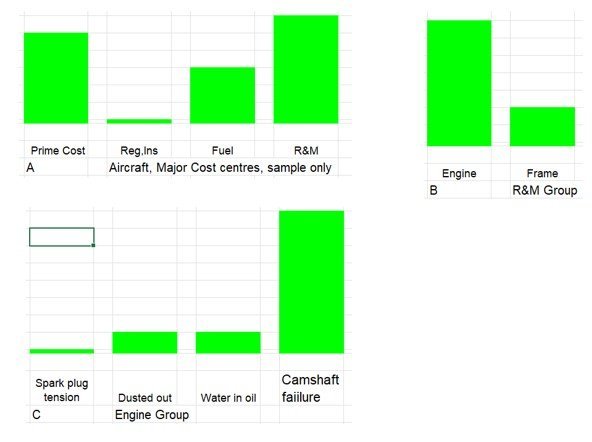
For those who've never done Unit costing or had trouble was just a depiction of cost centres which you could apply to soup makers or TV sets, Chart A is its equivalent, marked "Aircraft".
I just picked 4 cost centres to make it simple; the columns are not loaded so not to scale.
Chart A reads from all the other sub-charts.
In this case R&M looks high.
Chart B
This is the R&M sub group, I've limited it to two subjects, but nothing to stop you having 20.
In this case the problem seems to be in the Engine category.
Chart C
This is the engine sub group.
I've just picked 4, but you could have many such as electrical system, fuel system, oil supply system accessories etc.
In this case the first three look to be isolated but camshafts are out of control.
Chart D etc
I haven't drawn this but somewhere along the way the costs are isolated by make, model and the location they are operating.
Conclusion
We know that make X has an endemic problem with camshafts spread across all airfields surveyed and we have to make a decision to either work with the Manufacturer (warranty, out of pocket costs) or buy something else.
In most cases you see the pattern forming very early in the interview process, and the benefit of doing this is that you know the exact truth rather than relying on corporate propaganda or social media.

-
19 hours ago, facthunter said:
Techmen are the threatened species in the U/L department. You'd be insane to take that job.. I don't see how CASA can task out THEIR responsibility. actually. . Nev
Self Administering Bodies administer and automatically assume the legal responsibility. If an Entity tells them how to administer or what to administer, the liability shifts to that Entity.
-
40 minutes ago, skippydiesel said:
"It comes down to what data you can obtain reliably and this usually comes from service departments and repair shops" - Agreed but how to access & turn into data that can be used for genuine (level playing field) comparative analysis?
".....common TBO standard like 2000 hours" - the problem is, it can not be a "standard" if every manufacturer is using different criteria. I may be wrong but it seems to me that the main players all went to 2000 hrs (some higher) within a few years of each other. Sure this could be explained by technological improvements, historic time in service/repairs, etc but to me it's a tad too convenient.
"The manufacturer may have tested several hundred engines and achieved a safe TBO target, but once the operators and repairers start working them they might not live up to the testing". - There has always been a problem translating bench/lab, even manufactures test running, into real life data. Test conditions are usually close to ideal ie not with the variables of real life operating.
Correct; so good reason not to use arbitrary TBO, but focus on what each engine is costing and downtime per engine.
When you put an engine into any Application however, there is a need for it to achieve a certain result or the Application makes financial losses. So an airctraft engine for training needs to achieve x hours to maintain a profitable business.
40 minutes ago, skippydiesel said:So I would rely more on what the engines are actually achieving. - Agreed, however this would require the manufacture to encourage feedback from service/repair facilities , THEN be willing to make the accumulates data/conclusions available to the public
The way I've been doing it since 1981 is person to person contact with the people responsible for R&M work and budget. So you get real times from the cards and real costs from the invoices. If they practice Unit Costing, usually these details have already been entered in a spread sheet for each unit and there is a TOTALs speadsheet that allows you to compare each one vs the average, or between two different makes, or between those with carbies on top and the others etc. That data was used to choose correct specifications for applications, Whole of life costs etc. One company had developed their own software which was so accurate they could tell when someone was putting a packet of smokes on the bill when he was filling up.
Manufacturers have a moral obligation not to give out the IP of their customers, and I think you said you wouldn't believe it anyway, so it's best to talk to the workshops about one aircraft at a time. Getting the data on 50 to 100 doesn't take long.
40 minutes ago, skippydiesel said:Just guessing - TBO claims are not warranties ie not backed by any sort of financial support, in the event of engine problems that occur before TBO Ripe for the marketing department to inflate claims to equal/exceed the competition.
Another reason to make decisions based on cost and downtime.
-
32 minutes ago, skippydiesel said:
This debate started around Turb's suggestion that TBO could be used as a comparative measure of engine service reliability (paraphrase) - I don't think it can due to the influence of the various engine manufacturers marketing department on the TBO times generated - way to much hope & a prayer generated by differing faiths 😄
That was based on a common TBO standard like 2000 hours
Even if manufacturer A has a TBO of 1100 hours and manufacturer B states 2000 hours you can make a judgement on what to buy.
Just to complicate matters, if every Manufacturer engine made 1100 hours, and Manufacturer B engines were only surviving for between 800 and 1000 hours, manufacturer A would be the more reliable.
It comes down to what data you can obtain reliably and this usually comes from service departments and repair shops.
The manufacturer may have tested several hundred engines and achieved a safe TBO target, but once the operators and repairers start working them they might not live up to the testing.
So I would rely more on what the engines are actually achieving.
-
9 hours ago, turboplanner said:
No.
However minor is minor and temporary.Yes, marketing and manufacturing cross over but the market leaders usually have the better engines over the long term.
Skippy there's no point in just laughing at what I say.
I live and work in the industry that produces the most ICE motors.
You may well be able to tell me of a motor which made your definition of TBO, but that's no use if it was the only one out of 500.
We can't take into account whether an operator does the right thing when he uses it; we can't take into account whether the owner has it serviced with the correct products at the correct intervals etc., we just look at failures per 100 engines.
You are still welcome to get statistics on your benchmark of zero non-scheduled maintenance to TBO,
and you will probably find some.
You will get a bigger and better comparison at my benchmark of issues that didn't create downtime or cost.
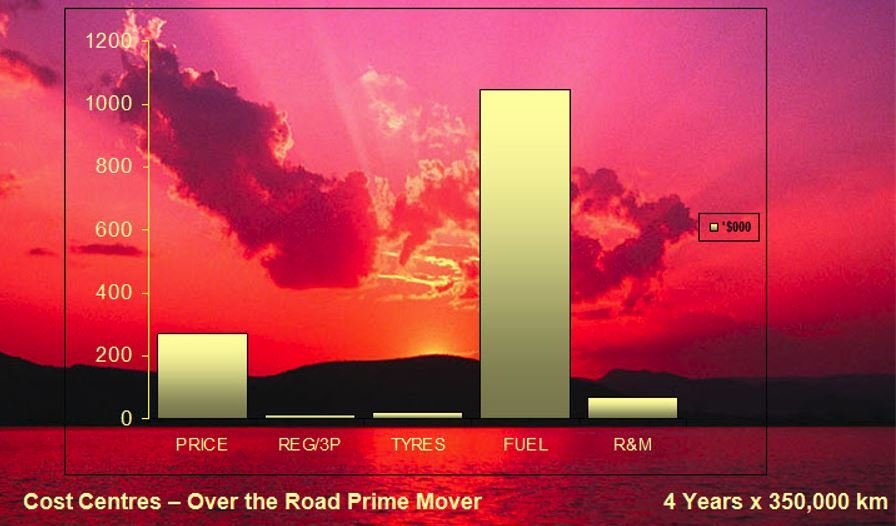
To put it in perspective the picture shows where you start doing a four year analysis on this product. The engine in this one is good for 1.4 million km to in-frame rebuild. Usually it would be sold by this owner at about the three year mark. The buyer would use it for local work and get about five years out of it, then rebuild the engine etc.
You can see from this chart that the owner's focus will be on fitting air sheild kits, gearing to minimise fuel consumption etc. nut not spend a lot of time anguishing over that small R&M column which includes scheduled maintanance, and non-scheduled maintenance on everything, not just engines.
The chart is for one Application.
If you break your own Aircraft Chart down, it will look different, and if the R&M column dominates the rest, then you certainly will be focused on engines but its the ones that keep R&M at an unsustainable level that need to be eliminated from purchase decisions.
For that you need a big cross section of records to look at.
-
 1
1
-
2
-
-
9 hours ago, aro said:
Industry is never going to buy nuclear power, it's too expensive.
Already, solar and wind are producing enough power that prices sometimes go negative at times of high production (during the day, when solar is producing and happily industry tends to be most active). Industry would rather build storage and buy cheap power (or even be paid to take it) than buy expensive nuclear power.
Storage for industry has the advantage that it doesn't need to be portable, so weight and size are not such an issue. Cheap materials are more important than e.g. low weight.
The nuclear industry knows they have missed the boat. They are desperately trying to convince people they need their expensive power so they don't have to write off their investments.
The major cost of Nuclear is its prime cost. Big countries can pay for the construction, then get their money back by sales over a very long period - 60+ years. On that model they can sell nuclear power cheap. For the present scenario Australia can't finance that and the lead time of around 2065 is to far away for the global warmists in any case.
Solar and wind have fixed outputs at which they can sell power cheaply. Australia made the mistake of letting them have an open market so they've been taking business off Coal-fired plants which always relied on base load, the idle load to prevent boilers from cooling and cracking. Without the base load income coal-fired becomes non-viable and we've seen an exodus from Australia to the point where we are now being conditioned to accept on hot days this summer, because it's only the few coal-fired power stations left that can stoke up to peak power.
Battery storage comes with its own issues. Battery life is finite and batteries are a replacement item on a cycle of time. All over Australia up until the 1960s farmers generated their own power with stationary engines and generators, or windmill size towered generators driven by the wind, which charged a bank of batteries and provided 32 volt power to light the house and run the refrigerator and washing machine etc. When the batteries went flat you had to go out in the rain, get a time of petrol, crank the engine and wait until it generated enough to make the lights come on. Those with plenty of money had a Lister diesel engine driving the generator. When you flipped a light switch the light would come on and it would also trigger the starter motor of the Lister which would go until it brought the batteries up to full charge, but you had a big fuel bill at the end of the month. Not a good system if you were sneaking home with someone's daughter at 4 am either.
-
1
-
-
12 minutes ago, skippydiesel said:
Yous is a marketing fabrication that will differ from manufacturer to manufacture & over time, as it suits the sales targets - it can not be used as a legitimate measure of reliability/quality.
So, say Rotax make a claim for their 912ULS of 2000 hrs TBO and the vast majority of these engines actually make TBO (++) with just routine servicing.
Say Lycoming make the same claim for their IO-233 and most require pistons/valve work/push rod (I am making this up to make the point) say at 1000 hrs - can you legitimately claim that this is just a minor intervention /low cost and the engine will make its 2000 hr TBO ?
No.
However minor is minor and temporary.Yes, marketing and manufacturing cross over but the market leaders usually have the better engines over the long term.
-
1
-
 1
1
-
My spies tell me Jabiru has been sold
in AUS/NZ General Discussion
Posted
Are you talking about the ability to ramp up a steam turbine?