


skippydiesel
-
Posts
7,611 -
Joined
-
Last visited
-
Days Won
73
Content Type
Profiles
Forums
Gallery
Downloads
Blogs
Events
Store
Aircraft
Resources
Tutorials
Articles
Classifieds
Movies
Books
Community Map
Quizzes
Videos Directory
Posts posted by skippydiesel
-
-
RossK - we can all site exceptions both good & bad - What concerns me is the overall approach to driving and the dumbing down of the skills required. Example: In NSW it would seem, if a few accident occurs on the same stretch of road, the answear is to drop the speed limit or spend squillions on a road upgrade (or both). No one asks the question, why are people (it is people not vehicles) having accidents on this stretch of road ?
Road condition's not cause accidents
Speed does not cause accidents
Vehicles do not cause accidents (unless poorly maintained)
Trees, bends, whatever do not cause accident. Yes you can be unlucky, our native animals have a tendency toward suicide but then why drive at speed, dusk to dawn (sometimes cant be avoided, I know as someone who has had a roo take out a tail light).
The fact is, some more enlightened countries than our's, treat driving as a serious topic, starting kids in driver/road education (part of the school curriculum), long befor they can actually get behind the wheel on a public road. Some of these countries have incredibly high (by our standards) speed limits on their major highways and what do you know, much lower accident statistics than ours, despite appalling winter climactic conditions, deer and other wildlife and much higher traffic densities - go figure??
I think we are second only to Canada is in land mass and yet we have 110 kph on our major trunk routes - even tiny Britten has higher motorway speed limits and much much higher traffic densities - go figure again??
-
 1
1
-
-
2 hours ago, Yenn said:
I cannot see any similarity between car accidents and aeroplane accidents. The car is easy to drive and we all do it on a daily basis. The plane is not so easy to drive and we don't do it as often as we would like.
That means that when we are flying we are more attentive to what can go wrong than when we are driving car.
My theory s that most road accidents are caused by inattention, no matter what the police put them down to. One of their main causes is speeding, but if you are attending to your driving you can safely handle high speeds.
Aircraft accidents are a different kettle of fish. Mostly they start off by something small going wrong and rapidly compound into a major problem. The pilot does not have the luxury of just puling over an stopping, he has to control the stop and that is where he needs knowledge and reasoning ability. Sadly a lot lack either of those attributes.
The lack of knowledge is apparent from reading this forum and wondering what some of the people posting really understand.
Yenn - you tempt me so. Your observations about land vehicles and their operators/drivers are largely at odds with my opinion.
We behave as if driving is easy and a right for all but in my humble opinion it should be regarded as a privilege (similar to flying) that requires a high degree of skill & knowledge, that must be maintained.
Speed never killed anyone, despite the Edwardians (?) believing anyone going faster than a galloping horse would cause instant death.
What causes accidents, is poor driver skill (part of which is judgement, discipline, courtesy, up to date knowledge & the ability to apply it correctly).
If you drive faster, than your, or your vehicles, capacity, or conditions will allow, you may be involved in an incident/accident that may cause damage, injury or death - the speed did not cause the incident, it was the drivers lack of skill/judgement. Your "inattention" is merely a component of lack of driver skill.
As a society we find this truth to be unpalatable. Law makers buy into it, because they can then use the speed regulations to generate revenue - got almost nothing to do with safety, other than if you sit in a stationary vehicle, there will be almost no risk of an incident - ultimate driver safety!!
Further - we allow a person to obtain a drivers license in their teens - they may not have a skill/knowledge review until they reach their dotage, 60 years later - how crazy is that?.
Testing, to assess your fitness to hold a drivers license is a joke - the bar is so low, they might as well issue the licenses on the kid 16 birthday - as a gift!
We the compound this by not even requiring "currency". As long as your renew your license (a financial /photographic transaction) you need not demonstrate you have retained your driving skill, even if you have not driven a vehicle in 20 years plus..
I would suggest , while not the same, driving and piloting (small aircraft) have very similar demands. Different skills & knowledge to be sure and the environment has few similarities, but the, for want of a better word, "philosophy" should be the same (and its not!)
-
1
-
 1
1
-
-
10 minutes ago, Thruster88 said:
In certified aircraft any fuel drain hoses from fuel pumps (seal failure) or fuel injection systems are ALWAYS routed to the bottom of the cowling for obvious reasons.
The reasoning is obvious and reasonable however Rotax go to some length to advise appropriate location of these vent tubes and its very short tubes terminating close to the carburettors. The most important instruction is to have the termination point(s) in the same air flow/pressure preferably similar to the carb intake airflow/pressure.
Airframe manufacturers routinely stray from this instruction - my aircraft has a Y piece to join the two vent tubes, with the single "tail" tube terminating in a custom made, perforated, length of brass tubing, that is fixed low down close to the bottom of the firewall - seems to work okay but definitely at odds with the Rotax bible.
-
2
-
 1
1
-
-
Garfly - not only does he mis name the vent tubes I suspect the exhaust/muffler system he is running (doesn't look like ball & sockets system) is prone to all sorts of stress cracking.
-
1
-
-
1 minute ago, RFguy said:
OH, and engine is 370 hours, which, from what I can gather up from all the information everywhere is a pretty common figure for needing a top end overhaul. Jab recommend new head bolts when doing a top end. Jab parts are cheap.
Surly you jest!😲
-
1
-
-
26 minutes ago, old man emu said:
These performance figures always beg the question - can they be achieved by the pilot who does not fly on an almost daily basis, or are they produced by a pilot who gets a couple of hours over the course of a week's employment?
What fudge factor would you think reasonable to add to the published figures to account for real world operations?
OME - I dont think this is a figure that can be easily quantified or fixed. Too many variables! - Aircraft load, X wind, cleanliness of aerofoils, pilot skill, familiarity with that aircraft, temperature & altitude. etc . The pilot must make his/her own determination of what the aircrafts performance might be on a given day and apply the "fudge" factor that they think they can "live" with.
-
1 hour ago, Jase T said:
Also remember the stated figures are for a factory new aircraft, with a factory new engine / prop. Not one with dents and faded paint and bugs and 1500 hours on the engine...
Ooooh! Jase - go carefully - sounds like my cautionary comment, several back - you might end up being burnt at the stake
-
On 16/01/2021 at 12:44 PM, FlyBoy1960 said:
Some people should never fly, just enjoy going for rides with people and life the dream from the other seat !
While I agree with you (& extend that sentiment to road vehicles) I would never say this to someone I have not met in person and had the chance to evaluate their performance. In short, unnecessarily abrupt and unhelpful - suggest an apology .
-
 2
2
-
-
3 hours ago, onetrack said:
Jack, possibly the biggest single cause of loss of oil pressure in flight is failure of an external hose, piping, or fitting - or catastrophic failure punching a hole in the block or sump.
A failed bearing or some other internal pressure loss, via mechanical failure, is a less likely scenario. If the oil supply is being depleted by the former, a prelube pump is only going to pump the little remaining oil overboard.
I like engines (any engines) with little or no external plumbing for oil, they suffer from engine failure on a lower percentage basis than engines with external oil plumbing.
Your observations/comments make a lot of sense but in reality a large number of aircraft engines run oil coolers (might this be an Au climatic thing?)
-
1
-
-
Soooo tempted to encourage your interest elsewhere BUT you do seem focused on the Jabiru J230d so will leave well alone.
-
 2
2
-
-
Thanks for that Onetrack always appreciate a friendly comment - just to expand a little on my installation - started with a vehicle horn - sounded laud a scary to me but the beasties took very little notice. Removed horn & installed (same location & wiring) the security siren thingy. It builds up to speed (moving part) & sound making a horrible wailing din - it works as hoped.!
-
1
-
-
The Oaks airfield, has had, on occasion, goats, cattle and the odd miracle of modern medicine, the brain dead pedestrian.
-
3
-
-
1 hour ago, Bruce Tuncks said:
I can see the argument in favor of hand propping, but could you actually do enough to make a difference? It seems to take a long time using the starter before oil pressure comes up.
This is the technique I use after a layup... crank with the mags off until oil pressure comes up. I would do this every time but I don't want to wear out the starter system. It is a quite an indirect way to just operate the oil pump, but it sure adds no complexity. It is turning the engine over dry, but there are no combustion forces.
I would prefer a small and light add-on electrical oil pump but his is probably not necessary.
When I hand prop my aircraft I get a small rise in indicated oil pressure - so oil is being pressurised and I would hope distributed.
With reference to a pre start oil pump:
The main benefit of such a system is on little used engines or after a long lay up. Of course it may have a small benefit for every engine, even those used daily(hard to gauge). The cost:benefit, additional weight and complexity are all of concern.
It would seem to me that you could remove most of the complexity & weight of a permanently fitting pump, by coming up with a system that can just be attached temporally (plugged in) to the oil reticulation - just connect up, turn on using an external or "ship" power source, pump for a few minutes to get good distribution (should show on aircraft gauge), disconnect and start up.
A stand alone pump system could be used over a number of aircraft. Each aircraft fitted with a quick connect/disconnect coupling. The coupling itself is a potential point of failure (unlikely). The weight increase negligible. The cost , spread over several aircraft and time would also be negligible.
What think you?
-
2
-
-
9 hours ago, onetrack said:
For the bigger industrial diesels, you can buy Delco-style starters that are fitted with a prelube pump on the end of the starter housing.
.............................................................
Onetrack - I can certainly see the merit of such a system helping engines that are expected to go from cold start, to full power & load, within a few seconds/minutes , such as generators and emergency pumps. May also be a good investment for the little used marine engine but cant see that it would be helpful for regularly used equipment/vehicles and hand "propping" of small aircraft engines befor the first start of the day, while not quite as good, is infinitely cheaper, significantly less complex and lighter.
-
2
-
-
3 hours ago, Kyle Communications said:
Stall of 27kts at 450kg not 600kg. The savannah can stall at 27 kts too...at 450kg but 30 kts at 600kg with full flap
-
1 hour ago, Kyle Communications said:
Your pitot is telling you lies. If you are at full throttle on climb doing 30kts indicated ...the AOA would be very steep and you would be like a helicopter on its way down not going up
Stall of 27kts at 450kg not 600kg. The savannah can stall at 27 kts too...at 450kg but 30 kts at 600kg with full flap
2 hours ago, APenNameAndThatA said:Seems the same as a Foxbat, at idle. At about 575 kg, at full throttle, at 30 kt indicated, the Foxbat climbs at 400 fpm.
Now now Kyle, its not like you to be making such dogmatic comments.
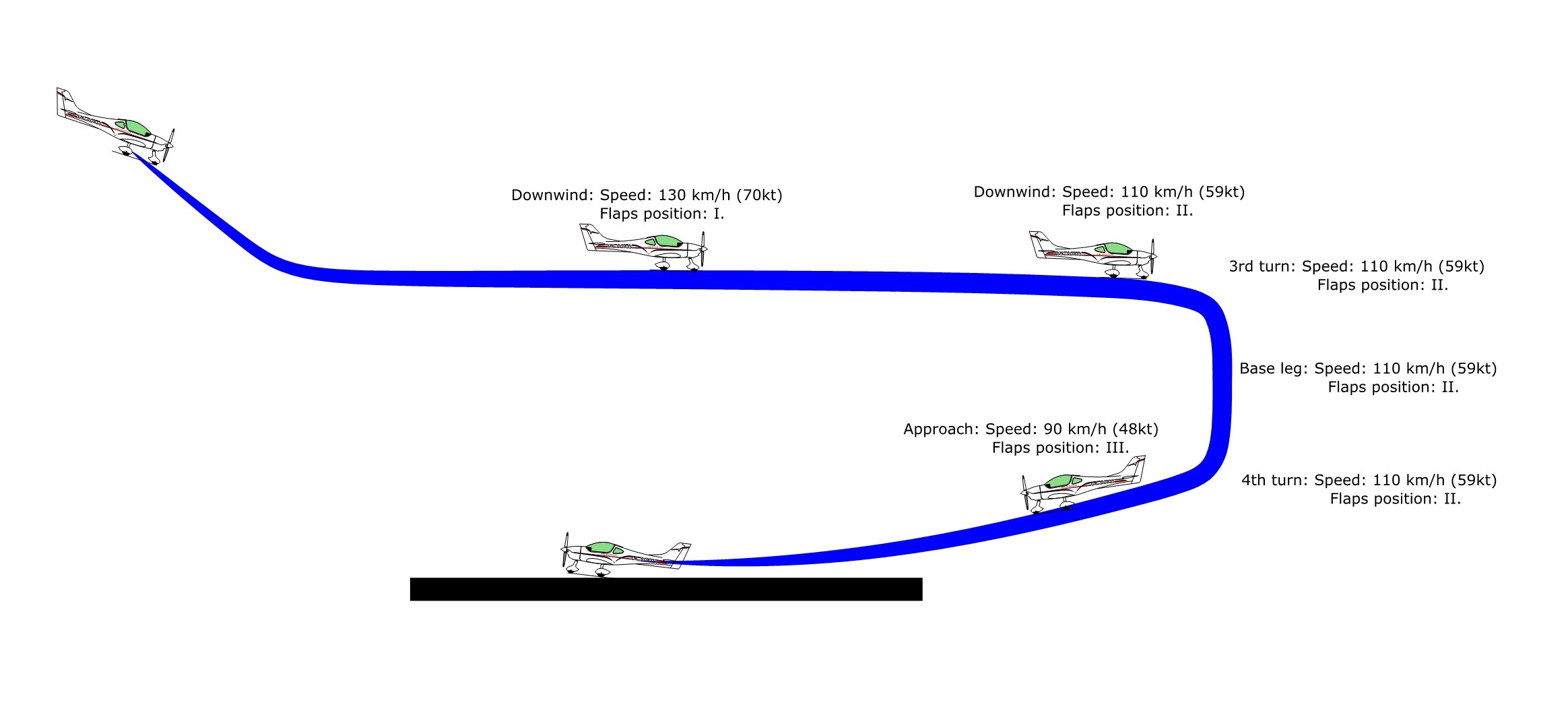
I flew a Foxbat, for the first time, last weekend. Being between aircraft & needing some practice/currency, I felt that the Foxbat has a circuit performance, very similar to the aircraft I am most familiar with and not to dissimilar to the one that is in the above schematic - I was correct. The training was most helpful and I will repeat it periodically until such time as I have found a new mount.
These figures may not sit well with you but they have been demonstrated in the real world, not just factory "gloss" and anyhow this conversation is about Turns at Low Air Speed not a contest between aircraft & their supporters.
-
OME - you wanted some circuit figures (I wont mention the aircraft make or model, someone might accuse me of making a sales pitch): This diagram forms part of the POH for this aircraft. Not on the schematic, is the stall speed of 27 knots, so to minimise ground role, expect to touch down at sub 30 knots to minimise float/ground effect. Max fuel load for this aircraft is 100L. Typical empty weight sub 300 kg. Max TO weight (in Au) 600 kg

-
30 minutes ago, SSCBD said:
Ok seriously - I have had a few frights over the years with kangaroos when landing in the afternoon at some strips or anytime during the day.
Yes I have buzzed the strip at ten feet and a few moved but still many stayed.
The bloody things don't move even when I get the plane down to walking speed on landing they have still been standing 10 feet from the wing. So of course I expect one to run in front of the prop or wing as you wont be able to shut down and stop as fast as they can hop in front of you.
SO has anyone used a horn on their aircraft for this reason. Is it effective to clear them away say during a flyby and on landing. As the engine noise is not doing it.
I have the same problem, plus horses, if the gate has been opened while I have been away. On occasion have had to phone for someone to do a vehicle "strip run"
I have fitted, low down on the fire wall/engine bay bulkhead, close to the exit air aperture, a preloved, 12v, car alarm, activated by a panel switch - seems to have the desired effect - general scattering of all unwanted living obstacles. In the fulness of time, they may become habituated to the noise and ignore it too.
-
Yennn - the human eyesight is a poor thing, compared to many of our fellow animal travelers. We are subject to so many potential visual distortions that can lead us astray - why would you not check out the highest points along your rout, add 1000 ft and fly to the most economical (ground speed) hemispherical altitude + 500 ft above this (using your altimeter)????
-
OME - I was trained/ practise having my VFR cruise altitude should always be (or at least where feasible) at least 1000 ft above the highest terrain point, when traveling in a virtual 10 mile wide corridor (5 mile each side of track).
OzRunway will help with this ,if you dont want to do it manually and it will also give you a vertical separation schematic.
-
1 hour ago, Bruce Tuncks said:
Is there an add-on electric oil pump? This could also be used before start-up to ensure there was no time where the bearings went dry. I have never heard of such a thing, but the idea is so obvious that it must have been used.
34 minutes ago, Thruster88 said:Pre start oil pumps are used on very large engines. I am guessing on aircraft and automotive engines the bearing clearance is small enough to retain sufficient oil for the next start up, think capillary action. The oil pump does not "pump the metal apart" it just replenish's cool oil to the bearing. Google "oil wedge".
As Thruster said - have been available for large engines for a long time - usually in the form of a "pilot" starter motor that will rotate the large engine for a period to raise oil & fuel pressures pre start.
I would speculate that the, pre first start of the day, hand/prop rotation of an aircraft engine would have some of the same benefits.
-
43 minutes ago, spacesailor said:
Diesels are not smupposed to be left idling as it Glazes the cylinder,s.
BUT
turbo diesels have a timer to let the turbo bearings cool down !.
spacesailor
It is good practice for all engines to be idled or be driven/operated under minimal load for a few minutes before shut down - I favour the latter for my vehicles, as I have 3 km of very quite, almost level road befor I get home. Low load driving has the benefit of good air flow helping to cool the engine. The former (fast idle) is what I use on my aircraft engine. Fast, as it facilitates air flow, oil and coolant flow encouraging engine to cool - a long taxi would have similar beneficial impact.
As for turbo chargers (petrol or diesel) - turbo chargers get very hot under load. They used to have bearing lubrication that ceased as soon as the engine stopped (delivering pressurised oil). So you have a very hot (can glow red) turbo, shut off the oil supply and you get cooked oil & a dry bearing. Do this often enough and you "bugger" the bearing - very expensive.
Don't know much about aircraft turbos but land based ones now tend to have a cooling system and some have after shut down oil delivery - both help to minimise the effects mentioned above - still I would maintain the good practise & allow for a cool down period.
Note: I am not a big supporter of turbo timers (usually fitted as an after market - not standard) - lazy drivers/operators and technically illegal, as a running motor vehicle is not supposed to be left unattended, on a public street (the latter point is of little consequence).
Glazing of the bore is usually associated with extended idling (well above the few minutes to allow cool down), lugging the engine, incorrect engine oil, operating at below optimum running temperature (city cars)etc etc
-
In my long life engine idle has never been the recommended way of warming an engine - assuming normal start and systems operating it has always been warm up under light load conditions (not nil load) - my understanding of this is -
Ground based engines gentle acceleration, keeping the engine speed above max torque (do not lug), but not high revs, until temperature stabilises. Most but not all ground based engines will also have some additional load from the "cold" transmission.
Aircraft engines fitted with Fixed Pitch props are loaded from the start, In Flight Adjustable will be lightly loaded as they taxi & perform run ups, so revs should be kept below mid range, until manufacturers temperatures are met or exceeded.
-
1
-
-
26 minutes ago, pmccarthy said:
The most useful thing I have learned in recent years is that if you hold your arm at full stretch and and hold your hand up at the horizon, the thickness of four fingers below the horizon shows where you can glide to. It works for a surprising range of aircrafty types and speeds, from LSA to military jets.
Ahhhh! This rule of fingers, does it work for gliders?
Co detectors from RAA
in AUS/NZ General Discussion
Posted
Just seen an advertisement for portable CO detectors, supplied through RAA. I guess being a dedicated aircraft supplier, it must be something extra special hence the cost - $80
Something very similar (suit all recreational vehicles/boats etc and your home) can be had from Bunnings Aerospace, and a range of other stores, for less than half this price.