


skippydiesel
-
Posts
7,613 -
Joined
-
Last visited
-
Days Won
73
Content Type
Profiles
Forums
Gallery
Downloads
Blogs
Events
Store
Aircraft
Resources
Tutorials
Articles
Classifieds
Movies
Books
Community Map
Quizzes
Videos Directory
Posts posted by skippydiesel
-
-
51 minutes ago, kgwilson said:
Radials have to have an odd number of cylinders because of the single crank so the firing order is every other cylinder. If it is a 2 stroke it doesn't matter so you could have an even number of cylinders.
I dont have the learning to debate the issue with any assurance but I will tell you a very learned engineering friend of mine told me , many tears ago, that the odd cylindered engines, confer some sort of balancing/smoothing out in their firing pattern and he wasn't talking about radial engines as such..
Soooooo far many years I collected Mercedes Benz W123, 300D's - a five cylinder single overhead cam engine that ran like the proverbial sowing machine - truly one of the great cars.
Had to sell them all when I retired (it was them or the aircraft).
As a consolation, I now drive a Ford Ranger, PX 1 with a 5 cylinder turbo diesel - not bad at all but not quite as smooth or easy to work on as the old MB's and will never even come close in "ambiance"
-
 1
1
-
-
27 minutes ago, Yenn said:
I
My preference now would be to use Oratex for a couple of reasons.
Firstly it is easier to apply and doesn't involve nasty chemicals.
Secondly it would be easier to repair. With Stitts you have to use MEK, to remove any covering that has to be replaced, then you have the multiple layering of fabric and chemicals which cannot be bought in small quantities. I think the smallest quantity of any of the finishing chemicals was about a litre or quart. Far too much to do a small repair economically. Those chemicals cannot be transported by air, which make freight expensive.
I cant comment on Stitts or for that matter on Oratex however I think any reduction in the potential to be exposed (and the environment) to harmful chemicals should be adopted (subject there being no reduction in performance/safety of the finished product).
I am very happy with the experience I had with The Stewart System and the resultant finish.
I would speculate that Oratex is possibly best used where the whole frame (wings, fuselage, control surfaces) is to be covered eg the fuselage & tail feathers of a Sonerai.
I do not think this system would be appropriate for the type of fabric coverage used in the ATEC Zephyr or similar aircraft.
-
1 hour ago, old man emu said:
Form follows function.
One would think - but air screws seem to be much about form, function being a close but definite second.
-
2 minutes ago, old man emu said:
Can you please explain where the imbalance originates?
I..................................... That's why a six cylinder engine appears "smoother" than a four, and an eight smoother than a six....................................................
I always understood it to be the uneven numbers , 9, 7 & 3 cylinders, are the smoothest. The problem is the customer likes even numbers 4, 6, 8 & even 12.
-
20 minutes ago, kgwilson said:
The theory that a single bladed prop is more efficient is all well and good but they look stupid & seem to be heavier so what's the point.
Well it was a concept that looked good, in theory but just didn't work out in practice.
Coupled with the dismal performance in real life, is our species need for symmetry - we tend not to favour asymmetrical objects (unless you are into some forme of rarefied artistic expression) particularly those that are functional.
I think you will find that throughout modern history we have experimented wit asymmetry in marine & air craft - some are successful, most are not and few survive the test of time/consumer prejudice.
-
1
-
-
In nature, where similar demands/objectives/environments are imposed, we see a tendency for animal shapes to "conform" ie be very similar.
The inference (possibly wrong) is that as animals evolve, to meet the demands imposed by similar environments/demands, so only a small range of body shapes/abilities will be successful.
Success in this case can be viewed as efficiency, leading to survival and dominance, so those body shapes (no matter the species) will become, over time, the norm.
So over millennia we see reptiles that look like modern mammals. We see mammals that look like fish. To a lesser extent mammals that look like birds (this may be the exception that proves the rule).
So if nature is the ultimate engineer/designer and it steers living organisms toward very similar shapes, for a given environment, why do our propellers have so many variations in shape - perhaps we lack the science or are we all being conned?
-
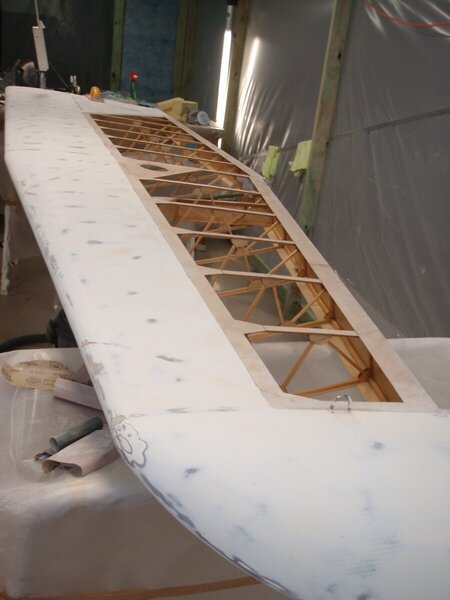
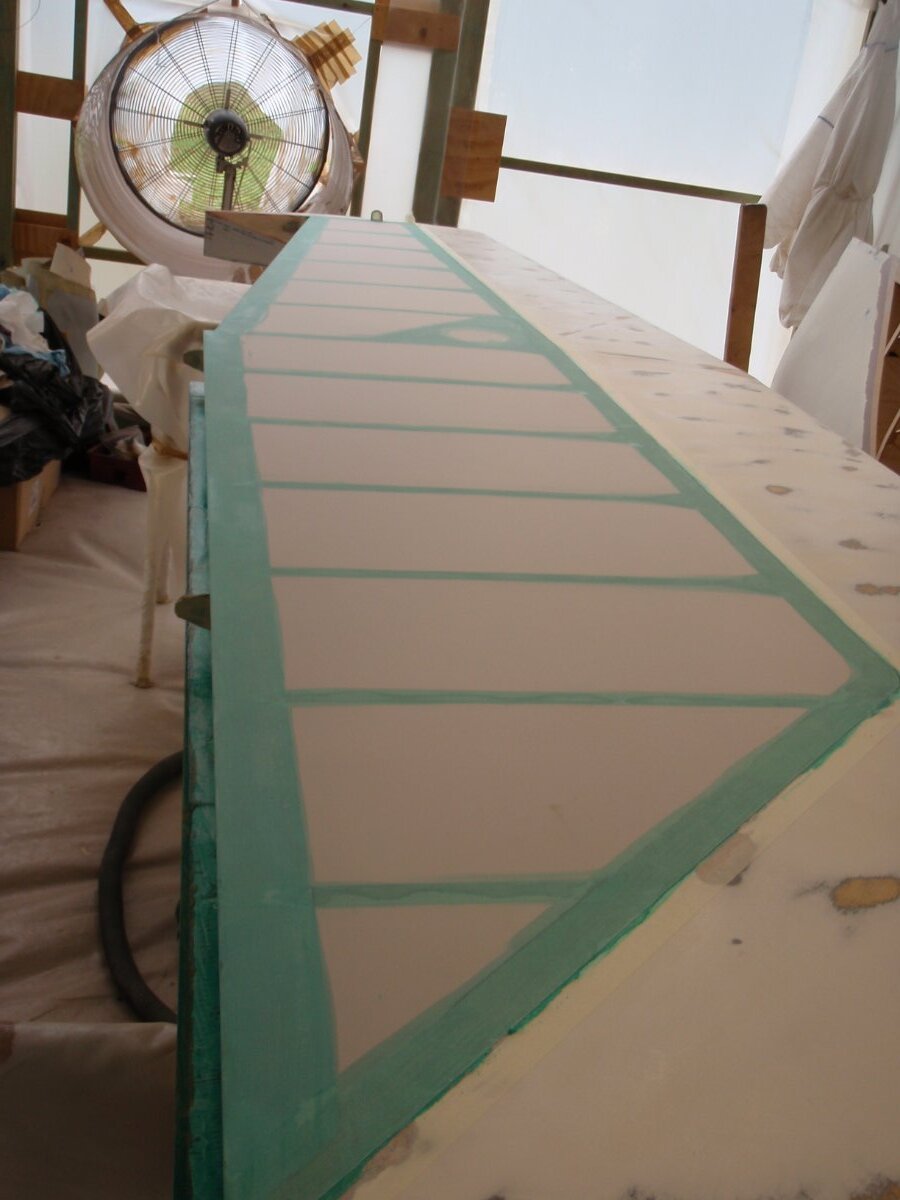
I briefly "looked" at Oratex - cant remember all the details but in the end it just did not suit my aircraft. The Zephyr wing has a ply wood skin from spare - around leading edge and back to spare, see photo of underside right wing. The fabric is glued, shrunk/tightened over the rear /trailing side top & bottom - Oratex, without painting to match plywood skin would look just weird and would defeat the benefit of the product - no need to paint..

-
If this be true (I hope it is) the E-prop designers must have developed what appears to be the optimum combination of science & art ,for it would seem that despite my original question/hypothesis, most props are developed this way.
Again I ask - how can this be?
- For the purpose of this discussion we assume air is a consistent medium.
- We are dealing with aircraft that are generally RAA compliant (similar weight range say 250-600 kg empty to fully laden).
- Engines range from 80 -120 hp, my guess being that most are in the 80-100 hp. Direct drive and gear box, may make some difference as the former tend toward significantly higher propeller speeds.
- Speed range has been increasing, for the last 20 years or so but most will still be in the 90-120 Cruise band.
- True we have quit draggy airframes at one end and slippery little beauties at the other.
- Fixed pitch props are by far the most common - dont have any idea as to the proportion that might be ground adjust.
Despite are often heated debates ,the above list sagest our aircraft have more in common (than their owners) than not - so why do our props not look very similar??
-
2 hours ago, old man emu said:
Maybe we should meet at a phone box and carry on this conversation there. There would be room there for all interested parties!
The argument was that, if you label one blade "A" and the other "B", then B must pass through air disturbed by A, reducing the efficiency of B. However, that is only true when the relative airflow is not moving, that is, when the aircraft is stationary on the ground. Due to the forward motion of the aircraft, the path traced by a prop is a corkscrew-shaped in side view. That shows that after following A, B moves into undisturbed air.
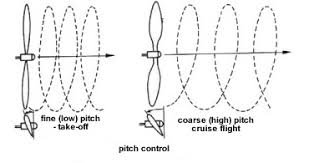
Just guessing (bad habit) but your disturbed/undisturbed air observation, would likely be true at course pitch & relativly high forward speed but what happens at fine pitch on TO role & climb ??
-
Sounds to me you've gone a bit shy Kyle - feeling OK?
-
Thanks OME - you seem to have stolen my non existent audience - however in support of your conversation;
It seems to me that while there theory of propeller efficiency leans toward a single blade , in aviation we like structural weight to perform a positive function/gain. So, for some aircraft, having lead in your tail, to balance out some forward system, is considered to be a necessary evil - the lead not contributing to efficiency/gain as such. Similarly. the single blade prop has this humongous counter weight, which does nothing to translate power into forward motion/gain.
-
What took you so long Kyle - this is a discussion custom tailored just for you (& others).
As for the above: Is it actually meant to fly or just do high speed/noise taxi runs to please the crowd ??? - has a bit of the monster buggy about it - great fun/spectacle but little practical application.
-
Just you & me OME - had hoped this topic would get the conversation FLYING!!!
-
OME - got the pic from the Rospeller web site http://www.rospeller-aero.de/the-propellers-in-english.html- very little information went with it.
With regard to your pdf - Brain Overload !!!! however after reading , the message to me, was that there are two valid calculation systems, that produce consistently functional propeller designs.
I did not get the message that explains the wide range of shapes/designs available for the same hp, similar application & aircraft speed.
Check out the Warp Drive Propellers https://warpdriveinc.com/ and compare with the Rospeller blades. The WD's (picket fence) would seem to be at one end of the shapely spectrum and the Rospellers (paddles) at the other.
It still seems to me that, in theory, a given power input, operating in a small rpm range, in a very limited forward speed range, should deliver almost identical propellers (if we disregard aesthetics).
True advent of more flexible blades (composite) that are designed to distort (change shape) in predictable ways and are durable with it, may change this perception but by how much?
There are plenty of other examples and they all seem to have their following and do the job (but how efficiently?).
The plethora of propeller suppliers would also suggest that there is still a great deal of room for different offerings (not just on price & materials)
How can this be??
-
We all know that the shape/dimensions, angle/pitch and length influences the behavior/properties of an airfoil. We also know that some airfoils have a twist over their length to better accommodate differences in speed range (the swept arc of a prop).
A logical assumption would be, that for a given speed (RPM) there would be an optimum blade design, modified only by limitations on ground clearance (length of blade) and the ability to translate the power of the engine into thrust (number of blades).
I would guess that forward speed and in flight adjust may also have some influence but again logic would suggest a fairly straightforward /consistent end result in design - bit noooo!
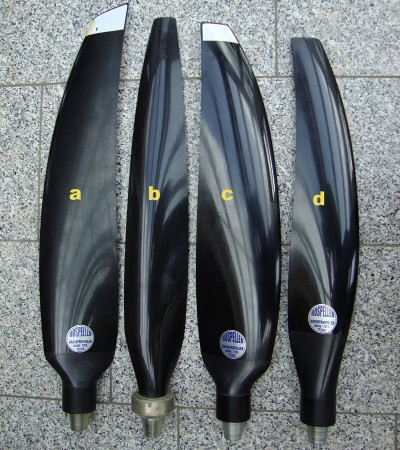
So why do blades differ so much, from thin, straight fence picket, types to graceful sweeping scimitar's, thin to broad, ?
By way of an example , here we have a 4 different blades, all from the same manufacturer/supplier. My question is what benefits (other than aesthetic) does blade shape confer on the performance of a propeller????
-
3 hours ago, Kyle Communications said:
To be brutally honest I really dont think any ulralight "needs" as CS prop..the cost well outweighs the advantages
Kyle:
1. Few of us would be in RAA aircraft ownership, if cost benefit was the reason for doing so, or was even a high point in our consideration - look at all the electronic panels that people are installing, sometimes staggering cost (a $10 k prop is just pocket change compared to some of these systems).
2. Some aircraft actually derive considerable benefit, all depends on the potential of the airframe/engine in use. Again I suggest you check out Robin Austins Sonerai, VH- SGS. True an extreme example but just shows what can be done - from memory 40 knot stall - 160 knot cruise - 174 knot max speed,all using a standard Rotax 912 ULS (small carby mods) that will easily comply with RAA weight standards
3. I agree that your comment "dont think any ulralight "needs" as CS prop" is generally correct, for say 80% of ultralights, especially the more "draggy" airframes but there are plenty that can achieve a 120 knots (Rotax 75% power) and quit a few are heading up towards 35 knots and a smidgen above this to the 145 knot area. I am not counting the very expensive north of $200 k exotics who's performance claims are very suspect anyhow.
-
50 minutes ago, Blueadventures said:
My take on what Mark provided is that the propeller pitch is set for best speed attainable WOT S&L and then the adjustment the other way provides the best (Better for) climb pitch available. Therefore extremely straightforward to use. A very 'KISS' arrangement with I like; mind you I don't think I'll ever have a need for one; but you never never know. Cheers.
There is little practical gain in having an In-Flight-Adjustable, of the type/limitation described ("A variable pitch propeller will allow shorter take-off and a better rate of climb, but not a higher maximum speed.) UNLESS your airframe is the limiting factor in cruise performance and you just want to enhance STOL.
Ground adjustable pitch E-Props are already the fastest on very fast aircraft, as VL3, Shark, WT9..." This statement suggests to me that these "very fast aircraft" fitted with a GA E-Prop pitched for max cruise are likely to have reduced TO acceleration, resulting in long ground role (long runway required), anemic climb (terrain/obstacle clearance concerns) and only come into their own in level flight.
( FP props: For Rotax 9 series engines, using a prop pitched for cruise has the added concern of potentially operating the engine in a RPM range that is below that recommended for climb, which may negatively impact on service life )
The last point is why I suggest that 2-3 propeller blade profiles should be offed, thereby giving the "fast aircraft" owner the option to improve their aircrafts performance at both ends of the envelope.
Is it my imagination or is E-Prop mainly focussed on STOL type aircraft ???
-
Hi Kyle,
Academic (until real world test results available) but this comment does not enhance the reputation of E-Prop (at least for me):
"A variable pitch propeller will allow shorter take-off and a better rate of climb, but not a higher maximum speed.
Ground adjustable pitch E-Props are already the fastest on very fast aircraft, as VL3, Shark, WT9..."Most of us are well aware that a fixed in flight prop can be configured for maximum Cruise speed (there are limits) however this is usually at the expense of Take Off & Climb performance . The corollary is also true.
I would go one step further and suggest that the fixed pitch prop setting, for most aircraft, has been decided on the basis of expected aircraft use and will most often be a compromise, leaning either toward TO or Cruise performance. Of course some will be optimised for TO/Climb others for Cruise. Whatever the pitch setting selected, it will bring with it performance limitations that may frustrate the pilot and could even be dangerous in some situations.
I would expect a well designed in flight adjustable to give the aircraft the best of both ends of the flight envelop (yes yes I know that in real life this may not be quite true). To achieve this, it may be desirable to have 2-3 blade aerofoil configurations to select from. This would facilitate an inflight adjust that will be better for 1. TO 2. Best of Both and 3. High Speed Cruise (a bit similar to the fixed pitch situation).
I would direct you to the experience of Robin Austin (my aerodynamic hero) http://www.worldrecordplane.com/. Robin describes how he experimented with a range of fixed pitch props, which failed to match the potential of the airframe/engine. Eventually using an experimental CS, that allowed full expression of the aircrafts potential flight envelope and several World Records
-
All good but It might be worth:
- Take the fuel feeds, of each bowl in turn, turn on auxiliary fuel pump & "flush" the system for a minute or two (repeat for each carby).
- Remove each float bowl , inspect for contamination and clean
- Similar for the mechanical/main fuel pump fuel supply but use tank pressure/gravity to flush lines (or gently pressurise supply tank)
- Check filters for contamination.
-
48 minutes ago, rhtrudder said:
Leaking internally, talked to wal, he seemed to think it was something caught under the needle or sinking floats, about to go flying always a worry when engine can get go you airborne and then starts to play up , not a lot of room to get back to my strip
Before further flight - Suggest extended run up, including full power, high speed ground run - then recheck for leaking, assuming no other symptoms.
-
No experience with the 914 but would expect system to work same/similar to 912 when it comes to fuel delivery:
I would not expect such a low fuel delivery pressure to be the problem.
When you say "right side carby running fuel" - where from ie down outside float chamber/bowl ? , out of carby throat ?
If running down outside of float chamber - could be the sealing gasket has been dislodged/pinched/broken when you installed it.
- Inspect flat bowl gasket - replace if damaged, otherwise just re install making sure it it correctly positioned (I use a dab or two of grease to hold in correct position)
Floats and or fuel cut off/float valve may be a malfunctioning.
- Check floats for correct buoyancy, weight, free movement.
- Check float fuel cut off valve working as expected, free movement, effective seating/sealing.
In an effort to remove /minimise risk of manufacturing /storage dross entering fuel system I use a blast of compressed air to clear new lines befor fitting.
-
Nice video - I look forward to the documented performance in all phases of flight.
Would be interesting to see the CS performance, along side the ground adjust , same aircraft/conditions.
-
 1
1
-
-
8 hours ago, Blueadventures said:
Probably like the Gazelles and tail dragged Skyfox, factory closed and approvals remain.
How can that be - approvals depend on the factory. The concept of factory approval, is one where the regulator (RAA) shifts the burden of certification/assurance from itself to the manufacturer/factory (for aircraft with approval to be used for hire/reward). RAA's response to, a non factory approved, change/modification, has been to deem the aircraft an E. A clear signal to owner/operator that this aircraft can no longer be used for financial gain. The inference here is that the owner/operator is now largely responsible for the aircrafts continued airworthiness, not the factory and not RAA . In general, the law views any financial transaction, as having actual or implied responsibilities, on the service/good provider, to provide a safe product/service, to the customer . The law also sees that a regulatory body (RAA) has a responsibility to oversee such transactions. It is in this area that RAA has sought to shift its responsibility, to the manufacturer.
With the exception of owners who deliberately set out to purchase an aircraft for financial gain, I think the 24 type standard is a bit of a furphy, having little more than a marketing (illusory) benefit to the owner. However 24 (while in play), is of great benefit to RAA.
Okay so example (not to be taken too literally):
1. A Passive Change - TBO has run out due to operational hours or passage of time. Aircraft no longer meets origination factory complacence. Solution, replace engine with one identical to original. The original configuration has been maintained exactly. One would reasonably expect, that even without factory approval, this scenario would meet the regulators (RAA ) approval. Aircraft retains its 24 status. All good.
2. An Active Change - Fancy glass avionics "kaput". Replacement no longer available. Replaced with another brand/model. No approval from factory. This small change means the aircraft, is no longer is as delivered by the factory. Under existing RAA requirements, with no factory approval, this aircraft can not be used for hire or reward. I guess RAA may make some sort of a case by case judgement call but what happens if an incident occurs where the change/modification is deemed to have been a contributing factor - RAA is now he certifier and the court awards a massive financial penalty?? All still good ?????
(You could substitute 2. with something a little more structural eg a new nose wheel assembly, a wholly different CS propeller , cockpit canopy, etc)
This is why I do not think it likely that a 24 (or similar) registration can continue indefinitely, simply because in the absence of factory approval (for whatever reason) the essence of RAA's ruling (to achieve minimal/nil responsibility for certification) is undermined and RAA becomes legally exposed.
-
1
-
-
2 hours ago, BirdDog said:
Skippy,
I spoke to RAA today, and the E24 rego can be reverted back to 24, if the engine was replaced. So a scenario like this....
At TBO, I apply and get issued an E24 rego. That allows me to continue running on condition. Then, 3, 4, or 5 years later (or whenever) me or a new owner can simply put a new motor in, and revert it back to 24 Rego - PROVIDED that any other mods done are approved by Evektor (Glass etc). If do those mods unapproved, there will likely be no way back to 24. Hence why I need their approval, or no glass gets installed.
So much depends on the continuing good will of the factory (Evektor in this case) What if the factory is bought out/under new ownership/goes bankrupt and fades from the scene? - what then for your 24 classification?
Seems to me that a Government authority may have a good chance of continuity (politics aside) a commercial entity is an ephemeral thing, here today, gone or changed tomorrow.
-
1
-
The love of turbulence.
in AUS/NZ General Discussion
Posted
This numskull recons that it induces mixing of the fast air (molecules ?) with the slowing air close to the surface, which induces an acceleration, which helps to "stick" the airflow to the surface of the wing for longer (not for ever) enabling a lower stall speed a - slower controlled flight, shorter take offs, steeper climb outs - am I close??????