


skippydiesel
-
Posts
7,611 -
Joined
-
Last visited
-
Days Won
73
Content Type
Profiles
Forums
Gallery
Downloads
Blogs
Events
Store
Aircraft
Resources
Tutorials
Articles
Classifieds
Movies
Books
Community Map
Quizzes
Videos Directory
Posts posted by skippydiesel
-
-
3 hours ago, Garfly said:
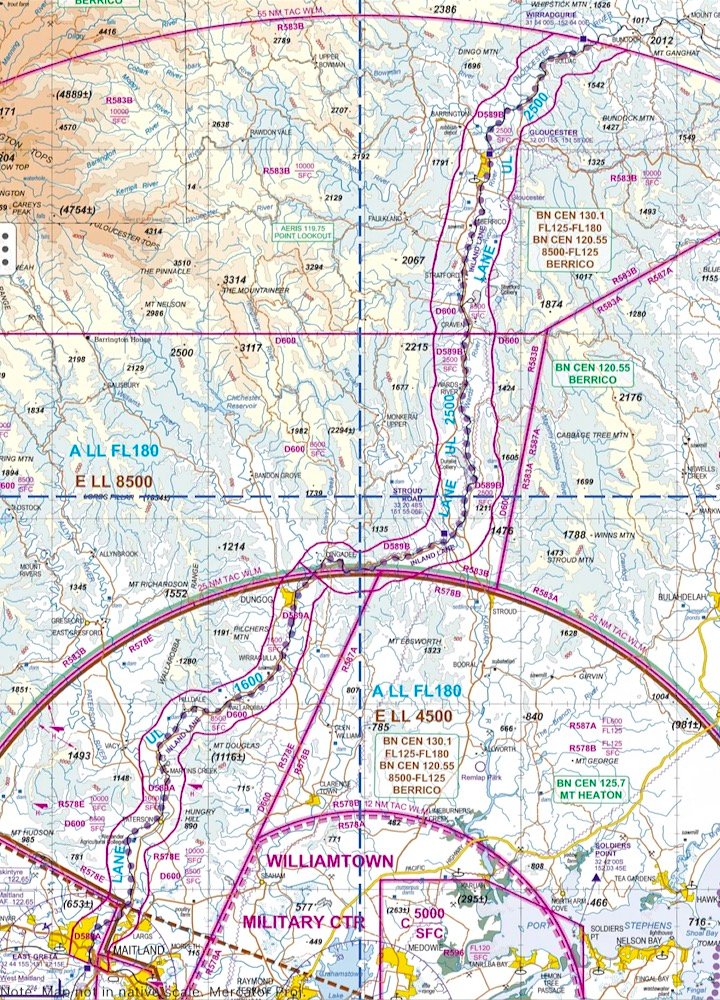
The back lane behind Willy is a pleasant and interesting trip on a nice day.
Again, it is something you might want to do with an instructor first (round trip ex Taree or Cessnock or Maitland?) though it's not hard once you've done it.
LL has now been raised to 2,500' (AMSL) north of Dungog. It takes you up a lovely valley with Gloucester at its top end.

Only did it once - turbulence HORRIBLE combined with very narrow lane and high terrain - quite the work out. No plan to return any time in the future.
-
 1
1
-
-
1 hour ago, Jim McDowall said:
Public servants have been known to use "consultation" as a mechanism to avoid change. CASA's approach to consultation is variable depending upon the target audience and CASA's real desire for change. For example, the way that they have responded to the demands of the big players in the drone industry (Google, Amazon etc) has been frighteningly quick (on their time scale).
So if Dr Smart Aleck and his cronies can do it for Bill Gates, Bezos and co. in whole new arena of aviation regulation, why can't they shift the goal posts in a long standing, known quantity sector like recreational aviation? I suspect there are no chances for high paying post retirement jobs in recreational aviation or international kudos as "innovators".
Recreational aviation is not alone when it comes to this self absorbed regulator. Just look at the way they messed up on Parts 61, 66 and 91.
"Public servants have been known to use "consultation" as a mechanism to avoid change." - AND a raft of other delaying tactics.
"I suspect there are no chances for high paying post retirement jobs in recreational aviation or international kudos as "innovators". - as a general rule innovation and innovators are not tolerated in the ranks of the Public Service.
"Recreational aviation is not alone when it comes to this self absorbed regulator" - not self absorbed so much, as so risk averse, no one wants to make any sort of move, as this attract attention, which may impact negatively on ones career - common to all bureaucracies not just Gov.
-
No offense Roscoe . I know your intentions are good.
Note: that I included the not so fresh student -I have been flying for 30+years and still consider myself to be in this bracket, when faced with an unknown (to me ) challenge.
No matter the qualifications, he radiates a level of inexperience/uncertainty that is best (in my view) addressed by his mentors/instructors.( "......................................definitely looks like something I'd prefer to do with an instructor first". )
I obtained my unrestricted PPL out west. When I first started to fly in the Sydney Basin, I found myself completely confused. Having been used to, the slowly emerging, navigation features like, dry lakes, grain silos, isolated hamlets, disused railway lines, hills that pop up out of the plain, etc. The change to the confusing jumble of the built up environment was very challenging - I took an instructor along, many times, until I started to see what he saw.
I would also add - when I did my Nav's at least one was into Canberra - ATC look after me the whole way in/out, from first contact outside their space, to parking and out again. Unless our friend is planing on using CTA he will not have that level of assistance.
-
10 hours ago, Roscoe said:
Skippy why did you give je a CAUTION note?
Easy question - I would advise any student pilot (includes freshly minted ones and the not so fresh, facing a new challenge) to stick with the instructors that know them & their capabilities.
-
3 minutes ago, Roscoe said:
I have operated in the Sydney basin for many years and would be happy to brief you on procedures.
PM me if you wish with your phone number,happy to help.
"......................................definitely looks like something I'd prefer to do with an instructor first". - good plan!
-
You dont look too happy - probably the aircraft problems😀
-
Wow ! dont have any Tomahawk experience but that seems like a very short range aircraft, with very low carrying capacity. Still you could probably carry 2 X 20Litre (or more) collapsible jerry can/bladders, to extend your range - just land and refuel.
I had heard that Scone was conducting renovations but that was months ago or is your info more sinister (CV-19 related)?
Wicki suggests the PA-38 has a still air range of 368Nm. YSCB- YBTH- YSCO- YCMH is 160 Nm ( X 2 + 320 Nm return) - to be safe you could easily refuel at Bathurst, up & back, if needs be.
-
Okay - Nil offers to date - anyone want a free working GPS - delivery at your cost
-
Don't forget, avoiding all CTA, via Lithgow or if you want an airfield Bathurst & Scone - different sort of "scenic "but great all the same. This is my favorite rout to NSW north coast- easy as!
-
Don't know how experience turned into "inexspert" (whatever that means) - the wonders of spell check!
Cant speak for you - however challenge's/stress can be a good thing.I would suggest having a good talk with your instructor(s), they should have a good idea of where you are up to and if appropriate, guide you through the more challenging rout.
It is all about thorough pre flight planing and in my case I like to do a lot of pre visualisation/day dreaming (basically a mental virtual flight).
-
The direct rout is not always the easiest or even quickest. The rout with the least climbs/descents/ turns is usually the most expedient and less stressful. If you want the inexpert of navigation through busier airspace then go the Sydney/Williamtown way.
-
1
-
-
1 hour ago, Thruster88 said:
There is no doubt J230's are fast, efficient and spacious machines. Excellent value in the used market ?
I agree. At least in that part of your statement "Excellent value" used or new. Cant argue with that, nor can I argue with "spacious machines" after all it was designed as a four seater , reduced to two.
BUT as for "fast, efficient" that's stretching the friendship, tending toward silk purse analogy. 120 knot top speed is not bad but certainly nothing to write home about and as for "efficient", yes compared with most GA but 23 L/h is thirsty compared with its RAA peers
AND lets not forget its 370 kg empty weight, is in the vicinity of 70 + kg more than its peers. So despite is spacious cabin, it can only lift (under existing RAA rules) 230 kg of fuel, baggage & pax - significantly less than many other RAA class aircraft
I am surprised you didn't highlight the factual points - rugged & minimal maintenance airframe, with the potential benefit from, the almost certain, RAA weight increase.
-
1
-
-
1 hour ago, M61A1 said:
It's very handy when you have a whole bunch of wires disconnected, possibly with the engine out. Makes it very easy to ensure that they go back to the correct place.
So you label everything, with whatever system you choose-- before engine removal--- engine reinstalled -- you remove labels as no longer required.😀
-
Not sure why you want to label engine compartment cables - they are mostly short runs, that terminate at a point that makes their application obvious.
Behind the instrument panel - different story all -together.
-
1
-
 1
1
-
-
Yes the "Soft Start" will have a beneficial impact on your Sprag Clutch longevity and all the other components of your starting system.
I relaced the Sprag Clutch on my 2000 commissioned 912 ULS @ about 600 hrs - no data to support my feeling on the matter but I am of the opinion that persisting with weak battery performance (may have had kick back's but dont recall any) was the main cause.
I installed a partial "Soft Start" - retaining my old ignition modules but replacing the original fly wheel with the Soft Start one - great improvement. The fly wheel is the cheapest part of the Soft Star upgrade.
I now only give a battery one chance to "come good" , from an overnight charge, using one of those multi stage battery chargers . If it doesnt get back to top performance (14.2V), it is immediately replaced with a new one.
To help maintain the battery and extend its operational life, I now give it a "tickle up" about once per 2 months - again with an overnight charge with the multi stage charger - so far so good.
-
1
-
-
No offence intended or taken - I may not have been the only person to think it sounded like an intention to overload an aircraft.
-
M61A1 - its not a conclusion, it is a concern over the language (words & cortex) used, that to me suggest an intent or at least an exploration, of the carry capabilities of the aircraft beyond its certified limits.
I did quote the phrases that concerned me.
-
SSCBD - I am honestly concerned with your references to "the plane as a type of all purpose UTE" and "VH form it can lift UP TO 750 kilos MTOW – and yes in RAA is limited to 600 kg on paper." and "Plus could carry extra fuel in the rear. (I did not say that)" all of which suggests , at least to me, an intention to explore the aircrafts maximum load carrying ability, which is likely to be well above legal & quite possibly safe limits.
It perplexes me that you appear to be comfortable expressing these ideas in a public forum.
I am further concerned, should there be an incident, the possible consequences for this Forum, by having fore knowledge of what may be your intentions in this regard.
-
1
-
-
13 hours ago, turboplanner said:
............................................................................................
Biggest loss around here was a group who paid 4.5 million for a site to build a Church and found Churches were prohibited on the site. Google is free.
I thought churches were in the aviation business.
-
 1
1
-
-
37 minutes ago, Downunder said:
Skippy has a long history of hijacking threads for.... commercial reasons.
And I'll note he's not a "First class member", so not even donating to the site.
Whattttt! are you for real? - "hijacking threads for.... commercial reasons." Would you like to list/quote where I have instigated a "hijack" or initiated a thread for "commercial reasons". Yes I support the make of aircraft I fly in - not an unusual stance amongst the Forum membership and secondly its availability on the Australian market, in my openly acknowledged, role as co agent for the brand. I think you will find I am always responding to someone else's question/opinion. Perhaps you might like to provide some factual data, to support what might be seen, as your rather scurrilous accusation.
As for the financial membership - true! I am not a financial member. Just a very active supporter, hardly a shameful position. When there is little conversation happening, I do my darnedest to try and keep "things" moving by introducing new topics, even a bit of controversy and attempt at humour, to stimulate some action, demonstrating a commitment to the on going vibrant life of this forum.
-
1
-
-
RF - you are absolutely correct - tractors & their ilk have comparatively low point loading - a sold tyre forklift could have a much higher loading depending on size/capacity and wheel set (have seen them with double front wheels to minimise point loading).
I dont much wok in imperial however 6 is near enough 150mm (I think) and is usually considered to be a HD floor. As I said earlier, if projected loads are particularly high and can be restricted to certain areas, you can have thicket/more reinforced pad where required and thin for thinner for the lower load areas.
-
5 minutes ago, RFguy said:
Maybe I need to better explain what I am trying to understand. It has been 25 years since I did a slab.
...........................................................................................................................................
3) and then the slab. Does slab size and the need to have the ground prepared over a larger area drive cost greater than the linear increase in area rate ???
-glen
Shed size, will have an impact on site preparation, which in tern will be influenced by things like drainage (surface & sub surface water movement) soil, slop and access (sort of thinking on the go here). A small slab will likely "float" have less & be lees of an environmental impact. On the other hand a large shed will require considerably more planning if it is to be a durable structure eg if its a hanger, it will have wide doors - a small shed will inherently be more likely to have a "stiff" frame, the doors (whatever their design) might be expected to work effectively for a long time. The larger/wider the structure, the more thought/planning will be involved in ensuring the tolerances required for the doors to continue operating without constant adjustment/modification.
-
1 hour ago, Jabiru7252 said:
From my experience the folks who build the hangar should know what's required. If they don't then they're shonkys.
Problem is, you only find out they did a shonky job well down the track - if you can be involved in all aspects of the build, there is a better chance of catching some "short" work befor its implemented & covered up
-
2 hours ago, RFguy said:
Hi Yenn
Yes I expect the soil reactivity and a geotech would be driving the numbers
If is a multi use facility, imagine loading requirements will be dictated by pallet racking, forklifts.... As forklifts with solid wheels and racking feet have high pressure.
The aircraft , even on jacks is not very many Mpa.....
Hope the following helps - I respond as an old "cocky" who has laid quit a few farm pads, for a range of applications - not an expert by any means.
Sounds like the maximum planned loads are for a forklift/industrial - you should be able to get the precise standards from your council, any half decent concrete contractor (in your area). I do not recommend a do it yourself project (unless you have a knowlegiable mate who will "oversee everythin) - too easy & costly to get it wrong and you need quite a few tools to make a good job/finish.
In my experience the pad will be 100 mm or 150mm - if necessary thicker again, where additional loads are expected/planned eg heavy machinery tracks width, under heavy laths, etc
The concrete quality, aggregate size, etc must be specified at the time of order (best left to your contractor unless you are laying it yourself) and includes "slump" which in my layman terms is the amount of water in the mix, which then impacts on the ease of laying, finishing and the strength of the pad.
I would very strongly recommend:
Having the area to be covered, leveled and compacted, if necessary. This will benefit the pad in consistent thickness, estimating quantities (your pocket) and support (less chance of voids) .
Consider drainage around & under the pad may or may not be necessary - rubble drains and ag pipe are often employed in this capacity.
A plastic membrane under the "pad" this prevents moisture wicking up from the ground - in the future, what ever is sitting/placed on the pad will appreciate this. It will also reduce the likelihood of spaulding/concrete cancer where the rio start to rust/expand.
Discuss with your contractor, the type of "finish" you expect - most hangers, factory, store type facilitates go for a hard smooth reasonably dust free finish, achieved, in large part, using a helicopter (mechanical troweling machine) and combined with finishing products..
Thinking about slope - do you want your pad level or with a slight gradient. If a gradient, to what side/direction do you want it to drain. - this impacts on wash down/spillage/setting up equipment etc
Consider the implications for a pad that is just the size of the shed or one that is slightly larger, a pad designed to have the shed built on it, as apposed to having separate foundations/piers. On oversize pad should have a small "step" down all around (except entry ramp(s) to prevent rain entry.
When the concrete is ordered, it is normal allow an additional percentage - you dont want to be "short" - this also means that you need to have a strategy for any left overs (I usually make up some large paver forms to accommodate surplus).
Enough?
-
2
-
 1
1
-
Is RAA getting 760kg MTOW?
in Aircraft General Discussion
Posted
Turbo - the phrase "risk averse" is contextual (as I am sure you know).
In aviation or any activity inherently dangerous, it pays to be risk adverse.
In bureaucracies, it also pays to be risk averse, as these highly political institutions, tend to reward anyone with the temerity to suggest a novel idea/approach or god-for-bid, make a decision (collective/consensus ones are safe) being labeled a rebel - a stunted career or early " voluntary" redundancy being the outcome . The most successful bureaucrats, have never so much as had a hair out of line, let alone made an independent decision or voiced a personal opinion.
Where the risk averse pilot will be esteemed, the impact of risk averse/fence sitting bureaucrats on society, is stultifying