


skippydiesel
-
Posts
7,613 -
Joined
-
Last visited
-
Days Won
73
Content Type
Profiles
Forums
Gallery
Downloads
Blogs
Events
Store
Aircraft
Resources
Tutorials
Articles
Classifieds
Movies
Books
Community Map
Quizzes
Videos Directory
Posts posted by skippydiesel
-
-
6 hours ago, onetrack said:
Has anyone considered coating their exhaust system with Cerakote heat reducing ceramic coating? I have no experience of the product, but I know people who have utilised it on vehicle engines, and it has made a substantial difference to engine bay temperatures.
Not sure but have heard that Rotax advise against exhaust wraps/coatings (check out Nev's comment above)
-
 1
1
-
-
6 hours ago, IBob said:
How about opening the oil inspection hatch on shutdown, to avoid the heat soak in the first place?
Always done but it doesn't " avoid" heat soak just helps to reduce it's effect along with all the other strategies..
-
Veeery nice IBob !
I don't seem to tire from looking at Rotax installations and the subtle variation's initiated by either builder or factory.
The above story was when I had an 2000, ATEC Zephyr/Rotax 912ULS however the fuel reticulation lay out was/is similar to my new Sonex/Rotax 912ULS (yet to fly) with one significant exception. The exception is the inclusion of a fixed aperture fuel return line from the fuel manifold. The Zephyr had an adjustable pressure relief valve set up, quite large & heavy, mounted on the firewall (this was before the simple return system had been developed/widely used)- it did work and had a fuel return to the tank. It is possible that the additional plumbing that this older system required somehow retained fuel vapour, that resulted in the delayed engine problems that I experienced.
-
IBob;
It sounds like you have just the two fuel lines (in/out of pump) over the top of the engine with the fuel manifold to carbs & return line on the firewall - If my reading is correct, this is a significant improvement over most set ups, that I have seen, where the fuel manifold and carb lines are also over the engine.
Would it not be a further improvement to have the fuel pump in/out lines under the engine ?
To do this the pump spigots would have to be pointing down ie rotate the pump cap.
As for your start & pre takeoff regime - sounds much like what I do, however on two occasion, when I was on an extended away trip, I experienced FVL on my take off run. From memory this was my third departure, starting in the cool of first light, and the last before final destination. I had refuelled on my last stop but this one was for "comfort" Temperatures had risen to around 40 C . Engine start was normal, however she soon coughed/spluttered & "died". I was fairly certain the problem was FVL. Restart took some effort despite prolonged boost pump, I think I even tried choke. Once the engine started there was no more hesitation and I did an extra long pre-flight check, with engine rpm to 4000 in an attempt to clear any residual vapour. All good, lined up and commenced my run - engine lost power close to rotation speed. I aborted TO. Engine still running, I departed the runway at taxi speed, returning to the parking area. I was pretty sure what the problem was but removed my upper cowling for a visual check with special attention to fuel filter condition - all good. Start was normal as was taxi & extended run ups. Lined up power on, instant cough splutter, recovery & this time we continued with normal climb out Rest of trip okay.
So the moral of the story is, with every mitigating tool (short of AvGas & delaying my departure to the cooler afternoon) available to me I still had a couple of FVL heart stopping moments.
Seems to me fuel lines under the engine might be worth a try BUT only if either Rotax make such a pump or it is safe fore me to rotate the cap.
-
Mitigation usually takes the form of;
My list was short two important mitigation tools ;
- A metered (small orifice) fuel return line, may encourage vaporised fuel to exit the up stream side of the fuel delivery.
- The use of a fuel "boost" pump may assist the expulsion of gases fuel from the system and assist in the suppression of further vaporisation.
I left out a symptom:
- If aircraft fitted with a fuel flow and or pressure gauge, the pilot may notice sharp oscillations in fuel delivery/pressure.
-
11 hours ago, Blueadventures said:
You then have to get up to the carbys each side.
Please explain why you feel there may be an issue with fuel delivery (pump to carb)
-
1 hour ago, Blueadventures said:
As the fuel supply from tank to pump is on top and if you must have the feed coming up from below; perhaps get some soft aluminium tube 5/16" and form it to 'U' towards the front then turn down and put a rolled bead on both ends and that will route the feed to your desired location for the design and just route the 1/4" feeds to carbs as normal. This way pump is as assembled at factory spec.
Thanks Blueadventure - might work but more connections means more weight and potential for failure.
I just cant see why the fuel pump cap/spigots cannot or should no be rotated/oriented to the builders desired position.
If the concern is Rotax QA then why doesn't Rotax offer pumps with spigots pointing in at least two directions eg the existing set up and a straight down ????.
I presume the robot/person who assemble the pump, could be programmed/asked to rotate the cap to the desired position and the whole shebang still meet Rotax QA & specifications.
-
1 hour ago, Thruster88 said:
Routing the fuel lines below the cylinders will only exacerbate any vapour lock. Think about what happens when you go to depart, engine starts, top of cowl fills with cool air, vapour exits via the orifice or enters the carburetors and exits the vent line. Remember cool air enters the top of cowl and hot air exits the bottom.
Thruster - No offence intended but I do not think you have a grasp of the issue.
Please Note: I am limiting my comments to Rotax 9 series carburettor engines.
My experience with fuel vaporisation/lock (FVL) and the understanding I have from commentary by others, is that this is principally a phenomena of aircraft ground operations, during periods of high ambient temperature.
Those flying in cooler climates and or confining their flying to cooler days or times of day (a management strategy) rarely if ever experience the problem.
I suggest (without any data) that temperatures from 30C will see an increasing rise in the potential for FVL (not suggesting it could not occur below this temp.).
So high ambient temperatures AND a hot (recently operated) engine are the precursor's for FVL
Susceptibility will likely be influenced by engine cowl design, parking into wind, duration of heat soak (engine off), degree of fuel pipe insulation and fuel type (ULP being more susceptible than AvGas ).
Mitigation usually takes the form of;
- Avoiding flying on the hot days or times of day (in my view the best option).
- Allowing the engine to cool to or near ambient.
- Using "fire" sleeves on fuel lines - fire sleeves having some insulating properties.
- Using AvGas (the Americans seem to be particularly fond of this expensive partial solution).
- Parking into wind in the hope of increased cooling air flow when engine off.
- Improving cowl air flow design for ground operations (including engine off)
I have never experienced taxi induced fuel vaporisation however there are many anecdotal reports that this can occur with prolonged ground running on hot days.
It would seem that few, if any, pilots have reported FVL in cruise or even well established (late) climb out. I speculate that this is due to enhanced cooling (air flow/engine rpm) greater fuel flow and cooling with altitude.
Symptoms;
Pilots may experience difficulty with "hot" engine start but this is more of an annoyance/inconvenience than a safety issue.
Once started there may be short periods of rough running, as in line fuel gas/vapour interrupts the liquid delivery to the carbi's, again more of an annoyance than a safety issue. A very strong signal that the pilots should be alert for this to occur during take off & climb out
I suggest that the real problem (safety) is the engine that appears to run normally during taxi & run up and then looses power during, the critical periods of, take off ground role and early climb out.
No matter the timing of the problem, I believe it all starts on the ground.
So speculation about in flight FVL is misplaced - the problem is on the ground - this is why I am interested in the possibility of fuel lines being routed under, rather than over, the engine as this simple change has the potential to add to the existing mitigation strategies.
-
Bob;
I have never proposed changing the fuel pumps function or internal settings (I do know how a diaphragm pump works & am satisfied with the pumps performance) - what I am interested in is the orientation of the spigot's and the potential (or not) to change that orientation.
Once it has been established that the orientation can be changed (either by the purchaser or the Rotax factory/supplier) I would like to see a discussion on the merits of routing the fuel lines under (rather than over) the engine.
Pretty simple idea - why is it such a taboo subject?
-
Simple IBob;
There is no "we don't seem to have a problem" - No Rotax 9 (carburetted) operator (flying in high ambient temperatures) is immune from the potential for fuel vaporisation.
The existing strategies do not completely remove the possibility. Its possible that routing the fuel lines below the engine would make little difference but on the other hand it might just add a further/incremental improvement - unless its been tried you don't know.
For engines prone to carbi ice, would you be so dismissive of a reduction in the potential for this to occur?
- who, if anyone, has explored this possible option for further reducing, the very real, the chance of fuel vaporisation ?.
- can anyone see any problems (asides from the illogical warranty matter) with this idea?
- does anyone have a fully functioning Rotax fuel pump, replaced for no other reason than 5 years in service, that they might like to donate to me, so that I can explore this concept (or go for it themselves)?
Any improvement in safety, especially where there is little or no cost involved, should be explored.
-
4 hours ago, IBob said:
Skippydiesel, looking at the illustration in the article, and assuming the cap screws are equally spaced, it would seem to be feasible to rotate the cap as you suggest.
Three things to consider, that I can think of:
1. We don't have a torque figure for those screws.2. Opening the pump voids the warranty.
3. Engine heat soak causing vaporisation is best dealt with by
a) Installing the Rotax recommended fuel return line with orifice, which will vent vapor back to the fuel tank/s and
b) implementing engine start and preflight routines that will both expel any vapour and allow sufficient time to cool the engine bay.
1. Torque recommendation can usually be found by consulting "generic" charts and even without this common sense (experience) should be sufficient.
2. Yeah! This I know - often this is a manufactures/suppliers way of removing themselves from responsibility rather than a practical/logical barrier.
3. I am well aware of the existing strategies for minimising the effects of fuel vaporisation/lock. Unfortunately rerouting the fuel lines is (at this stage) not an option due to the orientation of the fuel pump spigots.
It seems to me, in my aircraft, the option to point the spigots straight down, may enable the fuel lines to be routed below the engine.
The only potentially negative, that I foresee, is the proximity of the fuel lines to the exhaust system. This could be easily addressed through targeted shielding/insulation.
Fuel vaporisation is generally caused by a hot engine, that has recently been stopped OR protracted ground operations, combined with hot ambient temperatures. The variose fuel lines, running over the top of the engine, are heated by the engine , primarily by convection (rising heat). Fuel lines below the engine may be subject to radiant heat however this may be over a significantly shorter time, as the exhaust system will tend to cool quicker, than the mass of the engine. In addition the hot air leaving the top of the cowling would drag cooler air into the bottom, creating a cooler environment for the fuel lines.
The radiant heat from the exhaust may cause in flight heating of the fuel lines but a doubt that this would be any greater than the existing over engine system.
The combination of removing the fuel lines from the hot over engine location and the cooling air entering the bottom of the cowling should markedly reduce the possibility of fuel vaporisation - I font understand why this option has not been tried/offered..
-
My apologies for going off on a bit of a tangent:
I have two, closely related, Rotax fuel pump questions:
- Is it feasible, for the home mechanic/builder, to rotate the fuel pump cap, thus reorienting the fuel in/out spigots? This would allow for different fuel line routing which may reduce the effects of engine heat soak causing fuel vaporisation.
- If the above not within the capacity of the home mechanic/builder - why does Rotax not offer the fuel pump with cap/spigots at different angles to the basic 45 degree up & back (relative to prop)?
-
1 hour ago, IBob said:
Skippy, maybe we are looking at different documents, but I can't see anywhere it says the cooler must be mounted in that orientation.
The only references I can see are on Page 22 of 79-00-00:
1. Mount the cooler below the oil pump.
2. Mount the cooler with the fittings upwards.
If I'm missing stuff here, I'm happy to be corrected........?
Seems to me that I have somehow read into the oil tank location/orientation the same info for the cooler - brain cells not getting ant sharper. Thanks for pointing out my error (had me worried for a while)
However I still have the cooler in/out lets at very different location to the Rotax sketch (ideal?) - I cant see why the in/out lets must be on top as long as I am confident (which I am) thet there is not air bubble trapped in my oil cooler.
-
5 hours ago, IBob said:
Hi Skippy, I couldn't open your link, but was able to open Edition 3 here:
https://www.rotax-owner.com/pdf/IM_912_Series_Ed3_R0.pdf
For greater clarity, I suggest you post a pic?
And you have some means of directing adequate cold air flow through the cooler in that location?
Don't know why that link would not open but as you have found out this https://www.rotax-owner.com/pdf/IM_912_Series_Ed3_R0.pdfwill get you to the document & then search for the relevant page.

-
1 hour ago, Yenn said:
mounted horizontally (in relation to the engine) What does this mean Skippy. Is it horizontal or not and what does it's orientation to the engine have to do with it?
It seems that people nowadays mix up horizontal with parallel.
All true Yenn - if you open the Rotax Manual that I posted you will see what I mean. Essentially the cooler is to be mounted with its long axis in the same plain as the pistons (across the engine) with the in/out ports on top.
-
To Rotax 9 aficionados and other interested parties
Reference: "The oil tank must also be mounted in the correct position and within the set limitations of the Z & X axes on the engine (See Rotax installation manual Section 79-00-00 Page 20. https://www.rotax-owner.com/pdf/IM_912_Series_Ed3_R0.pdf.)"
The Rotax instructions, above, advise that the oil cooler should be mounted horizontally (in relation to the engine) & near vertical. The instructions go on to talk about air entrapment with the advise against having the in/out ports located below the oil cooler .
I have strayed from this advise & have my oil cooler mounted longitudinally with the in/out ports on the (aircraft) right side. The oil cooler is angled sharply up (probably 25 degrees), so the out port is well above the in.
I have no air entrapment concerns with my oil cooler installation - are there other potential problems that I have not considered?
-
It seems to me that all piston engines will require a certain level of "robustness" for a given power output. Robustness almost always means weight - the higher the power output the greater the weight. This may not be much of a considerations for land based vehicles but for aircraft presents as a major hurdle.
Is this not the main reason why diesel engines with their "attractive" characteristics (power/econamy/high flash point fuel) do not seem to quite "make the cut" as propulsion units for aircraft?
I would like to hear /know more about Geoff_H's Mercedes engines, as they may offer at least part of a solution however I suspect higher weights than a conventional petrol & lower weights than a conventional diesel (good compromise?). The "management" required for greater combustion complexity may lead to reliability issues - please expand .
-
 2
2
-
-
3 hours ago, turboplanner said:
In the real world many people don't adhere to manufacturers recommendations.
I know one guy who wrecked a perfectly good aircraft because he bought hoses from a discount car parts shop.
What you could do in designing an engine if you thought everyone would be compliant and what you need to do in the real world are two different things.
Is this not Darwinian selection in action?
-
1
-
-
17 hours ago, turboplanner said:
Not against them, but if you don't have hoses you don't have hose failures.
I am sure there must have been at least one hose failure but for the life of me I have no knowledge of such an event.
In the real world adhering to Rotax recommended service intervals/materials would seem to reduce such concerns to the realm of theory.
-
3
-
1
-
-
1 hour ago, turboplanner said:
A 600 hp truck engine weighs a tonne, its cooling and mounting system weighs about the same as an ultralight.
What?? are you positive about this? Even my 3.2L Rangers radiator is much much larger than my Rotax
1 hour ago, turboplanner said:......................and after the intensity of design in WW2, if it's a piston engine you would probably go air cooled.
So not an admirer of the Rotax line of 4 cylinder semi liquid cooled engines.
1 hour ago, turboplanner said:-
1
-
-
3 hours ago, Bosi72 said:
$$$
Not just dollars - a ground based engine of 1.3L must have a relative (to aircraft) large radiator to accommodation slow/stationary operation and a high degree of blockage (insects/chaff/dust/etc).
Up until recently, ground engines did not routinely run an engine oil cooler - so were further dependent on the radiator for cooling (& a large sump capacity).
The aircraft engine most similar to ground engines, Rotax, used a little over 3 litres of engine oil, with a slightly larger liquid capacity cooling system. This is much smaller than what would be routinely found in your average 1.3L car.
A diesel engine of similar output (say 90 hp continuous ) would probably require slightly larger oil/coolant capacity. I would expect the higher torque to facilitate courser prop settings which may offset a potentially poorer take off & climb performance and also give superlative econamy at cruise.
-
Ref. Direct prop coupling
Cant see it it - Rotax have proven (at least to me) that in relativity low hp (sub 200hp) engines, the way to go is liquid cooled, high engine speed, through a reduction system to optimum prop speed . Why? cause the efficiencies conferred by this concept are improved combustion (lower fuel consumption/greater power:weight), lower vibration & noise and in the case of Rotax reliability.
Ref. Comparing very large diesel performance with small light weight aircraft engines.
Cant see this either. Large slow revving diesel are incredibly heavy (power:weight) to cope with the combustion process - if diesel aircraft engines are ever to be a modern reality, they must (again in my view) go the Rotax route eg Austro & Fly Eco (both MB engines).
-
1
-
-
The weight issue is inherent in diesel engines due in large part to the much higher pressures (traditionally about 22:1 modern turbo ed engines can be down around 17:1 high compression petrol about 11:1) and what is essentially an engine designed to "knock" both features demand more robust construction which usually results in weight increase compared with a similar petrol engine.
I doubt very much that a diesel engine designed/adapted for use in a fixed wing aircraft would go back to the old style (heavy & comparatively inefficient) injector pump/injectors. Sure the Germans had diesel aero engines back in W2 but they were not continued/adopted after the war, why? The reality is that, today, a diesel engine designed/adapted for use in aircraft would have to be high revving (probably in the 3000-4000 rpm range), with a gear box, "boosted" and use common rail high pressure computer controlled injection system to achieve competitive efficiencies in power:weight and fuel consumption. The combination of boost & high revving = higher volumetric efficiencies which may translate into better power:weight.
Boosting is not jut a way to improve volumetric efficiency it also can deliver, particularly when combined with HP common rail computer controlled injectors, higher efficiencies and lower pollution due to cleaner burn and due to density altitude changes, is eminently suited to aircraft
I think your terminology eg "lean of peak" adopted from petrol aircraft engines, does not sit well with diesel engines
-
1 hour ago, Ian said:
To be clear a few of the advantages of diesel engines using diesel
.....................................................................................................................................
But I must admit I would be jealous if someone flew in an filled their piston powered plan with jetfuel.
Hi Ian - As a long time lover of diesel engines I agree with most of your statements however I find the following to be in need of clarification;
"Max power occurs at RPMs that are suitable for propellers without reductions gearboxes" - It is true that the compression engine/diesel has a longer power burn and this lends itself to power delivery at lower rpms, however the rpm that this peaks (torque & power) at is a factor of engine design rather than a characteristic of diesel engines per say. (approximate numbers from defective memory) My old DB 885 is delivering max torque power at around 1500 rpm, the last Mac I drove 1500 rpm, my Rocky 2200 rpm, my Ford Ranger 1800 rpm - most of the "car" variants will rev to say 4000 rpm not so the tractor & truck which will max out at about 1800-2000 rpm.
"Excess air ensures creates a leaner burn" - Please expand on this statement. Petrol engines require fuel for cooling (one of the reasons why they are not so economical) where diesels do not. This is not excess air or a lean burn.
"Max power occurs at RPMs that are suitable for propellers without reductions gearboxes" For a diesel to be used, in a heavier than air aircraft, it will inevitably have to be high revving & boosted to achieve a viable power to weight ratio, so a gear box or engine speed reduction must be employed.
"Can be electronics free. ie no requirement for ignition." - Not any more. To the best of my knowledge all modern road diesels & most off road use high pressure common rail fuel systems with computer controlled injectors.
"Power/Weight generally worse than petrol" - I would say always rather than generally. In recent times the use of high performance turbos has allowed for reduced compression . The reduced compression then allows for less robust (lower weight) engine construction however diesels are at this time always heavier than their petrol equivalents.
"Generally require turbos to bring them close to petrol engine performance." Again I have an issue with "generally" Diesel engines will always require some form of boost, be it turbo or supercharger, to achieve power/weight and clean burn approaching that of petrol. Diesel engines are , in my view, unlikely to ever achieve the engine speeds (rpm) of petrol engines, due to the slower burn characteristics of diesel. However diesel engines are likely to retain their superior torque and fuel econamy characteristics, compared with petrol, hence their use in commercial applications and wherever grunt is required.
.JPG.b5e03143347d90d0a2757670dc2d8ffc.JPG)
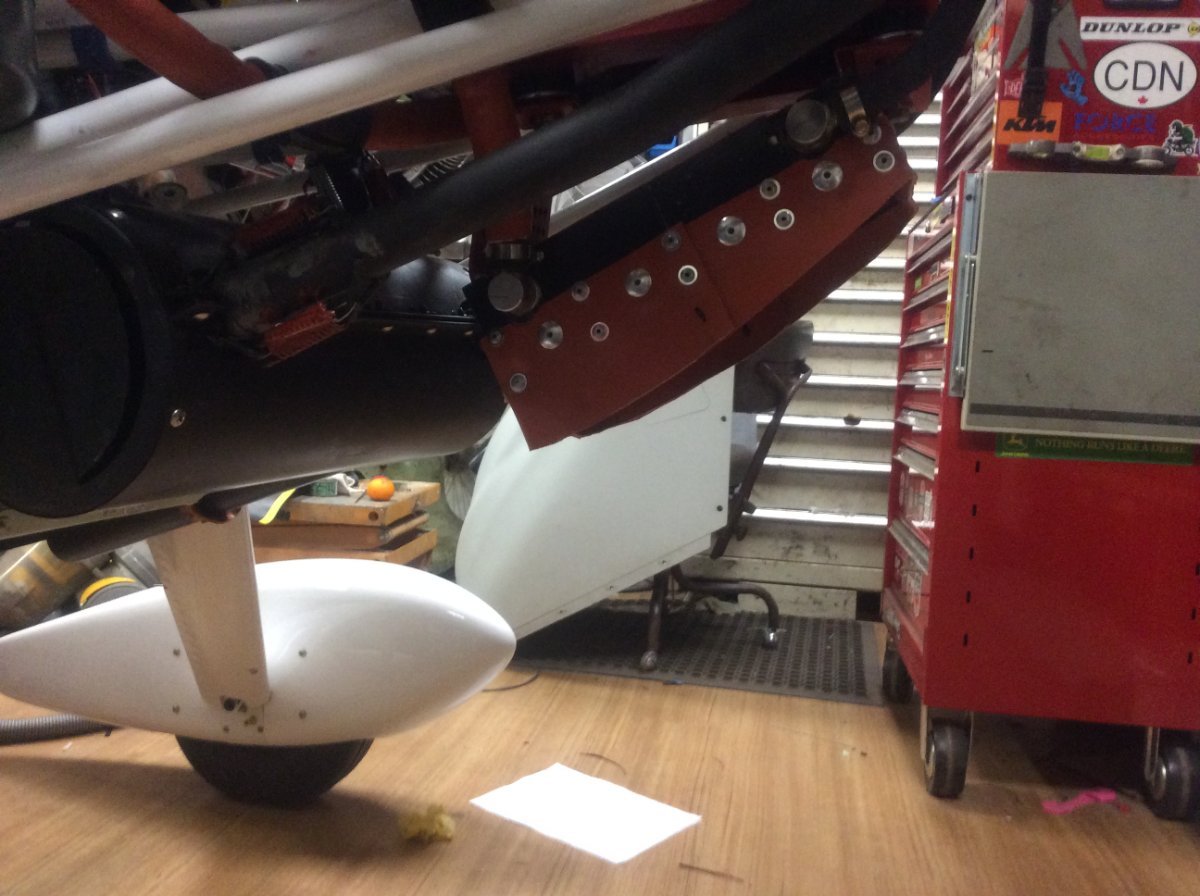
ROTAX 912 Fuel Pump
in Engines and Props
Posted
Soooo!
Has no one else;