


skippydiesel
-
Posts
7,619 -
Joined
-
Last visited
-
Days Won
73
Content Type
Profiles
Forums
Gallery
Downloads
Blogs
Events
Store
Aircraft
Resources
Tutorials
Articles
Classifieds
Movies
Books
Community Map
Quizzes
Videos Directory
Posts posted by skippydiesel
-
-
2 hours ago, rhtrudder said:
Just fitted a led to my landing leg, super bright, been a couple of midair’s so I figured it might help on final, trouble is it drowns out the radio , any way I can make it work, wired it to the nav lights
Just parroting stuff I have read & heard -
- Aircraft lights work well : in low light conditions and when viewed from the ground.
- Aircraft lights have little benefit: when viewed in bright sunlight and in aircraft to aircraft situations.
The consistent opinion/advice is that the best most cost effective defence (in small aircraft) against a mid air collision is the transceiver ie communication. Pilots, interested in safety, must give regular updates on their position and intentions, using the correct frequency(s) and verbal format. Its always best to make a few too many calls than to few.
The human eye is as well adapted for flight as the rest of the body and can not be relied on to see other aircraft without having a hint (communication) where to look.
-
 1
1
-
Well the Meguiar's Clay kit has no discernible benefit - will move to the next level.
-
 1
1
-
-
3 hours ago, facthunter said:
They usually improve when bedded in. Nev
Yeah but what technique would you suggest - accelerate to 30m knots and jam on the brake (but don't lock) repeat 10 times?
-
Have received the instructions but no mention of "bedding in".
The brakes will only hold to about (Rotax) 3500 engine rpm. This is just okay for ignition checks but it would be better to be able to get to 4000 rpm. I using MIL-H-5606BB (Aircraft) hydraulic fluid and there are no air bubbles (that I can see) in the system - any suggestions on how to improve my brand new brakes (only taxied once) will be most welcome.
-
4 hours ago, onetrack said:
Skippy, photos might assist in a better analysis of what the problem is, and how best to solve it.
Ever tried getting a photo of something on the inside of a shiny tinted "window" (my polycarbonate is tinted) - I suspect this would be very much the same.
-
1
-
-
Good discussion (we all have "plastic" canopies mostly of the Perspex variety).
Sonex use Polycarbonate on their forward "windscreen) and Perspex on the hinged main canopy. Polycarbonate is very strong but reacts badly to exposure to hydrocarbons (petrol, paint thinners, etc).
Most of you are assuming my problem is hazing and or scratches and making suggestions to minimise or correct the same . Hazing usually associated with exposure to UV causing a dulling of the surface - my polycarbonate has not flown nor been exposed in any way to UV. Scratches/abrasion caused by all sorts of unfortunate occurrences from a bit of grit on a cleaning cloth to contact with a metal object is also not the problem.
My blemishes appear to be on the inner surface, quite random in distribution & shape and mainly on one side. They present as a stain, rather than fog/hazing. There is no raised surface and a finger nail scrape makes no impression.
-
Thanks Gentlefolk.
RGMWA - "Silvo works. Be careful as overdoing it will result in visual distortion and may make the problem worse." I would be concerned that Silvo contains hydrocarbons, certainly smells like it. To the best of my knowledge hydrocarbons & Polycarbonate don't mix.
IBob - ".........fogging .........." My blemishes appear to be on the inner surface, quite random in distribution & shape and mainly on one side. They present as a stain, rather than fog/hazing. There is no raised surface and a finger nail scrape makes no impression.
IBob - "..........Meguiar's Clay kit........", I have some will give it a try.
Thruster - Thanks but, at $83 US, I might try the cheaper suggestions first.
Onetrack - Josco stuff looks good. Unfortunately the clearance between glair shield and underside of Sonex "windscreen" (Sonex) to tight for most power equipment. Thanks anyhow.
-
Hi All,
On removing the upper protective cover (the lower had been removed for installation 12 months ago), of my brand new Polycarbonate canopy, I have found strange blemishes, that do not come off with the application of VuPlex cleaner - anyone have a suggestion?
My thanks in anticipation
-
Hi All,
Hoping that someone on this Forum can email me a copy of the Tracy O'Brien brake system installation, operating and adjustment instructions.
My thanks in anticipation
-
Thanks for all the best wishes/support - pity that no one recommended a potentially suitable pilot
-
10 hours ago, FlyBoy1960 said:
Test pilot for what ? I am sure you will get a little bit more interest if you mention the type of aircraft ?
Sonex Legacy (A) - Not sure that this is all that relevant, as it would seem that pilots with good tail wheel experience do not often have an RAA Cert.
-
First flight immanent, need slim (tight cockpit) pilot, with recent/extensive tail wheel experience, Rotax 9 engine, CS prop, Dynon panel, RAA Cert and willing to fly out of Camden NSW.
I anticipate aircraft will be ready to go any time after this Saturday (05/11/22) after, hopefully, successful CASA approved W&B
Name & phone number
I will follow up all recommendations.
-
3 minutes ago, Student Pilot said:
Ahh, just read the "removing" 🙄 That would depend on what sort it is? Paper glued? Epoxy sprayed?
I would guess "paper" (?) glued style, in that it looks like it would have been supplied with a sticky one side (contact adhesive?) surface.
I would like to remove without damage to the painted surface.
As for replacement - I see that Bunnings Aero Space does a neat line in non slip stick on sheets. The alternative is the very course and expensive sandpaper type, supplied by dedicated aircraft parts stores.
-
1
-
-
Please advise your best techniques for removing wing walk/anti slip pads.
-
1
-
-
On wheel nut torque - It can sometimes be hard to find in your cars handbook (amongst pages & pages of gadget operating instructions) but somewhere there will be a recommended torque setting and tightening pattern. It is likely to be surprisingly low (especially for alloy rims) and is well within the capacity of a hand wheel brace to loosen/tighten. I do my own servicing (inc wheel rotations) and use a torque wrench, to tighten my vehicles wheel nuts, to the manufacturers recommended value (usually less than the random tightening a tyre repair shop will deliver with a rattle gun) and have never had a problem with the wheel staying on or distortion of the rim.
-
3
-
-
This is a political, not an engine topic - please transfer it to a general forum for debate
-
1
-
-
Thanks Blue ( & Yenn in anticipation)
-
Has anyone had any experience with the pressure pack, emergency tyre inflators ?
It seems you can get the better quality ones (eg Motul ?) in different sizes, to suite (come close) to the tyre you want to do.
I have recently purchased one of those "pocket" battery jump starters. Yet to use it however in addition to jump starting, it comes with capacity to charge other devises such as phone & a built in torch/strobe. Ii will also drive 12 volt accessories such as a refueling pump removing the need to access the aircrafts power supply.
My last aircraft was all metric (not a devil thread anywhere) unfortunately my new has a metric engine (Rotax) and american aviation spec (way worse than regular imperial) fuselage/systems, very much complicating (increasing weight)an emergency tool kit.
Aside from tyre repair (imperial) I will only be carrying metric tools and a very small number (to be decided) of engine spares
-
1
-
-
Wow! I seem to have stirred up a "hornets nest" - So far I have contacted 3 organisations offering W&B service - yet to have a response. I plan to phone around the local aircraft work shops, as it has been suggested to me that many LAIMS have their W&B approval but don't offer their services outside their employers business (one may be persuaded).
-
1
-
-
1 hour ago, Blueadventures said:
Hi Skip Was speaking the Jarrod today on another matter re details of E-props on my Nynja (change from DUC to E-Props allm good they processed info and got new registration with E-Props on it within the hour. Emailed thanks to them) ; back to topic. Yes, application with CASA to have all RAA trained W&B persons valid and they are hoping for result back within the next week or so (however no surprise if longer). The new W&B procedure will be a 21 page document and should be advised to members next month. (Sounds good and should answer any questions about requirements and how to do.)
Cheers Mike
Thanks Blue - Yes all true but as most would advise - don't bank on it happening within 2 weeks .
In the event of my favorited RAA service provider not getting his ticket to weigh back within a reasonable period (2-3 weeks) I have already started to research potential CASA approved W&B service providers that may be willing to come to Camden, NSW, airfield. This is extraordinarily hard to do because few advertise and there are no contact lists from CASA.
It woulds be much appreciated if any Forum member would pass on the name, phone number, email address or web page for a W&B service provider to the Sydney Basin & environs
-
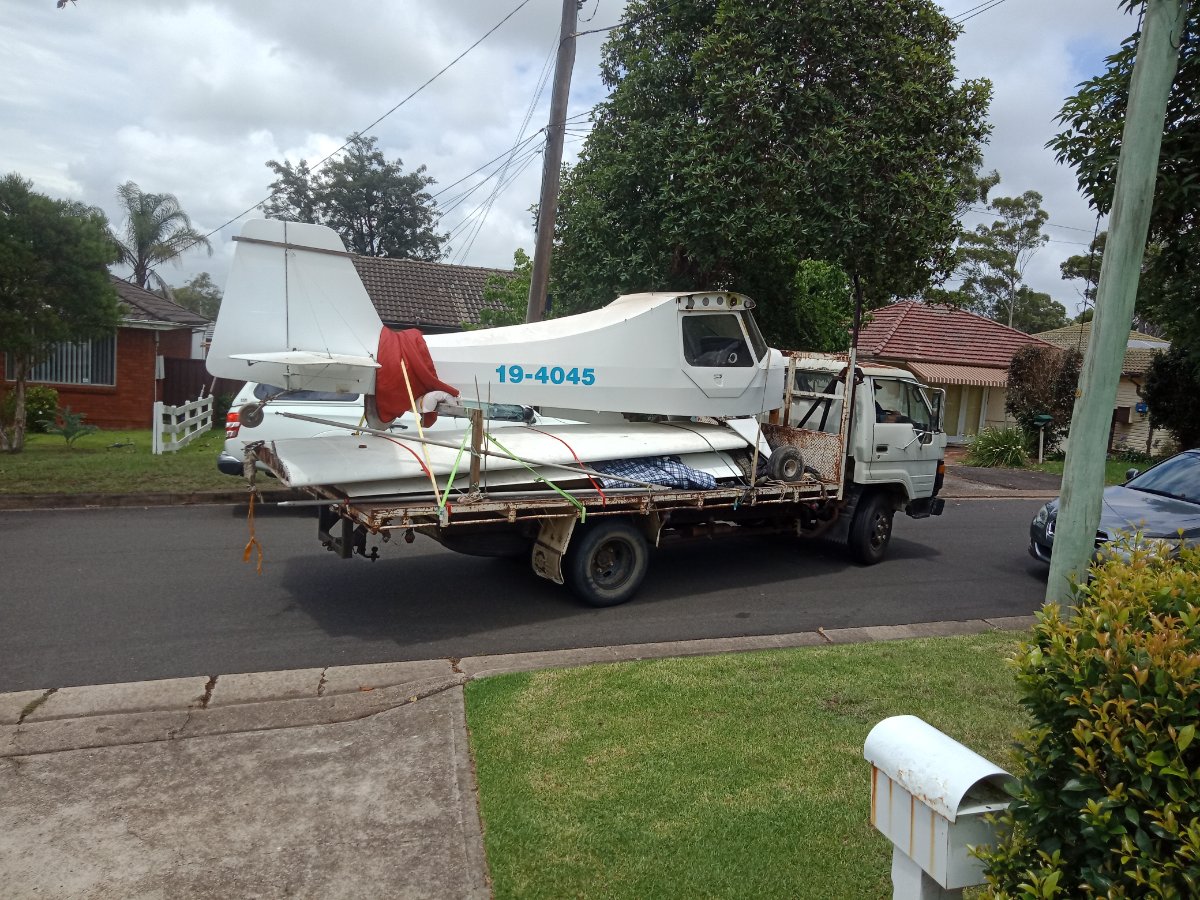
2 hours ago, Methusala said:
This is how we moved the Karatoo, Bungendore to Sydney. Don

Max Im overhang?? if I close one eye & have a cup of tea, may be.
-
1
-
-
I use a smear of dielectric grease between all my metal to metal contacts. Lots of different suppliers out there.
I dint live near the coast ,so that may be why my aluminium stock & builders malleable aluminium flashing doesn't seem to corrode OR its treated somehow to inhibit corrosion..
-
1
-
-
FYI - if anyone is interested I have number of unused Henst H 102 & 103 WK filters left over from my previous aircraft. Contact me through personal messaging.
-
1 hour ago, Blueadventures said:
lower number = finer ??
Yes
-
 1
1
-
Hash
in Instruments, Radios and Electronics
Posted
Without having the all important location "clue" aircraft lights for day time (good visibility) conditions are, at best, a nice bit of "bling" that adds a professional look to the aircraft/pilot.
When viewing an aircraft in flight, from the ground: we have immediately restricted (located) the aircraft to somewhere above the horizon, we may then have an audio clue (noise) further narrowing its position. If we are a pilot waiting for take off, we should have heard positions calls from the airborne aircraft and we will look for it (or any other aircraft) in the circuit/on final (location) - lights on the airborne aircraft will help, a little but we most likely already have it sighted.
When trying to find an aircraft in the 3 dimensional world of flight, our lack of adaption for this environment is almost total. Lights will make very little difference. The keys to seeing/being seen by, another aircraft are; having a practised visual sweep of the sky (still only a low chance of picking up an aircraft but better than nothing) and communication (by the far the best). Communication narrows the position, so that our poor vision has a chance to locate the other aircraft (& visa versa) It may no longer be required to give as many calls, as we were once were (possibly too many) but the current ambiguous communication rules just make our struggle to see & be seen so very much worse and wee lights, twinkly or otherwise, have very little benefit.