
kgwilson
-
Posts
4,894 -
Joined
-
Last visited
-
Days Won
142
Content Type
Profiles
Forums
Gallery
Downloads
Blogs
Events
Store
Aircraft
Resources
Tutorials
Articles
Classifieds
Movies
Books
Community Map
Quizzes
Videos Directory
Posts posted by kgwilson
-
-
Flying in CTA is one of the easiest things you can do. Contact the tower or centre with normal callsign, position, height, request entry & advise intentions. Contact made, readback instructions and carry them out. In 40 years I've never had a problem. If you get off track they will guide you back, same with altitude. Doesn't need much practice.
-
 2
2
-
-
The solution that gets my vote is the status quo with VHF pilots encouraged to install ADSB in/out with CASA/ASA providing a cashback subsidy as per UK CAA.
-
1
-
-
A bit of extra grunt is very useful when things are a bit tight or it is hot and the pressure is low or you are at high altitude and your normal climb out is not so good and there are trees ahead. I could have installed an 80 hp engine but went with 120 hp for these and other reasons. 1 up I climb out at 1500 fpm on most days but have on hot low pressure days not even made 1/2 of that although still better than a C172 on a good day.
-
 1
1
-
-
My ASI is not very accurate at low airspeed. I can fly it pretty much stalled at height, still have control & the ASI can be indicating 20-30 knots. It is the turn from base to final that kills too many pilots when they stall too low in the turn. I just never make that turn at less than 60 knots & often (if I have a bit of height to spare will use a bit of speed to lose the height. With full flap I can bleed that off pretty quick & once on late final never even look at the ASI. Once in ground effect even a tiny bit of throttle and I'll float the entire runway. My arcs are on the glass & I have no marks for anything. How this could turn is beyond me & I am not about to try pulling the instrument apart.
Just to see what I did as an experiment some years ago I had covered it so only my passenger (another pilot) could see it with instructions to scream at me if I got slower than my minimums. I averaged 10-15 knots faster every time. I have an aversion to flying slow near the ground except in ground effect.
-
1
-
-
This whole issue seems to be a resolution in search of a problem. En-route issues are few and far between. It is in the vicinity of uncontrolled aerodromes (& controlled ones where entry is denied) where danger lurks. This hasn't changed since we began flying. RPT traffic has steadily increased over the years leading to controlled airspace and now places like Ballina which remain uncontrolled are having bits of complexity added with the 10 mile and now 15 mile MBZ with a glorified Unicom service, but with a failure to address the issue of over transmits with 4 local aerodromes on the same frequency.
While RPT has increased GA has declined but RA has increased to fill the gap. The difference now is that 70% of RA do not have transponders so these aircraft keep out of CTR. I have no idea how many GA aircraft do not have transponders & neither does CASA or ASA.
I trained at a controlled aerodrome with RPT and International traffic. Our club had 5 aircraft used for training and a British flight training organisation was operating 40 aircraft. I knew most of the controllers and visited the tower every now & again. Transponders were irrelevant as most could not be seen on the radar anyway. The controllers were pretty busy keeping separation and used the ticket and position board, radio and Mark 1 eyeball with binocular assistance to keep everything running smoothly. There were probably a few incursions but there were never any collisions and I don't even know of any near misses.
What has changed is electronics and the information that can be provided to an already busy pilot and that is where the problems are going to manifest themselves.
-
3
-
-
Excellent article. What it says to me is that the RA/GA community is setting the pace. Transponders will become increasingly less relevant as ATC gain sufficient capability to receive ADSB out data. The issue regarding placement is somewhat moot. You are interested in seeing what you could bang into in the direction you are going then SkyEcho 2 does that well. Converging traffic from the rear you will not see but the pilot of that aircraft would have to be asleep not to see you. In that situation a transponder will only be valid if ATC can see the potential problem and alert the pilots. In many cases at low VFR altitudes they won't even see it.
-
Most gliders monitor the airspace they are in (CTAF or Area) and their own channel that they use to keep in touch with one another. FLARM was invented by Swiss Glider pilots in 2004 so has been around a while and now the upgraded Power FLARM is able to detect ADSB in and Mode S Transponder signals. FLARM made the jump to VHF GA quite a few years ago mainly in Europe. It's original range was only 3 km or so and that has increased to about 10km with Power Flarm. A great initiative by Glider Pilots especially when a lot of them are thermalling close together. Range is the big problem for fast VFR GA though.
-
1
-
-
Good commentary from AFAP but have they been asleep for the last 3 weeks?
-
Well it works in the US with transponders not required under 10,000 feet and they are the gold standard according to Airservices. Under 5000 feet you may have your transponder on but not be seen anyway. If the Class E base stays at 8,500 feet then I am not going to quibble over 1500 feet as we are a much flatter country than the US.
With a 3000 foot margin when crossing the great dividing range I don't have an issue when a good westerly is blowing. I do if I only have 1500 feet.
-
3
-
-
And in the USA that has no problems with class E, no radio or transponder (or licence or pilot certificate for part 103 FAR aircraft) is required at under 10,000 feet.
-
1
-
-
The proposed Airservices disaster does not include any change to the existing airspace approaches to any airports. Class C does not change. Class D changes to Class G as soon as the Tower shuts down at Coffs and others. A study done some 10 years ago concluded that there was inconclusive evidence that there were any real issues.
Two years ago in April 2019, Airservices began the AMP with a plan to change class C over Coffs to Class E so ATC clearance would no longer be required but a transponder would be mandatory as it is in all Class E airspace. Nothing has happened so far. If it had been changed the Mooney crash on 21 September 2019 partly caused by ATCs refusal to allow access to class C even though there was no conflicting traffic may never have happened.
-
In my response I advised them that the only way forward was to keep Class E as is and subsidise ADSB as the UK CAA has done. Most the aircraft flying around from 1500 to 5000 feet won't even be seen by Airservices radar anyway so forcing installation of this outdated technology is just plain stupid.
-
2
-
1
-
-
If you have not read the RA-Aus response to this pathetic Airservices proposal I urge you to do so. The new CEO has really done his homework and I congratulate him on a very professional, accurate and pointed response. It is 11 pages long but well worth the time to grab a coffee, glass of wine or beer and read through it carefully. Find it HERE It is in pdf form so can be down loaded and stored in a directory or just read it on from the web site. What amazed me though was they actually got 2 members responding that they supported this dumb proposal so I reckon these must be Airservices employees or paid stooges.
-
1
-
4
-
-
10 hours ago, Bosi72 said:
I am disappointed to see technology in General aviation hasn't move much forward over the past 20-30 years compared to e.g. General boating. A $1000 boat radar can paint an another boat up to 24nm at ~12deg angle. I don't see why boat radars couldn't be used in aviation. 12deg angle at 24nm is plenty for detection and evasion. Sure we don't need military precision, nor technology inside radar guided missiles, but yeah it has to be TSO'd, Certified which translates into a lots of $$$..
Skyecho 2 is cheaper than a boat radar and has a range exceeding 50 NM.
-
1
-
-
Cathay Pacific is based in Hong Kong but is managed by largely British staff and pilots are also mostly Western. Cathay is owned by the Swire Group headquartered in London. The company has been around for more than 200 years. Emirates and Etihad have a similar structure while owned by Dubai and UAR respectively have British CEOs and in other senior positions. None of these 3 could be classified as 3rd world as they are top class airlines.
-
1
-
-
I have submitted my personal 3 page submission. Much of the detail has been discussed in this thread so thanks to everyone who has contributed here.
-
1
-
-
1 hour ago, RFguy said:
plenty of misinformation out of RAAUS : . I will address them where I think I have something useful to say :
per item...
Aircraft conducting training manoeuvres such as stalling must operate above 1500’ AGL to ensure adequate room to recover from unintended operations. These aircraft would be required to fit transponders under this proposal simply to continue to operate as normalJUST FIT A TRANSPONDER ! A MODE A OR C IS CHEAP. No need for a Mode S. New GA installs must be Mode S, or S-ES, but not RA
Should this proposal go ahead in the timeframe proposed, it is likely there will be insufficient equipment available to purchase. Additionally, there will be a shortage of qualified personnel to fit the required number of transponders in the time stated
PROBABLY TRUE
Basic calculations to fit 2275 RAAus aircraft with a Mode-S transponder at an approximate cost of $7500 per aircraft results in a cost to the RAAus industry of around $17 millionTOTAL CRAP. putting labour aside : where do they get $7500 from ?
A Mode S-ES transponder is NOT required.
A standard Mode S would be fine- new unit price 2-3k. Mode S-ES (with adsb out ) unit price is about 4500 street price
A basic Mode A (no altitude encoder ) or Mode A/C together with an SKyecho would meet requirements.
The biannual calibration of these aircraft would amount to approximately $2.275 million, if a basic $1000 per unit fee is used, a significant and ongoing cost
That's total crap also. Check of these aircraf tis no more than a 30 minute job for competent personnel !!! and there is no 'calibration' required , it works or it doesnt- digital stuff doesnt drift. Old altitude encoders (AE) can go bad but that's if really old, and then you can just run ModeA and not nother with the AE.
Should the need to fit an additional VHF radio be required, as per the current proposal, the cost impact would be another on-off cost of approx. $17.4 million to the RAAus industry
That's crap also. Crapola. $if $2000 a radio + $500 install, about 2000 aircraft, 4 mil bucks.
This proposal introduces significant operational risk to pilots who do not have a serviceable transponder or radios in their aircraft. Pilots of affected aircraft will be required to operate at low levels over unsuitable terrain or around this newly classified Class E airspace, with the resulting effect of turbulence and an increased effect of wind on safe operationsFIt a transponder, then !
The proposed 1500’ lower limit has been put forward as Above Ground Level (AGL). It is not feasible for pilots to manage an AGL limitation. Even if a Lowest Safe Altitude (LSAlt) is the mandated management method, avoidance of airspace based on AGL will result in a potential increase in incursions due to pilot workload, terrain variations and the industry standard use of altimeters referencing Above Mean Sea Level (AMSL)
Yes, the minimum should be 3000 feet as not to get mixed up with aerodrome ops.
Insufficient time has been provided to allow industry to consider, consult and create alternative proposals, which could reduce the operational impact on aircraft operators and potentially reduce the cost
Maybe extend the compliance period.
A significant reduction in safety will occur due to reduced time for adequate decision making for pilots when managing emergencies below 1500’AGL
true. hence 3000'
An increase in complaints will occur as a result of occupants of dwellings registering concerns about increased aircraft noise and overflight of residential areas due to pilots of non-transponder equipped aircraft being forced to fly much lower than currently permitted
Oh maybe....
Airservices have not provided information as to how many VH- registered aircraft are affected. RAAus understands this data is not available from CASA
So what.
Airservices have not provided confirmation adequate separation services can be provided for the airspace levels proposed
A risk assessment has not been provided which adequately explains the need for the proposed lower limit of Class E
ATC will still only be responsible for IFR to IFR separation. VFR operations in Class E will still be able to operate without flight plan or ATC knowledge
Our sister organisations, the Gliding Federation of Australia (GFA), will be required to fit equipment to towing aircraft (gliders are exempt from the requirements) and the Sport Aviation Federation of Australia (SAFA, formerly HGFA) will also be impacted by requirements to fit equipment to aircraft. This equipment cost is significant in comparison to the overall cost of some of these aircraft
The overall safety benefit of the proposal will be negated if aircraft exempt from the airspace requirements are operating in the airspace
Gliders etc will need transponder and EC device.
" RAAus is unaware of a safety case having been presented to industry to increase the amount of Class E airspace"
While hemispherical operations are not required below 5000’ AMSL, effective separation between east and west flights will not be possible in operating outside the lower limit of Class E, leading to an increased possibility of collision
So fit the equipment
The proposal effectively ‘shuts out’ a large percentage of RAAus operators and training schools, and an unknown number of pilots in GFA, SAFA and VH- registered aircraftThat's crap. just fit a transponder, A,C, S, ES .
The duration of consultation phase is not sufficient to provide assurance that equitable access to airspace for all users has been considered
There has been no information communicated at this time nor does it appear there is any awareness of the cost this proposal imposes on industry
No Regulatory Impact Statement has been provided by Airservices
CASA must consider all these items in order to justify to Government this proposal and the associated cost to industry is reasonable
A suitable proposal must be created that cohesively and nationally manages the expected increase in drone traffic (VTOL and beyond line of sight) to ensure adequate separation from aircraft
GOOD POINT
Government support in the form of funding to ensure all aircraft operate with transponders could remove many of the current objectionsThis is not misinformation. It is what you have interpreted it to be.
- The whole concept around recreational flying and enshrined in CASA regulations is exempting Recreation Aircraft from costly equipment, airspace rules and operations. Why should 3263 RA aircraft (some do have them I agree but the majority by far do not) be compelled to fit transponders, a 75 year old technology when they have not been required before. Even GA do not have to fit them unless they fly in controlled airspace.
- Your comments regarding cost are again a broad statement. Many aircraft are located in remote areas and the cost of getting the installer to them or vice versa can be considerable. Also most Instrument LAMES charge like wounded bulls so $ 500 for fitting is way under done. That wouldn't even pay for their travel to the aircraft and back.
- No-one including gliders should be forced to fit equipment that is not currently required due to a proposal that has no demonstrated evidence based safety benefits.
- 1500 agl is not a legal lower airspace level. When I requested where the medium and high density areas of the J curve were they referred me to the proposed WAC charts. If the whole area is to be Class E then the lowest level will have to be above the highest point Bimber Peak is 6276 feet. That would make the LL a minimum of 7800 feet, hardly worth the change. This won't happen. Basically they don't have a clue where the medium and high density areas are. RPT generally cruise between 15,000 and 35,000 feet and it is only on descent/departure in IFR that they go through Class G. At major airports they descend/depart through the ATC approach levels which we already keep clear of.
This proposal if implemented in it's current form is a MAJOR safety problem for ALL airspace users. The current rules are not causing problems. If they subsidise ADSB like they have in the UK traffic awareness will be greatly enhanced. It is only near major regional airports like Ballina that there are any traffic issues and this is being dealt with separately with the MBZ and the glorified Unicom. Their failure to allocate a discrete frequency is the only real problem and over transmits in the area are common & that is due to the 4 aerodromes in the area using the same frequency.
-
2
-
In the early days of the pandemic I had plenty of spare time and 10 litres of white paint so I painted the internal framework of my hangar to smarten it up a bit. Worked out OK.

-
7
-
2
-
-
The arcs and numbers on the ASI in the picture are all fixed so that must be for a specific aircraft. My ASI had nothing so I got circles cut out of stick on vinyl the same circumference as the glass, cut bits off and stuck them on the glass. I've got plenty left over if I need to adjust it or do it again.
-
1
-
-
How can you calibrate something that is printed on the dial along with the numbers which are also immovable.
-
Aircraft lose their power supply all the time which is why we have engines independent of it. Battery technology has improved dramatically since lightweight lithium and others types were introduced. The likelihood of someone going flying with a flat or half flat Skyecho is pretty remote. Anyway it has a USB-C connection so you can keep the battery charged while you fly plus the battery LED has a traffic light system to tell you the state of charge.
How it is positioned is up to the user but the instructions printed below are dead simple and clear. You therefore don't need an external antenna.
SkyEcho should be placed vertically orientated on an aircraft window with the optional suction cupmount with line of sight and visibility in the direction of travel and to the sky for the internal GPS. Installation location can significantly impact the receive and transmit range of the device.
-
RPT have fuel and it could run out. It is all about planning. Yes SE2 could be installed in a bad position but not likely. Why would any pilot who has just spent $900 on a piece of equipment designed to show traffic in the area put it in a position where it is not getting the best view. That is left to idiots who buy something and don't even open the manual and then say it doesn't work. That is not my experience with Pilots who install Nav gear or any other piece of equipment for that matter.
-
2
-
-
Isn't that just the point though. It doesn't need to respond to interrogations because it is continually transmitting ADSB position data out which the (newer) TCAS can read & of course if the RPT aircraft has an old TCAS, they just need to add ADSB in and preferably out as well to have all traffic info & Skyecho jockeys will have it all as well.
-
1
-
1
-
-
38 minutes ago, Thruster88 said:
I dont see why TCAS has to interrogate newer ADS-B transponders and EC devices that transmit continuously without being "pinged". Old mode C don't transmit unless they are interrogated. Perhaps RFguy could explain if an EC device would or could be made to work with modern TCAS.
Agreed. This shoots down CASAs answer straight away. Interrogation is not required just readability of the pinged packets being sent which they can then display on their multi thousand dollar NAV screens & we can display their details on our tablet or phone. Airservices and CASA dinosaurs need to embrace the 21st century.
-
1
-
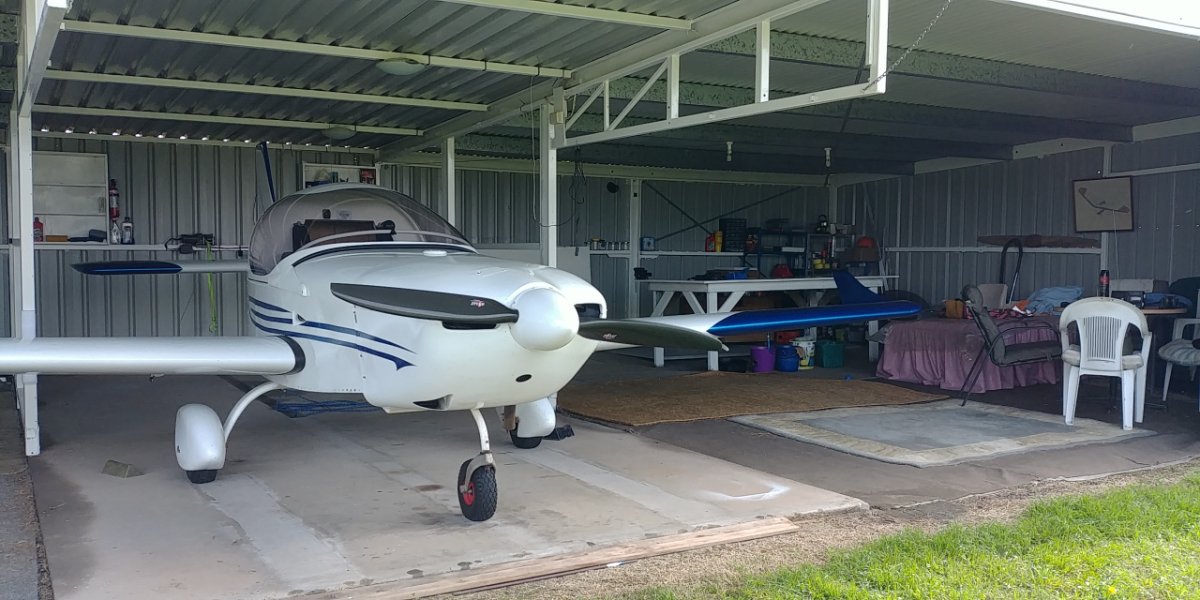
Show us your Hangar
in Just Landed - Welcome
Posted
The centre bit on the concrete was all that was left when I pulled the rest of this original T hangar down & made it full size, now with a 12.5 metre width and 7 metre depth. The steel from the original wing boxes was used for the external frame & C section purlins (unpainted) for the roof. Total cost was dilapidated T hangar 4K, purlins & house lot of hail dented colorbond, concrete footings, nuts, bolts, roof screws & welding rod, 1.5K so a complete hangar for 5.5K.