

Admin
-
Posts
9,322 -
Joined
-
Last visited
-
Days Won
110
Content Type
Profiles
Forums
Gallery
Downloads
Blogs
Events
Store
Aircraft
Resources
Tutorials
Articles
Classifieds
Movies
Books
Community Map
Quizzes
Videos Directory
Posts posted by Admin
-
-
Start Time: 15:00
Event: Airtourer Association Convention & AGM
Airfield: Cootamundra YCTM
Location: Cootamundra
Host: Airtourer Association Inc
-
The Flight Design CTsw is 49 inches wide and the Flight Design MC is 52 inches wide
-
Just to resurrect this thread and advise all users...the Recreational Flying (.com.au) site will be back very soon as the single login as mentioned in this thread:
http://www.recreationalflying.com/threads/recreational-flying.35214/
is now at beta 6 release as all the bugs are getting ironed out. There are 7 different website owners who have gone in together to pay for the application, and are all testing it across different combinations of sites, so if you are registered and logged in at any one of the sites, you are registered and logged in to all of them at the same time. Having separate registrations and logins at each of the sites was the biggest problem with this concept...so very soon now this will be so simple for everyone, allowing the site(s) to cater to all your needs by allowing you to simply choose what you want to use and what you are interested in. having all this available to you will provide and enormous "collective" growth of the sites to help you in your chosen areas of aviation and auxiliary subject matters.
If you know of any other web sites that you think may like to become a part of this huge "webring" of sites, then please let me know and i can approach them to be a part of it all OR if there is another subject that you feel you would like to have as another section (site) with your single login from here, also please let me know...Radio Controlled Aircraft, Airports, Commercial Aviation, Flight Tracking, Flight Booking even, dedicated Flight Sim site, Aviation Photography, etc etc etc
-
Over the last 12 months we have had a very rocky road here at Aircraft Pilots. For most of last year I was ill and unable to focus on the site with a clear head and make rational decisions.
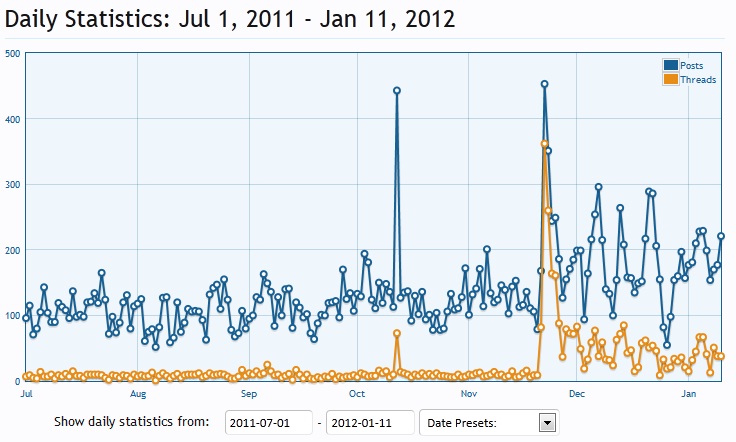
In October/November last year I had to make some very hard decisions for the betterment of the site and whilst some users were unhappy about that, I can now show you the figures that resulted from those unfortunate and undesirable actions:

In the above site statistics what can't be seen (it would look far too squashed up) is the forum's Threads and Posts had bottomed out at an extremely low level after earlier in the year being 2 to 3 times higher then what they ended up being from July to Nov. The site was going downhill and those hard decisions had to be made.
It took a month to stabilise the site from all the backlash that happened by a handful of users. I then began to manage the site like it was prior to my illness and you can see the results of that style of management that got the site going again.
Far more threads and posts began to occur meaning more variety of topics with more interest by users. From the end of Jan to now there has been slight growth but not as much as I would now like to see so I will be taking further steps, very slight ones, to stimulate that growth further to ensure the site provides you with an even greater amount of help and support in your flying endeavours and a greater enjoyment in your use of the site.
I want to stress that any changes now will only be slight, as I feel that perhaps all the sites changes of late have been a contributing factor in not achieving a higher rate of growth that I would have liked so any major change is "off" the table. You can be assured of a stable and resourceful site to meet your needs.
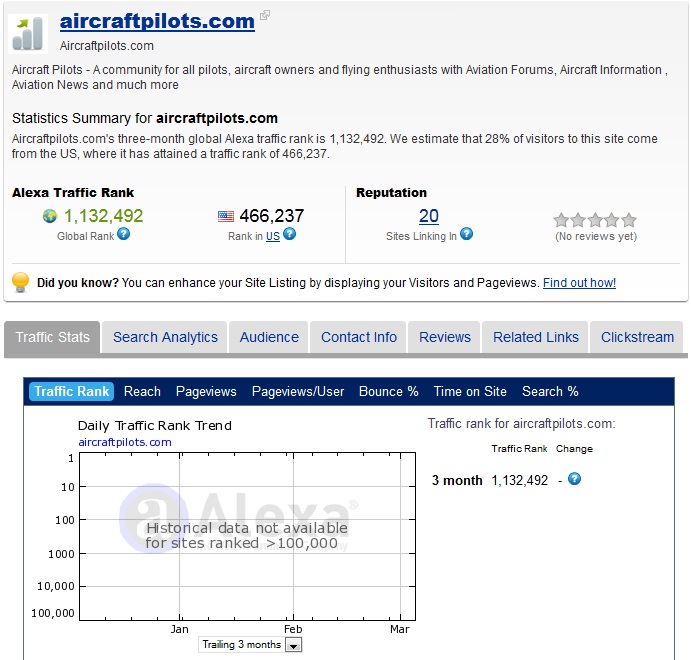
The other interesting thing is the impact on the site with the change from Recreational Flying to Aircraft Pilots. As Recreational Flying we achieved a world wide web site ranking of around 770,oooth. We lost that when we moved to Aircraft Pilots and had to start again which started us off at around the 10 millionth mark. I am happy to say that we have already, and extremely quickly, clawed our way back to the 1.1 millionth website in the world with the closest aviation website in the Southern Hemisphere being way back at 3.5 millionth (GA only site) and other recreational aviation websites either not ranking at all or 5 and 8 millionth. So Aircraft Pilots is still the number 1 aviation website in the Southern Hemisphere by a long shot and we are still climbing rapidly.
Another interesting thing is in changing our name we have literally screamed up the charts in the USA with now being the 466,000th website in the US and Aircraft Pilots, as such, has only been going for 1.5 months under that name. So we are making a huge impact in the area of aviation web sites.
We currently get around 300, and at times peaking at 450, registered users logging in every single day PLUS, we have around 2,000 "unique" guests visiting the site every single day, which going by the above independent chart, around 28% of those are from the US. We currently have around 8% of registered members from the US and a further 5% from other countries around the world, the remaining 87% of registered users are from Australia. So in essence we are maintaining the Australian flavour for you catering to the Australian aviator's needs whilst at the same time building up the International presence in a slow and managed way. No matter where we put our hat, we are all still aviators.
Some of those slight steps that I will be taking with the site soon will be targeting the conversion of visiting guests into registered users to hopefully further fuel the increase in growth for everyone to benefit from greater participation.
So there you have a current snapshot of the site figures. Unfortunately I know that the decisions that have to be made at times are not popular, often resulting in a severe dislike of this site and me personally, even to a point of some people's paranoia, but the figures don't lie and my focus has to be on making this site better and well managed for the majority of you and that's what I do. It's funny, even those that leave the site grumpy I see are still coming here almost every day anyway.
After all, if the site grows, more and more posts are made creating an enormous single repository of helpful information for all aviators, and someone posts something that saves the life of another user, even the grumpy ones...the job is done.
Thanks for listening and please, help this site to help others by posting as much as you can as you never know, your post, your experience, your mishap, your knowledge...just may help someone else and it is better to have it all in a single place for everyone.
-
 3
3
-
-
Brilliant Paul...Camden Haven airstrip is like silk...we had a Recreational Flying Flyin there a couple of years ago that was great fun...we must have another one
-
Update on this is the "Beta" version of the application was released today by the developer so the 7 of us site owners in the group will begin testing. It is hoped that within 2 weeks we should be in a position for the application to go final release so I can create the dedicated RAAus site with integrated login between this site and that one for everyone.
Note the RAAus site will only be for open, unbiased and unmoderated discussion on RAAus issues...a sideline, sister site for those users that wish to use it for such under the name of Recreational Flying (.com.au)
If anyone has an idea of a sister site, a specific non mainstream subject of aviation, please let me know as we are trying to accommodate everyone's wishes here at Aircraft Pilots. PLEASE always feel free to comment on what I can do to make the site better for you.
Meanwhile, I am very happy...in fact extremely happy with the way this site looks and feels now and really, I believe there is no reason for any major changes now...it has a great number of forums in their correct specific areas, there are all the different areas like all the aviation news from around the world, Photo Gallery, Video Library, Tutorials, Special Interest User Groups, Aircraft, Events, Resources etc that should fill the needs of everyone in those areas.
So, I suppose it is time to sit back for a while and enjoy the site...I know I finally am and I hope you all are as well...now I can get the wife off my back and focus on her Beauty Therapist site...now how do I entice all those girls to get involved
...anyway, hope Aircraft Pilots (.com) is helping you in some way and continues to do so for a very long time -
12.3 The standard circuit pattern
For at least the past 65 years, a standard procedure has been adopted for any piston-engine light aircraft approaching to land at a non-controlled public airfield. This procedure is called the standard circuit pattern and is adopted by convention rather than laid down by regulation. Following the pattern requires that an aircraft should track over at least three legs of a rectangular course aligned with the runway or landing strip that is most into-wind. Turns, once established within the circuit, will all be in the same direction, usually to the left unless terrain or ground habitation dictate otherwise. The downwind leg will be flown at moderate speed (adjusted to avoid overtaking preceding aircraft) and at a constant height — normally 1000 feet above the airfield level is recommended, but some primarily ultralight airfields may have a lower standard circuit height. And, of course, the aircraft must be operating in visual meteorological conditions [VMC] — clear of cloud and in sight of the ground at all times, if at or below 1000 feet agl. Check the visual meteorological conditions for aircraft operating under the visual flight rules.
Consistency
The height of the circuit is particularly important for ultralight pilots. Ultralight engines are not renowned for their reliability and the circuit height should be sufficient that, following power loss, an aircraft flying a reasonably tight circuit has every chance of gliding to a safe landing area on the airfield.
Pilots should adopt their own personal circuit procedures, to be used wherever possible; the principle being that consistency improves performance. Do not automatically apply the procedure utilised at a training airfield when operating elsewhere. The skills involved can only be assimilated by repeated practice at many airfields — not by reading books or web pages. Consistency is the key. Every circuit and landing should be performed to the best of the pilot's ability; such consistency makes the occasional difficult landing easy.
The diagram below (adapted from the Sydney Basin Visual Pilot Guide, courtesy of the Australian Civil Aviation Safety Authority's Aviation Safety Promotion program) demonstrates the full routine for a piston-engine aircraft inbound for landing at a public airfield.
The routine
1. The first stage is an overflight at a height not less than 1500 feet agl (preferably with Local QNH set, but if this is not obtainable, use Area QNH) to determine the airfield serviceability, the surface wind direction, the runway/strip being used by other traffic and confirmation of the circuit direction; or if no other traffic, to select the strip to be used. While in the circuit, keep monitoring the relative position and the movements of other traffic at all times. Note that the 'circuit area' is taken to cover the area within a radius of three nautical miles from the 'airfield reference point'. Assume that the latter is the runway intersection.
If the airfield is unfamiliar, the overflight also provides the opportunity to examine the circuit area for safe escape routes from each runway following a late go-around. Also check the area for suitable forced landing sites and associated hazards should the engine fail during a go-around or after take-off. See the Coping with Emergencies Guide.
2. The second stage is to manoeuvre so that a let-down from 1500 feet is commenced on the 'dead' side of the active runway, tracking close and parallel to that runway. This is the upwind or into-wind leg. The first and second stages provide the opportunity to carefully check the airfield area and boundaries for hazards — animals, power lines and other wires, ditches, obstructions, and to ascertain the whereabouts of other traffic in, or joining, the circuit and to be seen by them*. All manoeuvring should be done so that the airfield activities always remain in sight; i.e. don't turn away for a short time and then follow with a reversed turn onto downwind.
*The official term for this latter procedure is 'unalerted see and avoid', but it has its limitations. See the Australian Transport Safety Bureau research report 'Limitations of the see-and-avoid principle'. The report was first issued in 1991 when mid-air collisions in Australian general aviation averaged about one per year but collisions have increased slightly since then. Most — or nearly all — general and powered recreational aviation mid-airs occur in the circuit area, generally when one aircraft descends into another from behind.
3. When circuit height is reached and the upwind end of the runway has been passed, choose an appropriate position to turn onto the crosswind leg so that there will be no conflict with traffic on the crosswind and downwind legs, and to achieve optimum traffic spacing. You are now entering the traffic side of the circuit. Watch for aircraft joining the circuit on crosswind and for aircraft taking off; ensure that you provide adequate clearance. Maintain circuit height and, allowing for drift, track at 90° to the runway.
4. Turn 90° onto the downwind leg at an appropriate distance past the runway (after checking for aircraft joining the circuit on the downwind leg), check the crosswind drift against selected landmarks and adjust heading to track parallel to the runway, perform the appropriate downwind cockpit checks, and hold altitude and appropriate traffic spacing. Set power and trim the aircraft to maintain an airspeed that allows time to plan the landing without unnecessarily delaying other traffic — probably around 1.7 × Vso.
Note that although we call these legs 'upwind', 'crosswind' and 'downwind', they are only nominally named so, because the surface wind is unlikely to be exactly aligned with the 'into-wind' runway or a single airstrip, and the wind at circuit height might vary considerably from that at the surface.
5. Planning time! Pick an intended touchdown target on the airstrip. This should be far enough into the strip so that an undershoot on approach will still allow normal roundout and touchdown on the runway, or an overshoot on approach will still allow ample runway to bring the aircraft to a halt. For all ultralights and most light aircraft, the latter requirement is probably inconsequential for most runways at public aerodromes. A touchdown target maybe 400 feet from the threshold is about the norm; never target the beginning of the runway or strip for touchdown. Now choose another point, say 200 feet back from the touchdown target towards the threshold; this is the aiming point. Of course, it may be difficult to identify such positions at a featureless airstrip; also, the figures will vary according to the aircraft's drag characteristics in the landing configuration.
We are presuming here that we are operating at the average recreational aviation airfield where the strip length may be 2000–3000 feet. It can be a little embarrassing for the light aircraft pilot who touches down 400 feet past the threshold of a 6000 feet runway and then has to taxi a kilometre to the first exit. At a licensed aerodrome, the runway centre-lines are 100 feet [30 m] long with a 100 feet gap in between, and the 'piano keys' which normally mark the threshold are also 100 feet long. There should also be touchdown marks at 500 feet [150 m], 1000 feet [300 m] and 1500 feet [450 m].
6. At an appropriate distance past the aiming point, turn 90° onto the base leg, and hold airspeed but reduce power so that a descent is started during the turn. Lower the first stage of flap if so equipped. Reduce airspeed (but not less than 1.5 × Vso), and trim.
The time spent flying base leg is most important, as it provides the opportunity to: set up the aircraft in the approach attitude; establish a power and flap setting (and trim) for the required rate of descent; check for conflicting traffic both airborne and on the ground and particularly any traffic on a straight-in approach or very wide circuit; assess the crosswind component along the landing path; decide the touchdown technique appropriate for the conditions; and review the pre-landing checks.
Hold an accurate heading on base to carefully monitor drift, comparing the wind velocity at that height with the surface wind indicated by the windsock(s). A significant difference between the two indicates wind shear will be encountered during the final approach — this may erode the safety margin between the approach speed and Vso, or cause other difficulties. Never be tempted to fly a semi-circular base with a short final approach — it is very poor airmanship and negates all the safety check features of the square base leg.
It may be that preceding traffic conditions preclude a turn onto base at the optimum position — in which case you must reduce speed and/or extend the downwind leg further downwind; maintain altitude; and delay the start of descent, and some actions, until the aircraft is well into the base leg or even established on final approach.
7. Start a 90° descending turn onto the final approach so that, on completion of the turn, the aircraft is lined up with the extended notional centre(line) of the landing strip. During the turn, be aware of the reversal height phenomena and confine external scanning to the intended flight path and to the check for conflicting aerial traffic particularly ahead of and behind you. If satisfied with the initial approach, then lower full flap (if the wind speed is fairly high, then partial flap may suffice), adjust airspeed to the recommended final approach speed [Vref] and re-trim.
Once stabilised in the final approach, control the airspeed and the rate of descent with small movements of flight controls and throttle. The power setting should be such that it allows small power reductions, or power increases, in order to maintain the approach path. This can't be done if the approach is set up with the engine at idle power. In addition, the thrust response is not that effective from an idle setting and, for many aircraft, an approach at idle power will entail a high sink rate, which may be difficult to manage. Also, an idle power approach tends to over-cool the engine and may promote carburettor icing, both of which may result in high power not being available when needed — such as in a go-around.
8. Continue tracking down 'final', whilst correcting for the crosswind component, and watching the position and apparent movement* of the aiming point relative to the windscreen. Then at 50 feet or so, substantially reduce the rate of descent, reduce thrust to zero, touchdown and roll-out until it is safe to turn off the landing strip.
If so equipped, and in a nosewheel aircraft, brakes may be applied to slow the aircraft during the latter part of the roll-out — but only if the aircraft is moving in a straight line on a firm surface and the elevators are raised to keep excess weight off the nosewheel. In a tailwheel aircraft, be very wary of any brake application during the roll-out. The braking systems in ultralight aircraft are generally only provided for light use in ground manoeuvring.
* If the aiming point appears to be moving up the windscreen you are undershooting (too low) and will touch down before the target. If the aiming point appears to be moving down the screen you are overshooting (too high) and will touchdown past the target. If it appears to be motionless in the screen the approach slope is good and touchdown will be close to the target. The foregoing presumes that all of the runway is visible through the windscreen during the final approach. However, there are some aircraft where the forward visibility over the nose is inadequate at approach speeds and special techniques, such as side-slipping, may be required.
Variations on joining the circuit
The previous discussion outlined the full circuit pattern that should be adopted when inbound to an unfamiliar airfield. However, when inbound to a familiar airfield of which you are aware of the current runway in use and its serviceability, it may not be necessary to overfly the airfield, and the circuit may be joined anywhere on the green path; i.e. on the upwind, crosswind or downwind leg. Downwind joins are normally made at a 45° angle from outside the pattern. You should not join the standard circuit on base or final — the red shaded path in the diagram. When joining crosswind or downwind, you should already be at the circuit height.
Note that only the pattern of the standard circuit is fixed. Its dimensions; e.g. the length of the downwind leg or its distance from the runway, are variable. It is good practice to fly a nice, tight circuit. This also allows a forced landing to be accomplished safely on the airfield if power is lost.
However, for operational reasons, not all aircraft will fly a standard pattern or even base their circuit on the same runway. The turning radius of regular passenger transport [RPT] aircraft is too large to conduct the normal circuit pattern, so they perform either a 'circling approach' or a 'straight-in approach'; the latter being much safer for RPT aircraft. Agricultural aircraft reloading at a public airfield tend to use a runway and circuit pattern which best suits the job conditions.
CASA have produced two new (2010) advisory publications to support procedures and provide guidance on a code of conduct to allow greater flexibility for pilots when flying at, or in the vicinity of, 'non-towered' aerodromes; i.e. airfields in Class G airspace. These Civil Aviation Advisory Publications are: CAAP 166-1 'Operations in the vicinity of non-towered (non-controlled) aerodromes' and CAAP 166-2 'Pilots responsibility in collision avoidance in the vicinity of non-towered (non-controlled) aerodromes by 'see and avoid'.
Please read the combined CAAP 166-1/166-2 document. Note that the 'ultralight' term used in the CAAPs when recommending a 500 feet circuit height, refers only to those RA-Aus aircraft which have a normal cruising speed below 55 knots, or thereabouts.
CASA have also produced an online interactive learning tool titled 'Operations at, or in the vicinity of, non-towered (non-controlled) aerodromes' which is now available at casaelearning.com.au/M02/index.htm.
Source: http://www.recreationalflying.com/tutorials/groundschool/umodule12.html#landing_performance
-
An administrator or the event organizer has deleted this event from the system.
This thread has now been automatically locked.
-
Planning...fail to plan, plan to fail
From the outset even before turning final is when a good landing starts...in my humble opinion
-
Review on Avsim:
Contributing reviewer Luis Feliz-Tirado gives us his first impressions of Microsoft's Flight. "Flight Simulator is an excellent game where we all pretend to be pilots of different sorts, landing on dirt strips in Alaska, soaring high on a thermal, taking a chopper up for a spin, running an airline company, or flying the NAT according to the book. Flight is no more, nor less, a game than Flight Simulator X and has all the same hunts and hoops that are present in that game. And in the same way that many paid little or no attention to the game elements there, they will be able to do the same with Flight."
"Much has changed with Flight Simulator 11 (a.k.a. Flight) so let's take a look at some of the major differences. First of all, there are no jetliners, in fact, no jets of any sort. No helicopters, no sailplane, no Extra aerobatic airplane. No Cessna, no training syllabus, no Rod Machado jokes. No Artificial Intelligence (AI) aircraft traffic, no Air Traffic Control (ATC), no Flight Planner, and no Real Weather. No worldwide coverage with 24000+ airports. How's that for radical change? It's almost as if MGS had taken a close look at what we used and what we did not use and gave us a sim that reflected that."
"Some people had rejected Flight long before the RTW date and nothing will make them change their minds, at least at first. Experience has shown that many of them will sooner or later try it and switch, certainly as soon as DLC covering their area of interest is offered. Others, more open-minded, would like to give Flight a try; they look forward to it, but also do not yet see any content that could satisfy them. They shall just have to bide their time and wait for their wish to be released."
"MGS has clearly said that they want to attract a lot more people to Flight who would not normally have become users of FS. The content and format of Flight certainly are oriented in that sense. But they have also repeatedly stated that they will provide the same simulation experience for those long-time FS fans who expect a lot more content than is present in Flight. Let's see if we can take them at their word."
"It is normal to resist change, even when beneficial. This is a common human trait and the reaction to Flight was to be expected. But there really is no reason to despair. Flight is a very good base for a complete flight simulator. It seems to be relatively trouble-free, highly extensible, and holds a lot of promise."
-
WARNING...the download is 1.5gig in size. There are two parts to the download, first the installer at about 650kb, and then you click the installer file which will then download and install on your PC the remaining 1.5gig of data. I have super fast Optus Cable so I was getting around 9meg a second and only took a couple of minutes to completely download and install so it is obvious that the file is most probably accessed in your own country but even still, unless you have a decent internet connection it may take you some time to download and install.
Looks good though...as a game at this stage
-
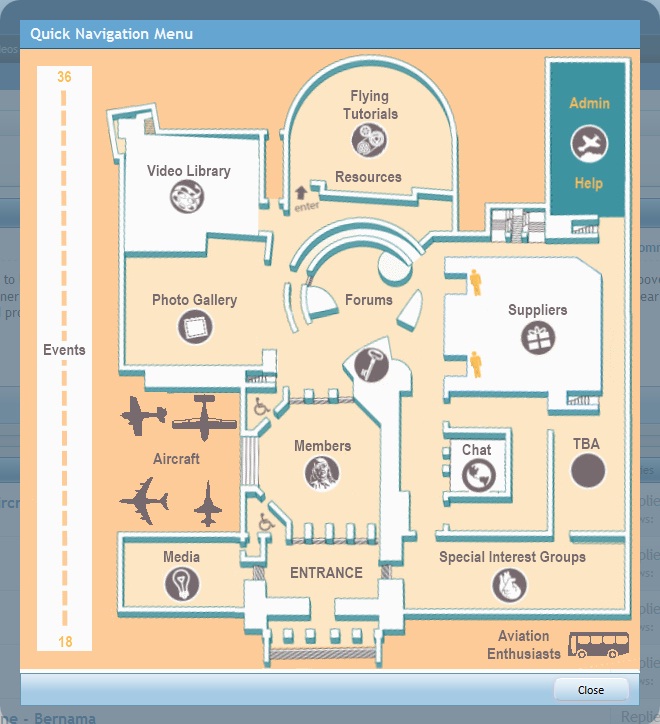
I know that no one really uses the "Quick Navigation" feature on the site so I thought I would dress it up for some fun.
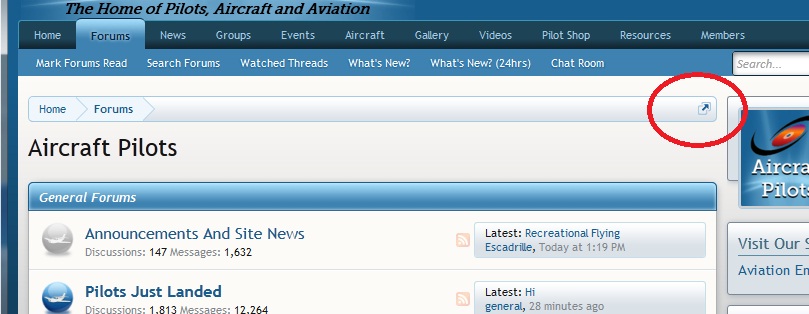
Now when you click the "Quick Navigation" arror at the right of the "Breadcrumb" that is on every single page of the site:
Displayed now is a Site Map of the site done out like an Air Show Plan...each area of the popup image is a clickable region that when clicked, the popup image closes and you are taken directly to that area of the site:
Just some fun...especially useful when at the bottom of a page instead of going back to the main menu...
(Note: The Suppliers Section as shown is coming)
-
1
-
-
Hi All
As you know a while ago we created another forum back under the Recreational Flying name to keep all RAAus specific discussions together and whilst they are a necessary part of our community, this way, they didn't distract the Aircraft Pilots site with such a large and specific topic.
The trial of that worked well but the biggest issue was that users had to have separate registrations and logins, one for Aircraft Pilots and one for Recreational Flying.
So before Recreational Flying (.com.au), with RAAus specific discussions, became too large where creating a single login across both sites became an issue, I pulled the Recreational Flying site. I immediately, together with several other owners of websites that use the same software as us, engaged a developer to create a SSO (Single Sign On) piece of code that will enable your registrations and logins to be just one across several websites.
It is costing us, as a group, just under $2,000 and uses a technology called OpenID which will allow you to register on any of our sites and your registration is current across all of them. Also when you login to just one of the sites, or logout of one, you are logged in or out of all of them...it makes it all so simple and easy for you as a user.
The project code is now almost at testing stage and will be tested by everyone in the group on all their sites. Once testing is completed and all proven to have absolutely no negative impacts, only positive ones for users, we will be resurrecting Recreational Flying (.com.au) as a specific unbiased, unmoderated resource for all discussions specific to RAAus.
You will be able to openly debate anything about RAAus specifically without any ramifications or impacts on Aircraft Pilots. Your site registration and logins will automatically be across all sites and you can even have different usernames on the different sites.
The other sister site Aviation Enthusiasts has not been touched for this same reason as it is using the old vBulletin software. Once the Single Sign On application is implemented here and on Recreational Flying (.com.au), Aviation Enthusiasts will start using the same software we use here on Aircraft Pilots and will be using on Recreational Flying so it too will come under the Single Sign On umbrella.
The end result will be, for the user, what will just look like a HUGE Website that is catering to all the different needs of its users...users will just simply click a menu item on each site to go to each area and they will already be registered and logged in...the only thing that will be different is the name in the header.
This is going to be great in being able to provide you with such a diverse range of aviation interests to suit YOUR range of needs...Recreational Flying (for Australian RAAus), Aircraft Pilots (the main "Aircraft Pilot's" resource and pilot forums site which will also include what will be like a 24/7 Air Show as well), Aviation Enthusiasts (emphasise on Commercial, Spotting, Photos etc) and in time what ever you would like to have in the group to suit your needs...maybe Radio Controlled Aircraft Site...maybe a Commercial Pilots Site...maybe we buy a large dedicated Aircraft Building website and add that to the Single Sign On group...giving YOU the freedom of choice on what YOU want to be involved in
Oh, don't forget the Groups Section we have here where you can even start your own specific interest group or an Aircraft Pilots Chapter and yesterday I began discussions with a person to start the research on the possibility of having a monthly Newsletter/Magazine sent out electronically free to all registered users...there are a lot of things happening behind the scenes here in creating an incredible and vast resource of everything aviation for you...hope you enjoy and benefit from even just some little part of it all...thanks for reading
-
1
-
-
Underpaid overworked website administrator
-
1
-
-
Maj, just ignore the comments about the hair mate...I thought I would do the right thing and support the wife while she was doing her advanced training in her diploma of beauty therapy - as one would normally do BUT BUT BUT it isn't suppose to be this painful.
Corrine was doing the advanced waxing module and you guessed it - I had to be the model.
Nothing to it I thought - a little bit of pain waxing a couple of hairs off the back but little did I know it was to be a full stomach, chest and back wax with Corrine and another girl going for it standing each side of me - it was a yank...YELL...
...yank...YELL... ...yank etc etc like a flamin production line.May I suggest that if you are ever asked to be a model for waxing then start running the other way FAST
-
1
-
-
February 2012
From the Director of Aviation Safety
John McCormick
For some years people across the aviation industry have been calling on CASA to provide greater consistency in decision making and standardisation in the way we deal with individuals and organisations. Over recent years I believe CASA has made important progress in addressing these issues. For a start, we recognised the problem and committed ourselves to finding solutions. A lot of work has already been undertaken to improve the delivery of regulatory services, with the creation of a service centre and the standardisation of processes and procedures. I know further improvements can be made in regulatory service delivery and I can assure everyone we are working to do even better. In more recent times we have turned our attention to improving the way CASA conducts safety surveillance of the aviation industry. Surveillance is one of CASA's obligations, both under the Civil Aviation Act and Australia's State Safety program. I believe it is imperative that CASA adopts a standardised approach to surveillance planning and the conduct of surveillance across both air transport and general aviation operations.
To achieve this CASA is now introducing a new organisational structure in all of our regional offices. This new way of operating is known as the certificate management team approach. It will be put in place in our six regional offices – North Queensland, Eastern, Sydney, Southern, Central and Western. The certificate management team approach creates multi-disciplinary teams in each office made up of flying operations, airworthiness and aerodromes inspectors, as well as safety systems specialists. In some offices there are also cabin safety and ground operations inspectors. Each team has a group of air operator's certificates and certificate of approval holders to oversight. This new way of working better manages resources and ensures surveillance tasks are prioritised. It moves CASA closer towards risk-based surveillance and minimises the old fashioned divide within CASA between air transport and general aviation. There will be nationally standardised planning processes behind the new approach and an enhanced support network for decision making. I am confident the changes will deliver more consistent decision making, which will be of direct benefit to the aviation industry.
Best regards
John F McCormick
Making regulatory breaches clearer
The purpose of one of CASA's key regulatory tools is being made clearer. Currently, CASA issues a notice known as a Request for Corrective Action where it believes there may be a breach of the regulations. These can be issued to air operators, aerodrome operators, maintenance organisations or other holders of permissions from CASA. From 16 April 2012, the name of this regulatory tool will be changed to Non-Compliance Notice. The new name more accurately reflects the purpose of the notice - to tell someone they or their organisation may not be compliant with the regulations and they need to take action to correct the situation. According to Terry Farquharson, CASA's deputy Director of Aviation Safety, the change will make it very clear that anyone being issued a Non Compliance Notice must treat it as a high priority. "With the current Request for Corrective Action, it almost sounds like people have a choice about whether or not they comply with the notice, as requests are normally something one may decline. CASA wants to make sure everyone realises these notices mean that CASA believes there may be a breach of the regulations and there is a need to take corrective action as a priority. These are critical safety matters and they are critical to regulatory compliance. What is important to remember is that this is a name change only. It does not affect the way that CASA's surveillance activities and audits are conducted, and it doesn't change what the notices were always intended to be." Non-Compliance Notices will advise recipients to take appropriate action to bring them back into compliance, examine the underlying reasons why the identified breach occurred and take appropriate steps to rectify those underlying deficiencies.
You can email for more information on Non-Compliance Notices to [email protected].
Tell us your maintenance training needs
People across the aviation maintenance industry are being asked to tell CASA about their training needs. CASA is planning a series of new training courses on the maintenance regulations and is looking at other maintenance related training. A short survey has been posted to the CASA web site to gather vital information from people in the maintenance sector on these training proposals. CASA is urging everyone involved in maintenance to have their say before the end of March 2012. The proposed training courses on the new maintenance regulations will be aimed at people working in maintenance organisations that maintain regular public transport aircraft or components, as well as people working in the continuing airworthiness management areas in regular public transport air operators. The new rules require key personnel working in these areas to have the right knowledge, skills and experience. Both managers and employees need to understand their obligations under the regulations and organisations must demonstrate compliance.
The survey asks if people want training on the new maintenance regulations, details about the organisation they work for and their location. CASA is also seeking information on the numbers of people who might take part in training and which areas of the regulations they are most interested in. This will help in the planning and scheduling of the proposed training. The survey also asks about other maintenance related training people might like to receive from CASA. People can nominate topics or choose from a list which includes ageing aircraft structure, safety management systems, accountable manager courses, maintenance reliability programs and airworthiness directives.
Find the survey and fill out the form now.
Change to payments for pilot medicals
A change is being made to the payment process for pilot medical certificates. As of Monday 19 March 2012, CASA will no longer accept payments over the telephone for medicals. Instead, pilots will need to complete a payment slip, which will be attached to the medical application form. The documentation can then be lodged by email, fax or mail. Payment can be made by credit card or cheque. The new system ensures greater accuracy as the payment is directly linked to the medical certificate application form. Designated aviation medical examiners will give pilots the payment slip, along with the application form. Medicals have been the last regulatory service payment that CASA has accepted over the telephone, so the change brings these payments into line with all others.
The payment slip will need to be sent to one of these addresses:
Fax 02 6217 1640, email [email protected] or mail Aviation Medicine, CASA, GPO Box 1544, Canberra, ACT 2601, Australia.
Piston engine overhaul requirements in spotlight
Issues relating to piston engine airworthiness are under review. CASA has set up a project to look at the engineering assumptions and conditions that allow piston engines to run beyond a manufacturers recommended overhaul period. This is done by following the requirements set out in an airworthiness directive - Piston Engine Continuing Airworthiness Requirements. An assessment by CASA of the latest amendment of the airworthiness directive shows some of the original engineering assumptions on which the directive is based are no longer valid. A number of these engineering assumptions date back to the 1940s. The assessment was carried out in the light of 20 years of data from service difficulty reports, as well as an Australian Transport Safety Bureau report on aircraft engine failures. There have been 11 amendments made to the airworthiness directive since it was first published to clarify CASA's policy on piston engine flight and calendar time between overhauls. The project reviewing these issues will ensure new requirements clearly set out CASA’s position on piston engine overhauls. It will also look at where these requirements should be located as it is no longer appropriate to set them out in an airworthiness directive. A better location for the requirements may be in the manual of standards for Civil Aviation Safety Regulation Part 90. These are the rules covering additional airworthiness requirements.
Find out more about the piston engine overhaul project.
Pilots - time to get to a safety seminar
The 2012 program of AvSafety seminars for pilots is underway. Already 50 seminars have been scheduled for the first half of the year, with ten being held in March. Seminars in March will take place in regional towns and cities in NSW, Queensland, Victoria and Western Australia. Registration for the popular and valuable seminars is now a simple and quick process done on the CASA web site. Online booking makes it easier for the aero and flying clubs that host most seminars. In 2012 the seminars will mainly focus on two key topics - human factors in aviation and aviation resources on the internet. The human factors presentation and discussion explains how an understanding of human performance is important to the safety of all aspects of aviation operations. It is based on CASA's publication Safety Behaviours - Human Factors for Pilots. This publication is specially designed for general aviation pilots and looks at areas such as fatigue, stress, alcohol and other drugs, decision making and airmanship. The presentation shows how to apply the knowledge of human factors in a practical way to everyday flying. During the presentation on aviation resources on the internet, there will be a focus on where to find the official information pilots need. A step through of web sites including CASA, Airservices Australia, Bureau of Meteorology and Australian Transport Safety Bureau will be undertaken. Detailed explanations will be provided on how to find training materials, information, advice and regulations, as well as how to lodge reports and forms.
Find your nearest AvSafety seminar and book now.
Action to stop control cable corrosion dangers
Action to deal with the problems caused by corrosion in flight control cable terminals is being stepped up. CASA has established a project to legislate for the replacement of control cables that use certain stainless steel terminals. An amendment is proposed to the manual of standards for Civil Aviation Safety Regulations Part 90. This Part sets out the additional airworthiness requirements for aircraft, supplementing design and type certification standards. It is proposed that control cables using terminals made from SAE-AISI 303 Se stainless steel be replaced before reaching 15 years calendar time. This is necessary as CASA has received a number of service difficulty reports from aircraft operators about control cable terminal corrosion. Terminals can be close to failing with no visible corrosion evident, meaning visual inspections are not adequate. A failure of flight control cable terminals can result in the loss of an aircraft in some circumstances. CASA has already issued an airworthiness bulletin urging aircraft operators and maintainers to replace the cable terminals before 15 years of age. This will be superseded by the requirements proposed in the Part 90 manual of standards.
Find out more about the stainless steel cable terminal project.
Read the current airworthiness bulletin.
Cessna nose wheel forks may be at risk
Operators and maintainers of Cessna 100 and 200 series aeroplanes have been warned of the continuing risk of fatigue cracking in nose wheel forks. In some cases this can lead to the failure of the nose wheel fork. CASA has issued the warning in a new airworthiness bulletin. The problem with nose wheel fork cracking in Cessna 150 through to 210 models was identified in the early 1970s. Cessna has addressed the issue since then by producing improved fork designs, however, reports of cracks and failures persist. CASA is using the new airworthiness bulletin to draw attention to advice first published in 1971, which is still relevant, about the issue. That advice said most of the cracks are very small and "tight". Where nose wheel forks have failed the cracks have been present for some time. Most cracks start in the lower machined area which accommodates the attachment bolt and they progress fore and aft. There have been isolated cases of cracks running vertically from the bolt hole. A Cessna service letter (63-31) agrees with this advice and contains useful inspection information. While the service letter is only applicable to certain early part number forks, the information can also be used to detect cracks in later design nose wheel forks. CASA recommends Cessna 100 and 200 series operators and maintainers consider the airworthiness bulletin when planning maintenance inspections.
Read the full Cessna 100 and 200 series airworthiness bulletin.
Sunshine Coast is now OnTrack
The on-line help available to general aviation pilots operating in and around controlled airspace has been expanded. CASA's interactive on-line tool - known as OnTrack – now covers the Sunshine Coast aerodrome. This means OnTrack is available for ten class D aerodromes. The other locations covered are Archerfield, Bankstown, Camden, Cairns, Cambridge, Jandakot, Launceston, Moorabbin and Parafield. OnTrack includes explanations of class D procedures, demonstrations on how to avoid airspace infringements and multimedia displays on how to fly the inbound and outbound tracks at the aerodromes. For the Sunshine Coast six inbound tracks and two outbound tracks are displayed. The displays feature photographs of key points along the tracks to make it easy for pilots to recognise their position by landmarks and geographic features. OnTrack is a practical tool for flight preparation and must be used in conjunction with thorough route planning and the checking of ERSA, NOTAMs and the weather. More locations will soon be covered by OnTrack, with Darwin and Alice Springs to be released soon.
Visit OnTrack now and check out information on ten class D aerodromes.
You can also provide valuable feedback to improve OnTrack.
New advice on hazardous material handling
New advice is now available to aerodrome operators on the handling of hazardous materials. The advice from CASA covers explosives, flammable liquids and solids, corrosive liquids, compressed gases and magnetised or radioactive materials. In an advisory circular there is information on the rules covering hazardous materials, what needs to be included in the aerodrome manual, procedures for handling hazardous materials and the rating of explosives. Whether an aerodrome accepts aircraft laden with hazardous materials is a matter for the aerodrome operator to determine. Where they are accepted it is recommended aerodrome operators provide an isolated parking position for aircraft needing to load or unload hazardous materials. The aerodrome manual should include information on any special procedures for aircraft carrying hazardous materials, detail the maximum quantity permitted on the aerodrome and set out the times aircraft with hazardous materials may or may not be able to use the aerodrome. The advisory circular says the aerodrome operator has a responsibility to ensure appropriate procedures are in place to protect other aerodrome users in the event of an accident, detonation, spill or exposure.
Read the hazardous materials aerodrome advisory.
Call for more traffic coverage in WA airspace
A review of the airspace covering south-west Western Australia has found a desire amongst airspace users for increased air traffic surveillance. The review was carried out by CASA's Office of Airspace Regulation as part of its ongoing program of airspace studies. The airspace examined is known as the regional services (south west) group, which covers 170,000 square nautical miles and includes aerodromes such as Albany, Bunbury, Busselton, Geraldton and Golden Grove. It does not include airspace within 36 nautical miles of Perth aerodrome. The airspace is made up of classes A, C, E and G, with control area steps in the area of Perth. Aircraft surveillance is carried out using radar and automatic dependant surveillance – broadcast (ADS-B). One issue identified by the review was the increase in air traffic to remote mining areas where there is no radar coverage. The review says efficient aircraft surveillance in these areas will depend on the fitting of ADS-B OUT equipment to aircraft. CASA has published a notice of proposed rule making on the mandatory carriage of ADS-B equipment by instrument flight rules capable aircraft which includes a specific requirement for this region. The proposal would cover instrument flight rules aircraft operating in controlled airspace within 500 nautical miles to the north and east of Perth, starting from 2016.
Read the south west group airspace review.
Air operator's survey now underway
The latest air operator certificate holder safety questionnaire is now underway. For the past four years air operators have been surveyed to ensure CASA holds accurate and up-to-date operational information on the aviation industry. The survey being conducted in 2012 includes all operators who hold an air operator’s certificate. CASA anticipates the survey should take air operators who have maintained ongoing data of their activities approximately 30 minutes to complete, although this will depend on the size of the company and the complexity of the operations conducted. The questionnaire asks for information about operations between 1 January 2011 and 31 December 2011. Information is also required on each aircraft operated under the air operator's certificate, including hours flown, number of landings, passengers carried by operation type. Information is also sought on staff numbers and safety management practices for each air operator.
An email and letter has been sent to all air operators with a link to the questionnaire. Operators have until Thursday 1 March 2012 to complete the survey. If air operators have not yet received this information from CASA about the survey they are asked to contact Julie Codyre on 131 757, extension 1841, or email [email protected].
-
Well done Bigfella...the great journey begins...enjoy!
-
Update...just in case there are users out there whose English is their 2nd language, I have added a "Translate" tool to the Aircraft Pilots Socialise System. You can now view the site in any one of many different languages that I hope you may find useful if you need it.
Simply click "Translate" in the Socialise menu and select your preferred language. The site will automatically in a few seconds be translated to your selected language.
Hope this helps!
-
Sorry, my mistake...it all worked for Registered Users in my development environment but when I transferred it to the live environment (the site) I forgot to turn the permissions on for Registered Users...all fixed nowsadly i don't have permission to customise my homepage.Maj, I may have just found a Google map app that will allow the pinpointing of 2 locations on a Google Map (and thus Google Satellite and Google Earth views) that I might have a play around with and check out its suitability for what you need. If I can add it I might add it to the Distance Calculator Widget so you have 2 choices...Airport to Airport (text popup) and Location to Location (Google Map etc view)...crikey, is there no pleasing some people
-
No, unfortunately the database is based on Airport Designators...an update I might do later could be along those lines but I would have to find a different database that has every single place name in the world in it...at least there are fewer airports then place names in the world...perhaps Google Maps might have some functionality that I can tap into to do this...hmmm, when I have a spare moment
-
http://www.recreationalflying.com/threads/home-page-update.34851/ok, stupid question following, how do you add widgets? -
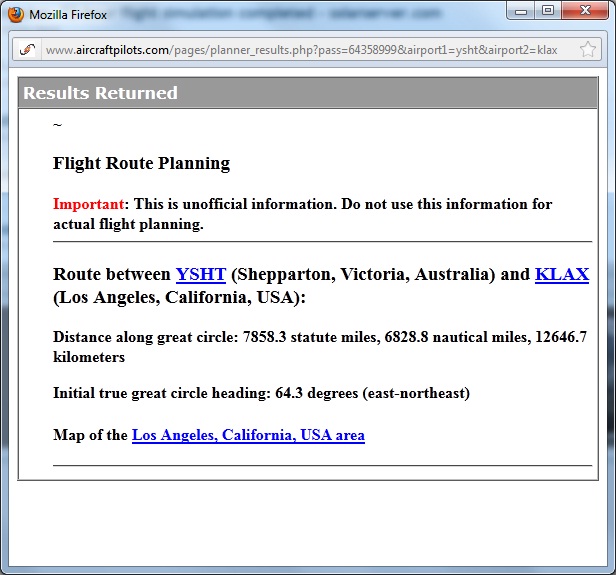
It is World Wide Airfields...you just need to put their unique identifiers in...you could put YSHT (Shepparton) to KLAX (Los Angeles) and you get:
Should be 1 or 2 fuel tanks in that but at least I know the heading
-
I can set the gadget to be more accurate if that is what people want but it could be "too" accurate...I could use a small version of the software that the site actually users but that will upset a lot of people as it is too accurate...I will have a look at what I can do to make it a bit more accurate without giving away user's privacy
-
1
-
-
That is because of the way you have set your PC up...you know that I know that is the case, so it doesn't help you, and all the other users on the site, when things like this are donefunny, he started chatting to me as well because he thought I was in the US.

 ...anyway, hope Aircraft Pilots (.com) is helping you in some way and continues to do so for a very long time

 ...yank...YELL...

[Fri 16th Mar 2012] Autumn Fly-in and AGM
in Trips/Events/Seats
Posted
Start Time: 08:00
Event: Autumn Fly-in
Cost: T B A
Airfield: Flinders Island YFLI
Location: Flinders Island
Host: Cessna 182 Association of Australia
Contact: Peter Jones
Phone (BH): 02 9904-4136