danny_galaga
-
Posts
2,141 -
Joined
-
Last visited
-
Days Won
24
Content Type
Profiles
Forums
Gallery
Downloads
Blogs
Events
Store
Aircraft
Resources
Tutorials
Articles
Classifieds
Movies
Books
Community Map
Quizzes
Videos Directory
Everything posted by danny_galaga
-
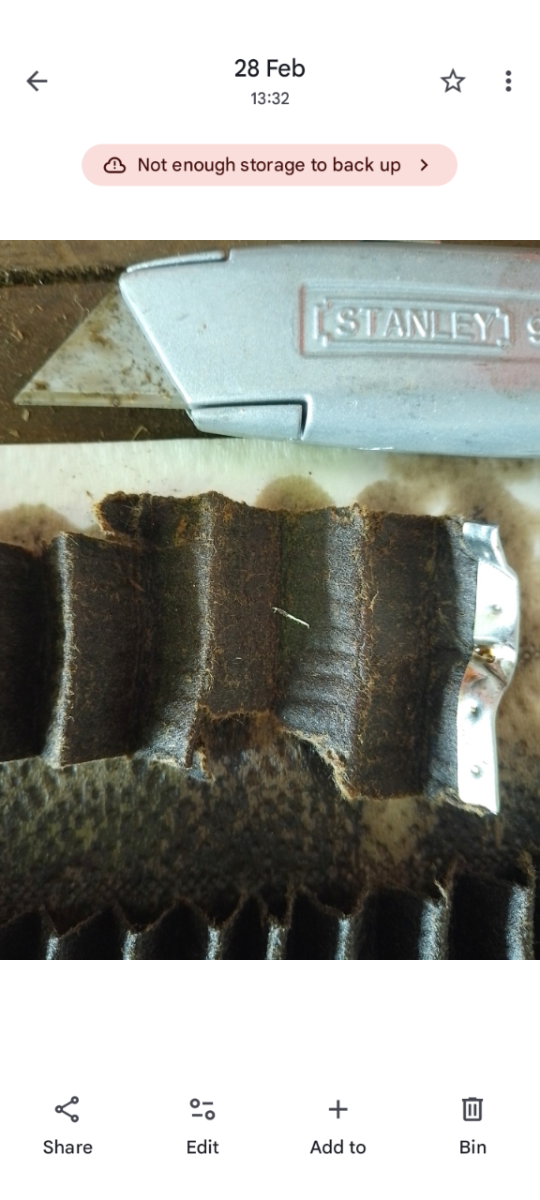
In that photo is a sliver of something non ferrous, probably 6-7mm long. There were maybe 3 slivers of roughly similar dimensions.
-
Oh oh 😟

-
It takes a LOT to totally block an oil filter. And the oil itself, it was always pretty fresh, since I had to keep topping em up all the time. My worst was a Mustang I drove from Vancouver BC to Phoenix AZ. I could only buy 1 litre bottles of oil at the time. So I bought four and pretty much used them up in two weeks 😄
-
Yes, there is a reason I'm doing this, as you would note from the oil filter cutter thread ☺️ Mind you, when I drove old clunkers, I used to change the filter every second oil change. And air filter? The engines still running , isn't it? I just didn't worry on a five hundred dollar car 😄
-
I was going to do an oil change this weekend, but realised I don't have a new crush washer for the oil tank, which it's recommended to change. I have a feeling my oil tank just has a copper washer, but I could be misremembering it. What are people's experiences here? Can a copper washer be substituted? If I need the crush washer, where are people buying them from?
-
 Thanks, that's what I thought. My brain can be quite literal so when I see contradictory info, I have a SYNTAX ERROR 😄
- 4 replies
-
- 2
-

-
- aerial ground
- plane
- (and 2 more)
-
I was assuming so, but further down in the speil it has 'general information about aerials'. Is that just filler for the page and not applicable to this set up? https://www.flightstore.com.au/airband-vhf-airkit-fibreglass-antenna-118.00-to-136.00-mhz-for-lsa-microlight-aircraft
- 4 replies
-
- 1
-
-
- aerial ground
- plane
- (and 2 more)
-
Motor has 1850 hours now. So not anticipating 'new engine' problems. Also, dry sump so not sure what the next step will be if there's large particles in the oil. But have a good workshop at the airfield to pick their brains or more likely if something serious, hand it over to them.
-
Living longer is a holistic thing. From running water to MRI scanners to vaccines to safety helmets. We all die eventually. I don't want to live forever, but I'd rather die at 85 nowadays because of some strange illness caused by microplastics or something, than 200 years ago at 35 from dysentery, or cutting my finger. And that after living slightly better than an animal my whole life.
-
On the subject of that video, I'm a bad one for not wearing gloves. Never used to, even washed parts in petrol as an apprentice. It's a bad habit now that I know better. I figure it's safer than smoking though 😊
-
What are you talking about? People have never lived longer than they do today. Even in 3rd world countries. And people died of all the things we imagine are modern, just that no one had described it yet. Go back 150 years, and if you died of something unknown, there just called it epilepsy and moved on. But it was probably lung cancer, or lead poisoning, or leukaemia or even just a small infected wound that no one noticed. Go back 1000 years and Europeans didn't even name their children until they were about five because they were probably going to die anyway. I feel the most massive thread drift coming on 😄
-
I never heard of such a thing until I started building my plane. The video is from a race car mechanic so I guess popular in those circles, as well as aircraft.
-
I didn't notice what one he had to be honest. The one I ordered has a circular blade
-
SS into Aluminium & SS into SS
danny_galaga replied to skippydiesel's topic in AUS/NZ General Discussion
-
My second question is answered on the FAQ 😄 Q: Will the ACS oil can cutter cut Rotax filters? Yes, it will cut Rotax oil filters.
-
Is this one ok? I anticipate using it once a year. And I assume it will work on a Rotax 912 filter? I don't have a filter onhand but from memory the Rotax is less than 5" https://www.aircraftspruce.com.au/catalog/topages/acsoilcancutter.php#
-
SS into Aluminium & SS into SS
danny_galaga replied to skippydiesel's topic in AUS/NZ General Discussion
I have no idea what this means. However, the saying "A night with Venus, a lifetime with Mercury" comes to mind 🙂 -
SS into Aluminium & SS into SS
danny_galaga replied to skippydiesel's topic in AUS/NZ General Discussion
Better than brass 🙂 -
Zonsen Aero Engines - Rapture Aviation (Adelaide)
danny_galaga replied to Rapture's topic in AUS/NZ General Discussion
True. I personally wouldn't be comfortable with aluminium cabling. Mainly where lugs are connected to the cable. As per the other thread, I think we both agree there's a lot of chance of electrolysis if moist. Then again, I vaguely recall the Piper warrior having aluminium cable, and I haven't heard of problems with it. On aluminium cabling, my American friends tell me it was popular in housing years ago, and still a big cause of house fires. -
So when I built my plane I used a dipole because it was neat and I didn't have to put a hole in my fuselage. But the radio hasn't been great. In desperation I ended up putting a hole in the fuselage anyway to make the dipole more upright. So two questions I guess. Would a regular aerial normally work better than a dipole? And what area do I make the ground plane?
-
SS into Aluminium & SS into SS
danny_galaga replied to skippydiesel's topic in AUS/NZ General Discussion
When I was a first year apprentice I went out with a 3rd year apprentice to fit some cabling to an aluminium hulled boat. He used brass bolts! I probably wouldn't have known better. The owner did and made us come out and replace them all with stainless steel. I got curious and at home I made a battery from some scrap Ali and copper coins with salt water for the electrolyte. From memory each cell produced 0.5 volts, which is pretty significant. Those junctions would have corroded in no time 😲 -
Zonsen Aero Engines - Rapture Aviation (Adelaide)
danny_galaga replied to Rapture's topic in AUS/NZ General Discussion
Totally agree and I see this on Zenith 701s. The only drawback is you have to add more weight in the form of thicker and longer battery cable. But better that than just adding lead or something useless. -
Tell us about your first solo
danny_galaga replied to Admin's topic in Student Pilot & Further Learning
Can't we all just be friends? 😇 -
Tell us about your first solo
danny_galaga replied to Admin's topic in Student Pilot & Further Learning
You need to be on the paperwork as a builder..not sure if someone is going to put you on there just because you handed them a spanner. As well, since in reality your friend built it, if he royally screwed up and it crashes, although really you didn't have anything to do with it, now you are legally liable.