


Oscar
-
Posts
2,485 -
Joined
-
Last visited
-
Days Won
67
Content Type
Profiles
Forums
Gallery
Downloads
Blogs
Events
Store
Aircraft
Resources
Tutorials
Articles
Classifieds
Movies
Books
Community Map
Quizzes
Videos Directory
Posts posted by Oscar
-
-
I doubt there is a more respected Jabiru engine maintainer/re-builder than Keith Rule, anywhere. All of his comments are cogent and relevant, and they reflect the opinion of other maintenance organisations I have experienced. That Jabiru's typical response to reports from people whose opinions they should respect is fundamentally denial, is indisputable - though it has to be accepted that Jabiru are not always automatically WRONG.Watch Keith's comment re Jabiru https://m.youtube.com/channel/UC9uoVIUeTwNC6FiD4_QIzQA/videos.He sums it up very well.
The nature of an engine is that it is a system of components; the nature of that system is that the root cause of a problem is not always apparent from the failure of a component. To go back to the simplistic 'weak link in the chain' examination of a failure of a system to deliver required results: simply strengthening the 'weak link' will not solve the problems of the system if the system is fundamentally flawed for delivery of the required results. It will - at best - expose another 'weak link', etc. etc.
What is required is an expert analysis of the 'task' for the system and the design of the system to meet - in every aspect, from beginning to end - that task. There is NO 'silver bullet' fix that will miraculously solve the problems that are experienced in Jabiru engines, because the target is not singular, it is systemic. We have seen passionate arguments that 'the problem' is the orientation of the pistons, the use of hydraulic lifters, the size of the through-bolts, the through-bolt nuts, side-loading on the valve stems, the flywheel bolts, the barrel lining material, the type of valve guide - and a number of others. All of these have some validity when looked at in a system perspective. We have even had a persistent hypothesis expressed that the material and manufacturing process for the crankcase is the root cause, which at least has been thigh-slapping comic relief for anybody with even the most rudimentary understanding of metallurgy and machining processes.
That neither CASA nor RAA have gone beyond the use of dubious (and unrevealed) 'statistics' of end results, is incredible in the context of actually trying to improve safety. Yes, the RAA response in the referenced video that it is 'not an engineering organisation' is fair - but CASA IS 'an engineering organisation'. Within 'Airworthiness' branch, there is a unit dedicated to 'powerplants' - and though it has to be conceded that industry sources who have to deal with them will tell you that they could not find their gluteus maximus even with the assistance of a GPS and a call to a friend, they ought to be able to evaluate basic engineering problems, at least if assisted by competent advisors.
And a 'competent advisor' is available: the manufacturer of the major componentry of the Jabiru engine itself. Even a half-ar%ed engineering graduate should be able to recognise if the information he or she is being presented with is believable, and therefore follow that information to its conclusion. The conclusion will be, self-evidently, changes to componentry / processes that actually remove critical points of failure.
Simply slapping on restrictions that mitigate the potential (the actual harmful effects of Jabiru engine problems in regard to fatalities/injuries to the users or the general public is extremely low) results of problems is NOT a solution to the problems - it is a prophylactic. If CASA were genuinely concerned with improving the potential safety of Jabiru engines, it would be looking at the root causes of the problems and requiring appropriate remedies.
That CASA has entirely abrogated its responsibility to improve safety through positive action and has instead resorted to limitation of the potential results of problems by placing damaging restrictions on all Jabiru engine operators is entirely indicative of CASA's priorities.
CASA's catch-tag of 'Safe Skies for All', has become in reality, 'Safe Front Page News for Us'. Recreational Aviation is collateral damage of that change; with Jabiru being 1/3rd of the RA fleet , a significant area of concern for CASA has been neutered. For those who may think this is a good and just thing, you may pause to reflect: who is next..?
-
 3
3
-
-
Bolding - mine.Thanks for a mostly nice post Oscar.2/ I have pulled every cent from my own pocket to take it this far and have not taken a cent from anyone else nor have I ever asked, so it all rates as rather harmless, and had it not been for an unforseen massive blow elsewhere (not related to anything of mine in the least), I would likely been in market by now.I absolutely acknowledge that - and salute you for it, too many try to pre-sell their 'miracle' while the dove is still in the egg, as it were. My main point is: the experience of those who do have an engine in the marketplace is that it never, never, turns out to be as quick, simple, or cheap as they had anticipated; you cannot have failed to notice that UL Power and D-motor are generally more expensive than Jabirus and neither have the certified/ certificated status of (various models of) Jabiru or Rotax engines. I sincerely suggest, that situation is not a result of them being unwilling to try to be more price/performance competitive than the established market, but a reflection on the realities of development cost and complexity.
-
 1
1
-
-
Engine development is a long, tedious, and oftimes fraught path. I know this from first-hand experience, having been deeply involved in the development - to initial running stage - of a two-cylinder, opposed piston 2-stroke diesel aero engine intended to directly replace the Jabiru 2200 (initially) in drones, done at and with the solid support of a significant manufacturing facility owned by someone with an established record of delivering an aero-engine development that has sold many thousands of engines world-wide. The prototype sits forlornly in a family member's shed; still a viable proposition but the funding ran out. I will say no more about its development other than to state that during the building phase, I became addicted to Bundaberg prawns..
Only a handful of people even know it exists, and that is because the primary backer, knowing just how difficult the path can be, did NOT engage in titillating the potential market-place with expectations, CAD drawings, a flashy web-site etc. He knows the old verity that 'to be a successful sausage-seller, one sells the sizzle - but one also has to produce the sausage in the end'. The investment in development was worth well north of A$0.25M; a venture capital broker was promising magnificent riches, but of course that did not transpire into actual spendable $$.
There are too many 'paper' engines around spruiking magnificence; look at the history of the Dyna-Cam engine: http://www.aafo.com/hangartalk/showthread.php?6033-MOVED-What-ever-happened-to-the-Dyna-Cam-engine More recently, I was accosted by a principal of the CoAxe engine company: http://www.coaxe.com.au/ - in a supermarket carpark, for gawd's sake! - to help them; anyone looking at their website can see it's horse-manure. I have better things to do with my time than be involved in a project based on flim-flam and fancy marketing.
For all the touted wonderful small aero-engine developments of about the past 25 years, only Rotax, Jabiru, UL Power and D-motor have gained any real traction in the market-place; there are others with promise, as yet unfulfilled.
You cannot blame the 'punters', Bex, for being skeptical given the weight of evidence against betting on anything less than deliverable pieces of metal with demonstrated performance. Even Porsche could not - ultimately - crack the aero-engine market. If you can succeed in being able to deliver a product into the aero-engine market with the price/performance/reliability parameters you have indicated, then it will represent a paradigm shift in small aero-engine economics - you will be a hero.
However, may I politely suggest: it would be better that others proclaim you a hero, than claiming that status pre-emptively?
-
3
-
 1
1
-
-
Thanks to all for the kind words. I do not intend henceforth to get into dispute with those who wish to continue with persistent anti-Jabiru diatribe, as it is both unproductive and not welcomed. I am already hearing from around the traps indications that the extent of the damage to 'the Jabiru community': those involved in the manufacture, operation, and ownership of Jabirus - is becoming evident. This was predictable, and there is more than a little chance that it will become irreversible.
The CASA 'figure' of in-flight engine stoppages is now becoming widely quoted in the Press in relation to any accident involving a Jabiru: e.g.: http://www.perthnow.com.au/news/a-light-aircraft-crash-landed-in-the-nattai-national-park-after-its-engine-failed-with-two-people-on-board/story-fnii5s3z-1227289453945 We do not see - as far as I have noticed - any subsequent coverage of the actual causes, certainly not with the same prominence as the original sensational story.
For this reason alone, I believe that pressure must remain on CASA to release the actual data so that the actualities of the situation are exposed for critical evaluation. Jabiru have been, in effect, tried and found 'guilty' by CASA, and the entire Jabiru 'community' has been punished on the basis of 'evidence' which is being held secret. While I am no legal expert - not even a self-determined one - it appears mightily to me that if a similar sort of process had been applied to an individual, there would be a compelling argument that 'natural justice' had been denied. We do not operate as a society on the system of Napoleonic Justice; yet it is hard to see in the absence of examination of the data, that the CASA action has done other than laid the charges and applied the penalty, and is continuing to deny anyone the opportunity to even mount a credible defence.
-
8
-
-
Let's look dispassionately at some facts here.
The ATSB figures for engine failures in the RAA sector showed that Jabiru engines had a decreasing ratio vs Rotax engines during 2013-2014. The attribution by CASA that there was a sudden upsurge in the ratio of Jabiru engine failures vs Rotax engine failures - and that WAS the criteria upon which CASA based the justification for its action - is not supported by the available data.
CASA has fought tooth and nail against releasing the actual data upon which it has made a claim of 'X' engine failures for Jabiru engines. You do not have to be a genius to realise that, if an entity has irrefutable data to support its case, it WILL release that data: short of 'national security' concerns, there is NO believable reason to restrict access to the data that has been used to support an action.
The first obvious conclusion is: CASA knows that the actual data does not validate its action and would not stand up in Court. If CASA were protected from a legal action of tort, it could simply publish the data with impunity, on a 'take it or leave it' basis. However CASA CAN be sued for tort, and therefore, protection of the data in which it made the decision for its action is a commercial reason for fighting the FOI release of the data: it has NOTHING to do with safety.
The second - and perhaps less obvious - conclusion is that the action by CASA had everything to do with protecting its perceived reputation for maintaining safety standards rather than actual effective action for safety itself. This has come about by the strident communication of opinion by a vociferous few, supported by certain elements of the 'social' media. Instead of performing a rigorous examination of the facts and compiling reliable data, CASA had a knee-jerk reaction to the possibility that it would be denounced publicly and noisily for having failed the 'public' - had a catastrophic situation happened due to a Jabiru engine failure.
Jabiru engine failures have NOT caused significant danger to either the flying community or the general public, in its history to date. There is no statistical evidence to support the case that Jabiru engines - operated within the limitations of the class of aircraft in which they are installed - present an unacceptable level of risk to either the general public OR the people who fly in aircraft powered by them.
The nature of 'ultralight' aircraft accepts a higher level of risk due to its lower level of regulation from GA. That 'recreational aviation' is a 'high risk' activity, is now enshrined in legal precedent.
In fact, 'recreational aviation' is not - from mechanical problems - a statistically major player in the 'high risk' category. More people die each year from rock fishing - and more of the 'general public' die from trying to rescue them than die from an innocent involvement in an ultralight accident. More people die from driving into flood waters each year; more people die from drunken fights outside nightclubs at 3.00 a.m. More people die from domestic violence incidents. More people die from falling off a damn ladder, FFS.
And many, many thousands of people die each year from automobile accidents.
-
2
-
11
-
 5
5
-
-
Ya got me there... yep, you could possibly turn the thing to look at the ground you're going to hit, or the ground that you weren't going to hit...
-
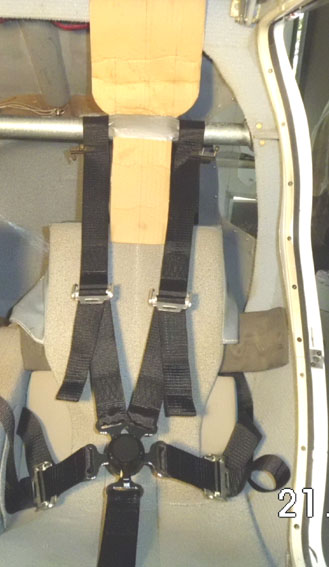
Doing work privately for MY Jabiru, JJ.Was it Oscar doing some work on better harness for Jabiru?
This is a test, using an el cheapo five point harness; I'll be using a full FIA-spec six-point with 3" shoulder straps and titanium camloc. The attachment points for the lap straps go onto the standard Jab points; the corss beam (slightly oversize tube in that piccy) attaches to the shoulder harness points so all major loads are taken on the original Jab. structure, with no modification. The beam will be 4130, and has been FEA'd by an aero engineer to meet the loadings that Jab originally had to meet (BCAR S) . The brown projections above the seat ( only cardboard in this test!) will be simple 'glass sheet with about 12.5mm temper-foam padding intended to provide protection from whiplash compression on the spinal column in your neck from the tube, and keep your head from impacting the flap cross tube. I've yet to design the attachment for those, but they need to locate the shoulder-straps from sliding on the cross-tube.
-
1
-
-
Well, thanks, FT. I don't intend to be really 'back', the editorial direction of the site and I have issues, and it's his site - but I do have some affection for my fellow aviators and I do believe it's important that people don't get dangerous information and believe it without having the realities explained.
A BRS is - quite literally - the 'last chance' option: I agree with you that it will slow down impact with the ground if that is uncontrollably INEVITABLE ( i.e. as a result of structural / control system failure / otherwise unrecoverable aerodynamic situation due to the proximity of the terrain / unlandable terrain - but to represent it as a controllable situation once deployed, is just completely wrong.
Once a BRS is deployed, the aircraft becomes at zero airspeed, it is hanging under a canopy that moves with the air. Therefore, NONE of the flight controls can have any effect - unless you have engine power and can achieve a positive airspeed of sufficient velocity to make the flight controls effective - in which case, why did you pull the BRS handle? I don't know of any BRS installations that have a 'detach' mechanism, so assuming you stabilised flight under the BRS and had engine power, applying power to achieve the effective use of flight controls would result in nothing more than a huge upswing of the aircraft against the drag of the BRS chute - negating the use of flight controls. Almost by definition, you could not regain use of the flight controls with the BRS deployed but still attached.
Aircraft are not designed to absorb more than a relatively low forward impact speed. They ARE designed to have a specified vertical speed resistance - i.e. a stall - smack down situation - and the undercarriage and even the tyres are all part of that. A BRS descent into water - particularly for a low-wing aircraft - is more likely to crush your spine than a BRS descent onto flat ground in a relatively fuselage-level position where the undercarriage can absorb the energy as it is designed to do. For more information, look at the FAA requirements for energy-absorbing seats.
If you pull the BRS handle, you have made the call to God on the Golden Telephone, you don't get to control what happens after that. I would agree that there certainly can be situations where that is the only option - but to suggest that you have any control once you have puller the BRS, is simply wrong.
-
2
-
-
There is NO pilot control possible once the BRS is utilised; this comment is complete nonsense. You are at the mercy of the wind speed and direction. The descent is NOT vertical unless there is zero wind. The attitude of the aircraft has precisely zero effect on impact speed. Aircraft are designed so that the undercarriage absorbs the major part of vertical speed at the moment of contact; tipping the airframe so that the undercarriage is ineffectual reduces the energy absorption capability of the airframe, which is NOT designed to be flown into a brick wall.Ballistic parachutes are designed to tip the airframe, to increase drag, to slow it down so that the aircraft makes a vertical descent. This is designed to improve accuracy of picking a landing area as well as reducing impact speed.
RV6.I guess pushing straight back is fine. I was worried about the "dash" folding back and sandwiching your head between it and the headrest....I think there was a thread on here about an aircraft that did that. After folding back on impact the front flopped forward again..?-
3
-
-
I have had a Telstra fibre-optic cable through my farm, about 40 metres from where my home office is set up, for over 20 years. But I can't get access through other than a derelict copper line that's about 3 km from the exchange! I can't get better than ADSL1. We're in a wireless black hole, I can't use the mobile phone unless I walk up the hill, unless there's heavy cloud cover. And my place is 80 km approx from Sydney, and about 2.5km from the Hume highway as the crow flies...
However, even on ADSL1 I can use the e-Sport Pilot. Yes, I have to be patient but it's acceptable. I would probably be inclined to chip in with commentary here, but for some really SILLY reason, I happen to think that the legality of flying RAA aircraft with / without an RAA Pilot Certificate is more damn important than bickering about access to Sport Pilot.
Pretty obviously, I'm on my own with that preoccupation. It seems most people here are more interested in reading about it, than actually FLYING.
-
1
-
-
I think (but don't know, I'm not in contact with the new owner of the 'Bat and moulds) that he's found the same effect that George did: everybody loves looking at the wee thing but when it comes to reaching for their wallet, the allure recedes. It's a high-tech structure, not a back-yard lay-up job, involving a lot of c/f requiring autoclaving etc. - it only looks a bit 'Sapphire'-ish. And it only does one thing well: aerobatics; it's not a thing you can use for anything else, really.
-
The moulds were packed and ready to go to Florida for development of a production exercise, that has fallen through and the owner has pretty much run out of options. The only 'Bat Mk II still exists; I delivered the fuselage nearly two years ago to have a specially-developed aerobatic engine fitted, and the wing followed a week later, but the Jabiru debacle has put that on hold for the indefinite future.
-
Peaceful, productive..He's back! Welcome back into the fold Oscar. It must've been cold out there away from the warm embrace of Rec Frying crew-
1
-
-
Is the cost of the magazine to RAA members the major issue for the organisation to face?
Is it possible that such issues as ensuring compliance with the mandated safety requirements of RAA aircraft so they can keep legally flying, that the questions of PIC competence as an arbiter of the right to fly an RAA aircraft, should be a priority?
Does the desire to damn well FLY your aircraft legally, insurably and safely rank higher on your concerns than the cost of Sport PiIot in electronic or paper format?
Answers will be judged by the neatest correct entry. But - here's a clue: compliance with legislative requirements have force in law. The cost of Sport Pilot doesn't.
-
2
-
-
It looks - sadly - as if the Ultrabat may not be in existence for much longer to terrorise the flying public; while the 'Bat itself remains intact at the moment, the moulds (magnificent pieces of work) look like, from last reports I had (two or so weeks ago) will have a chainsaw put through them and be dumped. George Markey put probably more than $500k into those moulds (with all the engineering costs for developing the 'Bat Mk II).
I worked on the 'Bat II with George a few years ago, and it was/is a tiny jewel of an aircraft, almost the ultimate bling for those who would fly unlimited aerobatics but can't afford a Pitts or an Extra. Badly let down by the unreliability of the Rotax 2-stroke engine; George ended up landing deadstick on roads etc. in the USA too many times for even his comfort - and George was not a man to put much value on comfort...
-
1
-
-
The FIA/SFI requirements for a 5 or 6-point harness slightly exceed the FAA requirements for the shoulder-straps; in all other respects the FAA requirements are a direct adaption of the FIA requirements. However, the materials for the camlocks, adjusters and anchors can add more than a kg per belt if you choose the 'wrong' ones. Also, for most small aircraft situations, you will need 'pull-up' adjusters for the lap and crotch belts and 'pull-down' for the shoulder belts to get optimum security.
-
1
-
1
-
1
-
-
It seems to me that there are two distinct and divisible issues here that are being enmeshed and confused.
The first of these is the established competence ( by means of licence/certificate and endorsements as applicable) of the PIC for the flight to be undertaken.
The second, is the compliance of the aircraft with the applicable rules and regulations at the time of the flight to be undertaken.
Before an aircraft can take off legally, BOTH conditions must be met: the aircraft must be compliant with all applicable standards AND the PIC must be suitably competent to fly it. HOWEVER: the competence of the PIC is NOT tied to the aircraft in question, any more than the eligibility of a licensed driver is tied to a particular car. If you are determined to be 'competent' to legally fly e.g a J160 reg. 24-NNNN, then you are legally competent to fly ANY Jabiru J160 24- NNNN, - even if you are not the owner of that particular aircraft.
That the specific Jabiru 24-NNNN about to embark on a flight is fully and currently compliant with all requirements is a matter for the entity held responsible for its registration, be that an individual or an organisation such as an FTF. The legislative authority for determination of the compliance of Jabiru 24-NNNN with all applicable standards happens to be RAA, by delegation of the powers of the 'head' legislative authority - CASA.
However, let it be recognised that CASA has no mandate to confer delegation of its powers under the CAA 1998 to any one specific organisation, nor that the selected organisation should have an incorporated status, (let alone such arcane and frankly bloody stupid conventions as regional representation for Board Membership). If a commercial service were to be established that guarantees competitive service to ensure compliance with regulations, CASA could NOT sustain a legal challenge to a determination that RAA is to be the only authority for registration and ensuring on-going compliance.
In case you are wondering - CASA has stated that it would not support a monopoly situation for any of the multiple organisations that currently form the regulatory bodies for Sport Aviation activities if there were compelling arguments against that position. RAA is not an impregnable fortress in this respect - however it has the advantage of a large number of (relatively) satisfied members, and from my perspective, is rapidly dragging itself out of the bad old days of the Middo-Runciman hegemony. Although not a member of RAA at the moment, I am entirely supportive of (most) of the current Board, and believe that there is a core of expertise on the current Board that bodes well for RAA's future.
Accepting for the moment that RAA is the delegated authority that provides assurance with compliance with the applicable standards for my aircraft (55-reg) - who then ought to be allowed to fly it as PIC? Only RAA certificated pilots (who by definition, have to be current members of RAA) ?
This is where it gets stupid. Competence is competence, whether signed off by CASA or RAA. Right now, a CASA-approved TEST Pilot, who happens to have MY aircraft flown in his log-book while he was doing test flying for Jabiru, cannot legally fly it because he is not a member of RAA. A mate, who was a Check Captain for Qantas, who has owned (amongst others) a Cherokee 6, a Pitts Special, a Tiger Moth, who could fly a Datsun 120Y through a hurricane in the Andes mountains IFR using nothing more than a clay figurine of his grandfather and a piece of wet string, cannot - because he is not a member of RAA.
Both of these people could legally fly a J430 - but not a J230? This is nonsense., or worse.
The requirement for an RAA certificate (and by implication, to be a current member of RAA) to fly an RAA-registered aircraft, is b&llshit. I support a requirement for RAA membership for owner/operators. to ensure that their aircraft are compliant with the regulations, since RAA is the current delegated authority. I support that a current RAA Pilot Certificate should be adequate proof of competence for the flying activities that it allows.
I do not support that a person with current defined competence to fly an aircraft of a type that happens to be registered by RAA cannot fly an aircraft registered with RAA as PIC, or has to hold an RAA-issued Pilot Certificate.
-
5
-
-
Not so far given; the media reports suggest Camden as the departure site but by drawing a rhumb line to Lilydale/Coldstream directly through the upper end of the Nattai, the Oaks would be the more logical departure point to end up in the Nattai near the Burragorang Road if climbing out on path. I was in Camden at 1100 that day and it was clear skies there, with cloud south.
A member of my family who used to commute daily by Auster from Mittagong to Bankstown for a number of years and knows that area extremely well, used later when flying his Cherokee 140 out of Hoxton Park, to traverse the Burrragorang -Taralga route - but NEVER with less than 6,000 feet before he entered the Nattai area. And that's with one of the most reliable piston aero-engines ever built.
-
J160 has 135 litres of fuel, everything topped-off; claims 8.5 hours endurance with nil reserve, there was only a bit over 4.5 hours of daylight left, so fuel should not have been an issue (unless they took off with the deliberate plan of extracting maximum distance from minimum fuel..) The general track you suggest is far more sensible and safe than flying the rhumb line, but might add maybe 20-30 minutes to the trip which I still calculate would NOT have had them at any 'Melbourne' strip by EOD.As for the route, i can't really understand why they are there unless they needed most direct for fuel but the possibly would have needed a stop along the way. the route along the freeway is pretty healthy once at Goulborn hang a bit of right to Wagga -
Conjecture, and the development of urban myth from an unsupported statement of opinion that refers to a source of information without any actual supportable analysis of the evidence. AKA, 911 conspiracy theories and reference to someone who knew someone's cousin who met a person who knew someone who had heard a man in a bar stating he had been told by someone about the third man on the grassy knoll.I dont know, go to the NTSB site and read the reports ? Also check other websites, i am looking now through a Google search for Jabiru aircraft and engine fatalities/failures.There are a lot more out there than you think. Also the 17 reports were only fatalities there were perhaps dozens or hundreds more on the NTSB website that were not fatalities.I await the decisive evidence from someone who has found evidence in the prophecies of Nostradamus that Jabiru engines would cause a world-wide devastation of people flying in Jabiru-powered aircraft. It MUST be out there..... somewhere....
-
Finger/brainfart error.. 19.39 according to Elders Weather.Sunset in Melbourne on 2nd April was 7.12 pm so not sure where you got last light as 17.39. Perhaps 19.39? -
Merv, see: http://www.dailytelegraph.com.au/news/nsw/a-light-aircraft-crash-landed-in-the-nattai-national-park-after-its-engine-failed-with-two-people-on-board/story-fni0cx12-1227289453945Interesting. Was he outbound from Yscn? I missed that part.Slight misquote on my part, according to the report he crashed at 3.15, so might have been maybe 10 minutes max. into the flight? Still leaves it damn tight to get say to Lilydale...
That report also shows the complete horizontal stabiliser and elevator lying on the (relatively open!) ground, it's amazing the thing didn't go in nose-down vertically, the trees must have caught it completely. Very similar situation to the Wedderburn crash of years ago, though this time the engine stayed on...
-
 1
1
-
-
There's something else that doesn't hang quite right with me here - and it may just be inaccurate reporting BUT:
Apparently, the pilot took off at 1515 to 'go to Melbourne'. The prevailing winds were - around here (near Mittagong), westerly at an average 15 kph; further south, swinging southerly at 15 - 20 kph. I would think one should not have planned on more than about 90 kts ground speed for the trip.
Last light getting near Melbourne was 1739 - say, for prudence, 1715 - four hours. You might JUST squeak it in from Camden to Melbourne in four hours at 90 kts ground speed IF you fly the rhumb line - which you cannot do without traversing a LOT of bad area.
-
My property is bordered by the Nattai, and I've been a firefighter for many years operating right through the Nattai and Yerranderie areas, and it is NOT - repeat NOT - an area to be flying over in any single-engined aircraft unless you keep sufficient height to glide to a clear area. There are very large areas of it where we cannot get the fire-trucks anywhere near.
This was a bad pilot decision mitigated by the crash-worthiness of the aircraft and aided by the fact that the pilot did a decent job of flying the thing into the crash as best (it appears) as could be managed in the circumstances. If travelling south from Camden there is a narrow corridor of reasonable country that roughly runs from The Oaks through to Mittagong; it happens to pass almost directly over my place and is very frequently used: on any decent day, I probably have half a dozen ultralights pass over near me. Consciously deciding to fly over that area, at that height, is a bloody stupid idea.
-
1
-
1
-
CASA 292/14 - Conditions and direction about Jabiru engines
in Jabiru
Posted
If we can just pass beyond the static in the airwaves here...
It is certainly my understanding, and others have the same belief, that a small group of RAA Board members were allowed to see the original CASA 'data' under very strict injunctions of confidence. Given the necessity for RAA to respect the relationship with CASA, it is not - I suggest - a case that RAA is (or may be) 'sitting on the fence' in relation to commenting directly on that data, but a practical necessity that certain communications, if presented as 'confidential', must be respected. If that particular arrangement is broken, then the operational relationship between CASA and RAA is also broken.
In my limited legal expertise, I believe the term that is used to indicate that information held by one side of a dispute as confidential is that it needs to be 'discovered' so that it can be challenged by the opposing side. Let's not get caught up in discussion of the similar requirement in other jurisdictions: 'tabled' in Parliament, 'scheduled' in contract documents etc.
Assuming that RAA has at least some - albeit 'confidential' - knowledge of the CASA data, it beggars belief that RAA would pursue an FOI to 'discover' that data if it had reasons to suggest that the end result of that process would not be advantageous to resolving the situation. It is equally unbelievable that CASA would not promptly make that data publicly available if it believes that public knowledge of the data would not validate its action. CASA has most certainly released information relevant to other actions it has taken, sometimes with the result of public/parliamentary excoriation of the actions - PEL Air, everyone?
So, on the one hand, we have an organisation seeking to provide public access to the relevant data: RAA. On the other, we have an organisation acting to block access to the data upon which they state their action was validated: CASA.
The application of basic intellect would lead one to conclusions as to which organisation is seeking to provide clarity to the current situation.