


Oscar
-
Posts
2,485 -
Joined
-
Last visited
-
Days Won
67
Content Type
Profiles
Forums
Gallery
Downloads
Blogs
Events
Store
Aircraft
Resources
Tutorials
Articles
Classifieds
Movies
Books
Community Map
Quizzes
Videos Directory
Posts posted by Oscar
-
-
Yep, they are well respected. However - and at the current exchange rate - there are several good CAD programs that will draw paper templates for each tube; slower but a lot cheaper!
-
Yes, it cost me more than that. There was no agent in Aus. when I bought it about five years ago. The only local alternative then was a Hafco pressed-tin lousy device, and 4130 buggered-up isn't cheap.I see they are available here in australia. All of the JD squared stuff...it in Sydneyhttp://jd2.com.au/$525 inc GST would probably cost that to get one here from the USA given the current exchange rate anyway
-
Damn near melted the headlining off the car after I'd paid the bill.... but the actual JD2 people were great to deal with, and everything up to it arriving in Sydney had been great, and very reasonable priced.
-
Ha! I bought it direct from the factory and the airfreight to Australia was something like $100 or so - then - because I had STUPIDLY not elected to have it posted to my local P.O. but instead elected to collect it from a freight store in Sydney...
Sydney airport charged me $90 to get it off the plane. Any parcel, they charged for at pallet rate. The airfreight company charged me something like $160 to move it less than 1 km to their premises, and Customs charges caused it all to cost me $340 or so before I could get my hands on it.
It is lucky that Sydney is still standing, I went thermonuclear.
However, it IS really good; I had a specific project for it, which unfortunately changed direction, but every time I've used it - e.g. that engine mount - I've not regretted spending the money on it.
-
The XU1 did not suffer mechanical problems. However, 'electrical' problems - such as the alternator being pushed off the side by a broken rod - were not unknown
-
 4
4
-
-
I've flown in a Cherokee 6 - three up - into and out of Tullamarine (in IFR, 500 foot ceiling both trips) and several bush strips on the way there/from north of Echuca - and underpowered, it is not - unless a Qantas Check Captain as PIC adds thrust.. A pretty benign aircraft with no discernible bad habits, though you need a bootful of rudder on takeoff.
Pilot error on this one.
-
Lycoming, Continental, D-motor, UL power, Jabiru, CAE...PLEASE. and anyway what's the stoke /bore ratio got to do with anything? We are talking about geared motors are we not?......Who in their right mind ( Except Becs) would market a direct drive engine nowadays?....-
 1
1
-
-
Jeez, that is NICE welding! You wouldn't get a raised eyebrow, I reckon, if you said it had come out of Barry Manktelow's shop - and Barry is an artist with a tig torch. Well. maybe from Barry himself, but few others would know.
Thanks for the heads-up on the 2% Lanthanated tungsten electrodes; I've always used thoriated on steel and was completely unaware of the health aspects. I'll be changing.. haven't done a lot of tig stuff recently ( like, last ten years!) and am a bit rusty; my last job of late was an engine mount for an engine test cell, and though I claim 'extenuating circumstances' because it was done outside and freehand, your welding leaves me mighty jealous. About the only thing good about it, is that a Jab engine plugs straight on, so I got the welds to not pull things out of line.

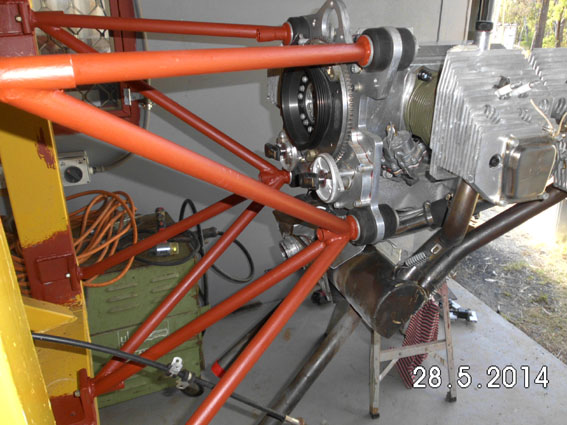
Incidentally - if you are ever looking for a tube notcher (and your stuff says you don't need one..), I bought a JD2 Notchmaster ( https://www.jd2.com/p-63-notchmaster.aspx ) a few years ago, after many years of notching by hand - and it is a REALLY good tool. They are gaggingly expensive by comparison with the el-cheapo pressed-steel ones, but are as solid as a cyclone-rated brick outhouse and correspondingly accurate.. You need to put a chamfer on the cut edge to ensure proper penetration throughout the joins, but with a thin s/s cutting wheel used carefully, ( yes, they should NOT be used for grinding, but hey, they do the job and don't leave bits of carborundum in the join face) the joins come up just a treat.
-
 2
2
-
-
YEP - that's the one. I've had more comfortable trips in a fat-bottomed yacht in a 3/4 following sea..
-
1
-
-
Ah yes, that 'ting' noise..... I know it well. Got the sequence wrong on one chassis and after three goes, decided to plate the corner - it was that or dismantle too many tubes and start again.
Using too many vg's in front of the ailerons is tricky; it can introduce a final and very, very sharp breakaway stall of the aileron which can make the stall very 'interesting'..
The inner vg's on the Seeker are designed to influence the downwash on the tailplane so that it it actually limits the maximum amount of elevator power so you can't drive the thing into a severe stall - but to the point where the thing settles into a mush with the centre section benignly stalled, keeping the ailerons fully effective. I know that it's tricky to get right; at one stage they re-painted the wings on the test mule and suddenly it wasn't flying quite right - because ONE of the centre vg's had been put back out of place, by not much either!
Re corrosion - I like the Stolspeed vg's, they look pretty good and won't cause a problem ( well, I can't see how they could!).
Moving slats... I'd not go there, I agree, unless there is some really compelling reason to do so. Flew in something - I am having a mental block re the name - low wing, French design - that had them from Canberra-Tocumwal and return once; it climbed like crazy but at cruise, the combination of the slats and a bit too much dihderal had it weaving in every gust like a Sunday-morning drunk on his way home from the pub.. Now, the set-up on the Wittman Buttercup, I think is rather clever, though a danger when doing the D.I.
Will be fascinated to watch your progress; it should be quite a machine when it's finished. I suspect Dafydd Llewellyn would be most interested to chat with you - he appreciates people who THINK about things rather than just draw a shape because they think it 'looks right'.
Cheers!
-
2
-
-
Absolutely! I even have a spare engine - complete with carby- for that one if you need it for baseline test purposes! Happy to donate it to the good cause. I can't guarantee the condition, the only Victas I have worked on in the last fifteen years had wings.
-
1
-
-
Geoff:
an LSA is certified by the manufacturer as meeting the applicable ASTM standards - there is no 'approval' other than that. A component manufacturer does not have to provide ASTM certified status for its part - but it CAN revoke warranty if the installation does not meet its specified standard ( Rotax applies this, as does Lycoming).
So: if that aircraft was, with the pump attached, certified as an LSA by the company - the company is wholly responsible. If the pump was an unapproved installation - the aircraft was NOT eligible to fly.
Somewhere along the line, SOMEBODY has serious questions to answer.
-
Who/what 'shot him down in flames?' The Victa (and its child, the CT4) are still respected and valued aircraft. Victa as a manufacturer was hung out to dry by the failure of the government to decide it warranted tariff protection. Henry was never 'shot down in flames', though many Victa owners have privately wished he had a better understanding of 'production' engineering' - a Victa is a bugger to repair, not least because every one was 'hand-made' and many critical parts have to be fabricated to match the actual airframe.
If anybody was 'shot down in flames', it was Merv Richardson, shot down by the Tariff Board decision.
I suggest you revise your appreciation of the history of the Airtourer. Bob McGillivray can give you some pointers.
-
Actually,it's the Victa, and a family member was on the team with Henry Millicer at Victa. I worked on a Victa about six weeks ago, a mate sustained Victas (was the signatory for mods etc. before the Airtourer Association came into being) for years. And your point is?
-
Bex will release news about its imminent production status in about two weeks. $5k purchase, 3,000 hours TBO and full overhaul for just under $2k to zero-time condition. Fits Rotax/Jabiru/Lycoming/Continental mounts. The IFA contra -rotating props, a $2k option, or build your own from Bunnings-available materials.
-
1
-
1
-
 1
1
-
-
HITC, that's really impressive. Your welding is something I admire; having built several race-car tube frame chassis and a number of aircraft-related bits and pieces, the skill required to get a complex set of tubes all welded up without them pulling everything out of feck is not a skill most people will truly appreciate. You - very obviously to me - understand that it's not just fitting but also weld sequence in a multi-tube frame that makes the difference between something that comes out to spec. and something that ends up just not to dimension. Been there...
I notice that you intend to incorporate the 'Dafydd Llewellyn' vg ideas in your design. May I - respectfully - suggest that you get in touch with him and discuss the intricacies of those? He lives not all that far away from you.
About six months ago, I believe, the chief Test Pilot from the FAA Small Aircraft Directorate flew the Sunbird Seeker, and commented that the stall characteristics were amongst the best he has ever flown. He added that he will be recommending to the FAA Small Aircraft Directorate, that they contact Dafydd Llewellyn to (this is not a verbatim quote) 'seek his assistance to understand how the aerodynamic design works'. Subtext: the application of the vgs to the Sunbird Seeker is sufficiently subtle in design that it's NOT intuitive nor something that one can say: 'oh, I see how that works, no worries'. Sub-subtext: 'none of you smart@rse engineers in the Directorate have the brains to understand how this works'.
The Seeker vg installation took many, many months of trial, test flying and changes, to get it right. With the greatest respect to companies such as Stolspeed - who have done great work and provided excellent information for those looking to use vg's to improve their aircraft's flight characteristics - there is NO 'one size fits all' answer - you cannot JUST apply a handful of vg's to your aircraft and it becomes magically transformed. A familiar analogy would be the time in the 70's when 'lowering and wide wheels' was considered to be the 'magical' answer to an ill-handling motor vehicle. Sometimes it worked, other times it made a dog into a vicious dog.
Your project is fascinating; there is very obviously a great deal of experience, thought and plain hard yakka involved. It will be extremely interesting to see how it all progresses.
-
2
-
2
-
-
Much of this regulatory activity is sparked by incensed vox populi demanding 'the Government should do something about this' - and politicians reacting.
Same story as the Jabiru restrictions.
-
2
-
-
The idea that you can snuff out a fire on the cowl area by diving hard - perhaps to past VNE - is, I believe, quite probably in the arena of urban myth and also likely to cause more danger than a better-considered response.When I did my RPC we certainly covered inflight fires, not that we spent hours and hours on it but certainly covered it.I'm still a bit bemused by the VNE comments in regards to 'putting out' a fire by diving past VNE. Doing that IMHO opens up the very real danger of MY most feared inflight problem, structural failure. Ok so MAYBE our planes can go a smidge over VNE without instantly exploding but can we be sure of that? Maybe a few more views of some videos of flutter resulting in structural failure would be appropriate? Some planes may be tested to withstand some flutter but I doubt most of our rec stuff is up to that same standard.Firstly, UNLESS that idea has been tested by the manufacturer and found to be effective, there is absolutely NO guarantee that in a high-speed dive, the airflow inside the cowl will actually increase to the point where it has the desired effect. Airflow in a convoluted and cluttered space is anything BUT intuitively understandable; you have quite small opening on the high-pressure areas of the cowl (the various air intakes), and also exhaust areas which, in a properly-designed cowl, will operate to generate maximum scavenging ( or in other words, to generate low pressure) in 'normal' flight conditions.
Anybody who has studied engine intake and exhaust design will be familiar with the problems of 'choking' due to changes in area, turbulence, even sonic pulse generation. While sonic pulse is highly unlikely even in a VNE dive, most certainly other forms of 'choking' may well occur. FFS, look at the size of the average air intake on an efficient cowl - they are small. By the time the air designed to pass over the heads and through the oil cooler has managed to get through those obstructions - carefully designed to extract the maximum cooling from the passing airflow - it may well be simply traveling at a speed and pressure that will do nothing but ADD to the oxygen available to a fuel fire in the cowl.
Secondly - the possibility of flutter is just ONE of the potential problems of exceeding VNE. Properly-designed aircraft have increasing control load with speed - to prevent excessive control application as speed increases. If you are going to try to use VNE as your escape solution - you'd better be REALLY on the ball WRT your airspeed, lest you enter control-lock-up.
Then there are fundamental aerodynamics considerations. Depending on - for instance - the airfoil, recovery from an 'overspeed' may be extremely dangerous. The Gazelle, for example, is KNOWN to have aerodynamic load reversal at a very small margin above VNE - and if that happens, the front lift-strut collapses and the wing(s) departs.
Personally, if I am ever in the situation of having to get an aircraft on the ground in the minimum possible time, I'd select the slideslip option - at least you can feel the aerodynamic effects. Diving at above VNE is, as far as I am concerned, a decision that 'I am dead anyway, let's get it over with'.
-
3
-
-
So far, the leading contender for uninformed comment of 2015. Going to be tough to beat.Camit may do well, but it still looks like a Jab engine to me. I am not happy that somebody can design an engine and then another person comes along and improves it plus calling it his own engine. To me it is still a Rod stiff design, possibly improved, but at the same time Rod Stiff is stiffed. Unjustifiably in my opinion.-
2
-
-
Wow... if I were running 'Oscar's Flameproof Knickers Co', I'd use that story as a 'testimonial'..Yep mine has the same marksInterestingly where the tailpipe sits resting on the cowl theres nothingI have stuck on some heat proof insulation but thats PPE i guess
Have you lookd at CAE new muffler design? Should get rid of plenty of heat if it can fit.
Another story, my heater hose somehow came off, lodged on top of muffler, pretty much pointing at floor under pilot feet. the incoming forced air jetted past muffler, caused burning of outer glass and core of the floor. Nasty black charred hole around 50mm accross.
Luckily i smelt and felt a problem and retuned to land. Was only doing test circut thank goodness.
Had it burnt through much further an extinguisher would have been very helpful
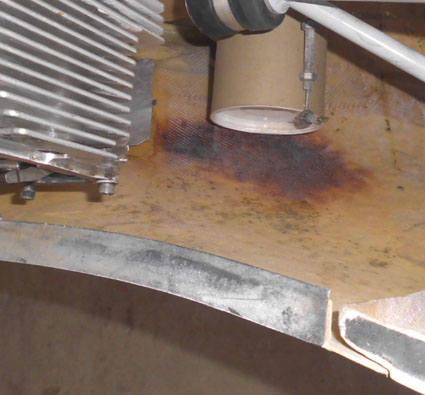
The scorch marks on the cowl are a warning sign; as an aero engineer has told me, part of the 'fireproofing' for 'glass comes from the 'paper-bag full of water vs. flame' effect - where the cooling on one side (airflow) keeps the temperature on the other side from igniting the material. Our cowls have coremat in them, which is quite a good insulator, so we rely to a considerable degree on the presence of Aluminum Trihydroxide in the resin - but eventually that loses its water-releasing property and can no longer cool the resin/glass matrix.
I intend to research, for my own cowl manufacture, the addition of an internal layer of a ceramic, heat-reflective and fire-retardant paint. I will be running some tests on that on a sample coupon of A-H containing lc3600 to see if it improves flame resistance - I'll pass the results on when I have done those.
-
 1
1
-
-
What did you think of his mods?
-
JJ - AMEN to all the above (and the bolding is added by me - I believe it to be the absolute safety base-line of all maintenance and installation actions). I also absolutely believe that one should NOT - as far as possible - do anything that in itself may constitute adding a risk factor because one is focussed on alleviating another risk factor - the law of unintended consequences applies to us equally as others. Anybody who knowingly takes of in an aircraft that contains a significant risk - e.g. a wiring of fuel delivery system defect / suspect condition because they believe they are 'fireproof', might as well place a plastic Jesus on their dashboard...Oscar my main points are with the habit, we all tend to have, of focusing on material fixes to problems rather than addressing major risk issues as their mitigation is harderIt is NOT Ok to use PPE as solution to a significant risk. The risk itself should be removed.Also the effects of wearing PPE in hot environments is now a well known risk. leads easily to human factors problems. Particularly to those not used to hot conditions or prepared for the 1l per hour rehydration.
Increasing HF risk even slightly is a big problem.
There is already others (in other threads) supporting mandatory BRS.
All these safety ideas are great, take them up if people want to, but be clear they are reducing % of a tiny portion of risk. Perhaps not addressing the big risk factors.
Did you ever sort out harness options for a Jab?
However, I do think that there is 'room' for the intelligent use of PPE - or at the very least, of not wearing 'dangerous' materials. As Geoff's experience shows, the unexpected can happen - and the unexpected can come from an absolutely hidden defect. I most certainly will NOT be ending up looking like the Michelin Man from using PPE appropriate to a high-risk situation, such as competition aerobatics, but I still like the idea of the nomex overalls that can be opened in flight to relieve heat stress but quickly zipped up again IF things get dangerous. And I WILL be testing how well one can manage the heat factor in a situation where there is the opportunity to bug-out in safety if it is becoming apparent that they are elevating my risk factor.
No current progress on the seat-belts: I have the belts I wish to use, I have made up a jig for the manufacture of the mounting in consultation with an aero-engineer, but I've been side-tracked on making a new set of cowls to hopefully improve the engine cooling situation: our original set are a bugger's muddle of something lashed-up from original 1600-engine cowls to fit a 2200, and given that the lower cowl shows extreme scorching marks from the heat of the muffler, I consider it to be a higher priority to remove THAT problem! ( Have a gander at this - the 'faux' muffler is a posting tube put in place on my dummy engine to see what clearance is needed)
And this, I must add, on an aircraft maintained pretty much all of its life by LAME's, L2s and used in flying schools for most of its several thousand hours...
-
JJ, I am very well aware of the problems of too many layers of clothing - having raced with (older) mandatory kit (only two-layer, but in a Clubman with your legs beside the engine and underneath the exhaust system, it gets pretty warm), but also for years as an RFS member - and working the fire-line gets very warm indeed at times.
I used to wear a tailor-made light cotton overall-type flight suit in gliders - cream in colour, for good reason - you're sitting under a long clear canopy for sometimes six-plus hours at a stretch, under the sun, requiring around 1 litre of water intake per hour on a decent flying day, and it all sweats out, believe me... Reason was NOT fire-resistance - obviously - but the location of pockets - gliders do not have an abundance of cup-holders and knick-knack bins.. Reasonably baggy legs on the overalls allowed some air circulation; in a race suit every opening to the outside air is closed off and your second-layer long johns are tucked into your nomex socks, gloves etc.
With the growing use of efi in aircraft engines, the possibility of a serious amount of fuel being pumped out into the cowl - or worse, into the cockpit if high-pressure lines run through the cockpit, which I suspect is the case in just about all RAA-class aircraft- in a very small time is heightened. We are all using / carrying more and more electronics - and some of the most popular of those ( iPads, iPhones) seem to be gaining a reputation for being anything BUT non-combustible..
Occupant safety / crash worthiness is something you choose with your choice of aircraft, and (at least for the more well-informed aircraft owner), we realise that there is a price/performance trade-off: like you, I choose Jabiru for occupant safety, and would not fly in for instance a Sting (having seen the results of a crash of a Sting) for that very reason.
PPE is a matter of personal choice, and (in the main) is fairly close to weight-neutral, unless you normally fly naked. And, I would add - the specific aircraft you fly in may make a difference to what gear you choose to wear. I would never suggest that it should be something for consideration as mandatory, but I can't see how elevating the general level of consideration of its use as an item to increase one's safety is negative to our sport.
-
1
-
-
A lot of good thoughts on here; Geoff's report has done very good work in causing people to think about causes and options for action.
Obviously, prevention - as far as possible - is the first line of defence. Both electrical and fuel are the obvious contenders for causing problems and while that is a glaringly obvious no-brainer statement, it is so very easy to do something that seems innocuous enough but could have bad consequences. 'Aircraft standards' for installation are sometimes pretty impenetrable to read but really do need to be considered.
Something that hasn't been discussed, is Personal Protection. I'll bet that just about all of us have trawled through maybe the eBay 'aircraft parts' or similar pages and noticed ads for Nomex overalls , and probably thought 'maybe a good idea', then dismissed it because - let's be honest - the idea of stepping out of your wee little plain-Jane Jab or whatever dressed like someone out of Top Gun is rather likely to cause others to think 'What a WANKER'.
Yet thoughtful clothing choices can make a considerable difference to your potential injuries / incapacitation from fire - or at least add a bit of time to get on the ground and out of there. We are strapped in with basically no room to reduce our exposure to a source of flame, and needing our hands and feet to continue to operate the controls. Just good leather shoes, woolen socks, non-synthetic material trousers etc. plus a pair of Nomex overalls would at the very least add protection from both panel fires and anything coming through the firewall, for longer than more dangerous types of clothing.
It's interesting that in some other sports, the attitude towards personal protection is very much oriented in favour of the best level of personal protection. Motorcycl;ists (with any intelligence, anyway) adopt what is called ATGATT: 'All The Gear, All The Time'. Those full leather suits with body armour incorporated, gloves with carbon-fibre finger protection etc. are not worn because it makes us look like grand prix racers - it is worn because sliding down the road at 100 kph does really nasty things to the human body. Serious motorcyclists consider the lightly-clad 'thong nongs' to be the 'wankers'.
So - a question: what do people think about someone flying with in Nomex overalls - even ones with fairly obviously 'Air Force' or 'Navy' badges removed that have been purchased as good second-hand equipment from a Surplus store? Is the reaction generally that they are a bit of a poseur or that they are cautious and concerned about their safety? I freely admit that I have had thoughts both ways about this idea, but I anm starting to come to the idea that a pair of Nomex overalls is not silly (and maybe I'd strip them off immediately after landing, rather than wander into the clubhouse wearing them..)
-
1
-
CASA 292/14 - Conditions and direction about Jabiru engines
in Jabiru
Posted
Great work, Camel, your perseverance has paid off and hopefully this will be the start of the way forward that Jabiru owners have needed. As you say, the information will need to be used carefully and by wise people, but at least it's breached the 'fortress CASA' which few people have managed to do.