


Oscar
-
Posts
2,485 -
Joined
-
Last visited
-
Days Won
67
Content Type
Profiles
Forums
Gallery
Downloads
Blogs
Events
Store
Aircraft
Resources
Tutorials
Articles
Classifieds
Movies
Books
Community Map
Quizzes
Videos Directory
Posts posted by Oscar
-
-
Ah - sorry KP, I had taken your post exactly the wrong way - yep, FTF is still important!
-
[*]Engine compartment fire shut off fuel & electrical supply and get the nose down as far as you can (wouldn't worry about vne at this stage) - excess air = excess oxygen, fire will go out as it is too rich to burn, additional airflow will assist in cooling the hot areas, need to be careful on pulling out of the dive though as you may stall the aeroplane and end up with an additional problem.
Aldo
Seriously - the idea that one should ignore VNE is not something that should be taken lightly. If it becomes a decision to be roasted or ignore VNE, than I can see the argument - but if anything less, then exceeding VNE may be the equivalent of diving out of the tenth-floor window vs. being lightly scorched while awaiting the fire crews.
VNE is not JUST a mystical figure above which the wings MIGHT fall off. It is also not 'just' a figure with a 10% safety factor for the sake of providing an observable limit.
Amongst things that may have contributed to the VNE figure for a specific aircraft are: flutter, reversing controls, locked controls.
Any decent attempt to snuff the fire, is worth it - provided that does not result in an incontrovertible plummet into the ground.
-
 1
1
-
-
Geoff - apologies for the slow response here, but other things have intervened.
An 'autopsy' of my old brick-type pump revealed a number of things.
At the base of the pump, there is a small circuit-board with what is probably a switching power transistor of the 13003 form factor, which is riveted to the base plate of the pump - presumably so the base-plate acts as a mounting for the circuit board and a heat-sink for the transistor.
The actual pump mechanism is a pair of coils that - presumably - are switched so that the 'piston' of the pump oscillates; there are simple valves at the intake and output ends of the pump 'cylinder'; it would be hard to get a more simple mechanism. I can't readily see how a mechanical failure of the pump could cause a seizure leading to a combustive situation - more likely, it would just cease to pump effectively.
The hole blown through the plastic ident. plate in your piccy, is already in the casing; it appears that it is used as an inlet for the pressure foam filling around all the components - which makes sense for sound attenuation ( or in less complicated terms, shuts the damn thing up from rattling your teeth when in operation). The entire inside of the pump is filled with this very dense, yellow foam and is obviously done by injecting the foam as a liquid.
The foam will sustain combustion when subject to flame/heat and produces a vast amount of acrid, almost black-coloured smoke.
There is NO electrical component anywhere near the hole on the casing that could cause arcing off the casing; our best guess is that the heat from the circuit board failing ignited the foam and what you had was a very small bomb in action, that blew the foam away from the hole in the casing which then became a vent. It probably required the foam to be burnt away toward the casing to the extent where the surface area of the casing cooled the remaining foam below its ability to sustain combustion before the smoke abated - hence the delay after you cut off the power before the smoke started to clear.
FWIW: my sparky is also the co-owner of our aircraft and we are intensely interested in avoiding what happened to your aircraft. Our conclusions from your experience and our investigations are:
We will still use a Facet brick-type pump, because the incidence of what happened to you appears to be incredibly rare. HOWEVER:
We will mount it with stand-offs beneath the feet, to give the base-plate room to 'breathe';
We will wire it up through a 5-amp circuit breaker in case of electronic 'hiccups';
We will twist the power and earth feed wires tightly together and a) put a cable clamp around them, and b) put a braided fibreglass 'sheave' wrapping around all of that, so an excessive resistance will melt the wiring insulation and trigger the circuit breaker before setting fire to the pump foam - and we'll add a slow-blow 5-amp. fuse to the power supply circuit as a redundant safety.
As an addendum: the standard Rotax (and Jabiru) alternators are subject to voltage spikes which can possibly fry electronics. We are using a CAMit alternator with more reliable regulation.
As a final point: what happened to you may be just a freak failure of the electronics - or may be an entirely predictable result of a bodgie installation. If it is the latter, a good electrical engineer should be able to give you a qualified opinion.
-
 2
2
-
-
No, we communicate on digital sites. Networking is FTF.what we network on digital mags??So that is OK?Regards,
KP
-
 1
1
-
-
Also, don't underestimate the value of making 'networking' contacts with key people in places like the EAA, and even the FAA Small Aircraft Directorate. If Darren can, for instance, get a decent handle on how repairs and modifications are done in the USA, MARAP might be further refined.
-
3
-
-
Ian Bent will be tied to his stand, but I have two family members there right now; will be getting a full report...
-
 1
1
-
-
Since the USA is an almost non-existent supplier of fully-manufactured aircraft into the RAA market, I think it might have been more useful for the Tech Manager to go to one of the major European shows and had the opportunity to really get familiar with what is coming out of there.
I personally support the idea that RAA should get exposure to the experience of other, and successful, spheres of RAA-class aircraft standards, manufacturing and operations - we would as a community be better served if RAA can assimilate and be able to present cogent arguments to CASA for changes to the regulations that bind us, where there is good evidence that changes to a different regime have palpably worked.
I have very considerable confidence that Darren and Jill will extract the maximum value to RAA they can get from their visit to Oshkosh. I would hope that they have gone with a definite agenda/prescription to research issues that can be translated back to the Australian situation. However, anybody who underestimates how much plain hard yakka it can be to meet and extract information from people caught up in a major international 'expo' of this nature - hasn't been to one.
Rather than be cynical, why don't we wait and see what results?
-
1
-
2
-
1
-
 1
1
-
-
CAMit are exhibiting there, which is a big step up in their confidence that they have weathered the storm of the Jabiru debacle and are on the way forward.
-
4
-
-
Friends have a farm about 20k east of there - halfway between Taralga and Oberon (Glen Road). On Thursday night they got about 15cm of snow.

-
1
-
-
Lynette Zuccoli has managed to keep Aerotec going and providing extremely good service to the aviation community in sometimes difficult circumstances following Guido's death. Guido was one of the true good guys of the Warbirds movement - (I've had some dealings with both great and less-than-great people in that milieu who engage in practices up to and including attempted smuggling of historic aircraft out of the country) and Lynnette and her daughter and team remain as the sort of people one would always HOPE to be dealing with on any aviation maintenance matter.
I would hope that Lynette doesn't 'take a haircut' on the aircraft, but receives a fair and reasonable price for it. I am very sure that she will not represent the aircraft as anything but what it is, and the ad for it specifically states this:
Notes:
Aircraft was last flown in 2009 due to corrosion being discovered in the outer, lower Port spar cap during Annual Inspection. The aircraft was grounded, engine inhibited, and the aircraft stored in the Owner's climate controlled hangar. A new set of wing spars (8) have been manufactured by Madlener of Germany and are supplied with the aircraft.
The world is full of people who delight in being 'winners' on 'the deal': Lynette is not of that ilk. She deserves decent recompense for the care and attention that is obvious from the photos in the ad. - and recognition of her honesty and support of the aviating community generally.
-
1
-
-
You won't get vapour problems with gravity feed though FH - it's like a permanently running pump.
WRONG, if there is a low point in the line between the tank and the carburettor in any angle of flight.
-
Probably all Jabs. - just for a start! But - has anyone ever heard of a Jab boost pump catching fire? - and Jab themselves state ( or used to) that simply leaving the boost pump on, is acceptable practice. (I doubt if many people ever did that with the standard Jab alternator)Sure Oscar, but if many of those pumps are fitted ,( as Maj suggests) we have a general problem, out there. For the level of the risk the Foxbat is just another aeroplane. It's NOT unusual to fit a fuel pump. They run full time on an injector system and at higher pressures. NevThe 'brick' type Facet pumps are cheap and cheerful by comparison to even the Facet Gold Top pumps, but - mostly - they work reliably. By cost comparison with TSO'd boost pumps - (e.g. the Weldon PMA'd pumps) the Facet is 1/10th the price - and that's for entry-level TSO'd pumps.
Conscionable installation would have included recognisance of the fuse requirements.
-
1
-
-
That is, by anybody's estimation, a MASSIVE failure to deliver a product fit for purpose. I would place it as culpable negligence and if Geoff had not been as good a pilot as he was when faced with the situation, Aeroprakt would have been the recipient of a major lawsuit. Still should be.The pump was fitted by the factory. At the time it was fitted during manufacture - over two and a half years ago - they would agree to do so if the customer demanded. Their suspension of the pump as an (unlisted) option or approval of local installations was only announced following this problem.-
1
-
-
From initial dissection and examination of my old Facet 'brick' pump, the hole shown in Geoff's picture is actually already drilled through the casing and hidden behind the label. It looks to me as if it is the injection point for the foam encapsulation for the pump interior, and if my (inexpert) assessment is correct, it was not arcing between the electronics and the case but simply overheating of the foam to the point where it caught fire. That should never have happened in a proper fused installation; IMHO a defect report and the removal of the licence for the installer is seriously indicated.
In respect of not installing a boost pump: the function of a boost pump is primarily to provide a redundant fuel delivery system in the case of failure of the mechanical fuel pump and secondarily to ensure that vapour lock does not occur. Has the Foxbat fuel delivery system been tested at the FAA-mandated 110F fuel temp, for a full-power climb to service ceiling?
-
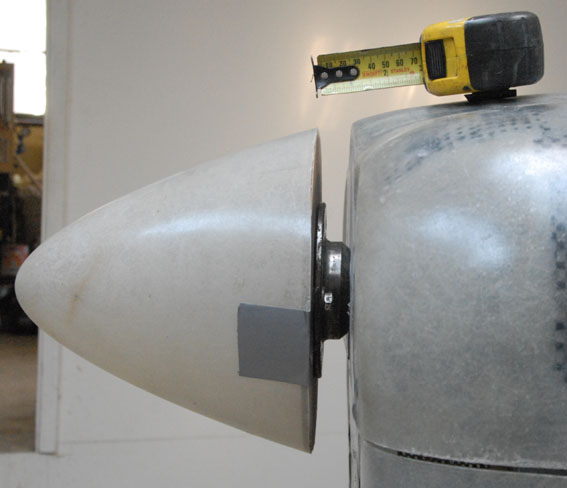
Bloody heck - that's not a spinner, that a proctologist's thimble..
-
Pip Borman's aircraft was a Pitts 'Sampson', and it was built - to standards that would put Rolls-Royce to shame - by Barrie Manktelow at Toowoomba. It was never designed as an 'Unlimited' aerobatics aircraft, but an Airshow 'Tour de Force'.
Immediately prior to his fatal accident, Pip Borman had modified the fuel system - against the specific warnings to NOT so do- of BOTH his LAME and Barrie Manktelow. The crash was a result of the engine failing to continue running.
Pip Borman was, by all reports, a great bloke - and very evidently, an excellent aerobatic pilot. However, he was neither an aircraft builder nor an aero-engineer/LAME. In that accident, Australia lost a great bloke, an excellent pilot, and the product of a superb aircraft builder (internationally-recognised and employed as such - you should SEE his latest project, for a US historic aircraft nut!)
-
1
-
1
-
1
-
-
What base diameter are you looking for? I have a mould for a spinner of around 200mm base diameter - here's a piccy of a trial mould of it I made recently for my own project:
-
1
-
-
A CASA-accredited TEST pilot - you know, one of those people whose job it is to test aircraft to and beyond their limits and report back on what happens - has viewed this incident and his conclusion was simply:But the way that the wing yaws backward and downward sure looks like the classic mistake of trying to pick up a stalled wing with aileron....Once again, a really good lesson of how NOT to fly STOLOps.....
'That was not an accident, that was a Deliberate'.
For a TEST pilot, a 'Deliberate' is a conscious decision to execute manoeuvers or apply control inputs that force the aircraft into situations they would not normally be expected to encounter - and see what happens. The Spin-testing videos on the Jabiru site are an example.
No intelligent pilot places his aircraft in such a situation without sufficient margins for recovery in hand. Ask Keith Engelsman.
-
1
-
 1
1
-
-
The aircraft involved has undesirable stall characteristics. It is entirely obvious that: 1) the rudder runs out of authority before the elevator - allowing an uncontrollable wing drop; and 2) the ailerons stall before the main wing. PROPER v.g installation could prevent the latter case, but the former is a basic feature of design.
Just because the damn thing has huge wheels and a low stall speed does NOT mean it is a wonderful aircraft. The PIC on this occasion demonstrated that bovine excrement does not always baffle brains - when the cards are on the table, the laws of physics apply.
-
2
-
-
Geoff - thanks, I had not viewed the piccy! Yep, a Facet brick type and this is - I suggest - seriously important information for a lot of Recreational aviators, as this is probably the most common pump installed. Exactly the pump I have intended to use. Those do not allow for substitution of Teflon wiring for the pvc wiring they are assembled with - they are sealed.
The fact that there could be an electrical short between the electronics and the casing, is a serious issue for installation. I am in NO way an expert on electrics - not even an advanced Bush Mechanic - but my Sparky friend who IS will be conducting a forensic examination of our old Facet brick pump shortly, and I'll report back. My first reaction is - that the pump case should be also earthed to the power supply, so if there is an issue with the internal electronics, the fuse (that SHOULD have been there) will blow before the pump casing is napalmed..
-
Geoff: following your information, I have partially dissected the old Facet 'brick' style pump from my Jab. for research. Whether the information I have so far gained applies to the modern ones, I cannot say, but it may well be that the design hasn't changed much.
In the older, points-style 'Gold Top' designs - which have a pretty good reputation - the points are in a sealed, argon-filled enclosure. In the 'brick'-type, the entire assembly is potted in some sort of foam - which (if that was the pump in your aircraft) was quite possibly the source of the smoke - and you and your wife may well count yourselves lucky for just minor health consequences. Some foams generate cyanide as a product of combustion, or so I believe.
Your mention of the POH defining a 5-amp fuse, suggests a Facet 'brick' style pump. From my investigation so far, it appears that the bottom plate of those acts as a heat-sink for the controlling electronics ( probably a transistor/switching electronic 'brick' module); the designers quite possibly thought only that it would be mounted to a steel / metal substrate, so (in the case of Jabs. at least) mounting it hard onto a 'glass matrix would not afford any additional heat dissipation. Possibly worth noting, for Jab owners (and any owners of 'glass aircraft where the boost pump is mounted to the aircraft frame without stand-offs).
Finally - and I have to ask this: do I read between the lines, that Foxbats come standard with pvc-insulated wiring rather than aircraft-grade teflon sheathed wiring? It appears from your posts that you have recognised the risks involved in flying anything using pvc-insulated wiring. I share that concern.
-
Geoff - I'd be extremely happy if I could handle that situation as well as you did.
A query if I may: what was the pump - make, model? I'm just about to replace my entire system from the tank forward in my Jab. ST1 and was on the point of ordering a new Facet 'brick' as a drop-in replacement for the old Repco facet-brick one (which won't handle ethanol or aromatics), but your experience makes me wary that there could be better alternatives - though as Nev says, most have auto-style pvc wiring for some inches at least.
-
We live in a society where the voluntary acceptance of risk vs. our desire to do things is moderated by the influence bought on 'authorities' to limit risk by imposing restrictions.Death is a part of life, just depends on your actions to how soon you end up deadEvery one dies in the endAs long as mine and your @sses keep pointing to the ground people are going to keep on dying in all sorts of crashes/ accidents including aviation
No one goes out with the intent on dying on a particular day pursuing their hobby or their job but it happens quiet regulary and you and I cannot stop it
We can preach all we like, we can bring in all the rules in the world but people will keep breaking them and keep on making poor decisions and keep up ending up dead
Only way to maybe curb a lot of these is look after yourself only by being smart in whatever you do and avoid being careless as any of us can be that someone else
Recreational Aviation has had precisely zero impact on the 'general public' safety - NO member of the 'general public' has been injured or killed by the activities of Recreational aviators. By comparison. many, many forms of activity HAVE killed/injured members of the uninvolved 'general public' -including unsecured building developments falling down, police car chases, ski-boats and PWCs hitting innocent swimmers, buses running over pedestrians, aged drivers crashing into pedestrians/ buildings, petrol tankers exploding in crashes in suburban areas, building awnings falling down... the list of activities that kill /injure people is so extensive that it is seriously incomprehensible.
If we then get to fatalities/injuries incurred by the participants of activities, Recreational aviation still remains right out on the end of the Bell curve. Obesity is by so far a major killer that it makes Recreational aviating healthy life-style choice. FFS, look at the number of rock fishing deaths, or deaths in tinnies over a year, by comparison.
As a sector of society involved in fatalities/injuries, Recreational aviating is so grossly over-represented in the media as to be a grotesque aberration. The number of people killed by bushfires started by human activity in the last five years - for example - is exponentially greater than the number of people killed /injured in all Recreational aviation activity.
In the grand scheme, Recreation aviating represents a hazard rather less than a fart in a bucket by comparison with the major risks that our society faces.
-
1
-
3
-
-
Going off-shore in a Tinnie. Riding a quad-bike. Swimming in the N.T. Being in a relationship with an abusive partner. Having breasts or a prostate.
-
1
-
.jpg.1936db3ca294ef5d38cc67cddf1e75b4.jpg)

Oshkosh
in Trips/Events/Seats
Posted