pluessy
-
Posts
138 -
Joined
-
Last visited
Content Type
Profiles
Forums
Gallery
Downloads
Blogs
Events
Store
Aircraft
Resources
Tutorials
Articles
Classifieds
Movies
Books
Community Map
Quizzes
Videos Directory
Everything posted by pluessy
-
I find the regulations/recommendations very confusing. In the VFR-world below 10,000', there should be ONE Frequecy in use, CTAF. Yet we are supposed to use area above 5,000', which means you are missing out on the traffic info below 5,000'. Area is also full of the jet-jockeys and ATC who talk at the speed of sound and none of their transmissions have anything to do with the VFR traffic below 10,000'. If CASA/Air Services would be serious about safety, there would be only one frequency in every airspace, eg CTAF from surface to 5,000' and an area frequency from 5,000' to 10,000' where ATC can be contacted, then anything above 10,000' on the normal area frequency. That would remove the irrelevant chit-chat and pilots would actually listen to the area frequency below 10,000'. There have been quite a number of occurences due to planes being on the different frequencies in the VFR space, a few with fatal consequences.
-
Unfortunatley, you are trying to put a bandaid on a very poor design. This will stay a very poor design not matter how many bandaids you are trying. The root cause of the issue is the very close mounting of the rubber isolators. Stiffening the current mounts will have other effects as other people have pointed out, many will not show up until much later (loosening rivets from high-frequency vibrations etc). The only way out of this is a new mount/adaptor that moves the rubber mounts further out.
-
What compounds the problem on your Sonex is that the angles move the rubber mounts closer together. Even small movements in the mounts will result in large movements of the whole engine. On my Tecnam, the angles are turned out and the mounts located further apart. The engine still shakes on start-up and shut-down but not touching any fixed parts due to the reduced movements.
-
Help with terms used to describe the status of a thing.
pluessy replied to flying dog's topic in AUS/NZ General Discussion
would be helpful to know in what context/industry/equipment. There are many variations across a large range of industries and equipment to describe these events. -
Anyone built a Teenie Two?
pluessy replied to Geoff_H's topic in Aircraft Building and Design Discussion
not sure where you looked, both the Ultracruiser and H5 plans are available. Need to send them an email for international customers.
-
Anyone built a Teenie Two?
pluessy replied to Geoff_H's topic in Aircraft Building and Design Discussion
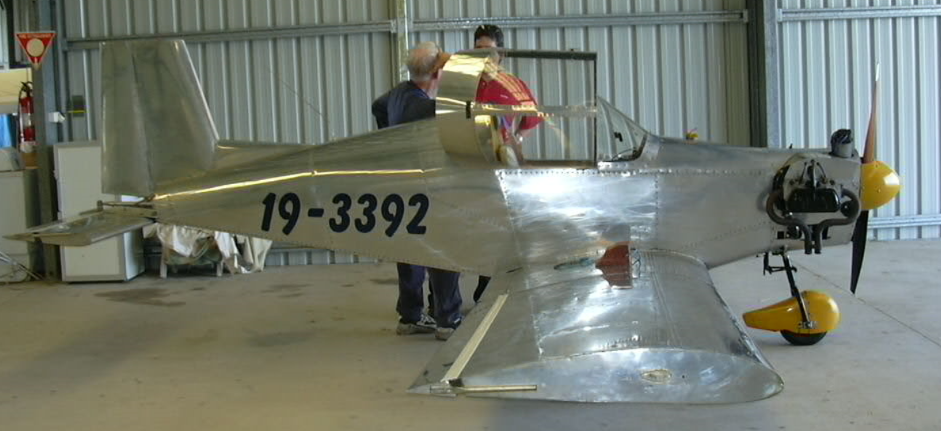
and one more (Caboolture, around 2008):
-
Anyone built a Teenie Two?
pluessy replied to Geoff_H's topic in Aircraft Building and Design Discussion
I bought the plans from Calvin Parker back in 1987 and studied them for a long time. I also looked at a completed Teenie Two many years later (Caboolture). In the end, I concluded that the Teenie Two was easy enough to build but not an easy to fly plane due to the high wing loading (most T-2s end up much heavier than plans say). I have since started a Spacek SD-1 Minisport, similar size & peformance on 2/3 of the power and much lighter. Check out the T-2 forum on groups.io, only forum left I believe: https://groups.io/g/teenietwo/messages I think there are better metal options with the Hummelbird or Minicoupe. -
Help with OzRunways - playing with it.
pluessy replied to flying dog's topic in Student Pilot & Further Learning
That's what I did, after I uninstalled the whole caboodle as it used up all the memory and locked up. They just assume that you have the latest 128Gb iPad instead of giving you the option of downloading only what you need, in the "Download" screen instead of the backdoor. -
Help with OzRunways - playing with it.
pluessy replied to flying dog's topic in Student Pilot & Further Learning
I have just re-installed OZrunways after 3 years and I'm not impressed. It has become so complicated that it is now a destraction while flying. I can't download just the maps I need (Qld) and it is clogging up my iPad memory. Flight plans are the little squiggly line bottom right (in map mode). Then give it a name and find your departure & destination (ICAO code). They seem to save automatically. With the new version, it becomes a fight with your finger to enter the waypoints correctly. I'll be looking at alternate options once this subscription expires. I have contacted OZrunways and told them that it is too complicated for RAAus weekend flyers and to give us a simpler version (best one is from about 3-4 years ago), but got brushed off. -
you forget the difference between DIRECT drive (aircraft) and the postie bike. Check the postie bike power at 3,000rpm!!! Rev the aircraft engine up to 6,000rpm and you will get over 250hp, but not for long. Same for fuel burn: aircooled engines have to use fuel for internal cooling due to the large bores. The weeny little bike piston ccan be cooled by the barrel. You are comparing apples with macademia nuts🙃
-
Fuel burn on the 80hp is around 14lph at 75% (91 octane), the 100hp uses around 18-19lph, but minimum 95 octane (premium). Here in OZ that makes a big difference in fuel price (UL95 is ~$.15 and UL98 ~$0.20 more than UL91). Many European countries have much smaller differences and some don't even produce UL91 any more.
-
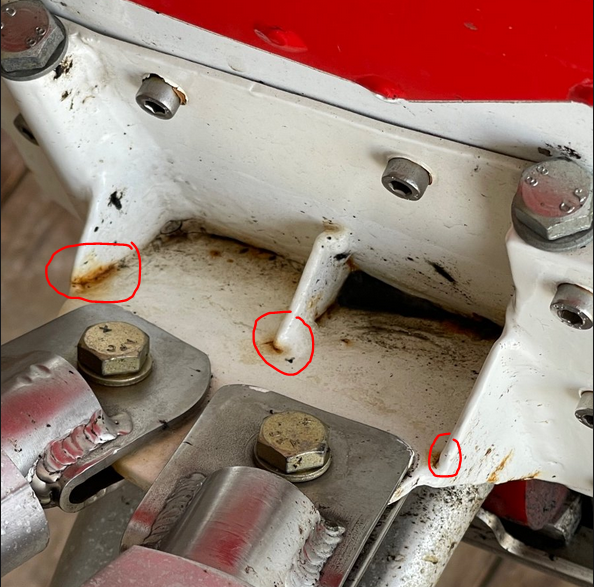
I would recommend to remove the strut brackets, strip the paint and crack test them. This looks like cracking has started at the gussets: For the chute cover, make a new plywood sheet, seal it with thinned epoxy and add some foam to the underside with 1 layer of G40 glass. The cover needs to be able to be blown off easily when activating the chute.
-
Using a sharp pointed pitot or a very thin-wall tube will reduce the effects of AoA and sideslipping on the ASI. Most commercial pitot probes have a very pointy end (conical) to reduce the flow disturbance at angles.
-
Warning! Warning! If your engine turns the same way as the 912 (CW looking from behind, then the advise so far is correct. If your engine is turning CCW, then the offset needs to be to the left.
-
windmilling prop RPM and water in float bowls
pluessy replied to RFguy's topic in AUS/NZ General Discussion
some 1st hand experience from today! My mower had some water in the fuel and stopped. I drained the fuel tank and the float bowl, flushed the line and added some metho and clean fuel. The engine wouldn't start unless I covered the carb intake with my hand, then it would run for a few seconds. I had to repeat that for a couple of minutes before the engine would run normally. Bottom line: water in a carb means dead-stick landing, no matter what! -
windmilling prop RPM and water in float bowls
pluessy replied to RFguy's topic in AUS/NZ General Discussion
you will find that the surface tension of water will stop it from going through the main jet without significant differential pressure (more than the venturi can provide). Water in a carby is usually a dead-stop until removed by draining/cleaning. -
I have one of these jump-starters, have used it a few times now on V-twin mowers. Would start a Jab or Rotax engine as well. https://www.jaycar.com.au/450a-li-po-jump-starter-and-powerbank/p/MB3757 The unit is just under 0.5kg.
-
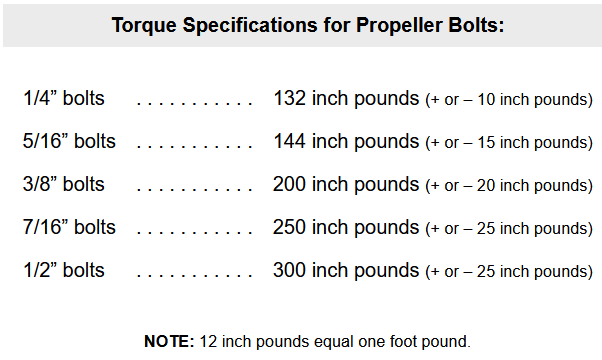
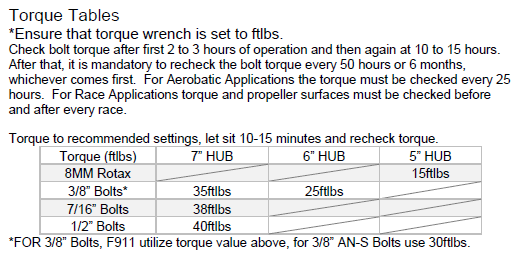
I would check other manufacturers data that make wooden props. Main criteria is bolt size and some times hub thickness. Wood type could also have some influence: From Culver props (left) and Catto (right):
-
some on ebay: this one seems to be 006 to 016 in 002 increments: https://www.ebay.com.au/itm/264092846959?epid=2295842872&hash=item3d7d290b6f:g:X6AAAOSwubRfoxxz&amdata=enc%3AAQAHAAAAwJv5UrkQn98de5bchTVWZNfEwmMXCu0KOylz6vCToVdj6Y6krrUi4x5AbGC1ookaLWl6crNapl%2BT4OsAV9XPkk3n6tLHtWnjsdTZ15FUaXAkjYo49HOsXVbDKAAxyY0VXJRrwlKpJ9Nioy3%2BSHHbXY58m1hXIcav4XbLVS5EhGwwhxQg5zt8Msc1frL4vL6tsWtmdJRPltYf7NpYNoJdUq59HC3PGSZQVjUVkJH%2BfQjVfBL%2BwR%2FiTOyteMVJ8XyJlw%3D%3D|tkp%3ABk9SR4y8qI_oYQ this is a full set, 0.05-1.00mm in 0.05mm steps: https://www.ebay.com.au/itm/155393994522?hash=item242e342f1a:g:QaIAAOSwMthj32NR&amdata=enc%3AAQAHAAAAwHqtnRRWgt4WvHiNEfCed%2BjRc7At7LfGwuwGzceT3DLOOx66Erlzqw6n3yOpieenIfrqHEE%2Bb8LY%2BC6mmb3o2lqJ2GG0jozTHeqB6UYZl1pfppv3V1dLW9tdg4s5ymwA9Qhk%2BBTJyPBoxRJAHO0BIcK54svlyARf88c5mtwBAxi8SIAbG%2BTpAs0Kna8k7pvk3k%2BEI6WPkxejzoKD7HBYkLJ3xlDQuMZUb4IkfTwgWdsrCVaBUexJhHuiPhYWSt%2B3Ig%3D%3D|tkp%3ABk9SR86QrY_oYQ
-
what oil filter brands do you use besides RYCO
pluessy replied to lyle janke's topic in Engines and Props
Look for the equivalent filter from Donaldson or Fleetguard. I consider Ryco to be a cheap filter, Donaldson & Fleetguard are used by major OEMs in the mining industry. They also publish their filter specs. -
What about your fuel pressure? Is that now staying in the normal range?
-
no need, the #35 (0.35mm) jet has been documented by Rotax and mentioned a few times in this thread.
-
That 3lph is correct for 0.4bar fuel pressure and reduces proportionally with lower fuel pressure. In flight at 4,800 and higher rpm, I do have 0.4bar. At lower rpms, it can be less, at WOT in climb (5,300rpm), it is just below 0.4bar. I did have a few episodes where the fuel pressure fluctuated a bit in cruise. It is usually happening with fuel level at the lower end and possibly short unporting of the pickup. My Tecnam has wide but shallow tanks with no internal baffles, so fuel sloshing around will unport the pickup at low levels. I deliberately ran the LH tank (with fuel return) dry once to see when I run out and what happens. I picked it up on the fuel pressure, watching it slowly dropping to 0 and then switched tanks before the engine stumbled.
-
I used the fuel flow gauge, engine off, electric pump on and running it for 10-15min to get a stable reading. Then I used that to re-calibrate the fuel flow meter so it reads correctly at full fuel pressure. I have suggested to JP Instruments to add a calibration routine to the FS-450 so that the instrument can compensate for the return fuel and show true fuel flow.
-
Not confused. The 3lph of fuel return are insignificant compared to the 18-26lph that go to the carbys. The carbys will overflow if the fuel pressure exceeds the float force. With the engine shut down and temps increasing, the fuel pressure will increase and over-power the float force (fuel pump valve prevents venting backwards) if there is no return line vent. The longer the fuel lines, the more fuel it will force into the carb bowls. Reading a pressure gauge is not just the value, it is also the way the needle moves (fast/slow/steady etc). I have been flying behind a 912 for over 500h and do my own maintenance, so know a thing or two. The return orifice is not required for flying, just makes starting easier and helps with extended ground taxiing times (low fuel flow to the carbys and high under-cowl temps).