


skippydiesel
-
Posts
7,613 -
Joined
-
Last visited
-
Days Won
73
Content Type
Profiles
Forums
Gallery
Downloads
Blogs
Events
Store
Aircraft
Resources
Tutorials
Articles
Classifieds
Movies
Books
Community Map
Quizzes
Videos Directory
Posts posted by skippydiesel
-
-
24 minutes ago, spacesailor said:
There is one overlooked " grease " , by the name of Lanolin.
It is the oil from sheep's ( wool ) hair .
I have used it on rubber & it hasn't damaged it , after five years . It still has a little
Shine left .
Not ' animal ' fat , as it is only in the fleece.
spacesailor
Yeah! I have only occasionally used it (Lanox) but like the idea that its of organic origin and is therefore likly to have very low toxicity (if any) is appealing. I would steer away from the pressurised spray cans and go with the liquid applicators (less likly to be thinned with hydrocarbon)
-
 1
1
-
-
12 hours ago, onetrack said:
The only thing to use on rubber items for a lubricant is tyre mounting paste. All other petroleum-based products will eventually have a detrimental effect on rubber-containing products - even silicone sprays.
Silicone comes in may forms - some may have hydrocarbons present.
Silicone spray. The WD40 Silicon is almost rubbish - I use it for jobs where I don't feel high lubricity or persistence is required. CRC Automotive Silicone on the other hand is in a galaxy of its own, compared with the likes of WF40.
I suspect that many "sprays" have a hydrocarbon thinner in them.
Molykote 111 is a silicone grease that is approved for use in food preparation/manufacturing - I doubt any hydrocarbons present.
-
10 hours ago, onetrack said:
Not quite. Personal care soaps contain numerous additional ingredients that are not necessarily beneficial for tyre mounting. Proper tyre mounting paste contains rust inhibitor, and dries somewhat tacky to prevent tyre bead slippage on the rim. In fact, there are plenty of undesirable additives in some personal care soaps that are not even good for your skin, or your health.
 Do You Know What Goes Into Your Soap? | Here’s Our Top Ingredients to Avoid - Australian Botanical Soap
AUSTRALIANBOTANICALSOAP.COM.AU
Do You Know What Goes Into Your Soap? | Here’s Our Top Ingredients to Avoid - Australian Botanical Soap
AUSTRALIANBOTANICALSOAP.COM.AU
Your health and peace of mind are worth the extra attention when selecting the right soap for your daily routine.I have a feeling that the definition of a soap is not limited to the type used for personal hygiene
"Soaps are potassium or sodium salts of a carboxylic acid having a long aliphatic chain attached to it"
-
 1
1
-
-
What do you think a recreational activities chart, showing relative risk of an injury, requiring hospital attention would look like???
-
5 hours ago, Marty_d said:
She did extremely well.
She certainly did.
Interesting that the canopy latching system is not connected, through an inhibitor/safety switch, to the ignition system. The switches are very simple & cheap - every ride on mower has them.
-
1
-
-
I have had a lot of success with Molykote 111 where a "rubber" lubricant is required.
One tube will last me up to 2 years, so despite its initial cost, it works to be quite economical.
In general products containing hydrocarbons (engine oil/fuel/ many polishes/ etc) should not on "rubber"
-
The focus is on dying - All very dramatic however nothing can be done for the dead .
Far more important is the risk of injury, especially those that leave the person with a permanent disability.
I would speculate, that death has quite a ow economic impact. Injury costs a motza and ongoing disability must have a huge impact.
My bet - the above chart would look a lot diffrent if it was about injury, requiring hospitalisation.
-
2
-
 2
2
-
-
If your planning on cutting an oil level inspection hatch, check out the very many examples on other aircraft. Location & size are critical for frustration free operation.
-
"There are comments here that imply just that...that this the best way..period."
The implications are but your interpretation ie may not be the writers intent.
-
27 minutes ago, Red said:
It really depends, if your track is 90 degrees to an airfields Runway then flying directly overhead at an appropriate altitude is far safer than offsetting some miles away where the likelihood of encountering descending traffic becomes a factor.
As Nev alluded to, constraining yourself to a single mantra that works for one set of circumstances is never optimal.
Descending/Ascending traffic can come from any point of the compass, relative to an airfield.
Communication and the eyeball are you best defence against a collision with another aircraft.
Pilots operate in a dynamic environment, who in their right mind would "constraining yourself to a single mantra that works for one set of circumstances" ?
-
On 16/06/2024 at 8:56 PM, Blueadventures said:
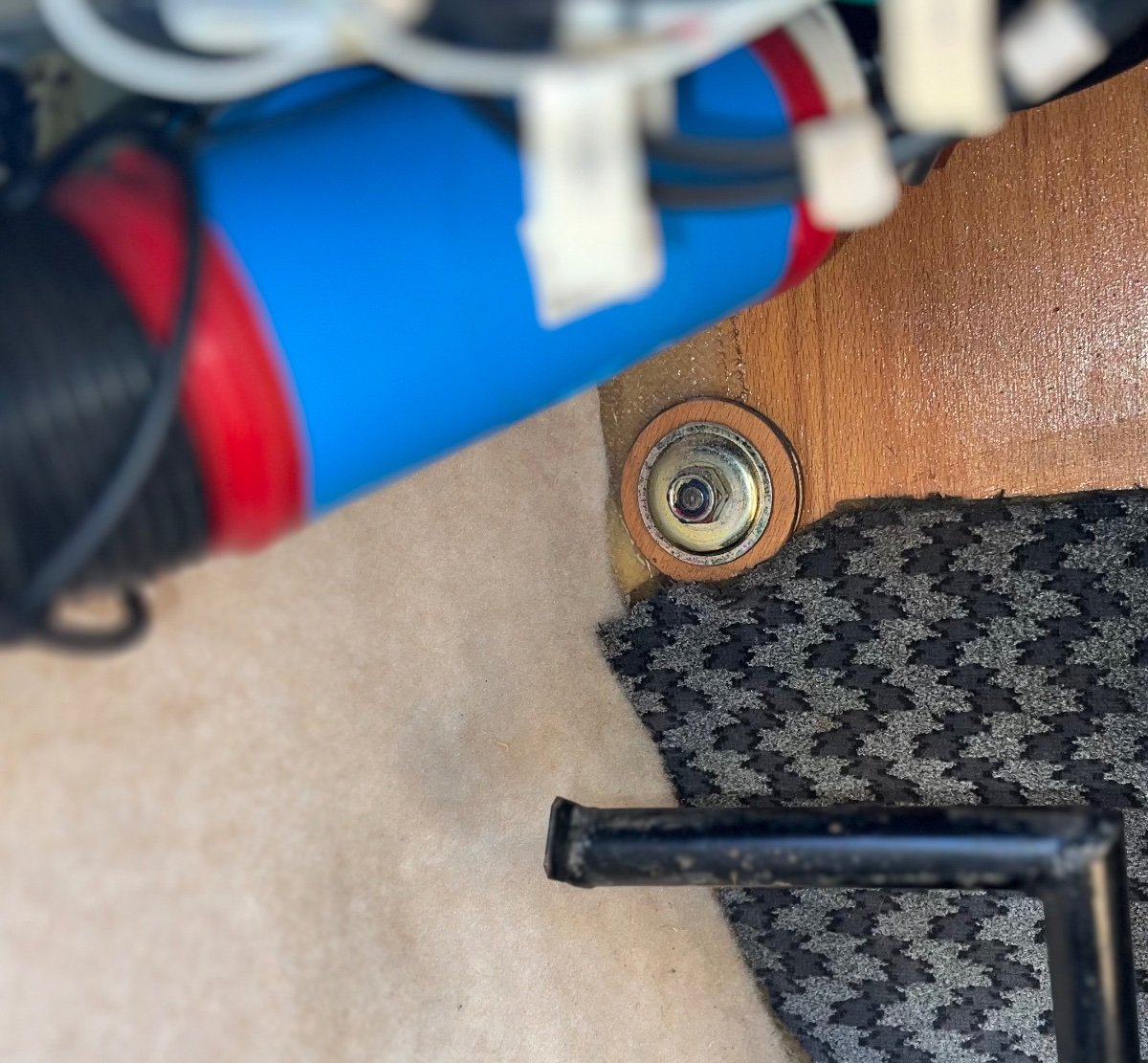
Skippy this is image of lower port engine mount bolt; others same. Thread not protruding nylon nut.
Something has been changed.
If memory serves, where you have whats looks like a cupped washer from a car suspension, there were purpose made aluminium plates. This goes for all the through firewall bolts.
You need to remember that the engine frame and remains of front wheel mount, steering mechanism were all removed, prior to the new owners purchasing the aircraft.
Prior to the accident, the engine frame to firewall mounting bolts , all had at least 3 shreds showing above the nut.
How the engine frame has been fixed and refitted, is for the new owner to comment on.
-
1
-
-
2 hours ago, Blueadventures said:
Some over fly airfields on a route, (bit like playing baseball where you touch each base). No need to over fly; just fly say 5 miles off that way your not congesting the air space in the close vicinity to the airfield.
Depends on, amongst other things the transit height and traffic associated with the airfield.
When on a trip, for the most part, I fly the shortest distance, at the altitude for best time & minimal fuel consumption.
If I am at , say 7500 ft, most airfields & their circuit, are so far below me that any aircraft in/out bond aircraft in the circuit, are also safely well below - safe to over fly the airfield.
If I was at 3500 ft, a detour might be the safest decision - 10 Nm would be appropriate. However if radio traffic is very light/non existent, I may elect to fly closer or even overhead the field.
No matter the altitude or the radio traffic, I would still do the 10 Nm call, with estimated time overhead/abeam the field. I would call again when reaching my intended position, relative to the airfield.
The above lets pilots and ground radio monitoring, know where I am, what my intentions are and when I am leaving their vicinity. It also provides me with a bit of a safety net in the event of some misfortune to me & my aircraft - when/where was my last transmission, was I on planed track/altitude.
-
1
-
-
1 hour ago, kgwilson said:
Joining overhead or overhead join/re-join has been a commonly known and documented procedure since I first flew in the mid 1970s
You live and learn - still don't see how you can" join overhead" from 500ft plus over the circuit height. I do an overhead call for almost every airfield I land at but its a position call, followed by "joining X wind for runway ?????"
-
1
-
-
11 hours ago, Red said:
..................then a call of crosswind can indicate someone who just made the first turn into the circuit after climbing out........................
Hmmm! I have no recollection of hearing or making a X wind call on climb out - this would certainly cause confusion if happened in a busy circuit.
-
58 minutes ago, Red said:
Overhead joins are seldom used of even understood.
What is an "Overhead join" ?
I routinely call "Overhead The Field xxxxft" followed by whatever circuit joining information as previously stated.
As as far as I understand, to be overhead the field means that you are at least 500 ft preferably more, over circuit height. You can only join the circuit once established at circuit height.
-
1
-
1
-
-
6 hours ago, jackc said:
This brand would only be my only choice, costly? Yes, but probably the best there is……
https://www.turtlepac.com/products/collapsible-jerry-can-fuel-tanks/
Yeah! I have visited the factory. If attention to detail, cleanliness and order, have any bearing, they must produce top products.
For the most part their aircraft products are aimed at in flight fuel transfer (as in "ferry tanks").
I already have a fixed (in aircraft) conservative 6 hr duration with reserve. On all my travels I intend to land at around 2 -3 hr intervals, if for nothing else to have a pee & some exercise. This will greatly impact on overall trip time but what the heck, I am retired and I do this for fun. The carriage of additional fuel would only be contemplated in the event of uncertainty about the next refueling point.
Not sure but think my 2 x20 L collapsible Jerrys/bladders may have been made by them - they don't have inflight transfer capability. The Jerrys have, up until now, only been used for fetching ULP from the nearest suitable petrol station (do not containe fuel in flight).
-
1
-
-
10 minutes ago, jackc said:
The more I read this thread, seems lots of differing interpretations making me feel safer paddock jumping in a FAA Part 103 aircraft and staying well away from any airfields/airports etc. Not over 400 feet, just dodging the odd Drone. 🤩🤩
It's not as bad as these vested opinions(including mine) might seem.
For the most part pilots are keen to feel that they have communicated their position (in space) and their immediate intentions. That they may not have been absolutely correct in their phrasing /terminology is a secondary (not unimportant) consideraton.
For my part I believe courtesy is vital -
A pilot should not go against the established circuit pattern, without very good reason
Should be only so brief in transmitting, so as to establish an accurate understanding in the receiver(s)
Should, only if needed, seek clarification (Say Again) in a neutral tone
Should not, while in the air, belabour any point of air etiquette IF sufficiently informed of the other pilots position/ intention and that no conflict need exist.
Be willing to "make room" for the inexperienced or stranger, even if this means Going Round or flying an extra wide pattern, etc
Should inform the transmitting pilot that their radio has a problem (transmission is weak/noise/broken/etc) thus alerting them to a possible communication issue
😈
-
3
-
1
-
-
1 hour ago, Thruster88 said:
A Question. I think I was taught many years ago when I got a PPL that all turns above the circuit (over flying) were to the left. If joining crosswind to a RIGHT hand circuit like we now have at Cowra on 15 would this not make the mid field the only option. Perhaps this is why pilots should spell it out.
Skippy saying you are joining cross wind FROM THE DEAD SIDE is just cluttering the air waves, is there another way to join cross wind?
The landing direction, therefore the circuit direction, is decided by the PIC ie there is nothing in the rulebook that says you can not land down wind. This is even more so in light/nil wind. By announcing the approach direction & the joining choice, all pilots in the vicinity will know where to look (find me) and what to expect.
The Oaks airfield has a conventional (left hand) circuit for 36 and a right hand circuit for 18 ie there is no circuit over the nearby township of The Oaks (it's always DEAD/not active) . By announcing "From The Dead Side" I am informing the listening pilot(s) that that is the direction I will be coming from and intending to "Join Cross Wind" - I will be overflying the departure /upwind end of 18 or 36 , to turn midfield, on Down Wind, whichever is the active (or pilot selected) landing direction. There is no ambiguity.
-
2
-
-
4 hours ago, pmccarthy said:
Crosswind is a location... it is leg flown by planes that have taken off and have turned to join downwind. It is not a safe place to join, as they may not see you coming!
Cross wind in this context (joining the circuit) is a direction not a location - simply put its flying across the wind/active runway prior to joining. The only other X wind is on climbout again a direction.
4 hours ago, pmccarthy said:Midfield crosswind is further back - over the runway itself - and over the top of any aircraft taking off.
To be precise its between the centre of the runway and the upwind (departing) threshold - no aircraft should be climbing anywhere near circuit height between these two points and no aircraft should be descending below circuit height
Circuit procedures are given in non-controlled-aerodrome-circuit-procedures.pdf (casa.gov.au) Note that midfield crosswind is the ONLY crosswind join.
The example broadcast from the CASA website is:
Tyabb traffic, C172, ZTQ joining midfield crosswind, runway 17, Tyabb.
It isn't complicated!
Thanks for that reference pmccarthy - it appears I am mistaken about the use of the word "midfield" - my apologies.
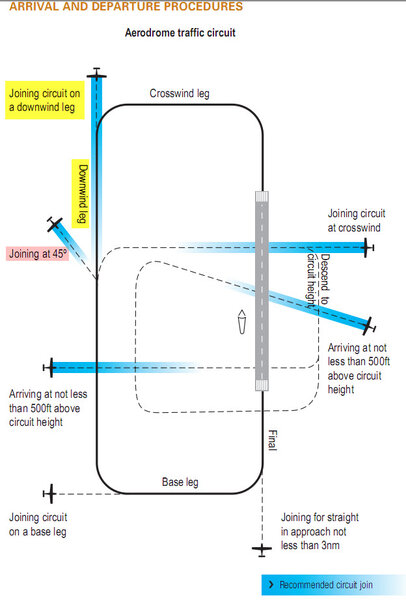
There does seem to be a bit of official confusion on this point - the circuit joining/landing diagram just refers to joining cross wind and shows the aircraft joining at the approximate midfield point on the downwind leg..
As midfield is the recommended joining point, it still seems to me that using the word "midfield" is redundant - I almost always used the phrase "Sonex #### joining X wind from the dead side" and have never used the word "midfield" as listening pilots will know at what point I will join and turn down wind (midfield).
-
1
-
-
1 minute ago, RossK said:
At YLIL, crosswind joins are over the depature end threshold. The ERSA entry for YLIL also states, "no Midfield Crosswind joins".
The meatbomber dropzone is on the dead side next to the middle of the aerodrome.
Interesting - I guess the airfield authorities wish to emphasis the need for pilots to avoid the midfield area - bit hard to do if they don't use the word midfield.
To be clear, I am not suggesting that pilots should not join midfield (where allowed) but that they don't use the word midfield, as its not approved terminology, adds to the length/complexity of the transmission, for no improvement in clarity.
As I said earlier joining X wind means the pilot will be transiting between the upwind threshold and midfield (preferably the latter), across to the downwind section of the circuit. The actual joining point will be aproximately midpoint downwind, between the top of climb (Cross wind) out and the top of descent (Base) for most aircraft ie not midfield (which refers to the runway itself, as in airfield).
One more thing: As stated earlier I am far from an exponent/good example of aviation terminology - I am expressing my understanding of what should be uttered at this point in a pilots activity.
-
1
-
-
"Joining crosswind means joining at the point where an aircraft taking off would turn onto crosswind, say 0.5 to 1.0 km beyond the end of the runway"
I do not think you are correct - there is no joining point "beyond the end of the TO runway".
Joining, beyond the upwind threshold increase the chances of conflicting with climbing aircraft.
A X wind join is preferably over the upwind threshold but may be closer to midfield should the PIC decide to do so.
"Midfield crosswind means over the runway, toward the departure end. "
It may be that we are saying the same thing but the use of the word "midfield" in the joining circuit context, is non standard ie not in the book of rules
Note the blue highlights & wording below
-
1
-
-
1 hour ago, Red said:
I guess it's a local terminology thing, to me (a simple pom) its as clear as mud
so what does midfield crosswind mean that makes it different from just saying crosswind?..Im guessing it doesnt literally mean half way along the crosswind leg as that would be a daft place to enter the circuit
Enlightenment required
I understand "joining X wind" to mean the pilot intends to join the circuit, crossing the airfield at a point between the up wind threshold & midfield.
The objectives are, for the joining aircraft to # not conflict with fast climbing aircraft climbing out, to be # in a known 3 dimensional position.
The use of the word "midfield" is redundant ie does not enhance awareness and just adds to the length of the transmission.
-
Via Forrest - Fuel IS the BIG consideration
My assessment of the options for fuel on the inland/railway route via Forrest :
Refuel with AvGas @ Forrest - No problem. Rotax will accommodate the resultant "shandy" with 98 RON. Cost may be a factor.
Carry additional fuel - I will have 2 x 20L fuel bladders with me, that could containe 98 RON. If needs be could add a third 20L. This would add > 4 hrs to my duration, still air > 1339 NM.
There seem to be a number of auto fuel possibilities, close to ALA's , along the Stuart Highway, well within range but of course all would have to be contacted/verified before decision/launch time in Perth.
Not entirely comfortable with idea of carrying fuel in the cockpit area but many have done it before me.
-
On 18/06/2024 at 6:45 AM, Red said:
Only downside I can see with motors incorporated into the wheel is they hugely increase unsprung weight which has a negative effect on the the suspension.
Interesting! Speculation:
Motors in the wheels delivers;
True 4X4 without the need for complex systems to overcome torsional wind up
Potential for each wheels traction to be controlled by the "drive" computer = Much better acceleration, safer cornering, braking and control on sub optimal surfaces (oil/gravel/ice)
Places the weight of the vehicle were it needs to be for optimum traction and minimal body roll
Potential for optimum body design/shape to minimise drag, while maximising internal space/layout
Zero transmission efficiency loss
Simplifies construction (cost efficiencies) and same basic motor/wheel may be used across many diffrent body styles.
-
1
-
1
-


The risk of dying doing what we love
in Student Pilot & Further Learning
Posted
I think you're probably correct.
It's interesting, at least to me, how biased statistics (in this case recreation, death & age) can be used to sway/influence people.
The statistics may be correct but that they reflect a very limited/biased view of the dangers inherent in activities in question.
In this case using the fear that we all have of untimely death, would lead people to believe that certain activates are so dangerous that they should be avoided.
I suspect that if the risk of injury (resulting in a visit to an emergency department) was the criteria being studied, flying a small aircraft would likly be very low on the scale, horse riding (I have been a rider all my life) on the other hand likly to be high on the scale.