


skippydiesel
-
Posts
7,611 -
Joined
-
Last visited
-
Days Won
73
Content Type
Profiles
Forums
Gallery
Downloads
Blogs
Events
Store
Aircraft
Resources
Tutorials
Articles
Classifieds
Movies
Books
Community Map
Quizzes
Videos Directory
Posts posted by skippydiesel
-
-
6 minutes ago, pmccarthy said:
At a country airfield, if there is inbound traffic, it is good practice to announce departing circuit to the east not above 3000 or whatever, jus so everyone knows where they are.
Make the call, irrespective of knowing that there is inbound traffic.
-
29 minutes ago, BrendAn said:
where does it end though. are you going to broadcast your intentions every 30 seconds. you should be having a good look in both directions before you call entering and rolling.
Its a while since I did my last GA BFR however if aged memory serves; At a controlled airfield you ask permission to line up (enter the runway). When permission granted, you may also get be cleared to TO. Without TO permission you don't. TO off will be authorised when appropriate.
-
VH JEY -
VH registered aircraft seem to be able get away with very small registration letters (compared with RAA registered numbers). No hope of seeing JEY's rego from the ground or air. How can this be???😈
-
On 21/07/2024 at 4:54 PM, laserfly said:
I flew across the Nullarbor and back to Melbourne in a Searey April 2024.
Cruises at 80 kts and 4 hours endurance. Head winds are a factor.
The road houses where fine. All Airstrips where ok.
Nullarbor has the best runway looks to be all weather.
Boarder airstrip is good. Landed on the cross runway on rtn. It is rough, the surface is ok a lot of weeds growing up.
Mundrabilla ok in places lots of weeds growing up. No fuel.
Caiguna Good surface flat. Airstrip, looks prone to flooding if raining.
Balladonia Good surface. Wide and long airstrip, great food and 98.
My thanks - Great information for aspiring trans Australia flyers.😈
-
Awsome!!!!
-
On 17/07/2024 at 3:27 PM, spacesailor said:
Not all ' ship ' voyages were " happy ended " .
Check SS YONGALA 1911 ( see Wikipedia ) .
The story I heard was ,
The southerly storm chased her up to " cape Bowling Green " , (were they were to take shelter ), they readied the anchor , but it slipped overboard, gripped the floor & pulled the ship under . All were lost and only a dead ' horse ' was recovered .
Now a great dive site .
spacesailer
If no survivors ,who told the unlikly anchor story????😈
-
On 17/07/2024 at 9:29 AM, pmccarthy said:
I was taught that the location comes second. The reason is that people are often slow on the transmit button and you may lose part of the first word. Saying traffic first gives the listen a chance to pay attention and then hear the location. I think the CASA radio procedures booklet is wrong in that regard, though I can see why you would want to follow it. And there is no "traffic" at the end of the message, which I hear a lot.
It would seem you have been taught incorrectly :
You are speaking to a location "Cowra" - its a general call to all aircraft in this geographic location as in "Traffic"
When entering Camden air space its "Camden Tower" not Tower Camden
You end the transmission with the location ("Taree") , just in case you clipped/did not transmit the location at the start.
The format is"
Use the IMPAIR format to make clear calls. IMPAIR stands for:
- Ident: to whom am I speaking?
- Me: aircraft type and callsign
- Position: distance/bearing
- Altitude: in feet
- Intentions
- Request (if in CTA/CTR/ADIZ).
-
 1
1
-
On 10/07/2024 at 11:22 PM, Moneybox said:
I’m on a rush trip south tonight. These long drives, 900km in a day, are too much for me these times. We’ve sold a property down here and I’m trying to clean out 25 years of junk before I head to Queensland to look at the Sportstar. That caravan transporter would be perfect but I don’t think it’s going to fit.
Just remove the horizontal stabiliser fiberglass tips & it will almost certainly fit.
-
 1
1
-
-
9 hours ago, pmccarthy said:
Why incorrect? And the time is right as I said it. Don’t see how you could say it much quicker.
The location comes before the "Traffic" as in "The Oaks Traffic"
As for time taken, your delivery/speech rate may be just part of your personality, which is absolutely fair enough.
I would rather a slow delivery, that I can understand/take in, than an overly fast but I still think your estimate is about twice as long as needs be.
-
7 hours ago, pmccarthy said:
I just checked timing for my calls. Average length is 8 seconds. Example: Traffic Kyneton. Foxbat 0000 joining downwind runway 36 Kyneton. Other calls are no longer. So, with (say) 5 aircraft, each calling inbound, downwind, base and final, you have 32 seconds per aircraft, 160 seconds for five aircraft, call it three minutes, of radio calls in the time it takes to get from 10 miles inbound to on the ground, typically ten minutes. About 30% of the time. Seems OK to me.
8 seconds is one hell of a long time/message. Your (incorrect) example is 2-3 seconds at most. Could be the cold in those southern areas😈
-
1
-
-
37 minutes ago, cscotthendry said:
Or a similar situation that happened to me:
You key up the transmitter to make your Joining call at the same instant another plane does. Neither of you hear the other's call and you end up at the same point in the circuit.
I had joined the circuit at Gympie, made a joining call and heard no other radio calls and neither did my pax who is a commercial pilot. Just as I was about to key the TX for my Base call, I heard "Gympie traffic, Jabiru xxxx turning base for 14." and a second later a Jabiru popped out about 20 feet below me and turned base!
You have gone a long way in proving the need for more calls.
You didnt say if you made an ",,,,,,,Inbound......." or an "......Overhead......" for Gympie or if the Jab did similar. Either way neither of you appears to have been aware of the other, from well before you joined the circuit.
Silence may be Golden but it may also end in tragedy.
-
2
-
1
-
-
On 18/03/2024 at 10:00 AM, BurnieM said:
Clarify idle speed;
1400 is with zero throttle
Normally we use 2000 for warm up
Hmmmm!
When I cold start, with "zero" throttle, my 912ULS engine runs at 2500 rpm.
I immediately reduce choke by 1/2 - pause for a second or so - reduce /close by second 1/2 and increase throttle to maintain 2500 rpm (top of Green arc) for warm up.
I assumed this to be normal cold start procedure/ warm up
-
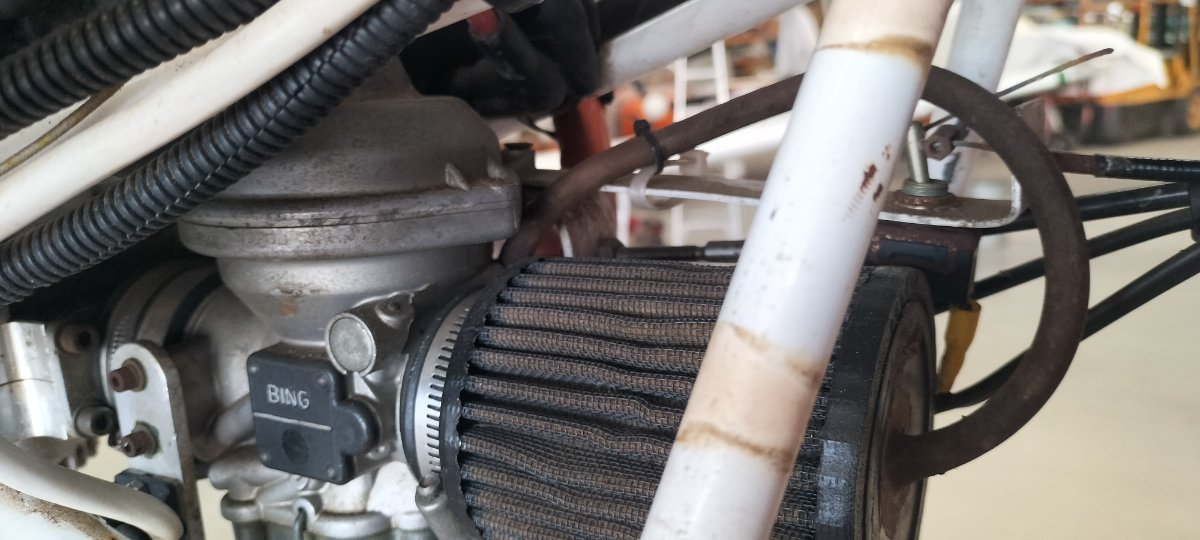
55 minutes ago, BrendAn said:
The hose must be for carb vacuum or maybe a vent ?. It just loops over to a nipple on the carby.

It likly the carburettor float bowl breather/overflow. Its supposed to terminate in an area of atmospheric pressure thats the same as the carburettor air intake.
-
 1
1
-
-
I am aware of the history/vested State interest and resultant problems - none of which is to the economic or safety benefit, of the nations driving public. Apathy Rules!!😈
-
1
-
-
"It's a rule introduced in Victoria about 5 years ago; it means that you can't cross it. You can cross a solid white line to park if it's safe, but the other side of the yellow line is a no go zone."
Thanks for that . Next time I'm down Mexico way, I will look out for solid yellow lines (are there very many?)
Just completed a 4 hr round trip, one city one large town & many small villages - not a yellow line anywhere😈
Back, in my Mothers day, when Australians numbered about 6 million, it made sense for each geographic area (State) to make their own road rules - now at 27 million, plus a lot more interstate/international travel, it's crazy that there is not a standard set of road rules for all Australia (role on the yellow line?????).
-
Hmmm!
Not sure that I have seen a solid/unbroken yellow line in Australia - A solid white line (lane marker) indicates the usable limits for vehicle movement, of that side of the road .
In Britain a solid yellow line is a no parking sign/indication.
-
Hard Quiz last night. Subject Roundabouts. Question (in short) Which of four vehicle do you give way too? Only one of the 5 contestants answered correctly.
A telling statistic!
-
1 hour ago, Red said:
As I've mentioned in my experience it just works for a less than adequate time period.
If you look at the installation manual, Rotax actually states fitment should include a supporting airbox, the omission of such in many uncertified aircraft is done for a variety of reasons, mainly space and weight constraints
What is the "time period" you refer to? - less than 5 years, 5 years, more than 5 years?
"Rotax actually states fitment should include a supporting airbox" - Take your word for it but I would point out they also support the minimalist individual conical filters (part number 825551) that are almost ubiquitous, in this part of the World.
-
For any other intersted aircraft transporters
Following are all internal dimensions:
- Length 7.3m
- Min Width 2.201m
- Max Width 2.300m
- Max Height 2.230m
- Min Height 1.805m
Back Door Frame:
- Hight 1.805m
- Width 2.201m
For most aircraft (after wings removed) the width of the van, is likly to be a fraction too narrow for the horizontal stabiliser. Two solutions seem have potential:
- Remove entire stabiliser. May be a big task in some designs.
- Remove stabiliser tips. Many aircraft have fiberglass tips to their empennage. Usually pop/pull riveted in place, it should be quite quick & easy to drill out the rivets, remove the tips, making the empennage fit easily into the aircraft carrier.
-
25 minutes ago, pmccarthy said:
Its the weather, unsuitable for flying so we deviate.
Hmmme! "deviate" - that could also be a whole new topic😈
-
 1
1
-
-
45 minutes ago, BrendAn said:
it doesn't matter what i prefer. the thread will get shut down soon like it always does when we drift too far.
That it has gone so long & far afield, is probably due to the adjudicators recognising a "slow" Forum (hopefully temporary)😈
-
1
-
-
It strikes me, that those of us who discuss engineering systems, all have some concept of "perfection" (don't take me too literally). Where perfection is wanting, we call that poor engineering (or worse).
Over many years of tinkering, I have come to realise that what might, at first glance, be categorised as poor engineering (rubber socket/inlet manifold to carburettor) just seem to work despite the naysayers.
Rotax carburettors are actually supported, at least in part, by another engineering oddity, a spring. At least this is compatible with the vibration reducing rubber - it just doesn't look quite adequate and is in an odd location - again it just works.😈
-
1
-
 1
1
-
-
5 hours ago, turboplanner said:5 hours ago, turboplanner said:
Almost all of that fits into the "Behaviour" category which indeed is a significant fatality sector on our streets, roads and highways.
It's almost a zero fatality cause in racing because it's observed in multiple places on a circuit/oval by stewards all the time the person is driving.
Good points - it's not all about penalties, there is also a shared ethos ie all understand that bad driving will slow the race, cause accident ($$$$$) and may incur loss of privileges(earnings$$$$)
r..............measurable behaviour like speed, seat belt and mobile device traps. I agree and would add non address bad driving only mitigate the outcome - crash survivability
New drivers they have the best knowledge of road rules in the user groups and the best habits and, like flying fewer fatalities. Logical ,even reasonable but I dispute this (no data) as I frequently see P plate drivers not using manoeuvring signals correctly, unable to merge, use a roundabout as designed, dont reverse park, cut in without signal, etc etc
The next group, under 20s is the reverse, learning about hooning, drug taking and alcohil etc. Fair comment
"drive to right"
Initially freeways and multi-lane roads allowed passing on both sides.
This allowed freedom of choice for both slow and fast vehicles where slots opened up.
Trips times reduced and accidents reduced substantially. There was an official figure for reduction of fatalities on freeways.
Even though we, as humans could successfully pass safely on the left or the right, righteousness from the "safety industry" set in and in some states on some roads new rules were introduced prohibiting driving in empty right lanes where there was a (crowded) left one available. The nett effect is no real news on fatalities, so probably no reduction on the already small number, but a drop in travelling efficiency. This has been compounded by, in some States on some multi-lane roads and freeways, a total ban on trucks in the right lane because they slow the traffic (In reality virtually every semi and multi-combination is road-speed-governed to 103 km/hr and the freeway is flat.)
I absolutely disagree - I started driving on an Australian license (late 1970's) before relocating to the UK for 8 years where I received my semi (articulated vehicle) license. The UK traffic was and probably still , is exponentially more populated/dense than Australia, had strict No Passing On The Left (exception being a town/city one way street) and trucks not allowed to use right lane, on 3 lane plus motorways (freeways). UK free ways were posted 80 mph (130 kph) and this almost seemed to be interpreted as the minimum speed. The system worked perfectly - drivers actually knew how to EFFICIENTLY pass and return to the inner lane. Trucks passing did not cause mobile traffic jams. For the most part driver singling of intent was excellent as was road courtesy (eg slowing/ changing lanes to allow another vehicle entry).
Allowing passing on both sides encourages lane hogging (slowing traffic) requires the driver to monitor both sides of the vehicle for passing /faster traffic making situational awareness more complicated than needs be (less safe).
"Truck drivers many km to pass"
If you slow down to say 80 as soon as a long straight becomes available, he can judge the opportunity and pass in a very short time.
I like this idea. I think it may not often apply to cars but Grey Nomad Vehicles should take note
5 hours ago, turboplanner said:I agree with you road design is a very important segment and is responsible for a significant slice of the relatively small road toll.
I would like to debate this but feel we have strayed too far from aviation, so perhaps a "rain check"?
5 hours ago, turboplanner said: -
1 minute ago, BrendAn said:
As interesting as this subject is it has nothing to do with flying any more.
Sad but true;
In the last week or so, not a lot of aircraft debate on the Forum.
Any general interest discussion is good, almost all of us drive & have an opinion on other drivers/road design/etc.
We could change the topic and have a go at religion, sex, politics, if you prefere???😈
-
1
-
Uncontrolled airports. Which call to make in circuits if you’re only going to make one call?
in AUS/NZ General Discussion
Posted
ALL calls (in non controlled environment) are at the pilot's discretion. He/She should make whatever calls judged necessary for good airmanship (safety of his craft & any others known & unknown, in the area/circuit).
Flying is a dynamic activity, within which the PIC must adjust his /her calls according to the circumstances of the moment.
YOU as PIC must stop trying to make the responsibility of good communication someone else's ie proscribed.😈