


old man emu
-
Posts
5,297 -
Joined
-
Last visited
-
Days Won
78
Content Type
Profiles
Forums
Gallery
Downloads
Blogs
Events
Store
Aircraft
Resources
Tutorials
Articles
Classifieds
Movies
Books
Community Map
Quizzes
Videos Directory
Posts posted by old man emu
-
-
Crickey, Phil! I was trying to be tongue-in-cheek!
OME
-
 1
1
-
-
Yenn, I appreciate your thinking behind this comment, but by using "Europeans" I was making a distinction between those whose cultural origins are northwest of the Alps and the rest of the wogs, dogs and other undesirables.Surely the majority of people in Australia should be Australians, not Europeans.OME
-
I know it's not PC, but have you ever noticed that the majority of people in Australia who use firearms during the commission of crimes are non-Europeans?
OME
-
Fortunately, we Australians don't have that gun-toting culture of the Yanks. I don't think that the Shooters Party will ever gather the backing to get act in the way that the NRA does. We might be a weird mob, but we ain't crazy!Too right they'll never beat the NRA. THAT's what lobbying and campaign donations achieves. Don't kid yourselves that it couldn't happen here, especially with the current far right wing mob in power.OME
-
 1
1
-
-
I bet there's a lot of pilots who have never seen an IFR En-Route chart, only VFR ones. I don't know if they have changed since my youth, but the IFR En-Route charts were on green paper where the VFR ones are bluey-purple (?). The IFR charts were a good cheat as they gave the bearing between airports so you didn't have to draw all over your WAC chart to get your track.
I remember doing some flying "under the hood" when I did my PPL. I think the idea at that stage of training was to create skid marks on the Y-fronts so the rookie pilot took care to avoid those situations where reliance on flight instruments was required. I remember that the Night Rating involved a lot of training in recovery from unusual attitudes, and well as regular currency requirments after the rating was achieved. My mate had his Night Rating as I always enjoyed gong with him while he flew to maintain his currency. There were two conditions that he said were distracting - flying on the Full Moon because of the moonlight reflecting off the wings (we flew a Mooney) and flying below cloud because of the reflection of the anti-collision strobe from the clouds.
OME
-
I agree with you. I think the machining involved produces a work of art. Collecting them as art works, or to preserve the history of firearms is a fine thing.I personally see nothing wrong with collecting gunsPersonally, I think the fun of firing a gun is in the "bang" and the hole in the target. I used to love attending my annual qualifying shoot when I was a policeman. It was more fun when we went from Smth & Wesson 6-shot 38s to 9 mm, self loading Glocks, which are a much nicer handgun to use.
For me, hunting with a firearm is pretty ho hum. But that's my viewpoint.
OME
-
 1
1
-
-
I think that the stats will show that the majority of firearms that are stolen are long arms of .22 and 12G calibre - that is, the firearms most commonly owned by people who don't take suitable security precautions. The rest of the responsible gun owners are just that ... responsible. Having said that, it seems that when a firearm is used in a shooting where the parties are well known to each other, it is a long arm that is used.It would be interesting to see the stats on firearms stolen in the last year or two.It would appear that Australia's major weapon problem comes from the use of knives by people from those ethnic groups where knives are part of their culture. A fair dinkum Aussie uses fists, boots and a lump of 4be2. Glassings are an Aussie adaption of the knife culture, since it's a bit hard to get a cut-throat razor nowadays. The majority of shootings by criminal gang members are carried out with hand guns, as part of wars for control of drug distribution.
Personally I can't see the need to hold more than three firearms: a shotgun for ducks and rabbits; a .22 for cats and foxes, and one bigger calibre for pigs (razorbacks).
OME
-
3
-
-
Obviously Australian and in the 1970s. I'm thinking that it was designed and built by a bloke from Melbourne who had an Italian name. He was killed when this thing crashed. There was a thread here on this plane a few years ago. I think his son, who is now an adult was looking to revive it.
-
It's been five days since this happened and still no confirmed information about the owner or operator of the airplane, nor of the PIC. This is a most unusual occurrence for this forum.
What's behind the lack of information? Was the airplane being operated by ASIO on some clandestine mission? Are our drug lords using airplanes to transport their vile products between cities to avoid interception by Police?

A conspiracy theory is in its embryonic stages!
OME
-
You're OK Phil. The humour in your postings is often insignificant.I really DO hope that my "Humour postings" are not too significant in this regard. . . . PhilOME
-
3
-
 1
1
-
-
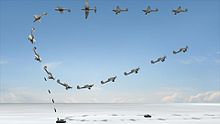
I was thinking more of moving targets. The Italians were hit whilst in harbour, basically sitting ducks. The hit on the Bismark must be considered as a lucky one, as the torpedo hit the rudder section - a moment or two later and it would have missed.Tell that to to the Italian navy!!If you look at the diving flight path:
you can see that the pilot would have more chance to adjust for the movement of its target during aiming.
The advantage the torpedo airplane has is that it can fly very low on approach and the target's anti-aircraft guns often can't be depressed enough to fire at low flying targets. That's what gave the Swordfish an advantage in the attack on the Bismark.
OME
-
Would have flown rings around a Swordfish - 210 kts vs 120 kts for the Stringbag, and I suspect that a dive bomber would be more effective than a torpedo bomber against most targets.
Hey, http://aviacaoemfloripa.blogspot.com.br is a very good blog to look at.
OME
-
Not being a member of RAA-Aus, I can't access the registrations database on its site. Maybe a member would do it for us?
Also, I would have thought that since the RAA is a smallish community, there would be people here who would recognise the airplane involved, or might have some information on who normally flies it.
Or maybe everyone has been head down, tail up in their hangars doing maintenance since the weather on the east coast has been 8/8 crappy, and today it's 8/8 'let's commit aviation!"
OME
-
I'm astounded that it is now Sunday nearly 60 hours since the report was received and the registration number of the airplane was given, that no one has come on here and identified its owner/operator, or if the information was to hand, the name of the pilot. Previous reports of incidents on this site have quickly provided these facts, if only so that people can voice their commiserations. Why, in this case, the information black-out?
OME
-
Phil, I understand what you are saying, I was just commenting on a difference we make here. I don't suppose that there are the great numbers of what you would call Orientals in England that there are in our major cities. A great game to play while walking through the Sydney CBD is "Spot the European". The odds of finding a European are often worse than 50 to 1. It's because of the difference numbers of Asians and Indians here that we have to make the distinction based on physiognomy.
As for the "-ation" jokes,
A Japanese tourist on his first day in Sydney went to a bank to change 100 Yen to dollars. The teller did the exchange and gave him 97 dollars. A few days later, the tourist did the same, but this time the teller gave him 98 dollars. About a week later, the tourist returned to change a further 100 Yen, but this time the teller only gave him 94 dollars.
The tourist thought he was being ripped off and said to the teller, "Why you alway neva gi'me same dollar?"
The teller answered, "It's the money market - fluctuations."
The tourist shot back, "Fluct you Australians, too!"
OME
-
3
-
-
Great way to get quick service at a pub near a back-packers' hostel in Sydney.Yeah,. . . I've seen it before too. Sorry. ( slinks away into the woods. . .)OME
-
"Interrogation = Inter - rug- asian" shows an interesting difference between you English as we Australians. To us, Asians come from the countries starting with Burma and going east, and north through China and Mongolia and on to Japan whose inhabitants have facial features one typically associates with a Chinese person. We consider all the peoples of the sub-continent to be Indians, only making the distinction between nationalities when it becomes necessary for clarification.
OME
-
Do we know who owns this, or where it is based? As far as I can recall, it is not one of Gostner's. I think it is a private owner.24-7852OME
-
 1
1
-
-
Marsupial meat is different from placental mammal meat in its composition and response to the heat of cooking - much like fish is different from chicken. Marsupial meat will toughen if overcooked, that's why the recommended best cooking method is a short exposure to high heat. Cook it for as long as you would cook a filet of fish. (If you are a Scot, you can batter it and then deep fry it!)
OME
-
Imagine that you have the misfortune to be flying along on a cross-country jaunt when your airplane suffers engine failure which means that you will soon be back on the ground, BUT the terrain you are flying over presents no suitable, cleared landing patch - just trees or rock-strewn paddocks. You know that your arrival at ground level will result in the airplane being severely damaged. How do you handle the landing??
Old advice is that you have to fly the airplane as far into the crash as you can. So the first requirement is to decide that the approach to landing will be the sort that would result in a 'greaser' in front of the Sunday crowd at your home field. All that remains is to decide how to fly the last two feet.
In my opinion, the airplane should be side-slipped to the ground, trying to make the wingtip furthest from you hit first. Obviously, every attempt should be made to reduce ground speed to a minimum.
What's my reasoning? Well your moving airplane has Momentum, which is dependent on speed and weight.
M = mass x velocity
(Not quite the correct scientific words to use, but clear enough for this post). Momentum is a form of Energy, and this energy has to be dissipated before the airplane will stop. One way to dissipate the energy is to distort structures. That's why modern cars have front and rear 'crumple zones'. In a collision, the car's momentum distorts the material in the crumple zones so that the total momentum of the car is reduced before the cabin area starts to distort.
If the airplane is flown with the nose leading the motion, this sequence will happen.The front of an airplane usually contains a big mass of heavy metal (the engine) supported by relatively soft metal (engine bearers). In a front-on impact, the first parts of the airframe to bend and break are the bearers. This allows the cabin to collided with the rear of the engine, without much of a reduction in momentum. The next thing which can dissipate energy is the instrument panel, and then when it crumples, the occupants are next in line to get rid of the momentum. Have a look at some photos of WWl flying crashes. The pilot is usually slumped over the front of the cockpit, and the engine has been pushed back. Note that the wings are often only slightly damaged.
What I am suggesting is that by side-slipping to the ground and trying to have the wingtip furthest from you hit first, it will be the wing spar that will start collapsing first, and there are quite a number of feet of strong material to break up before the force exerted by the ground reaches the fuselage (Remember Newton's Second). The airplane may rotate around the collapsing wingtip, but this will have the advantage of making the engine collide with the ground at an angle to the longitudinal axis of the airplane, and may cause the engine to rotate away from the cabin, where you are sitting. This rotation with force you to the rear and centre of the cabin away from the collapsing instrument panel. However when it is your turn to do some momentum dissipating, you will stop your rearward motion and start to move forward, but towards the side of the cabin which is going to be a lot softer that the instrument panel and engine.
So my suggestion for surviving a crash landing onto unforgiving terrain is to:
1: Fly the airplane into the crash as slowly as possible, while still maintaining directional control.
2: Side-slip your approach to the impact point, with the wing tip furthest from you leading the motion.
3: Prepare for the impact of your body with the side of the cabin on the opposite side of the airplane to the wingtip that hit first.
There is one thing that will affect your decision as to which wingtip hits first - if you are flying with a passenger in a side-by-side, you have a moral and legal Duty of Care, to place your passenger's welfare above your own. In that case, you land on the wingtip on your side. "Greater love hath no man ..."
I'd suggest that as an exercise in airplane control, you shoot some circuits on a calm day and make each landing a power off, side-slip approach, so that you get a feeling for what the situation looks like.
WARNING and DISCLAIMER
Before conducting side slip manoeuvres in landing configuration with flaps, consult your airplane's Operator's manual to see if such manoeuvres are permitted.
Old Man Emu
-
2
-
2
-
-
Insecure Load - there's a grave o'er fence!
OME
-
If you have had a passion for aviation for a while, and you have managed to do a bit above average in your High School studies, then you will not have any overwhelming difficulty in taking on the theory part of learning to fly. Despite its seeming like an awesome task, the amount of theory you need to become a pilot is no more than that required to get your driver's licence.
At your age, I would suggest that you spend the rest of this year earning money from you part-time job, then after you have completed your High School finals, book in with a flying school for two or three weeks' solid training. You'll learn pilotage skills much quicker by doing your flying in a block of time, and while you are waiting between lessons, you can work on your theory. In the meantime, put a lot of effort into basic algebra and trigonometry during your Maths lessons. These are the parts of Maths that are directly related to piloting.
Old Man Emu
-
1
-
1
-
-
I think John cleaned it up a bit. I know the analogy as "As tight as a nun's nasty."
OME
-
1
-
-
He probably would have spent two hours trying to work out how to paint the gaps between the palings!
OME
-
3
-


More ( Racist ) one liners
in Aviation Laughter
Posted
Ahh! Phil Perry - our very own Staffordshire Bullsh|t Terrier!
OME