


old man emu
-
Posts
5,297 -
Joined
-
Last visited
-
Days Won
78
Content Type
Profiles
Forums
Gallery
Downloads
Blogs
Events
Store
Aircraft
Resources
Tutorials
Articles
Classifieds
Movies
Books
Community Map
Quizzes
Videos Directory
Posts posted by old man emu
-
-
If the airplane was insured, the wreck belongs to the insurance company, just as happens with cars. They will sell the wreck by tender. If the airplane was a GA one, then there are a couple of commercial dismantlers who would tender. If the airplane was an RAA one, then there might not be any commercial dismantlers interested in it. You would have to approach the insurer.
If the airplane was uninsured, then it still belongs to the unfortunate owner. You would have to approach the owner to see what his/her position was. Maybe they want to walk away from the wreck and are willing to sell bits to cut their losses, or maybe they want to recover as much as possible to rebuild. If a person owned a Jabiru which had been totalled, then they could get back into the air by stripping out the wreck and putting the bits into a new airframe. In the case of storm blow-overs, the damage is going to be to the airframe. Everything else would be still OK.
Don't forget that it is the identification plate attached to it that is the airplane. In theory, your could rebuild MH170 if you owned the identification plate.
OME
-
-
Strewth! Someone at RAA got a dose of foresight one day.Nope, the four numbers in the registration are only used once. Eg- there will only be one 24- 7030 and not 24-7030, 19-7030 etc.OME
-
The Grief is so deep.
Makes you wish you could have known Phillip personally. What a person he must have been.
OME
-
 1
1
-
-
Give the ATC people a fair go! They cannot be expected to know the name (and in some cases the performance envelope) of every make of Flutterbug, Puddlehopper, Slickchick that is operating. Sure, they would be familiar with the more common RAA types. By simply saying those two first numbers, you switch them onto the fact that they are talking to an RAA airplane. If I heard a call with the identifier 24-1234, I'd be aware that it was an RAA type.
With respect, as far a type "Stratus", I wouldn't be able to readily know (identify?) what that was, simply because there are so many makes of airplane in the RAA hangar.
Old Man Emu
-
C'mon, Yenn. You know that there is a big difference between engaging in a dangerous occupation and making the ultimate sacrifice and engaging in a relatively safe activity and being accidentally killed.
I agree that losing 26 year-old Private Phil, and losing 26 year-old cricketer Phil are equally as bad, but we have made arrangements to remember the passing of Private Phil and those who fell before he did. Apart from the remembrance ceremonies, war memorials, war cemeteries and the like, we also play sport on their special day and dedicate the games to them. This weekend, Phil Hughes closest friends are trying to come to terms with his death on the field and there has indeed been talk of abandoning the Test. However, my money is on the team reaching the decision to play the Test in honour of their friend.
Old Man Emu
-
Well that's buggered the weekend.
OME
-
I hope that Ian doesn't pull my tail feathers for posting this but it is a link to the eBay site of one of our new members.
http://www.ebay.com.au/sch/Collectables-/1/m.html?_ssn=kevdoncarder
While I was working for QED, we would lend this bloke some of our hard to get maintenance manuals and useful documents. He scanned them to disk and offers them for sale, allegedly to finance the restoration of a Tiger Moth. I suppose he must have sold a few CD's cause he's posting on this forum that he bought a project job.
His ulterior motives don't distract from the fact that the CDs provide good quality copies of hard-to-get material. I just can't get on with the job without my Wirraway maintenance manual on CD.
Old Man Emu
-
 1
1
-
-
(I posted this on an internationally followed forum that I contribute to.)
Australians today are mourning the loss of a young life.
As way of explanation, Australia's favourite summer sport is cricket, a game played around the world, even in the USA. During a game at the second highest representative level, a young batsman was struck in the head by a cricket ball. Although protected by a helmet, the ball struck the lower rear of his skull, seriously damaging his cerebellum and rendering him unconscious. Despite the best of medical attention, he did not regain consciousness and died 24 hours ago as I write this.
The batsman, Phillip Hughes, would have turned 26 next Sunday. He had risen through the ranks starting as a boy playing in his home town; progressing through District representative level to being selected to play for his home State. From this, his talent and potential led him to being selected to play for Australia at the International level. Obviously he was a great athlete.
Messages of condolence have flooded in from around the world, not only from the world cricket family, but from players of other sports, politicians, entertainers and the cricket loving man-in-the-street. It has been noticeable in hearing these messages of condolence, the number of people who have eulogised Phillip, not simply as a great batsman with the cricket world at his feet, but as a likable polite young person who, despite his hero status remained a caring, sharing local lad. That must come as a grain of solace to his parents and sister.
The injury was accidental. The ball, weighing between 5.5 and 5.75 oz (156 - 163 gms) was bowled to him in a legal way, within the spirit of the game, at a speed of around 90 mph (~150 kpH). It rose from the ground sharply and would have been described as a "bouncer". For a batsman of Phillip's standard, such a delivery would have been run-of-the-mill. However, as he swayed his body and turned his head to get out of the ball's path, he may have misjudged its line of flight and the ball hit him in an area of the head that is not expected to be in danger in the normal course of events.
What makes his death so tragic to my wife and I is that, although we did not know Phillip personally, we have traveled the path he and his parents traveled as he grew up. Our son turned 26 last Sunday, so he and Phillip are the same age. Our son was a successful batsman as a lad, and we spent our summer weekends going hither, thither and yon for games, and suffering the heat, dust and sun at cricket grounds. In every game, we watched, hoping that serious injury would not befall him as he batted, or even as he was in the field while the opposition batted. Competition for places in representative teams, and his interest in the opposite sex, halted his progress up the grades. We feel deeply for Phillip's parents who lost their only son, only to find out with in what high esteem he was held in his local community; his home State; his Nation, and Internationally.
At the same time we must extend our sympathy and support for the bowler, Sean Abbott, a friend and former team mate of Phillip. There was no malice in Abbott's heart as he bowled that fatal ball. We must prevent him from believing that he did wrong. What happened after the ball left his hand was God's way of selecting an opening batsman for the forthcoming Heaven -v- Hell match at Lord's Ground.
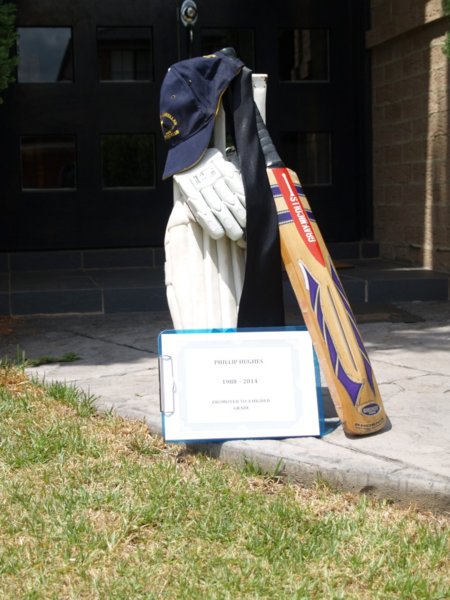
Vale, Phillip Hughes
1988 - 2014
Promoted to a Higher Grade
-
1
-
 1
1
-
-
Bout time you joined us here.
Sen Const Old Man Emu
-

Phillip Hughes
1988 - 2014
PROMOTED TO A HIGHER GRADE
-
6
-
-
Our fathers used more genteel language in those bygone days. Society has changed and along with it our day-to-day vocabulary.
Instead of INTERCOURSE LEAVE, I believe that the current RAAF term is F^UCKED OFF.
OME
-
I notice that his wife went out with him, but he held on to the plane.The things we do, at the spur of the moment, to protect the things we hold dear.PudPud, was you punctuation incorrect in your post? Should it have been "... , to protect the things, we hold, dear."
OME
-
 1
1
-
-
It's been a while since I raised this topic and we have a lot of new members who are Owner/Pilots who may not have heard this message before, so I'm repeating it.
It you are interested enough to own an aircraft that meets the requirements of the RAA, then you must have a modicum of interest in knowing how things work.
I'll bet that you have a stack of well-thumbed aviation magazines stashed away somewhere and that you follow aviation news religiously. Most of the articles in those magazines relate to piloting. What about getting the most out of your airplane mechanically. Along with your aviation magazines and books, you library should include an smattering of technical books relating to how your aircraft is put together and stays together.
As starters, I strongly recommend these:
1. Mechanics Toolbox http://www.mechanicsupport.com/
This is probably the most comprehensive collection of aviation related maintenance there is. It is an outgrowth of John Schwarner's Engineering Manual which you can purchase through here http://www.aircraftspruce.com/catalog/bvpages/skyranche.php , or from John direct.
2. Light Plane Maintenance http://www.lightplane-maintenance.com/
This is a monthly magazine that deals with a variety of aircraft problems that have come up in the field. It also contains subscribers' letters seeking answers to their problems. The subject aircraft tend to be GA, but there are always articles dealing with problems that beset the most basic of aircraft. Subscription details are on the site.
3. AC 43.13-2b
If the manufacturer doesn't say how to do a repair, then this is the accepted way to do it. Download it now and burn it to a CD. It's free!
4. Old Man Emu's Blue Bible of Aviation Hardware.
This is a collection of information relating to the nuts, bolts, screws and other bits that keep our aircraft together. It contains explanatory notes on how to work out the descriptors of hardware so that you can send off an order to your supplier and know that you will get the correct thing back in the mail.
There's no link for this. It will be available from the Clear Prop shop when Ian burns a few copies. He's told me that the price for a copy should be about the price of a cappuccino.
You should always be on the lookout for aircraft maintenance books in places like 2nd hand book shops, markets etc. because the techniques for constructing aircraft from wood, tubing or sheet metal haven't really changed since Pontius was a pilot. It's the electronics that have gone ahead, but for Owner/Pilots at our end of the scale, the ole knowledge is still OK.
Old Man Emu
-
5
-
2
-
 1
1
-
-
Oh f*ck. That's kicked my guts in. What more can I say?Ok, to stop ongoing inputs as to the "why " .....Was not machine, environment, or....pilot error. The reason was pre documented .( guys, seek a best mate, and if needed talk, really talk )
OME
-
Without pre-empting the inquiry, this factor will have to be investigated:
"As a result of the crash a spot fire started which quickly developed up the steep hills here and with the dry wind that we have got at the moment it's flamed fairly intensely."
Doesn't take much for the best of us to get caught out.
OME
-
And I bet that your response to "Can I borrow your torque wrench for a minute, mate?", would have been, "Yeah. Sure mate, but she's a boomerang."
And after reading this: http://www.mechanicsupport.com/articletorquewrench.html , is it worthwhile paying a motza for a torque wrench anyway? I just bought a German made one from ALDI for $14.99 on special.
Old Man Emu
-
This, from the Unbrake site, fills me with confidence ... not!
COATINGS:
- We have largest capacity of cold forming for bolts in India. We can cold forge up to 36mm dia bolt.
- We can do close tolerance in hot forming.
- We can do close tolerance in hot forming.
- We have in house CNC machines.
- We have in house Spherodize annealing plant for wire rod.
- We have in house continuous Mesh Type Hardening & Tempering plant.
- He have in house Hot Dip Galvanizing.
- He have in house Mechanical Dip Galvanizing.
[*]Xylan
- He have in house electro galvanizing of zinc & copper cadmium.
- He have in house Rilsan coating for Water Board Industry of U.K., Europe & U.S.A.
- He have in house sheradising coating.
- He have in house Kunz Decrotizing coating.
- He have in house PTFE coatiing
Spec for 12.9 class metric bolt:
12.9 M1.6-M100 alloy steel, quenched and tempered
OME
- We have largest capacity of cold forming for bolts in India. We can cold forge up to 36mm dia bolt.
-
Here is a quote from the above post:
Examination of the timing gear on engines with broken bolts has identified severe fretting of the gear against the end of the crank, this cyclic movement is the reason the bolts are breaking. The retaining bolts are 5/16th socket cap screws property class 12.9, although some of these are threaded full length, which wouldn’t normally be considered best practice, all the bolts are fracturing on the shear line.
12.9 bolts have an ultimate tensile strength of 1220 MPa and yield strength of 1100 MPa, it is normal to tighten these to within 90% of yield; this is to ensure proper clamp pressure of the parts.
This would cause the Jabiru bolts to elongate by about 5 thou and is the mechanism by which clamp pressure is maintained.
A company in Hamilton (New Zealand), Asseco has analysed this joint and come up with a torque figure of 41 Nm for these bolts with lubricated threads and washer face. I have used the formula from MIL-HDBK-60 and come up with a figure of 43 Nm using the same lubrication and 56 Nm with no lubrication.
The Jabiru manual states a figure of 24 Nm for these bolts with out lubrication, it is my belief that this where the problem partly lies. (Jabiru apparently now recommend 32 Nm but this is still almost ½ the maximum preload the bolts can take.)
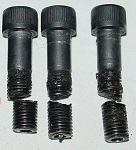
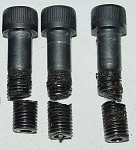
Here is a picture of some of the snapped bolts:
12.9 Class bolts are the top end of classification of Metric bolts. In other words, they are the duck's guts. However I have found that is is virtually impossible to obtain certification documentation for Metric hardware, whereas AN, MS and NAS hardware can be tracked right back to the furnace that smelted the ore.
There is also the argument to be had whether bolts should be lubricated or dry when fitted. I'd support dry fit in this situation as it is said to produce more distortion of the threads in the hole and the bolt. It is this distortion that makes the clamping pressure to hold the parts together. At least Jabiru recommends a situation that leads to higher applied torque. (24 Nm = 17.7 foot-pounds; 32 Nm = 23.6; 41 Nm = 30.42; 43 Nm = 31.7, and 56 Nm = 41.3)
Old Man Emu
-
2
-
-
Hmmmm.
Metric bolts. Bloody hard to get certification for Metric bolts compared to AN, MS and NAS imperial bolts. Sorry, I just don't trust the hardware used by Jabiru. They might sometimes get it from China via Bunnings.
I recommend that you click on skeptic36's link. This picture is from it:
These are Property Class 12.9, which is the highest class of metric bolt.
OME
-
The Mechanics Toolbox and the Sky Ranch are written/produced by the same person. Essential reference material for anyone doing aircraft maintenance, and very interesting for people keen on mechanical engineer.OME, that reference of yours agrees with the part in the Sky Ranch book where the story is told of how Continental or Lycoming tried every "safety" method on big end nuts, eventually using nothing.
Now, that might be the key to the problem. What is the material that the bolt is going into? Also, have you ever seen fine threaded bolts used in association with high torque?It's a fine thread OME. LaurieOME
-
I can't remember what the thread on these flywheel bolts looks like.
If it is a coarse thread, then the metal the bolts are going into is "soft", like aluminium, cast iron or alloy. When the were initially fitted and torqued up, there would have been damage to the threads into which the screw was going. That is the way screws/bolts work. They get tight by distorting the material they are screwing into. This also happens to the bolts as they tighten. If you take the bolts out, you are left with a minutely "stripped" thread, so that the next time a bolt is screwed in, it is going into an over-sized thread. That's why it would be a good idea to at least replace the bolts each time they come out.
This all begs the further question: Why are the flywheels being taken off? The only reason I can see for removing a flywheel is to replace a toothless ring gear.
Old Man Emu
-
1
-
-
I wonder if anyone at Jabiru has read something like this
http://www.mechanicsupport.com/torque_loss.html
and http://mechanicsupport.blogspot.com.au/2012/02/tightening-rubber-gaskets.html
You need to look at this, too.
http://en.wikipedia.org/wiki/Poisson's_ratio#Poisson.27s_ratio_values_for_different_materials
OME
-
As I have said here: http://www.recreationalflying.com/threads/casa-draft-proposal-for-jabiru-aircraft.126874/page-3 , Jabiru has shown that it does not have clue about the correct procedures for assembling an engine. One could add to your list of engine manufacturers, Lycoming, Continental, Poll Royce (Merlin) General Motors (Allison), Ford etc, etc. Rotax probably wouldn't do it either.Jabiru is the only engine manufacturer that uses loctite so lavishly that I know of. Cat, Cummins and other mainstream diesel engine engineers would have a fit if they knew the extent of loctite glued in bolts on crankshafts to flywheels etc. .OME
Prof Avius..Really??..This is the best we can do??
in AUS/NZ General Discussion
Posted
Correct me if I'm wrong, and I don't mind at all, but, in relation to low speed stalls, I thought that the first action when the signs of an imminent stall manifest themselves is to regain airspeed by lowering the nose. This has the effect of not only gaining lift by decreasing the AoA, but thereafter, increasing the speed of the wing through the air. I was also taught the mnemonic APT - Attitude; Power; Trim. So on approaching the stall the sequence would be:
Attitude: Lower the nose to reduce AoA
Power: Increase power until Straight and Level flight is attained
Trim: Adjust trim (via elevator) for S&L flight.
By now control of the airplane has been established; you can breathe again, and fly back to where you were before you cocked things up.
Actually, I believe that the practical exercises in stalling are taught incorrectly. How many of you are were lead to believe that STALL was the Word of the Beast? Don't like to stall? How the hell do you stop your plane flying when you want to put it on the ground?
The most enjoyable experience I've ever had in relation to stalling was a time when my instructor told me to fly to the point of imminent stall (shudder and whistles and bells) and fly the airplane in that condition for as long as I could without going stalling, and without using power. Man! I was pumping that control column back and forth like a wood chopper in one of those wind-driven toys. What did I learn? That an airplane will fly all the way up to the stall and remain under control.
(I should add that in this configuration, with power off, Lift may not be equal to or greater than Weight and the airplane will descend. So you go from SkyCatcher to Sky-Diver - unable to navigate easily from A to B, but not falling from the sky out of control).
So next time you go up with an instructor, spend some time doing very low speed flight and see how long you can keep flying at the point of stall. Bet you reach Lowest Safe Altitude before the wing stalls.