

Ian
-
Posts
505 -
Joined
-
Last visited
-
Days Won
11
Content Type
Profiles
Forums
Gallery
Downloads
Blogs
Events
Store
Aircraft
Resources
Tutorials
Articles
Classifieds
Movies
Books
Community Map
Quizzes
Videos Directory
Everything posted by Ian
-
Yes you're probably right. Curved beams in wood are cheaps than steel generally, I just like the whole ww2 vintage feeling of the arched hangars. Sliding doors start off nice and over the years become more difficult and you arms need to become stronger.
-
Yes, you're right, however an arch type hangar, width 20m with 3x8m sheets spanning the roof, with glulam beams ~400mm deep providing support, and cross bracing using standard strapping would meet Australian standards in terms of strength and wind loads. Cyclonic wind loads or public shelter requirements might need thicker sheeting or plate attachments but that's out of scope for my needs. The centre section is spanned by a single sheet and the fall at the point of the join is well beyond minimal fall to ensure that leaks don't occur. Condensation is reduced by a vapour barrier like sarking and is the recommended way to mitigate this, birds in hangars seem to be more problematic for paintwork in practice. Solid timber maintains its strength for longer under high heat loads, however it does burn of course. The main risk from a durability perspective is probably termites and from a construction perspective finding someone willing to build the arches cost effectively to spec. An arch is more efficient in terms of steel used than a box and you can use dish drains rather than guttering so it's a bit of swings and roundabouts. You can go pretty large with simple wooden arch frames. https://internationalforestindustries.com/2019/04/17/nz-massive-new-hangar-wood/
-
Is would be simpler with multiple sheets not a single sheet, using three sheets, ie 2 sides and a top sheet over the crest gives sufficient expansion on GA hangar sizes. On a larger project you'd be putting in expansion joints when you exceed 23m spans. Even with a single sheet.On a 20m span you get about 12mm of expansion with a 50C temperature change which is reasonable. So about 6mm on each side which should be manageable using standard attachments and tolerances.
-
Not sure what you meant. Arches extend easily in along their axis, changing the span is difficult, however gabled rooves suffer from the same limitation. Is it likely that you're going to buy the neighbouring block and extend, and have a neighbour willing to sell? Is it simpler to just buy a bigger site?
-
Yes but that requires a custom roll and $$. Standard roofing iron is suitable for a 12m bend. Some types will do 8m without artefacts.
-
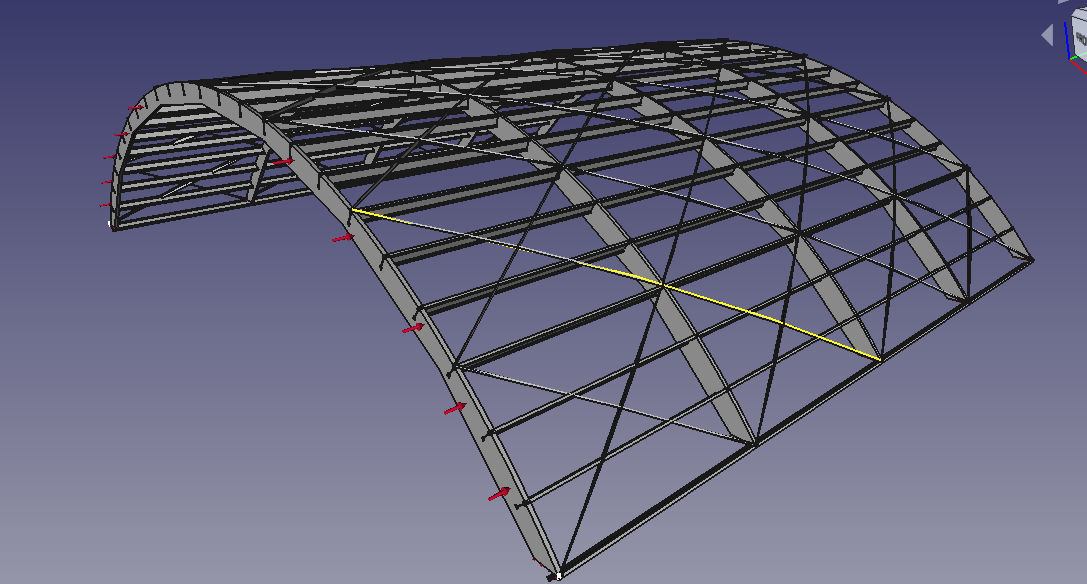
I worked on a number of tilt up concrete construction jobs while I was a uni student and really liked it as a building process. It was never mm accurate and there was lots of optimistic packing when the slabs were tilted. However the sites have aged better than I have over the intervening decades. I'm a bit less enamoured by concrete at the moment just because I've become a bit more worried about CO2 but there are a lot of pros. Maybe there's a grant somewhere for geopolymer using volcanic tuff. https://www.aph.gov.au/DocumentStore.ashx?id=a27746a7-775e-45c9-957a-e8ba0d2e636f&subId=565096 I was playing around recently trying to figure out if you could build the old style hangars cost effectively using glulam arches. A glumlam arch using 10MPa laminates gives about a 50:1 span capability. Standard corrugated iron has a minimum spring curve radius of about 12m so skinning uses standard materials and your height is about 6.5m. Doors remain an issue however at least you get to use some of the area closer to the boundary of your site.

-
What design/size hangar and door combination did you choose and would you care to share the budget?
-
I don't really rate your fire services engineer. This is a henny penny type argument, it is a basic infrastructure problem and it's an easy problem to solve from a design perspective, electrical engineers design standard circuit types to be deployed in these environments which are specified in Australian Standards, if a standard can't found it should designed by a qualified engineer. For example in some environments low smoke flame retardant non-toxic insulation TPE/TPU is mandated (specified in Australian Standard). Sounds like it would be suitable for deployment in an underground car park with limited insulation. (We did have a discussion earlier of whether there's a difference between a university qualified engineer with a BEng or someone who has put the word engineer in their title) The technology to solve the peak load problem exists and has been in existence for years and yes even Governments know about it. Essentially it's a modern version of off peak power but smart enough to tell the difference between I need the car charged now or I need the car charged by 9am tomorrow. https://www.smartgrid.gov/the_smart_grid/electric_vehicles.html Unsurprisingly power companies are also looking at using your car batteries to stabilise the grid https://www.agl.com.au/residential/energy/electric-vehicles/smart-charging-trial, I wouldn't participate in this unless there is a very large payback, your car batteries wear out.
-
The other option is experimental, especially if CASA allows non-builders to maintain. Different set of risks https://saaa.asn.au/courses/mtc-amt3-advanced-endorsements-permissions-to-maintain/
-
You'll have to point out the research papers which show vaccines have caused EBV in 80 people in australia. As far as I know there are a couple of cases of COVID reactivating EVB. https://pubmed.ncbi.nlm.nih.gov/35349757/ https://immunityageing.biomedcentral.com/articles/10.1186/s12979-021-00252-x However, it now seems that “long COVID” could also be related to reactivation of the Epstein Barr Virus (EBV), which lies dormant in a very high percentage of the population You may have had EBV in the past and recent illness of stress may have reactivated it. Or you simply may have been exposed to it recently. I doubt that a vaccine is going to give you EBV. It would take some pretty messy manufacturing controls for that to happen.
-
Below is another good video on the theory and story behind the dynamic soaring record which is interesting but a little more esoteric. Who would have thought supersonic airflow would cause a glider to crash. I just like the sound of it going through the air. In it he says that the G force meter topped out at 120G It isn't like an ordinary glider weight isn't so much of an issue but strength so it can withstand the G forces. I'm surprised that they don't crash more as it's moving so fast.
-
If you're testing positive, the test is picking up the antibodies that you have, so you've been exposed to the virus . Nothing to do with COVID it's a common infection. Epstein-Barr virus (EBV) antibodies are a group of tests that are ordered to help diagnose a current, recent, or past EBV infection. EBV is a member of the herpes virus family. Passed through the saliva, the virus causes an infection that is very common.
-
Yes I used to sail cats and was wondering if anyone would be pedantic enough to call some of the high speed records 😉 How about "In the majority of situations, powered craft will be significantly faster than wind and solar craft". This allows for world speed records on water, air, ice and land. You missed the wind powered dynamic soaring speeds of 548 miles an hour on a very good day.
-
The energy flux of sunlight reaching the surface is about 1kW per m2 and assuming that you have 20% solar panels that about 200W/m2 Compare this will a 200kW subaru WRX and you can see that there's an issue. A car moving at 100km/h requires about 20kW on flat ground so you need an area of about 100m2 ie 10x10m to cruise on flat ground, at midday.... It might be a bit difficult to fit in the garage. If you had a local battery with 90% (so make the panel 120m2 and less than optimal charging times) charging efficiency you need to park for an hour at ok generation times (9am-3pm) for every hours travel. Most houses with solar don't have panels of this area or mounted at optimal angles. But over a number of days house solar will charge a car. Solar and wind are diffuse, that's why sailing boats are slow compared to motor boats.
-
I think that the Government should have done the "Australia Card" properly as a smartcard and collapsed medicare, banking, drivers licences, pilots licences, building access, computing credentials and ASIC cards back into it. I recently had to sign up to the ATOs mygovid as a company director as yet another form of identity but I can't make it subordinate to my mygov identity. A central Gov id could have been voluntary allowing those who want to carry 50 different things around the option of doing so.
-
What you've identified is not the issue with not vaccinating. I fully support people right not to vaccinate be it on the basis of a conspiracy theory, it being banned by the pixes at the bottom of the garden or on good scientific evidence. However I don't support those people being able to participate in functions where they pose a risk to others such as healthcare, teaching, policing and interacting with the public on such things as RPT when there is a heightened risk of transmission as their belief system is putting others in danger. If the belief is based on good scientific evidence eventually logic will prevail however if it is because of the first two reasons, basically you're out of luck. Read the story on Typhoid Mary to understand the risk a carrier can pose to others. I still find the final solution somewhat harsh but the reality was that it achieved a greater good as some estimates put the number of deaths caused by her at 50.
-
Seriously what Australia needs is both, it's not an either or thing. Solar power is cheap up to a certain percentage of your grid, especially when you have consumers who only care about cheap power not intermittency. Think of a swimming point with a salt water chlorinator as long as you get about X hours per couple of days you're sweet. However when you're wringing the neck of a process which needs 24x7 power to provide a return on capital its a different story. Think of aluminium refining or ammonia generation or even H2 generation of course you'll buy cheap solar power when it's available however you need a low cost continuous power solution to fall back on. Fossil Gas or Hydrogen is neither cheap not carbon neutral, neither is battery power of scale that you'll need. Of course you could say well just turn off the refining during the night or dunkelflaute periods however unfortunately many of these components are damaged by cycling processes. And also you're not generating the return on capital of the equipment when it's off so from a business perspective it stinks. It will take at about 10 years to bring nuclear generation online assuming broad based cross bench support and consensus politics unless of course small modular reactors turn out to be economic however By the way that generator is powered by biodiesel rather than fossil fuel so its powered by newly captured carbon new sunlight not dinosaur sunlight. But is does give some some indication of the footprint difference required for a solar-battery-storage solution which would be the size of a couple of a number of tennis courts compared to a bathroom size footprint. Getting off fossil fuels will be very hard and if done poorly expensive.
-
I'm not so sure, my take is the guy is simply a clown and thought he could make a quick buck. Until he was caught he was boasting about how clever his scam was. Not much different from a someone pretending that they're a doctor, policeman or engineer. It's not a simple case of bending a few rules, he was actively recruiting work that he knew he was unqualified to offer without the correct training or permits.
-
Creating areas for plugging in cars is not an enormously difficult piece of infrastructure work. If you really want to run a cable from your house you can already buy simple footpath safe covers which are approved in Australia, they're used in the building industry already. The whole henny penny issue of "not enough charging points" is lets face it, pretty easy to solve and is only required for inner city areas without offstreet parking which isn't the majority of Australian car owners. City planners want residents of high density housing to catch public transport. The extra generating capacity and load on the grid is a much more difficult, especially given the fact that fossil fuels are being progressively phased out. Cars tend to be at home during the evenings and at work during the day when solar is generating cheap power. Given that solar and wind often generate more power than the grid is absorbing, are you going to pay people to charge their cars during these peak times to take power off the grid? If so who's going to pay? Services and infrastructure will adapt, often in an unexpected manner and often to the chagrin of city planners and Governments. A good example of adaptation is the creation of the suburbs, https://en.wikipedia.org/wiki/Suburb historically these were created by better transport options and now 70% of Australians live in the suburbs. Given that most people tend to like to live in a house houses compared to apartments this trend will accelerate now that many workers have demonstrated the ability to work remotely as the requirement to commute has evaporated for this set of workers. Property developers and city planners have been actively marketing the concept of "liveable cities", with convenient local shops, high density housing and mass public transport, prizes are given for the "best cities" which demonstrate "high density" services however these are sponsored by vested interests. Large active marketing budgets trick people into buying into this concept, as the profit margins are better on apartment blocks, and it allows Governments have large centralised service centres such as industrial hospitals. However given the choice people pick free-standing homes, views and larger living areas. Economically this preference is easy to demonstrate, the percentage of high income earners living in apartments is significantly lower than the general population. The whole e-working concept will create a second wave of urbanisation as knowledge workers can now live further from their "work offices".
-
Road rage at petrol station. https://www.9news.com.au/national/knife-pulled-out-during-petrol-station-confrontation/5c3153d2-6f53-4323-bd3c-13f8a56541ac Rage at airport https://www.dailymail.co.uk/news/article-4183992/Air-passengers-fight-queue-jumping-row.html Rage at resturant https://www.mirror.co.uk/news/uk-news/mum-broke-womans-elbow-punched-8860869 Yes, people don't like to queue, and you'd expect with a significant increase in vehicles that as charging point patronage increases. However the situation is Australia is significantly different in Australia, where garages are commonplace so changing can occur at home. For instance you probably have a garage and if you bought an BEV you'd also get a charger installed at home. Most people will do the same.
-
You may be able to leverage an openCL Kalman filter on an embedded platform using an onboard GPU. I've got a multicore embedded AMD Ryzen board somewhere with fairly powerful integrated GPU somewhere that would probably be overkill but OpenCL provides an abstraction between CPU and GPU which is good for this type of operation
-
Out of curiosity what language and library have you written this in and how computationally expensive is it?
-
One thing that I can say about the Chinese economy is that they make a lot of stuff. The Australian economy appears to be based on digging stuff up, growing stuff, moving it around and housing. Housing doesn't actually produce anything except debt and yet we have a tax system which prioritises it. The only thing which weighs against the Chinese is their Government which in the long term will be unable to manage the complexity of their economy efficiently
-
The issue in the near term isn't reserves its pollution and its impact on climate. If we get another la nina next year that should raise a few eyebrows we might see some talk of a locked in la nina.
-
I think that the reason why is that hybrids are a bit of a camel, both electric and ICE so essentially they have higher build costs and maintenance costs. Going 100% electrical appear to be cheaper and more economical in terms of both upfront and ongoing costs. I watched this a while ago and it made me do an about face on my views on nuclear. The presenter is a bit of bit of a green tree hugger type and was involved significantly in solar and wind projects. In this he digs into the out some interesting facts and it made me realise it was an area I didn't know much about.