Ian
-
Posts
519 -
Joined
-
Last visited
-
Days Won
11
Content Type
Profiles
Forums
Gallery
Downloads
Blogs
Events
Store
Aircraft
Resources
Tutorials
Articles
Classifieds
Movies
Books
Community Map
Quizzes
Videos Directory
Everything posted by Ian
-
There are some who swear by them, mostly by those who fly in the stormy areas of the US. The key discriminators are that they're real time, sometimes register small discharges in turbulent air, and can show buildups prior to radar. I originally dismissed them as old tech but I'm not as sure anymore.
-
Hi All, Just wondering about the utility sferics devices such as stormscopes and their kin in Australia especially given that the year ahead is looking particularly wet again. It's interesting trying to correlate what you see on BOM with realtime strike activity on lightningmaps.org on especially in those regions not well served by weather radar. Not that I'm advocating flying into bad weather in any way shape or form, I just wanted to get some idea of their utility or lack thereof.
-
What is CASA's/Airservices resistance to allocating different frequencies for nearby airstrips? I've noticed that airports in reasonable proximity, using the same frequencies, often with similar sounding location names and with similar orientations can lead to those flying in the location ignoring "noise" from arriving aircraft. It just appears to be a bit backwards, especially when the solution which reasonably presents itself is to allocate discrete channels. The whole concept that it will cause more issues isn't really valid as there are different frequencies allocated already.
-
https://en.wikipedia.org/wiki/D-Motor I thought that it was a diesel but instead it was a flathead side valved engine. Can't say I'm a fan, but I like the sleeve valved engines https://en.wikipedia.org/wiki/Sleeve_valve I also like the Deltic engine which is a design which could push some good power to weight figures. https://en.wikipedia.org/wiki/Napier_Deltic
-
So from the above Diesel enjoys about a 10% advantage volumetric advantage over petrol and as you buy it by the litre that's pretty important. Diesel also enjoys a more efficient combustion process which adds another 20% or so advantage in terms of the efficiency extraction process. On a weight for weight basis you lose the 10% advantage however you still see the 20% combustion efficiency advantage of the diesel. Basically this is a thermodynamic limitation brought about by the much lower temperatures associated with petrol combustion due to lower compression. PV=nRT
-
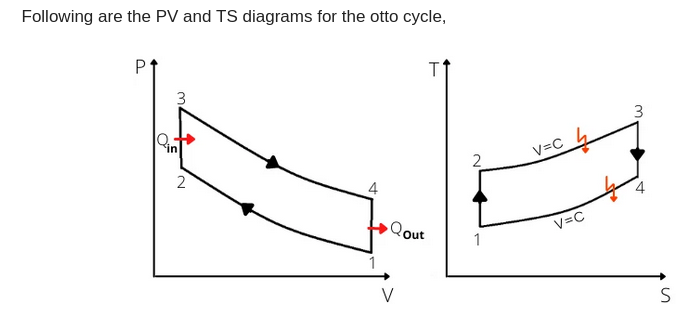
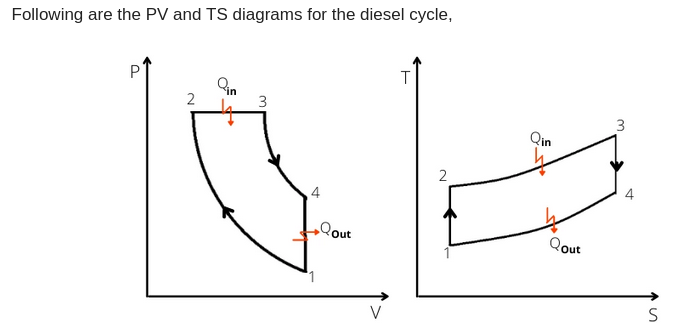
Hi Yenn, think about it, there's a difference between the Otto and Diesel cycle, that's why they each have a name. Notice the differing shapes of the Pressure/Volume diagrams for ideal cycles describing both. The otto cycle requires an external source of ignition because the temperature rise due to compression becomes less when you throttle. A diesel always compressess a constant volume so the pressure rise is constant regardless of throttling. Rather than explain it read the below. https://en.wikipedia.org/wiki/Otto_cycle https://en.wikipedia.org/wiki/Diesel_cycle And here's an explanation of the difference from where I stole the diagrams. https://mechcontent.com/otto-cycle-vs-diesel-cycle/ Of interest is that the Otto cycle is more efficient than the diesel for a given compression ratio. The diesel cycle is practically more efficient because the higher compression enables a higher combustion temperature, laws of thermodynamics etc. From the wikipedia article.

-
Out of curiosity I'd like to know the performance numbers possible using a guiberson with a turbo and common rail.
-
I'm struggle to see your point or maybe I stated it poorly, by definition an engine which always runs with excess air is lean of peak and is a lean burn engine (ie diesel) and an engine which requires operation rich of peak is not (ie o360). https://en.wikipedia.org/wiki/Lean-burn It's a little more complex but in general it is true. Most Airplane engines are designed to use excess petrol for cooling and reduce detonation and may only be run lean as lower power settings. Modern car engines are not, demonstrating that this is possible not an inherent issue but a design choice. Diesel engines are essentially constant airflow, only fuel flow changes during throttling not airflow. So they operate to the oxygen rich side of stoichiometric. ie diesels normally operate at ratios between 17:1 and 70:1 however stoichiometric for a diesel is about 14.6 an tends to leave lots of soot in the exhaust due to the slower burn of diesel. The guiberson diesel from ww2 era was normally aspirated and designed as an airplane engine. It's power to weight was reasonable and it's efficiency was better than most modern cars including a prius. Turbo's can improve the power to weight and allow increases in power at the same rev range. Due to the combustion properties of diesel they tend to have a narrow rev range in which combustion can proceed efficiently. This is why forced induction, allowing more air to be pushed through the engine without changing the rpm is popular. Always is a very strong word, the guiberson has a power to weight of 0.781 kW/kg and the junker ju 205e 0.903 kW/kg and 0320 makes 0.99kW/kg in comparison. So generally works for me. I'm sure there's engines outside this rule and if I stated always someone would just prove me wrong. Also electronics are pervasive however they're on an inherent part of a diesels operation, however you can't design an otto engine without an ignition system.
-
To be clear a few of the advantages of diesel engines using diesel Better thermodynamic efficiency from higher combustion temperatures (due to higher compression) Higher energy fuel per litre 36.9MJ/l compared to 33.7MJ/l. Excess air ensures creates a leaner burn Max power occurs at RPMs that are suitable for propellers without reductions gearboxes Generally can run on Jetfuel (lubrication of the injectors can be an issue). Less flammable fuel Can be electronics free. ie no requirement for ignition. Some disadvantages are Power/Weight generally worse than petrol Power pulses tend to the stronger so items designed for petrol may endure. Limited track record Low temperature cloud point and pour point issues. Generally require turbos to bring them close to petrol engine performance. But I must admit I would be jealous if someone flew in an filled their piston powered plan with jetfuel.
-
It's a tragedy for all involved. All engines, airframes and pilots can fail, lets hope that there's a few lessons in the washup from this that we can learn from.
-
It's a manual process which is a bit unwieldy. The following article gives a bit of an overview of the principle and operation of a couple of commercial kits. https://www.aviationconsumer.com/maintenance/engine-dehydrators-engine-saver-prevails/ There's also the DIY approach https://www.pilotsofamerica.com/community/threads/engine-dehumidifier-diy.115754/ It's not an elegant solution by any means and your mileage may vary.
-
The key problem is that the airspace in the crankcase is moist regardless of whether you use water injection. Yes it may result in the exhaust stream being going through the block and existing via the breather beingslightly more humid however there is a significant amount of water either way. Steam passing over hot components won't condense so condensation occurs for a short period after starting and once the engine turns off and the crankcase cools. Condensate in the oil will evaporate after extended runs and exit via the breather. This is why systems which actively ventilate the crankcase with dry air after parking should reduce internal corrosion for planes which are kept sitting for extended periods.
-
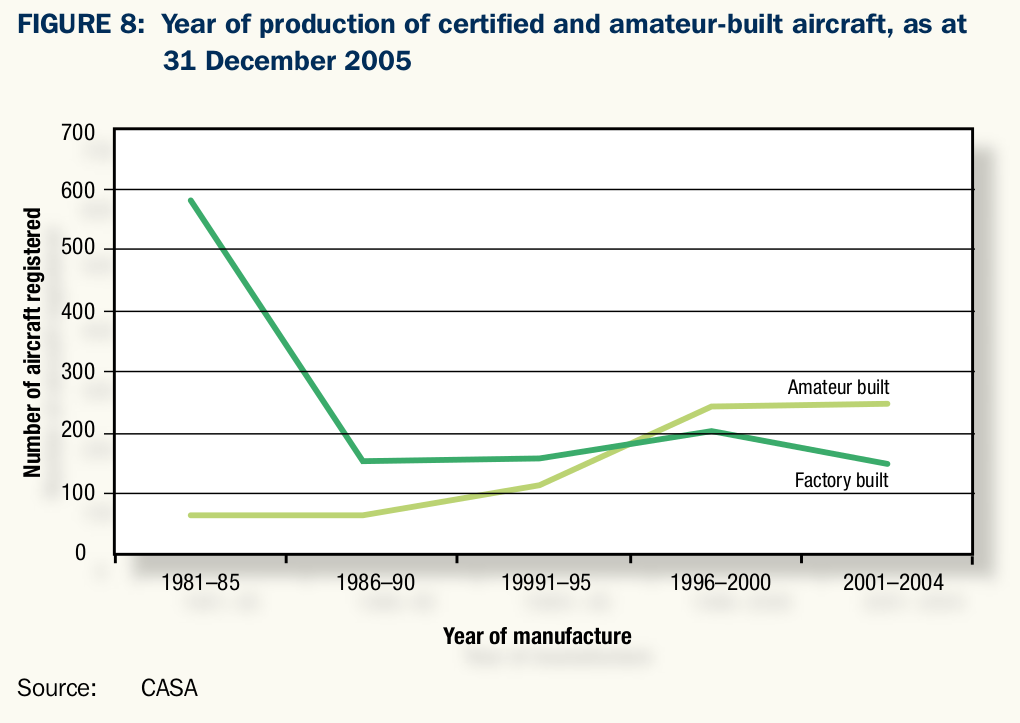
It's from the "ATSB TRANSPORT SAFETY REPORT Aviation Research and Analysis Report" in 2007. It just wouldn't be possible for it to be incorrect. I think that both domestically and internationally there has been a trend towards experimental and light sport aircraft at the expense of the commercial GA streams. This report has some interesting facts. The best selling piston airplane manufacturer shipped 79 aircraft in the quarter. That's ~320 per year for the best seller worldwide. https://www.aopa.org/news-and-media/all-news/2022/may/19/not-all-pistons-remain-popular
-
Personally I think that there is a strong conflict of interest in this area which should be articulated by the commitee, and a key requirement being harmonization of the medical requirements between the different streams of aviation.
-
Because it's a win, both politically and for people in these areas, It is a good thing. Government in Australia is about the delivery of common goods. There is a clear and justifiable common good associated with this activity which is why they should nurture and support it. Their primary consideration should be safety however they should use a risk based approach which incorporates all factors including the fact that regional areas have demonstrably poor health outcomes. I don't think their approach came anywhere close to these goals. As I've stated a risk based approach would be better as well as allowing the consumers of the service to participate in this risk process. I'm aware that there are those in the aviation sector and CASA who think that Angel Flight is a shanker on the prick of aviation, however I think that view is wrong. Volunteer work when properly supported an nurtured can complement and fill areas of need which are difficult to prototype and fill. Often volunteer or charitable services are more efficient mechanisms for delivering services. For example the RFDS was originally a completely charitable organisation without Government support which combined two new technologies to pilot and prototype a new type of service and the Federal Government provides funding of 1B over the next 10 years. The whole point isn't about cost, its about access. Angel Flight as a charity covers the cost. The fact that someone is considering using an U/L for a service which people in metro areas take for granted is telling. It's the sheer dislocation associated with the process which is inherently difficult. As I said, rather than wasting time and efforts commenting here reach out to the political elite to make sure that the Government bodies which are meant to support aviation continue to do so. One of the reasons that I think that experimental aircraft should be included in the mix is that based on recent trends these aircraft will eventually dominate the fleet. For Angel Flight to continue to work aircraft need to be available.
-
This is not a job normally done by a qualified pilot. It's normally done by a family member or some other sap and it's not without risk. A relative died in a car accident on a country highway on her way back from medical treatment in a head on accident. My father had to travel over 5 hours each way to receive treatment for a bone infection for a number of months in Brisbane by car because RPT wasn't available at suitable times. This is common story for people in these areas and any volunteer support to these people is good. He is more than capable of acknowledging the risk that Angel flight wouldn't provide a service as safe as commercial air transport. There's a perception that those running small aviation businesses connected to CASA have an axe to grind and think that Angel Flight is interfering with their revenue stream. The reality is that it is unlikely that Government is going to fork out the requisite funds to improve these health outcomes, at least without something demonstrating the concepts feasibility. There is also leads to a inherent conflict of interest when these parties are involved in the debate. Angel flight has a wide support amongst the RPT transport pilots, no so much with the small aviation operators. If the funding did become available to provide free medical flights as required then the whole reason for the existence of Angel flight would disappear however even in this scenario there would likely still be gaps. I actually think that significantly wider adoption of angel flight could form the basis of wider ranging business case for better public funding in this area. The reality is that there are literally thousands of excess of deaths in regional and rural areas and while increasing the scope of RPT to provide twice daily flights to all these areas back to capital cities would be the best and safest solution it's not likely to happen. To me Angel Flight is an example of "Don't let the perfect be the enemy of the good". There is nothing inherently wrong with providing a "free" service to people in need and it's the context of the risk that is important.
-
GAMI G100ul Unleaded aviation fuel finally approved by FAA.
Ian replied to Thruster88's topic in Aircraft General Discussion
I've got a pretty thick skin and would be happy to have a beer and chat with flying bikini without resorting to fisticuffs. 😉 It's not my job to do your homework even though I did provide you with the EPA document which has instructions on how to download their datasets over the internet. The bottom line is that there are a number of reports with similar findings. (also referenced in the biblio) Given the fact that the petroleum industry also has access to the same Government grants don't you think that if there was the slightest chance that the research was bogus they'd be in there "boots and all" demonstrating the counter argument. If you read the paper it explains the methodology and where they got their data. Your side of the argument is spurious and consists of lots of handwaving, rather than rational considered thought. Knocking down your arguments is about as exciting and challenging as shooting fish in a barrel. For example, you have made multiple reference that sea water and sea spray is a source of lead, trying to equate leaded fuel exposure to family friendly activities like visiting the beach. (Classic handwaving/misdirection argument by the way) Would you be able to explain your belief in this as you've mentioned it many times. Or point to any research that indicates that people living near the coast have statistically higher levels of lead or something to hang your hat on in this regard. Basically the reverse is true, as the chloride in the salt ie sodium chloride, tends to form compounds with lead that precipate out of the water. Otherwise I'd like you to eat a bit of humble pie and admit that you were well an truly waaayyyy off base with this claim. I mean different planet off base. (This doesn't mean your whole argument is wrong though but it does create a couple of credibility issues though) If you think about basic chemistry you'd understand why this is so. It also explains why those undersea vents which you were fond of mentioning deposit lead out of solution. However the oceans are big and the huge slug of lead that we've pumped into the oceans will take a long time to settle out in the deeper water. This is also why uranium is pretty much uniformly distributed through the oceans and lead is not. However we have gone a long way from the topic of why the GAMI initiative is so important and a good thing for the aviation community. Especially in airports that have a large population centres nearby as we can substitute unleaded fuel to counter arguments that we're poisoning children. (Which the research says we're doing) Which I think everyone will agree is better than shutting them down. -
GAMI G100ul Unleaded aviation fuel finally approved by FAA.
Ian replied to Thruster88's topic in Aircraft General Discussion
Some aircraft may require active treatments like MW50 or water injection. It worked for the germans in WW2 -
No I'm not however the compounding effects of poor decisions may have been mitigated by better technologies. Yes multiple decisions which in hindsight were poor, however in the final instance assistive technologies may have helped. The pilot ultimate ended up in a situation beyond his abilities to manage. Expecting people to consistently make good decisions completely ignores the track record of flying accidents. Seatbelts in modern cars don't mean that you should drive in a more reckless manner however they do save lives. Technology in RPL has demonstrated it's ability to reduce the accident rate by reducing pilot workload.
-
GAMI G100ul Unleaded aviation fuel finally approved by FAA.
Ian replied to Thruster88's topic in Aircraft General Discussion
Where do you get the notion that going to the beach exposes you to lead? Lead in water needs to remain soluble, however aqueuas lead is poorly soluble https://en.wikipedia.org/wiki/Lead(II)_chloride Or from another of those dodgy government publications ] https://www.waterquality.gov.au/anz-guidelines/guideline-values/default/water-quality-toxicants/toxicants/lead-2000 Lead speciation in seawater is dominated by chloride complexing, which becomes negligible at salinities below approximately 6%. Hence increasing salinity reduces toxicity. Lead can bioaccumulate in aquatic organisms but it is generally not available at sufficient concentrations to cause significant problems. You may also note at the beginning of this article it states that So it's those pesky planes fueled on pure lead poising the planet 😉 Anyway this is a silly argument. Leaded fuels will be removed from circulation in the near future and future generations will be astounded that it took so long. ps I wouldn't invest in plane that struggles with unleaded fuel. (remember with investment it's the timing that's important) -
I agree there is a strong conflict of interest area the medical specialists area however that's not the whole story. The real culprit has been the rise of industrial medicine and mega hospitals. The equipment and capabilities associated with a high grade hospital facility make it tempting financially to have fewer larger hospitals. However the side effect of this is that people away from capital cities no longer have access to these systems. For example a high end MRI done in a capital city hospital may provide a significantly better scan than the low end systems available. A 3T scanner gets you to a resolution of about 1mm and there are now 14T MRIs. Your garden variety one is 1.5T with about 2.5mm resolution with few scan capabilites.
-
This is one of the factors why, as soon as you leave the major metro centres that life expectancy declines significantly. The burden in time and financial expense of leveraging appropriate health services is too high. From an image perspective I think that this has a lot to offer the aviation community and reinforces the public goods that maintaining a local airfield provides. as opposed to something like leaded fuel 😉
-
GAMI G100ul Unleaded aviation fuel finally approved by FAA.
Ian replied to Thruster88's topic in Aircraft General Discussion
Maybe, however I'm not sure where you got the 70% figure from. If its facebook, brietbart, youtube etc. I'm not really interested, research from a peer reviewed journal, major university or Government sponsored paper might get my attention. Yes there are problems with people falsifyng research however they're generally weeded out and disgraced however all in all it's the best source of information. I gave you the paper which provides the EPA airport data as well as the estimates lead emissions from each site. This is a furphy which you have repeated a number of times but it's just not true. While lead occurs in the environment naturally, everything that I've read states it typically only occurs at very low levels. Do you have any research which shows these high levels of naturally occurring lead? The vast majority of lead pollution be it around Broken Hill or in inner city precincts is man made not natural. For example the picture shows lead in older areas when it was a commonly used industrial compound. By the way it's Sydney. This organization https://www.360dustanalysis.com/ has been doing soil analysis is here https://www.sciencedirect.com/science/article/pii/S0160412021002075?via%3Dihub -
If the Doctor covered the expenses, it would be reasonable but angel flight already has a good operating model To help offset the pilots’ operating costs Angel Flight Australia subsidises fuel used on flights, negotiates the waiver of landing fees at many supporting airports around the country, and arranges the credit of any air navigation charges thanks to the support of Airservices Australia. Angel flight specifically requires a referral from a health professional. Also the scope of activities which are excludes are What circumstances are not suitable for an Angel Flight? International requests. Unaccompanied minors. Nursing home relocations. Adults who are not able to enter or exit the aircraft unaided. Passengers requiring a rescue service or an air ambulance service, or who need monitoring by medical staff or medical equipment during the flight. Passengers who are not medically stable or whose medical condition is unsuitable for transport in a non-pressurised light aircraft. Passengers travelling for critical care (for example, an organ transplant) as flights can be delayed by the pilot or cancelled at short notice due to unsuitable weather conditions.
-
It doesn't impact me however my glasses have lightweight flat metal arms. So no not personally. Straight arm glasses exist for aviatiors And helmets with integrated visors, that way you get head protection and oxygen as well