

onetrack
-
Posts
8,094 -
Joined
-
Last visited
-
Days Won
101
Content Type
Profiles
Forums
Gallery
Downloads
Blogs
Events
Store
Aircraft
Resources
Tutorials
Articles
Classifieds
Movies
Books
Community Map
Quizzes
Videos Directory
Posts posted by onetrack
-
-
The site below is a helicopter website, but it's a pretty useful page to keep potential refuelling problems uppermost in your mind.
Note that the story of the helicopter pilot getting burnt by a fuel explosion says, "as the alligator clips came off the battery terminals, they touched, and caused electrical arcing".
The alligator clips did not even have to touch anything, as soon a connector carrying power is (accidentally) disconnected, you have an arc.
I have a friend who was burnt badly simply by opening the flip top of a steel jerrycan, whilst securing it between his legs.
The jerrycan had been warmed by the sun, and the petrol expansion made the higher level of petrol in the can gush out, over his legs and feet.
There was a campfire burning some 8 to 10 metres away, the fumes drifted straight to the fire and ignited, and the flames travelled back to the jerrycan, and set him alight within a few seconds.
-
Skippy, you may have been using a Holley vane-type fuel delivery pump successfully for 5 years - but all I'm saying is, that your connections to the Holley pump are not explosion-proof, not certified for pumping petrol, don't meet any Australian Standard for petrol-pumping equipment - and you may find yourself in trouble if you start a fire, and damage results. Your insurance may not cover you.
IMO, the simplest and most foolproof method of fuel transfer involves a little air pressure. You only need 2-3psi to transfer fuel, and all fuel containers will handle considerably more pressure than that figure.
https://www.aircraftspruce.com/catalog/pspages/goatthroat.php
-
 1
1
-
-
M61A1 - Yes, you're correct, I do stand to be corrected somewhat. From 2001, regulations for the control of unmanned aircraft were introduced. But the UA's back then were RC and model aircraft and helicopters, blimps, kites and rockets.
Drones were virtually non-existent in 2001 and numbers were very low for about 10 years after that time. But then, drone production levels, and the number in use, rose rapidly, until the Govt was forced to introduce specific drone control legislation in 2016.
https://www.aph.gov.au/Parliamentary_Business/Committees/Senate/Rural_and_Regional_Affairs_and_Transport/Drones/Report/c02
-
So - where's the intuition in the old Chrysler push-button automatics? I've driven lots of machines, it just takes a bit of brain re-training to remember what you're driving, and where the controls are located, and which direction they go.
Then you jump into a manual and forget, and you think you're still driving an automatic, and you just step on the brake, forget the clutch pedal, and stall it!
I've driven old Cats where the throttle was on the right, and it was pulled back towards you to gain revs - but now I've got a Cat where the throttle is on the left, and it's pushed forward to gain revs!
-
Synthetic clothing is the greatest static-producer you can get, Watch these people set their cars alight by jumping in and out of the seat whilst refuelling (videos follow on).
-
 1
1
-
 1
1
-
-
The oil companies/refiners are your best guide to fuel use. Avgas and Mogas keep their fuelling abilities satisfactorily, if stored in air-tight containers - for months.
However, if there is any ability for air to enter the fuel container, there is an ability for the volatile components of the fuel to escape - thus lowering startability and fuel performance.
This means that vented fuel tanks will gradually lose a certain percentage of the volatile ingredients over a period of weeks.
This is the reason road vehicles have sealed fuel systems, because the volume of volatile compounds being released from fuel tanks vented to the atmosphere were seen to be becoming a major pollution problem. This automotive fuel system design change happened in the early 1970's.
Mixing Avgas and Mogas is quite acceptable, provided that you understand the octane rating is lowered, and the volatile aromatic compounds in Mogas lead to a lower vapour pressure than Avgas.
Avgas is paraffin based, with the more stable paraffinic compounds offering a higher vapour pressure than the volatile compounds in Mogas, which is refined from aromatic hydrocarbons.
Additionally, Avgas contains Tetra Ethyl Lead, which protects the valve seats in engines without valve seat inserts. Most engines of recent manufacture have hardened seats, it's the older engines that can be affected by the lack of TEL.
-
 1
1
-
1
-
-
There were no regulations for drones in 2013. The regulations were introduced because of concerns about uncontrolled drone use near flight paths and airfields.
-
In 1975, I watched the Mobil bulk fuel depot in Norseman, W.A. burn completely to the ground - multiple bulk tanks, buildings, the lot.
The cause? The depot had a fuel bowser inside the compound that was available to the public for fuel purchases for road vehicles.
One traveller pulled in with a car and caravan, and refuelled his car. In doing so, he overfilled the tank and splashed a couple of litres on the ground (a common problem when refuelling).
Despite all the warning signs about "No Naked Flames", No Smoking", etc, the traveller forgot he'd left his gas fridge in his caravan, alight. The petrol fumes drifted into the caravan and ignited.
Once the fuel on the ground ignited, the car caught fire - followed by the caravan. In the ensuing panic, fire extinguishers were only located and used too late. The local fire brigade was only volunteers, and they took a while to get going.
The burning car and caravan set the bowsers on fire, and then the buildings lit up - followed by the bulk tanks. Amazingly, there were three large overhead petrol tanks located in the depot, probably about 40,000 litres each.
These tanks became heated by the fire underneath, and their spring-loaded vents opened, setting fire to the escaping fuel vapour, until they were roaring like huge Roman candles.
I sat and watched the firies play water on the tanks until they cooled, then the vents snapped shut, and the fire from them went out!
The depot loss ran into hundreds of thousands of dollars and brought about a major change in fuel depot layout, so that any bowsers installed, are now located outside the depot and well away from any bulk tanks or buildings.
Many bulk depots removed their bowsers completely after that event. So be very aware of any potential sources of vapour ignition within 50M of your refuelling activities - particularly in the direction the wind is travelling.
-
You can utilise an electric automotive fuel pump, but the connections you install are the critical area. A properly-designed petrol pump is totally flameproof. Arcing at connection points is a real threat.
No "consumer level" electric pump is designed for pumping petrol, they all specify "diesel only".
The danger is in the fumes, not the liquid. Remember, petrol fumes in confined spaces have substantial explosive power - and even in unconfined spaces, they will start a fire from many metres away.
After you've watched a 200 litre drum, containing nothing but petrol vapour, travel 300M after it's been ignited (purposely, for demonstration purposes), you gain a whole new level of respect for the power in petrol fumes.
-
1
-
-
Well done, Captain Mollison of Long Tan fame - and kudos on completing an aircraft kit build, and going flying in it, at age 86! You're an inspiration to us young 'uns!
https://www.facebook.com/unheraldedaustraliananzacs/posts/captain-charles-s-mollison-38281-vietnam-wardob-341934captain-charles-mollison-w/827124457389265/
-
2
-
-
The bloke needs to be employed on a prime contract by the ADF to advise on how to reduce the costs of defeating terrorists and insurgents - who run their Wars at little cost, while they ensure their Western Crusader enemies go bankrupt spending multiple hundreds of billions on high-tech armaments and equipment, that can be brought down by a single shoulder-fired missile - or just desert dust.
The U.S. has learnt nothing from Vietnam and Afghanistan and all the other Wars they have fought in the last 50 years, where they threw thousands of billions of taxpayers money into expensive war waste.
The defence planners need to bring back the few remaining Vietnam Vets as advisers, to remind them that the VC and NVA, the originators of low-cost guerilla technology, won the Vietnam War against the most powerful and best-equipped nation on the planet. Yes, they didn't win with overwhelming military might, but they won with a combination of pyschological War and guerilla tactics that cost the U.S. dearly.
I have never forgotten watching a captured propaganda film during Engineer training, showing the VC carefully defusing a failed Mk 84, 2000lb bomb (despite anti-handling traps), removing the detonator, cutting around the casing with a handsaw to within a millimetre of the explosive, tapping the casing with a hammer until it broke apart - then scooping out the explosive, to enable the VC to manufacture hand grenades and booby traps.
The VC had little wood-fired foundries in the jungle, where they melted down the failed U.S. bomb casings, and poured the molten metal into grenade moulds. With resourceful enemies such as this, all the high-tech equipment in the world will not prevail.
-
3
-
-
Somewhere in that pronouncement, someone forgot to include numerous repetitions of the forms, "exemptee", and "expiree", and "extensionee", to complete the lawyer-speak.
-
Whoa, that poor little neglected beast would be a prime depository for nests of rats and their destructive antics, wasps blocking orifices, bird poop (highly corrosive), and corrosion from fertiliser dust. You'd want to examine every square mm of the machine and every single component in it, before you would risk any attempt at getting airborne.
Barn finds may elicit glee and excitement upon discovery, but the bottom line is, they are unloved and neglected machines, with all the attendant massive corrosion and destructive critter problems.
Brothers FIL had his (fairly new) Bedford truck stored in the farm shed, in the early 1970's, between seeding and harvest. He went to crank it up come harvest, and the Bedford starter only spun for a second then stalled out.
The starter repeatedly refused to turn the engine, so it was removed. Upon removal, they found a rats nest built between the starter pinion and flywheel ring gear.
Upon starter engagement, the pinion wound the rats nest into mesh between it and the ring gear. There was only a small opening in the flywheel housing, but it was just the right size for a rat to squeeze through on a regular basis, using the chassis crossmember under the housing as a walkway.
-
Eightyknots - Finding information on any website is better done using Google Search. Google's Search algorithms are the best around, they beat every websites own search engine, hands-down.
Just type into Google Search, "recreational flying: xxxxxxxxx", where "xxxxxxxxxx" is the subject you're searching for.
If you get no worthwhile results first up, change the search words around or alter them to other words that the post may have in it.
Google Search will pick up key phrases, part names, part numbers, common names for items, and regularly-used terms.
-
1
-
-
-
1
-
-
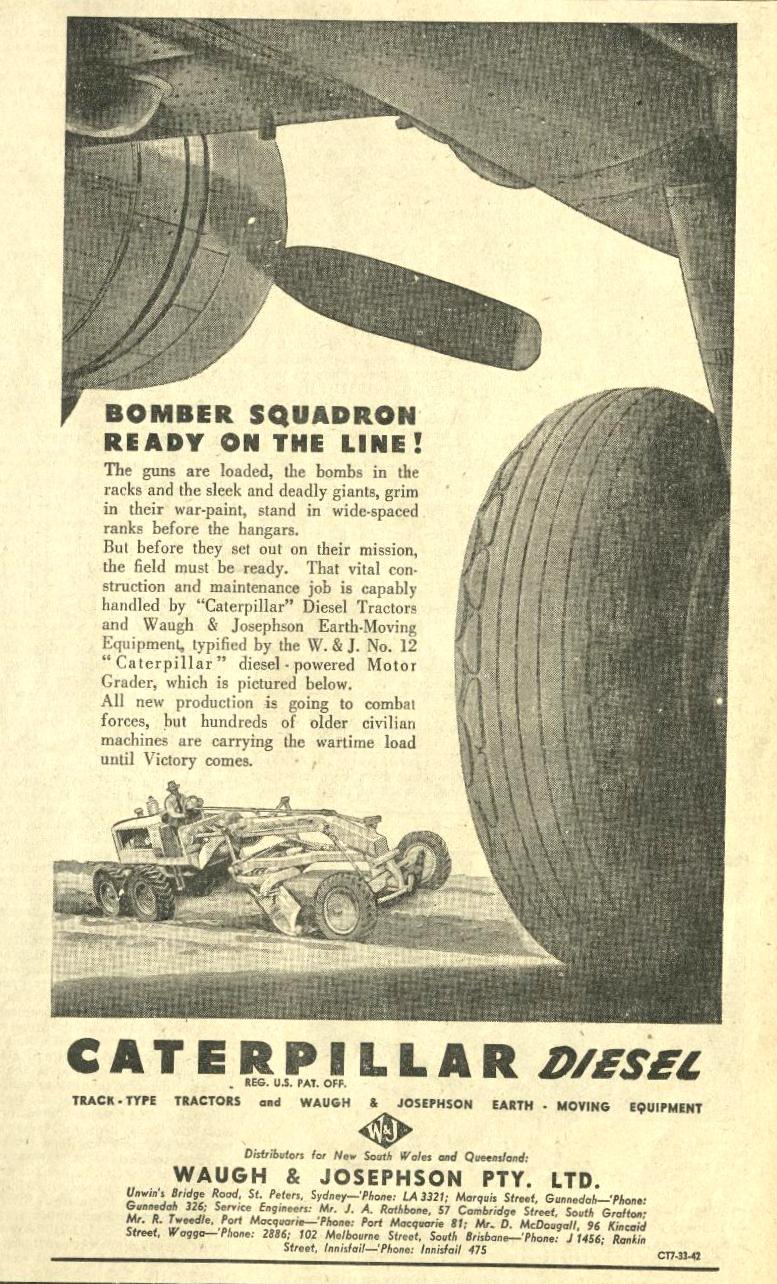
I found a rare Wartime ad for the W&J-built Caterpillar grader, from the Bulletin, dated July 21, 1943.
It was rare to see this equipment advertised during WW2, because all Caterpillar Grader production in that period went directly to the Military.
So, I expect the ad was probably allowed through as part of the Australian Govts, "Defence of Australia", morale-boosting programmes.

-
1
-
-
The Americans were on a war footing in 1940. They were building new military aerodromes by the dozen, in that year. Many U.S. military leaders, and quite a few U.S. politicians were warning of a coming War with Japan in the late 1930's.
There was substantial funding allocated to military production and purchases in the U.S. from 1939 onwards
Congress passed a law banning the export of engineering equipment to the S.E. Asian region, that could be used by an enemy based there - in 1936. Specifically, the ban covered Motor (Road) Graders and other aerodrome-building equipment.
Caterpillar was badly affected by this export ban, and Australia was in the area included by Congress. As a result, we couldn't get American-built Motor Graders from 1936 onwards for our road works and public works projects.
This led to Waugh & Josephson, the NSW Caterpillar dealer, to visit Caterpillar headquarters to get permission to build Cat Motor Graders in Australia under licence. Caterpillar agreed, which was a world-first agreement for them, for the manufacture of any Caterpillar machine outside the U.S.
W&J built about 80% of the Caterpillar Motor Grader in their major engineering workshops (from Cat blueprints), and Caterpillar supplied the transmissions and engines to power them. W&J built around 500 Caterpillar Motor Graders under licence to Cat between 1936 and 1945, and their Cat Motor Grader production was an exceptionally vital part of our contribution to the War effort.
In the same vein, the Le Tourneau factory at Rydalmere, opened in July 1941, churned out large numbers of earthmoving equipment (mostly Carryall Scoops), that also made a major contribution to the ability of the Americans and Australians to build airfields in the S.W. Pacific during WW2.
-
1
-
2
-
-
Mike, the greenhouse supplier link has already been posted in post #7.
-
1
-
-
Blackhawk799 - Rather than fork out a large sum for a LAME to inspect the aircraft in the NT - and then end up losing that whole amount, when the aircraft turns out to be a pile of junk - can you find someone in the NT who is a pilot/kitbuilder or with adequate aviation experience, to give you an initial "quick inspection" report, as to whether it's worth proceeding with a full LAME inspection/report?
That way, you will get an idea whether the aircraft is even worth consideration. An initial report that says "Forget it, it's a pile of junk" will enable you to save a lot of otherwise wasted money - but an initial report that says, "Yes, it's O.K. but it will need work", will then give you confidence that it's worth buying.
You can then proceed with a LAME inspection/report that is detailed, and which will give you the ammunition you need to negotiate the price to an acceptable level, because you have the full cost of restoring the aircraft to flying condition in front of you.
-
1
-
-
.....only employed pilots who had reached puberty and perspicacity. But Turbo was struggling with both, he was a typical pilot who had never grown up, and that's why the Cessna 152 was a good fit for him - an aircraft that hadn't grown up, either.
It was a hot and windy day when he had to put the 152 into a steep dive to clear some large gum trees, and at the bottom of the dive, as he pulled back on the stick, there was.......
-
......meanwhile, bull was starting to get worried, because not only was his HF set batteries running down, there was something even worse happening.
He was running out of Popeye comics, and would possibly have to end up entertaining himself, playing pocket billiards. But the machine guns and murderous-looking NK guards weren't going away any time, and the mud was drying out in the Summer sun, making him unable to sink into it whenever an NK guard looked in his direction.
It was time for him to get serious about getting out of there. What would Popeye or Indiana Jones do? He didn't have any canned spinach (and he wouldn't eat it if he did), and Jonesy had obviously been detained somewhere else along the DMZ, in his rescue attempt. It was time to put in a call to Turbine Enterprises.
They were sure to have an NK representative who could roll up and whisk him out of there, explaining to the guards that he had personal instructions from Kim Jong-un's sister to pick him up, because he was involved in deep mud testing of NK's new ballistic missile system, which was guaranteed to destroy all imperialist running dog capitalists - and speaking of dogs, bull felt a strong desire to..........
-
Those blokes wouldn't want to lose that handsaw, it's the most crucial component of the whole assembly system!
I'm amazed those crate designers didn't go a little further, and construct the crate so it could be re-assembled into an on-site hangar, complete with a wooden gantry crane!
And putting in 300 psi with a hand pump!! I reckon those blokes on the pump would have being pumping for a while, and wore out a few men!
-
1
-
-
There's nothing "fascist" about laws and regulations that are designed to ensure adequate safety in the handling and storage of dangerous goods.
This is worldwide standard practice, as evidenced by global transport systems and procedures, UN hazardous goods numbers and standardised firefighting and containment procedures.
Your alternative is complete lawlessness and total disregard of safety and regulation, as in the likes of the Port disaster in Lebanon. Not only an explosion causing multiple billions in losses, now followed by a major tyre and oil fire.
A few OH&S Nazis have certainly gone overboard, and God knows, I've experienced that in the mining industry - but OH&S should be all about education and ensuring compliance with satisfactory safety standards, without using jackboot tactics or penalties as a tool.
Penalties are there purely for those who constantly defy any attempt to make them obey laws and regulations, that are designed to stop innocent parties from suffering loss and injury, and even fatalities.
-
1
-
-
......to go and investigate where Cappy got taught his French. After some major investigations, with many leading to "dead ends" as people refused to talk, Turbo was finally enlightened when he came across an old French Madam, who was on very familiar terms with the Captain.
"Oui!", she grinned, "Ze Capitaine and myself are verrrry long-time friends, and eeet waz I who taught heem hees French! Mon Dieu!! He was soo-o dumb, when it came to teeching heem French!! He said he only wanted to learn enough French to be able to chat up zee girrls! - but I insisted he.......

Anyone know about a trike accident at Gatton Airpark this morning
in Aircraft Incidents and Accidents
Posted