

onetrack
-
Posts
8,088 -
Joined
-
Last visited
-
Days Won
101
Content Type
Profiles
Forums
Gallery
Downloads
Blogs
Events
Store
Aircraft
Resources
Tutorials
Articles
Classifieds
Movies
Books
Community Map
Quizzes
Videos Directory
Posts posted by onetrack
-
-
....of tubes of the lubricant mix being sold, and the factory couldn't keep up with production, as aviators flocked to the retail outlets like todays truckies searching for AdBlue.
"This is just amazing!" cried Turbo, "Even my heady days of selling fleets of trucks, and making multiple millions, doesn't compare to this lube winner we're on!"
Then came the sad eventual day where the news was released, that CASA was investigating engine additives with unproven claims - and the fish-based ones in particular, were in their sights.
"There's definitely something fishy going on here", said the CASA spokesperson. "We've identified some major failings in this product, whereby the aircraft utilising this new fish-based additive product, takes an unprecedented dive, whenever they're over water! We need to investigate this as a matter of urgency, as it's happening too many times to be a coincidence, and therefore we need........
-
.....who was doing his Yoga headstand as part of his daily brain-sharpening rituals. However, when Cappy thumped into him, he knocked OT somewhat off balance, causing OT to become quite irritated and yelling out .... ,,¿ƃuᴉop ǝɹ╻noʎ ʞuᴉɥʇ noʎ op suǝʞɔᴉp ǝɥʇ ʇɐɥʍ ʻʎddɐϽ,,
This confused Cappy even further. First, he didn't know what had hit him on the head. Second, he couldn't get it off. Third, he couldn't see where he was going, and he knew he'd hit something or someone. Funnily enough, it felt like a foot. Fourth, a voice was speaking to him from the floor, which confused him the most.
He started to think about all the gin he'd consumed, and how it must be starting to affect his mind. He was losing it! It was his.........
-
 1
1
-
-
....Cappy - but upside-down, unfortunately. What was worse, it jammed itself there, with the points of the crown covering Cappys eyes.
Cappy staggered around, wondering what had hit him (which happens to him on regular occasions), while he struggled to get this thing off his head (because he had no idea at this point, that it was a crown - he suspected Mavis had hit him again with a saucepan, but he couldn't figure why the saucepan had points attached to it).
Whilst struggling with his upside-down crown removal efforts - and staggering around, Cappy thumped into.........
-
All current motor vehicles with high levels of electronic technology are not designed to be extensively repaired, that's a thing of the past.
If you have a major electronic failure on a current model vehicle, and it's over about 8 yrs old and it has more than 150,000kms on the clock, it is often scrapped.
If you have a moderate prang which results in a "structural member" being deformed, your vehicle goes in the scrap bin, written off, and declared a Statutory Write Off, unable to be repaired or re-registered anywhere in Australia.
A structural member can be as little as a suspension component. See the advisory booklet, "Damage Assessment Criteria for the Classification of Statutory Write-Offs", it's an eye-opener.
We live in a era where automated manufacturing on a huge scale, and a lack of trained and qualified repair people - along with "unrepairable" styles of manufactured components - simply means todays products, including vehicles, have a short lifespan.
-
 1
1
-
 1
1
-
-
.....he is often confused with Luke the Busker, and Cappy often gets coins thrown at him as he........
-
My scientific qualifications are minimal - but as I understand it, 5G utilises millimetre-wave technology, as compared to microwave technology for many other telecommunication devices.
And this mm-wave propagation distance is pretty limited - 200 metres on average, according to what I've read. So, as a result, there needs to be a vast increase in the number of antennas needed for 5G devices.
The information I have perused tells me that the 5G signal is limited to a maximum of 500M metres on average - under good conditions. Rainfall, vegetation, buildings and numerous other shielding situations, impact on the 5G signal severely.
As a result, I fail to see where there's a major interference problem - unless the 5G-wave emitting device is right under, or next to, a flight path, and near an airport boundary.
Admittedly, in very high density areas, this is a potential problem - but as most commercial aircraft are still travelling at around 250kmh on final approach, that means the actual interference time with a 5G tower close to the flight path, would appear to be minimal.
In addition, simply ensuring that all 5G towers were located a minimum of 500 metres from flight paths/airport boundaries, seems to be the simple solution to eliminating 5G/radio altimeter interference.
I guess the proof of the pudding will be in actual flight tests over 5G towers, purposely located for test purposes, close to, or under flight paths.
Blancolirio's explanation is very good, as usual, but I personally believe he's becoming unduly alarmed at the potential size of the threat.
Probably the biggest worrying part of the whole deal, is that the FAA's main telecommunications advisor, the RTCA, is a non-profit organisation relying entirely on aviation communication volunteers, for providing technical expertise!
Compare that to the absolutely massive funds that the telecommunications companies have available at their fingertips, to destroy any opposition to their profit-making telecommunication ventures, and that is where the problems develop. Remember Boeing's constant striving for profits over safety?
https://www.viavisolutions.com/en-us/5g-technology
-
The 83 yr old passenger, a local resident, has been killed, and the pilot is in hospital in a critical condition with head injuries.
I can't see the rego, but it is a VH-registered aircraft, and the rudder has "Serpentine Field, W.A." written on it.
This is a terrible thing to have happen on Christmas Eve. My condolences to family and friends. Take care, everyone.
-
1
-
 1
1
-
-
Don't the heavies have 3 ASI's? Bruce, something tells me you aren't going to cut it, as a heavy driver.

https://skybrary.aero/articles/air-speed-indicator
-
....comment of Turbos, and thought back to how Turbo's wife was questioned about the purlion necklace, when she wore it to court. "Is that purloin?", asked the court clerk as she sighted the massive necklace and gazed at it with unbridled admiration.
But before Turbo's wife could answer, Constable Doubtfire, who was right nearby, misheard the clerk's word "purloin", as "purloined", and immediately collared Turbo's wife, and threw her to the floor, whilst screaming, "Gotcha, ya thieving b.............
-
.....unbelievable stomach pain and tooth damage, as the guests try to chow down on charred wooden purloins, which had been put aside for Cappys next round of additions to his hangar.
"You did say 'purloins', didn't you?", said Cappy as he gazed ruefully at the hacked up, half-chewed, and charred remnants of his next construction project.
"No, I said 'sirloins'!", said Turbo, clutching his stomach and rolling around on the ground. "I knew that Wagga butcher of yours didn't sell the best meat, but confusing your purloins for sirloins, and then BBQ'ing them, and attempting to get us to eat them, makes the......
-
Mazda's current SkyActiv-X engines use a modified HCCI (Homogeneous Charge Compression Ignition) engine design, that Mazda call SPCCI (Spark Controlled Compression Ignition). The engine runs at 16:1 CR, so definitely a diesel.
Their SkyActiv-X engine is pretty impressive in torque, power and economy figures - but the downside is, they're an exceptionally high-tech engine, with microprocessors controlling every single combustion event, as they happen.
The problem with HCCI is it's a particularly unstable, very lean combustion process, that needs a high level of electronic control to ensure stability during the combustion events.
Mazda SkyActiv-X engines also utilise an air-to-water intercooler, a low-boost Roots-type supercharger, an EGR cooler that helps prevent premature combustion, electric variable valve timing actuators (that use stepper motors) for faster valve timing, and they also use a 48v electrical system.
Overall, a major step forward in engine efficiency for cars - but at the expense of extreme complexity - and probably not a design you'd want to adapt for powering your ultralight.
-
1
-
-
However, the BAGs have a Plan B in place to get around the slight technical hitch of Santa and the sleigh being unable to enter W.A. airspace. OT has advised Santa to file a flight plan that overflies W.A. to a destination further NW - so he can simply parachute the presents to the desired locations in W.A., as he overflies the State.
Santa was quite pleased that OT had thought of this alternative approach (avref), and advised OT, that as Cappy had been naughty, many, many times this year - especially with his derogatory contributions on the NES towards the inhabitants of W.A. - and he had eliminated Cappy from his presents list, so he would give Cappys presents to OT for his great flight planning assistance.
OT was quite pleased at this great news, but wondered what.....
-
The Higgs engines show a lot of promise, with simplicity, light weight, multifuel capabilities, and high HP for weight - without major design complexity.
They simply utilise a second piston below the main piston to supercharge the inlet mixture, and utilise porting, a la all 2 strokes. The supercharging of the intake charge is the crucial feature of the design.
As with all new designs, extended testing is needed to find the "bugs" in the design. Adequate and efficient sealing, of pistons and sump, comes to mind, straight up.
https://www.ac-aero.com/technologies/
The Allis-Chalmers tractor company had a spark-ignition diesel engine in 1936. It was called the Hesselman engine, after its inventor, the Swedish engineer Jonas Hesselman.
Scania-Vabis, Volvo, and Tidaholms-Bruk, all truck manufacturers in Sweden in the 1930's, all produced their versions of the Hesselman engine. The engine fitted to the Allis-Chalmers model LO tractor was built under licence to Hesselman by Waukesha, and called the Waukesha-Hesselman engine.
The Hesselman engine was a true multi-fuel engine, designed to utilise low-cost, semi-refined fuels to get around high European taxes on refined fuels.
The ASTM fuel standard for diesel (ASTM D975) was not introduced until 1931, and even after that time, there were many varieties of partly-refined fuels available.
The Hesselman engine ran at 6.5:1 compression, was fitted with a Bosch diesel fuel injection pump and injectors and also fitted with spark plugs and a HT magneto. The fuel was injected near TDC and the spark plug ignited the fuel.
The engine was not a true diesel, as it did not ignite fuel via the heat of high compression.
The Hesselman engine was a short-lived success, as other high compression full diesels, such as the Cummins Engine Co, GM with their famous 2 stroke diesel - as well as MAN and Mercedes - all produced quite satisfactory full diesel engines by 1937 - and these engines very rapidly superseded the Hesselman engine.
The Hesselman engine was unsuccessful because of its poor combustion abilities, which meant a lot of unburnt fuel went out the exhaust, and crankcase oil dilution was high. Smoke levels were unacceptable, and fuel economy was poor.
https://en.wikipedia.org/wiki/Hesselman_engine
-
...set of medals (which he wore constantly to impress people), jammed into a crack in the floor, stopping him in mid-roll, and........
-
I trust there's a lot of "forward planning" going on at CASA headquarters, as regards aircraft tracking - because the coming era of delivery drones, electric air taxis, and all the other projected plans for moving substantially increased numbers of passengers via air, is going to pose a very large tracking headache for CASA, Defence, and AirServices, unless they're well in front of the development progress curve.
The problem is, most Govts and their bureaucracies are usually caught napping with major and sudden technology changes, and generally fall back on a knee-jerk reaction to major technological changes, rather that being forward-looking and developing strategies to handle the changes.
And of course, we all know that you can fly in totally unihabited airspace all day - but the moment you intend to land, another aircraft often manages to pop out of the blue, and arrive at the same destination, at the same time, as you do.
https://www.mckinsey.com/featured-insights/the-next-normal/air-taxis
https://www.airservicesaustralia.com/about-us/innovation-and-technology/future-airspace-management/
-
....you let me handle your fire hose for a short while, so I can get a feel for what it's like, to have such a huge......
-
....doubt and would only charge him with ATC abuse, as the Tassie ATC believed he was saying "Bull!" in reponse to their communications, when he was actually only identifying himself.
However, this level of miscommunication wasn't only confined to bull, it was common knowledge amongst the RA drivers that radio communication was only needed when........
-
The greatest impediment to selling an aircraft is advising it was a former flight school aircraft. Many buyers would be put off by that fact alone.
Add to that, a high total hour level for a recreational aircraft, and you'll really be pushing to get a decent price for it.
-
2
-
-
-
1
-
-
Jeffmel - It's very easy to buy aircraft/cars/machinery - but not so easy to sell them. Every buyer of your rig for sale, has a vastly different idea of its sale value as compared to what you're asking for it.
You'll get dozens of "buyers", a large number of whom only want to pay about 2/3rds what you're asking, another sizeable percentage who are only "tyre kickers" and who are only dreaming, or they only want to try out their negotiation skills on you. The rest will just waste your time and annoy you.
When you sell an aircraft/car/machine, you have to "market it". You need to advertise it on every single publication, website or place you think a suitable buyer might spot it. Many a sale doesn't happen, simply because the buyer never saw the item for sale.
Once you've got your likely buyer in front of you, you have to go into overdrive, outlining the items features, benefits and value - some of which, the potential buyer may not have been aware of.
Then you both have to agree on a price - and you have to be confident the buyer is going to come good with the $$$'s.
Take a deposit - in cash - to secure the deal. No deposit - the buyer can walk away, after changing his mind.
As a general rule, if you can buy a highly depreciable item, use it for quite a while, and then sell without losing less than 20% of what you paid for it, you've done exceptionally well.
-
Thanks for the correction, APenNameAndThatA - I'm quite happy to be corrected when I'm wrong, and letting me know doesn't make you look like an idiot, it just shows that you're a perfectionist.
Nothing wrong with being a perfectionist either, except it often grates with people who aren't.
-
.....no sooner had he ground to a halt and jumped out, when bull appeared in the distance, carrying out a shallow dive.
Bull knew he'd be safe out here in the boondocks of W.A., so he made the radio call that changed everything. "Bull at 1500 feet on final, and on course to...."
-
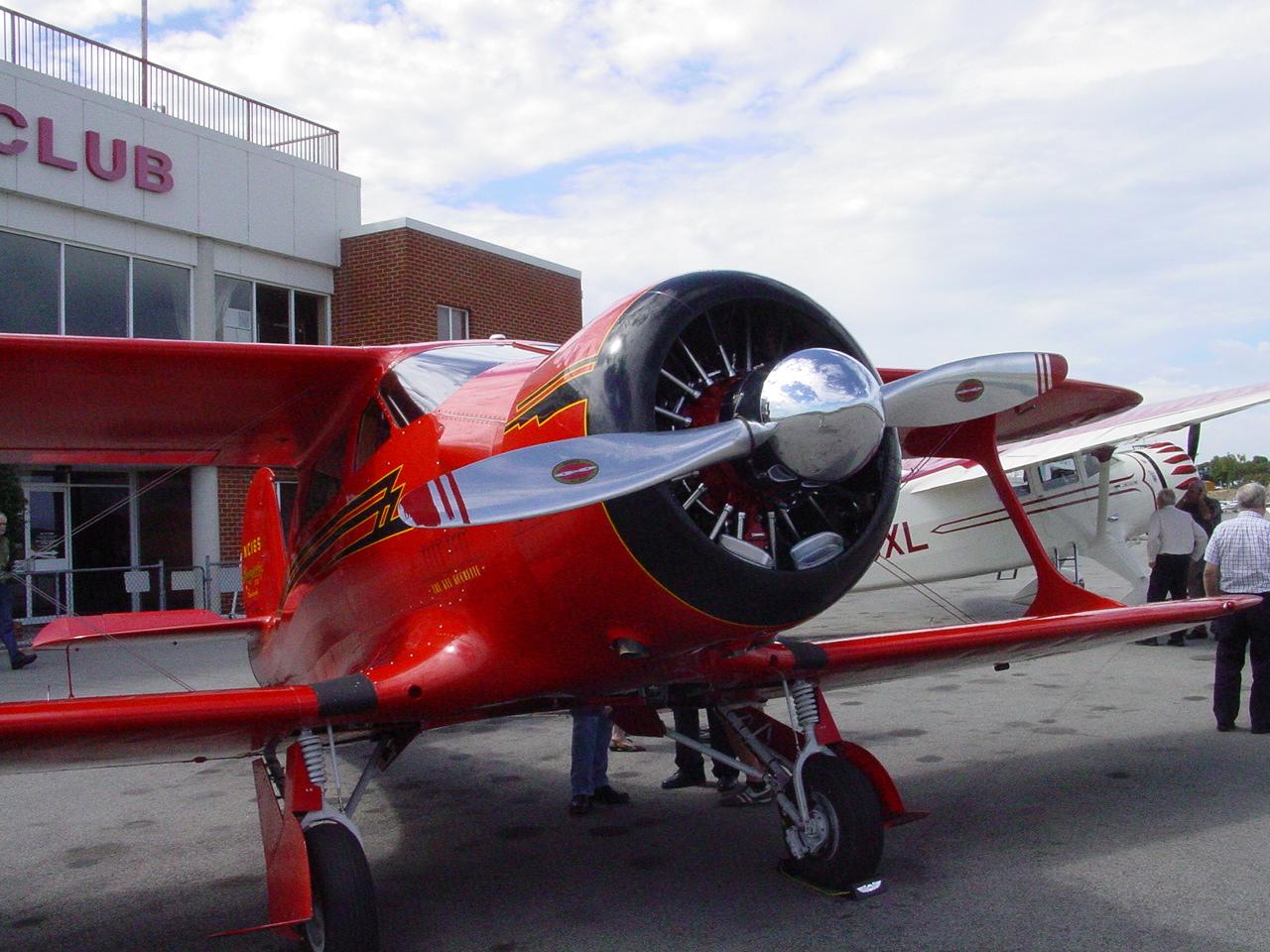
Kawanishi K-12 Sakura (Cherry Blossom). Planned as a long-range, non-stop, trans-Pacific aircraft, Kawanishi found its performance was inadequate, and the design was abandoned after only two prototypes were built.
It reminds me of a 1931 DeSoutter "Sports Coupe", which obviously came later. Perhaps the DeSoutter design was influenced by the Kawanishi.
Art Deco influenced aircraft design, as well as buildings and the automotive scene. I still believe the art deco era provided us with some outstanding designs of great beauty.
-
This writer claims gear-up landings are seriously under-reported ...
https://www.flightsafetyaustralia.com/2015/11/those-who-wont-avoiding-gear-up-landings/
The Never Ending Story
in Aviation Laughter
Posted
.....well-known playboy of the flying fraternity. To correct the truth of the story behind bull selling all his drawings for the price of a beer, the actual pub where he sold them, was called The Flyers Short Arms.
This pub gained its name because it was sited not far from a major airfield, and was frequented by many members of the flying fraternity - who, after flying all day, and consuming copious amounts of expensive fossil fuels, paying landing fees, engine repairs, fees to flying organisations, fees for training, insurances, licences, and the myriad of other costs and charges that left virtually all of them skint, meant that when it came time to shout drinks in the pub, the flying fraternity were known to have the shortest arms, and the deepest pockets, of any drinkers in the nation.
What was worse, of course, was they weren't allowed to drink when they flew (unlike the speedway crowd, who drank from dawn to dusk, regardless of whether they were driving, sleeping, chasing skirt, or watching their mechanics repair their cars), and the flying fraternity made up for their daily abstinence by consuming twice as much alcohol as anyone else in the pub, when they'd finished flying.
This was the major reason why the attraction of fish designs of aircraft had great appeal to many of them - because "drinking like a fish, and flying like a fish", had a great ring to it, and this meant that.......