

onetrack
-
Posts
8,088 -
Joined
-
Last visited
-
Days Won
101
Content Type
Profiles
Forums
Gallery
Downloads
Blogs
Events
Store
Aircraft
Resources
Tutorials
Articles
Classifieds
Movies
Books
Community Map
Quizzes
Videos Directory
Posts posted by onetrack
-
-
That photography is very well done, and the WW2 bathing suits and dresses would raise fond memories for any of our WW2 veterans that are still alive (and that is very few today).
IBob, I was waiting to hear that they made so much money out of the red thigh boots, they were able to afford a kitplane!

We just had some entertainment before Christmas, as the DIL was engineering a camping trip away for her and hubby (not having done any camping before).
So she'd acquired a big tarpaulin and was looking for a long ridge pole that was collapsible, for the centre of the tarp to hang over.
She knew exactly what she wanted, but she didn't know what it was called precisely, so she made the mistake of Googling "spreader bar" - and, "images"!
Needless to say, despite being over 40, her eyes were opened to some amazing sexually-oriented equipment that had nothing to do with camping!
She was carrying on about what she'd found, in her search for the ridge pole - and of course, we all had fun, telling her we all knew, what she was really angling for, something to spice up her love life!
-
 1
1
-
-
An aftermarket "brand name" such as Mahle would ensure the valve quality is satisfactory. I certainly wouldn't be buying exhaust valves made in China.
-
Calling this bloke a Pilot and a Captain gives flying a bad name. If there ever was a Homer Simpson of flying, this bloke fits the bill. I cannot believe he is still alive.
-
1
-
-
Have you tried going to a Subaru dealership and speaking to the Service Manager, he may be able to bring up the engine or model fitment details from the S/No.?
Might have to sweet talk the Service Manager or slip him a few greenbacks to help you out. Could also help if you tell him you'll purchase the exhaust valves off his dealership - if they're available.
The engine is 1980's, so getting more difficult to acquire parts for today, just like all 35-40 yr old engines. The aftermarket suppliers will be the best likelihood for sourcing the valves.
-
Surely there are plenty of valve suppliers in the U.S. that can meet your needs?
-
Performance Springs in Yatala have a range of off-the-shelf valve springs, or they will do a production run to your specific sizing/strength - at much increased cost, of course.
-
Bruce - Yes, the ocean racer sails are carbon fibre. It's been used in sails since at least 1992, when it was introduced on an Americas Cup entrant. Yes, they are very light and very strong. Their porosity is low when new, but it deteriorates over time, as the materials become affected by stretch, salt, and UV light exposure.
https://www.northsails.com/sailing/en/2020/02/why-are-racing-sails-black
https://en.wikipedia.org/wiki/Sailcloth
Carbon U/C leg design is a minefield, you could spend a lot of time and money trying to get the correct level of springiness.
-
1
-
-
It probably went the same way as the Dornier S-Ray 007? Looks great, but the practicalities are non-existent, and Dornier is only repeating earlier design mistakes. He's only ever produced a couple of prototypes.
http://iren-dornier.com/en/aircraft/iren-s-ray007.html
http://do-24.com/index.php?s-ray-007
http://www.flugzeuginfo.net/acdata_php/acdata_dornier_sray007_en.php
-
There's plenty of information available as regards "fatigue" testing of FRP - and all composities, in fact. They've been in use for decades now, so performance, damage and repair criteria is established.
Turbo is right on all counts, FRP does not "fatigue" the same as metals, so the comparison is apples to oranges.
Metal fatigue shows up initially as cracks, then the cracks propagate to component failure, if left unattended.
FRP does not necessarily show initial surface cracking under fatigue, it can sometimes fracture with little warning, because the fracture point is actually debonding within the component.
FRP performance and life under cycling loads can be quite variable, because the end product is dependent on the level of professionalism in the construction, the types of resins and fibres used, and the levels and periods of exposure to UV light and heat/cold cycles.
Vacuum bagging techniques are now used extensively, and "Vacuum bagging failures" is a good area to research.
FRP performance is also related to the types of strengthening materials used. Boats originally used light wood beams (usually Balsa) covered with FRP for strength - but water ingress into the timber is a major factor in the life of a boat component.
Then foam was used for cores, and then advances led to a range of exotic core materials. Nowadays, if you want the ultimate core, you use Nomex honeycomb core.
Not surprisingly, boat builders were quick to pick up on advances in aircraft composite materials, and boat-building has advanced considerably in recent years, thanks to that.
https://onlinelibrary.wiley.com/doi/10.1002/pc.24177
This Chinese writer has written up a good, and a very comprehensive outline, of the huge amount of FRP and composite construction types and materials in boats.
https://www.linkedin.com/pulse/what-materials-frp-boats-杰-任?trk=read_related_article-card_title
-
So what does a girls panel look like?
-
Maybe it was still bouncing, as it reached the hangar? It certainly seems to have hit the wall of the hangar, whilst it was in the air.
-
Old K, it's a shame there's not a readily available source of the information gathered up by Cyril Kleinig, who was one of Australia's best engineering innovators, as well as a very good race car driver.
Cyrils "Mist-Master" water/alcohol injection unit was advertised in the "Modern Motor" magazine for decades, from the late 1940's.
It was simple and it worked - although it did have its risks if it malfunctioned, as it would pool water inside the engine. I wonder if you could even find an old Mist-Master unit, and utilise it?
I don't know how heavy they are. Of course, they did also work on gravity feed alone, so more potential problems there, as compared to an electrically-driven water injection unit.
Today, Snow and Aquamist provide high-tech WI systems for current-model vehicles - but they're all designed to work with engines that use an ECU (or PCM, depending on which company terminology you're using) - which is all automotives engines today.
-
1
-
 1
1
-
-
It's interesting to note that Hyundai is the latest in a string of manufacturers (many of them, European) to reportedly close down their IC engine development dept, and turn it over to an EV design dept.
I believe we will see this trend happening on an increasing basis over the next several years, as manufacturers start to realise that EV's are a suitable product for a very large percentage of the population, who don't travel long distances daily, and who don't need heavy towing capabilities.
The rest of the country will still be buying diesel Landcruisers, Hiluxes, Rangers and Isuzu's, for a few years yet.
-
The speed with which the Jab hit the building - after hitting the shed door outrigger - and possibly the water tank as well - appears to me, to indicate LOC after a failed go-around.
Perhaps this article below is highly relevant? I know there's major differences between high-wing and low-wing response upon landing, but a PIO is a PIO, regardless of wing position?
https://www.gleimaviation.com/2020/01/10/recovering-from-bouncing-porpoising-during-landing/
The final report will make for useful reading. I trust the blokes involved make a full recovery, that must have been a very frightening and painful episode for them.
-
1
-
-
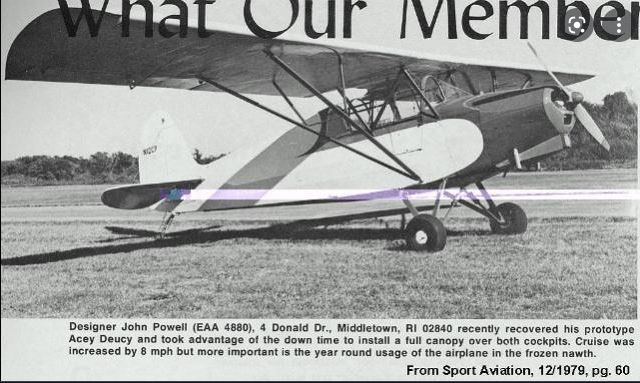
It's quite interesting that the Acey Deucy was designed as a pretty lightweight machine, in the Cub class, and designed for the 65 HP and 85 HP Continental A & C series engines.
The Acey Deucy specs state "65 to 90 HP" for power units. At least one has a VW engine. But N567CM, which was destroyed in a double fatal crash, was powered with a Lycoming O-290-G, rated at 125 HP.
What is highly relevant in the N567CM crash was that the Acey Deucy fuel tank holds only 14 US gallons (53L approx).
The fuel burn of the O-290 at normal cruise power is 10.5-11 US gallons/hr - thus giving N567CM a range of just over one hour flying time!
N567CM ran out of fuel, and the pilot mishandled the forced landing, entering an unrecoverable steep stall, and both pilot and passenger were killed, and the aircraft totally destroyed.
http://www.kathrynsreport.com/2014/06/roger-brining-and-daniel-bishop.html
The other factor in Acey Deucy searches is that it appears the aircraft builder is allowed by the FAA to add his name to the aircraft type name - an interesting concept.
So you will find names such as "Stadel Acey Deucy P-70", "Robert L. Schrieber P-70 Acey Deucy", "Wright Cecil/Duane Acey Deucy P-70", and so on - rather than just "Acey Deucy Powell P-70".
The only Acey Deucy on the FAA register listed as a Powell P-70 Acey Deucy, is obviously the one that Powell built - C/N 1.
There's a list of current and non-current Acey Deucy P-70's on the FAA register - and also an interesting "P-26 Acey Ducey", which listed as a "STEVENSON R M/HOUSEHOLDER E D Acey Ducey P-26".
-
Nev, all the Acey Deucy's have a door on the RHS to allow entry to the front cockpit. I can't see much difference in accessibility to the front cockpit in either the biplane version or the parasol wing version, there's angled wing struts to climb over in both versions.
-
Peter, all the photos online of Acey Deucy P-70 aircraft show a single parasol wing design - except for two aircraft. The blue/yellow bottom aircraft above - tail number NX12CP, is listed as C/N 1 - indicating it was the first aircraft Powell built - and it was a biplane - with a sliding canopy that fully enclosed both seats.
It appears all subsequent Acey Deucy P-70 plans issued, and aircraft built, are a single parasol wing design, with tandem-seat open cockpits.
However, to add to the confusion, there's a photo of a red/white Acey Deucy with a biplane wing structure - but this aircraft carries the tail number N12CP.
What is totally confusing is that N12CP is also listed as C/N 1. As NX12CP and N12CP share the same fully enclosed, sliding canopy design - I can only assume that NX12CP and N12CP are the one and same aircraft, with different paint jobs.
All other Acey Deucy P-70's in available photos have tandem-seat open cockpits.
Here is a short list of Acey Deucy aircraft. It's far from complete, and far from accurate, as several of the tail numbers listed, are other types of aircraft. However, by searching for images using the tail numbers, a lot of other Acey Deucy's show up.
Photo of N12CP - Click on the tail number above the photo, and photos of the identical NX12CP appear - https://www.airport-data.com/aircraft/photo/000971949.html
The second "different" Acey Deucy P-70 is a single parasol wing aircraft with a sliding-canopy, fully enclosed cabin.
This aircraft is C-GEMY, the original prototype Acey Deucy P-70, that was re-purchased by Powell, and who apparently reshaped the original fuselage from tandem cockpits, and altered it to the fully enclosed cabin style.
https://www.airhistory.net/photo/29321/C-GEMY

On page 11 of the article below, you'll find a story of a bloke who not only built an Acey Deucy P-70 - he had to rebuild it all over again, when a tornado destroyed it at the 2011 Sun ’n Fun International Fly-In & Expo.
https://www.eaa.org/~/media/Files/EAA/EducationResources/Experimenter/1407.pdf
In addition to the write-up about the Acey Deucy that was wrecked, there is also a short piece about Powell and the Acey Deucy P-70 story.
-
This is just plain painful to watch. I don't know what's worse, watching the village idiot try to kill himself, or watching him destroy a classic Taylorcraft.
As the frequently-used American saying goes, "You cain't fix stoopid".
Just watching the idiot pour fuel all over the cowl as he complains about "stoopid" fuel can spouts, is unbelievable. I wonder if he's ever seen a funnel?
-
How the dickens did he do that? The wind was reportedly 6-9kts from the SE at the time, turning Southerly and lighter now. Did he get hit by a wind gust?
Those buildings are at the end of the runway! He went a lo-o-ong way off the runway, to do that!
Also, the airport cam didn't pick up his excursion, or even his landing?
https://www.windy.com/-Outdoor-map-map?map,-35.475,138.747,18
-
Here you go, Jackc - a V4 Chinese 2-stroke of 1200cc by Benda, producing 113Kw/150HP at 9500 RPM. Reported to be in production next year.
Slow it down a little to preserve the engine life, you don't really need all 150HP anyway - gear it down for a prop, and Bob's yer Uncle! Probably set you back all of about $3K!
-
 1
1
-
1
-
-
Hi Don, and seasons greetings. You don't state the precise model of the Tab A7 that you have received as a gift. As there is more than one model of the Samsung Tab A7 - and trying to find precise product specifications on the Samsung site is a chore, I like to check exact product specifications on the GSMArena site. You can expand on the "Technology" heading on that site, to find operating bands and speed. This helps assist you with the units capabilities. OzRunways may also offer advice as to compatibility and useability of the device with their programme, if you ask them.
Like you, I have a distinct aversion to Apple products, their price gouging, their insistence on Apple-only sourcing and fitment of accessories, plugs, cables, etc - meaning that you're a "captive customer", at their mercy forever, forced to utilise their products, without choice.
But unfortunately, many programmes with a high level of graphics use are designed specifically with Apple devices in mind - and some Samsung programming is definitely deficient. Hopefully, Samsung are improving in that area with their latest offerings.
https://www.gsmarena.com/res.php3?sSearch=Tab+A7
-
Somehow, despite the constant engineering and research efforts, the 2-stroke appears to be eternally doomed to oblivion, perhaps because everyone immediately associates 2 strokes with smokey exhausts, nasty exhaust smell, poor fuel economy, and generally unacceptable exhaust noise. But the perceptions are all based on fact.
No matter how many clever people have tried with advanced designs - in this day and age of noise limitation requirements, fuel economy requirements, and emissions regulations, no 2-stroke has ever met all three requirements satisfactorily, on a long-term basis.
A former South African F1 driver and engineer, now resident in Australia, one Basil van Rooyen, has developed a complex 2 stroke engine design (the CITS engine) that separates the crankcase area and combustion area of the 2-stroke engine.
He's utilised the Rotax E-TEC heads with a Suzuki Boulevard crankcase, and added his own modifications, as regards the pistons, cylinders and combustion system.
His design shows promise - but he came up with the design in 2012, and he has spent 9 years trying to get financial backing for his engine - all without success.
He took out a number of patents worldwide, but I suspect many of those patents have now lapsed, as he speaks in early 2020, that he only had a few months left on the patents life before renewal was required - and he didn't have the money for the renewals.
https://motorbikewriter.com/aussie-two-stroke-invention/
https://motorbikewriter.com/aussie-2-stroke-invention-may-fail/
https://motorbikewriter.com/aussie-2-stroke-engine-attracts-investor/
https://www.rideapart.com/news/432752/clean-two-stroke-bridge-gap-electrification/
https://contest.techbriefs.com/2020/entries/automotive-transportation/10356
It appears that Basil van Rooyen has now retired, so the chances of his engine meeting with success, get slimmer by the day. The supposed local investors in the CITS engine design, from July 2020, don't appear to have materialised.
I feel that Basil van Rooyen is another similar version of Ralph Sarich - because, despite Ralph Sarichs cleverness and persistence and ability to extract large amounts of money from auto manufacturers, Ralph could never produce a satisfactory major engine alternative - either with his Orbital Engine, nor with the Sarich 2-stroke, Orbital Technology, air injected engine.
Ralph did manage to make a couple of billion along the way with clever licencing fees and royalties, auto manufacturer funding, and selling his 2-stroke air-injected technology to the likes of outboard engine and UAV engine manufacturers.
Ralph was smart enough to invest that money into major property development, that has returned him more money than any new engine concept ever did.
Ralph does still believe in technology developments, as he has Cape Bouvard Technologies as one of his companies - but he no longer looks for a "new IC engine" design that will revolutionise the world - because there isn't any.
Even when GM presented a 2-stroke Sarich-injection microcar to the American public to see if it was a goer (in 1990), the board and beancounters of GM cruelled the project, mostly because it was deemed the 2-stroke powerplant did not stack up for the long-term - and quite likely due to the GM outlook, that both emissions regulations and fuel economy demands, would only get tighter and tighter in the future.
"The promise of (2-stroke) lightweight horsepower has been continually thwarted by poor fuel economy, traceable to the basic concept of the (2-stroke) engine," said Dan McCosh in Popular Science in 1990. And McCosh's opinion has been proven correct, time and time again.
But it appears Basil van Rooyens 2-stroke engine will also be another clever new engine design that falls by the wayside, thanks to a general unwillingness by anyone with serious amounts of money to invest, to invest that funding into what is now regarded as "obsolete technology".
-
1
-
2
-
-
The Rotax E-TEC technology is somewhat overblown by Rotax, and it appears the low oil consumption is nothing like Rotax claim. Add to that, the E-TEC technology is still basically 2 stroke design, pumping out nasty emissions, and you won't find the Rotax E-TEC engines anywhere else but snowmobiles - because the snowmobile industry has lobbied long and hard to be exempt from exhaust emission regulations - and they've largely won.
Snowmobile engine emission laws didn't start to apply until 2006, and they're weak and watered-down emissions laws, with engine companies producing 2-strokes being allowed to "average" emissions across all their engine product lines.
https://www.ecfr.gov/current/title-40/chapter-I/subchapter-U/part-1051/subpart-B/section-1051.103
The E-TEC advertising is slick and smooth, big on fancy "fun activities" imaging to suck in the punters, but pretty short on precise technical and emission information.
At least one E-TEC owner on the Youtube site is complaining the oil consumption of the E-TEC engines is double what Rotax claim.
Despite 2-stroke technology being high power output, and despite regular "major 2-stroke design advances" claims, you won't see it in aircraft or cars, anytime soon.
-
2
-
-
....had pedal-assistance for the propeller when the Coleman Lantern ran low on kero; was fabricated from all the ply offcuts from the Men's Shed, that was only 300M from bulls house; and was covered with surplus fabric from the Gumly CWA Sewing Club. Instruments were deemed unnecessary, not only to keep costs down, but to keep the design simple.
Bull advertised this was true "seat-of-the-pants" flying, when he posted the plans for $65 on Gumtree, indicating in the ad that anyone could get airborne for a fraction over $500 - excluding the cost of the Coleman Lantern, of course.
It was presumed by bull that any adventurous soul who wanted to construct one of his Flying Machines, was already an outdoorsy-type, and already possessed a working Coleman Lantern.
The beauty of the design, said bull in his ad, was that when you landed on last light, you already had the lighting you needed to make camp for the night, in the shape of the power unit.
Sales of the plans exceeded bulls expectations by about 1500%, and he was hard-pressed to keep up with the demand.
Then, one day, an ominous-looking official letter arrived in his mailbox (because bull still used snail mail and telegrams for daily communication, and he was on first-name terms with his postman).
Bull picked the letter up and studied it. It had a Canberra return address on it, and he opened it fearfully, fully expecting.....
Question re MTOW increase
in AUS/NZ General Discussion
Posted · Edited by onetrack
Peter, there is no maximum speed limit for RAAus aircraft. VNE is set by the aircraft designer. LSA speed limit is 120kts in cruise. See the FAQ below ...
http://www.foxbat.com.au/qa.html