


Oscar
-
Posts
2,485 -
Joined
-
Last visited
-
Days Won
67
Content Type
Profiles
Forums
Gallery
Downloads
Blogs
Events
Store
Aircraft
Resources
Tutorials
Articles
Classifieds
Movies
Books
Community Map
Quizzes
Videos Directory
Posts posted by Oscar
-
-
So, two reported/suspected cases out of many hundreds flying. Well less than 1% of all Jabs with wing tanks. The pernicious intent of the comment is obvious.Would I be considered a Jab Basher if I suggested that is the result of piss poor design or lack of proper testing ??.....-
 7
7
-
-
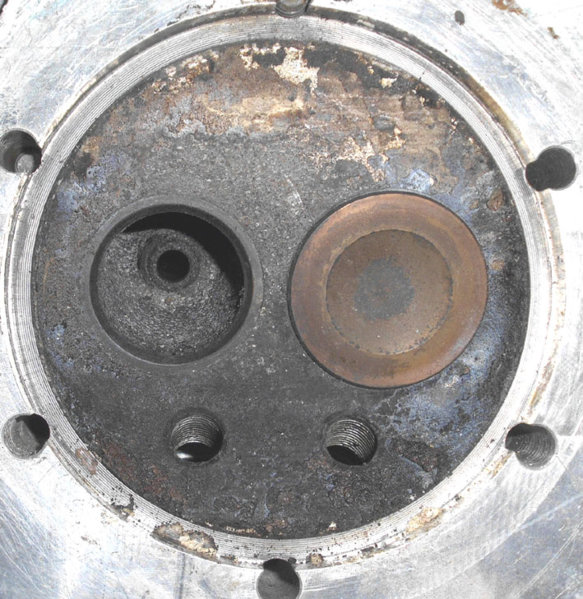
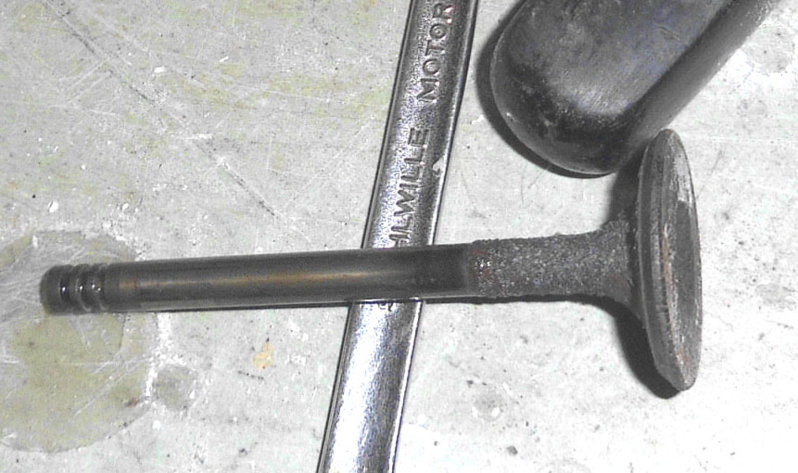
Going back to the lead fouling issue for a moment, here are a couple of piccies (apologies for the quality) of one of the heads I have on a dummy engine I'm using for R&D purposes for developing cooling set-ups etc.
I have no idea of the history of these heads, they were donated to me for the R&D work ex a rebuild. They appear fairly much uniformly as this one, though there are noticeable differences in the amount of fouling between them all, indicating probably BOTH mixture and cooling differences between pots. There are no signs of warping /leakage normally evidenced by burnt oil deposits. They are thick-finned 'Mk.II models (i.e. with the exhaust pipe chamfer - style rather than the original flat-port and gasket heads.
The lead build-up is fairly evident on the head: there is a patch - just to the right of the inlet-side plug hole - that is 1.7mm thick.

The valve guide is good, well within tolerance, and the seat is ok as well - but have a look at the leading on the valve stem!
-
 1
1
-
-
jj, as we've seen (and discussed, with really useful contributions from yourself and a lot of others, in the 'Jabiru cooling' thread), there is so much variation in installation effectiveness between different Jabs. that until there is a 'standard' test done comparing a CAMit install and a standard Jab install on a specific aircraft with no change to the installation details, we're not likely to get any 'authoritative' data re one vs the other in terms of cht performance - unfortunately. Since CAMit use (at least currently) standard-machined Jab heads, (but with a different alloy that has higher temp tolerance), about the only differences one would expect would come from changes to the exhaust-valve heat dissipation ability from any changes to the valve seat and guide material and improvements to the barrel cooling, and they may actually slightly increase the cht slightly if the head is 'working harder' in getting heat away from these two areas.To add to the issue of induction swirl, it seems to change with rpm, which does make sense, egt go up and down as expected with needle position BUT it the spread of EGT thats alarmng. I have one which is hottest in climb, a different one (on the other side) in cruise and a different one again for power off descentsRegularly use carb heat to bring them into my limitsBy installing under barrel deflectors, it has definitely helped stabilise CHT
I have seen some data from a Camit installation and egt were excellent spread, cht a little high and uneven though.
.
Provided such slightly higher chts aren't going anywhere near becoming of concern, that isn't necessarily a bad thing IF what is happening is that existing 'hot-spots' - and particularly those that cause exhaust-valve failure and top-ring lead deposit caking - are being managed better. If they are being managed better - and testing will determine that - then the next step along the yellow brick road is to improve the cooling installation so it becomes more effective: better distribution to and around the heads and barrels, better cowl extraction etc. Once again, it's the old 'everything is part of a set of interlinked systems' approach - and your experience with under-barrel deflectors I believe is a good example. Work is being done in that area to develop a set of deflectors based on NACA reports, that will be tested to see what benefits they might hold - watch this space, as they say...
-
 1
1
-
-
Magic indeed! Now, if you added the Brock Polariser and carefully tuned the turbo encabulator, with an IFA prop you could actually generate fuel by descending with the prop in reverse pitch and the fuel pump turned to suck instead of blow, thus making all your fuel-stops into touch-and-goes and avoiding call-out fees. Low-cost flying- at last!
-
 5
5
-
-
Andy - when up at CAMit last year, I saw two engines with injector ports on the intake tubes, ready to push out of the engine assembly shop. I think (though don't take this as gospel, I was too busy to delve into it) that these were for Jabiru to deliver to an Israeli drone manufacturer; I seem to remember Sue Woods mentioning in an interview in Sport Pilot that they have been supplying engines for drones.So we know Rod has a fairly firm view on a non carburetted approach, What position does Ian take, for those closer to him?I have heard that Rotax are having all sorts of fun with their injected 912, but I guess that's to be expected with ver 1.0 of anything.That said with these J engines what exactly constitutes a version? It seems to me that as things are done to an engine it gains some of the newer stuff but has some of the older stuff on it, perhaps in doing that creating a unique instance...I guess that doesn't exactly help.
Andy
So, progress is being made towards incorporating EFI on Jab engines, but the regulatory requirements are a major hurdle before we'll see them in aircraft. It will happen... but not overnight...
-
Merv - Wedderburn is one site for which I can certainly understand the fear of not having enough height - but it's debatable as to whether this engine was actually dieing, or just being flogged unmercifully. We don't know. I've had the delightful experience of having to nurse a dieing Commodore (ring a bell?), with a Jabiru on a trailer behind it - along in 32C+ conditions when the EFI rail pressure relief valve decided to go troppo; it called 'uncle' about 2/3rds up the first Moonbi range hill. Not a nice place to come to a juddering halt.I would do the same thing..And have actually.. Ive opted to squeeze the last remaining goodness form a dieing engine to help me, and any pilot with half a brain would do the same thing (I would hope). No point nursing an engine while you eat gum trees!!!Every situation has its peculiarities and unless you are the PIC at the time, your decisions have to be the best judgement available at the moment. However, it isn't necessarily the fault of the engine if you decide that the best course of action is to extract the last breath from it - especially if a different action might have reduced/removed the problem. We all know the apocryphal 'turn up the radio to drown out the knocking noise from the engine' story..
-
1
-
-
I can certainly verify the fact that some - at least - airboxes are quite foul - mine is (and absolutely does NOT conform to Jab's instructions for airbox finishing), but then my aircraft was used as a test mule for the development of the 2200 and there is some truly dreadful cobbled-up work in the whole airbox and cowl area, which was never rectified (and may have been exacerbated) by what is incontrovertible evidence of lousy maintenance practices over many years. Since it was originally VH-reg (the first one for Jab) and subsequently moved to 55-reg, that maintenance was carried out by LAMEs /L2's, and some of it would disgrace a billycart. We're talking about stuff of just about the same quality as fencing-wire and re-used bent staples, but with an aeronautical twist to them.Yes, you're dead right. The difference is what we urgently need to discover. Ian Bent is working on a "better" engine; but there's still obviously something out there that affects engines quite separately to any marginal design. So far we have two contenders - lead fouling causing valve sticking marginally open; and changes in mixture distribution due to (a) Carburettor being re-installed slightly tilted; (b) Change in airflow "swirl" due to minor changes in the induction duct geometry (I've seen some very distorted airbox outlets) - and, possibly but far from proven, air leak into one of the manifold joints at the point where the distribution tubes connect to the plenum. Keep the reports coming in, please.The fact that the poor little bugger kept on flying, in school use, for so many years - albeit with too-frequent engine problems - is mute testimony to the fact that even Jab engines will tolerate SOME abuse, just not for long.
-
Absolutely, screamingly correct - and that's why collecting (and sharing) in-depth information about the causes of failures ( including failure to meet a decent TBO schedule) would be of immense value. Maintenance is fairly easy to deduce, if the log-books are kept scrupulously, but it would help, I believe, if users had a sort of 'User Guide' - not the POH itself, but more in the nature of 'tips and things to watch out for' that would provide them with a much better picture of how the 'systems' all interlink. That would indicate areas to watch closely, and with sufficient reliable information being reported to them and explanations in the 'User Guide' as to what the sort of numbers they are getting and when might mean, they have a fighting chance of being able to deduce ways to avoid venturing into critical areas, whether that be in terms of their pattern of operation, the performance of their cooling installation, their fuel mixture distribution under particular conditions of flight etc.Problems are not occurring for everyone and that is the point - what are the differences that are causing problems? And I don't believe it is just user maintenance or poor handling at fault!-
1
-
-
This sort of information - regarding the 'profile' of actual operation - is extremely valuable. We know that some owners/operators have a run of issues, (and often, fairly typically similar issues at similar hours of operation) while others, conversely, have a run of very satisfactory service, even in 'school' use. People get, understandably and reasonably, upset if questions /suggestions / allegations (choose the term that suits you) of 'operation' are raised in connection with problems, because that tends to carry an assertion that 'you have abused this engine', when they have (as far as they know) done everything correctly and by the book.The use of the aircraft typically requires a bit of idling due to the nature of the airport which requires a fairly long taxi before and after flight exasperating the problem. A number of other aircraft at the site had similar issues which were solved by running mogas.This is why I feel that the typical engine tests where the engine is run at full power does not take into account the real world usage and is hiding some operational issues that are only getting picked up on the fields.
With the exception of one report I have heard of a (GA) pilot who hired a Jab (out of Wedderburn, I think it was, years ago) and noticed the cht going overtemp so 'climbed as hard as I could to get height' (the engine grenaded, jeez who'd have thought?), I very, very much doubt that any owner/operator wilfully 'abuses' an engine. However, full reporting and recording of engine performance (chts and egts on all cylinders) has a way better chance of an operator developing an understanding of what is actually happening at all stages of engine use, and it may well be that some slight changes in use can make a considerable difference to engine reliability.
The full-power running used in testing demonstrates the limits of the engine, and its ability to operate TO those limits. The flight instrumentation is there mainly to provide information that the engine is operating WITHIN those limits, and as I think we all, from either 'side' of the debate, acknowledge that Jabs. are finicky about those limits and also have variability in installation etc. that requires considerable vigilance on the part of the operator. If all the requisite information is not available to the operator, then he/she can hardly be blamed for not being aware of something that is potentially/actually harmful to the engine happening.
-
No idea - but the figures are %ages, so unless there are just a few, and they've all been amazingly lucky, you're not comparing raw numbers.Yea Oscar, I Just wonder how relevant the figures are. How many Jabs are in the USA? -
Um, I think you and Merv have a fundamental disagreement. CASA is just CASA, with responsibilities to provide accurate information. Merv is a CFI.Its not just a cold weather event...[ATTACH=full]31638[/ATTACH]-
1
-
 1
1
-
-
Merv: it's still the same Jab aircraft and engine over there as over here (though it seems Jab USA have done a bit more for engine cooling installation). As far as I am aware, air and associated stuff over there is pretty much the same as here (I certainly haven't noticed much difference in five visits), so I suggest it's reasonable to add FAA statistics to our own re Jab engine failures, in terms of getting a handle on the problem.Why are FAA stats relevant Oscar? Have I missed something?Once again, I add: is the failure rate of Jab engines acceptable? - and I join with those who say: 'NO'. But when it comes to the suggestion that we're looking at an Ebola-type epidemic catastrophe vs. a disturbingly noticeable incidence, then the statistics show that just isn't realistic.
-
Riiight,
And Cessna 152's don't have carby heat, that'd be it?
-
1
-
-
Turbs: yes, Ian Bent has 5,000+ engines manufactured (to Jabiru's specifications, admittedly) and a vast amount of research to back up his explanations - but the proof will be in the results.
However - have you seen this?: http://flightdesign.com/files/Media/The Aviation Consumer - LSA Accidents.pdf It provides some interesting statistics, drawn from the FAA database.
Amongst the notable points: Cessna 152 accidents from engine failures (that good, old, mature, reliable Lycoming 0-235): 19%. Overall accidents: Cessna 152, 2.2%, Jabiru,: 3.5%, Cessna 172: 8%, Evektor a staggering 27.7%.
LSA class causes combined: engine 10% - which seems to be about median with our projected - but not reported - Jab engine problem rate.
So either we have a global conspiracy that the FAA has embraced to under-represent Jab. engine failures, OR Jab engine failures are not as epidemic as imagined.
You choose.
-
1
-
2
-
-
Turbs, the hydraulic lifters altered the oil pressure distribution pattern throughout the engine. They, in effect, exchanged routine maintenance for exacerbating the problem areas. CAMit haven't gone back to solid lifters just on a whim, but on the basis of research.
Um, what drag racing engines are air-cooled? I remember - if my memory is faithful - Don Garlits? ( it may have been Don Jenkins, whose work I followed religiously in my own race engine developments) developing a ceramic-filled drag engine, but drag engines run what - 12 seconds max? - whereas our aircraft engines are supposed to hang in there at 75% - 80% max power for ever. As you say, rich is good for cooling; lean jetting was a major mistake for Jab. engines.
Your point about the difference between temps registered on the outside of the engine (CHT, specifically) and what's happening inside, is valid - but the thermodynamics involved in extracting heat from critical areas means that you can't ignore CHT's as an indicator of the general cooling performance. Ian Bent explained this at Temora this year, people need to take that on board.
-
1
-
-
Turbs - I did say - and underlined it: 4% of reported failures. I'm damn sure there are plenty of occurrences of people deciding even before start-up that they 'don't like the feel/sound of that' - and NOT proceeding to fly until the reason is discovered and rectified. I find it hard to accept that there is some huge pool of unreported genuine failures resulting in forced landings, though; from memory, and with far less access to back copies of the RAA mag., I seem to remember even forced landings determined to be icing or precautionary only tended to be reported (though there was a major and disturbing gap in reporting in, I think, 2013?).
Let's say that as many as 1 in 2 of 'failures' (or incipient failures picked up by attentive owner/operators) was in fact NOT reported, that would make it 8%. Let's round it up to 10%. That's way, way too many, we're in complete agreement here. In fact, if there were NOT a problem, what CAMit is doing - at a lot of expense, time and sometimes frustration - would make no sense. It's EXACTLY the reason I went to CAMit and re-built my engine there incorporating as many of their mods as I could afford at the time (I'll add later ones in due course) and spent days learning how to (and doing) the machining of the cases and heads; my engine is so early in origin that CAMit had to make some special jigs and tools to do that work (my heads are the earliest version of 2200 heads, and had to be machined to accept the later-style exhaust headers - Ian Bent personally hand-made a tool for me to cut the chamfers for the later exhaust tubes into the exhaust ports, that's how early they are!).
The point I am trying to make here is: the basic Jab engine is not fundamentally flawed, but it most certainly has detail stuff that doesn't work adequately except under near-perfect conditions of maintenance and use. What CAMit have been doing is going through the engine exhaustively (pun intended here!) and analysing the entire 'system' chain of failure points and rectifying them. The success of that work is undergoing both in-flight testing and is about to start a major programme of highly-controlled testing.
Jabiru made two HUGE mistakes, I believe, in introducing hydraulic lifters and the (now repudiated) 'lean running' carby jetting. Jabiru have also not done enough work on cooling installation detail, and that's a major, major area for improvement; there is more than sufficient research that has been done (principally, by NACA) on cooling design parameters for air-cooled engines that needs attention. Lycoming won't warranty their engines if the installation is not audited by them and been found to meet their criteria.
Cooling design for air-cooled engines does NOT correspond to 'intuition', and simply stuffing lots of air in the general direction of the engine is only marginally better than useless. Not only is it necessary to ensure that the airflow gets to the right areas with maximum effectiveness, but it also needs to be balanced against cooling drag if the aircraft is going to perform decently. You'll know very well how much ridiculously expensive effort goes into F1 aerodynamics - and a significant part of that is directed at cooling drag. In water (or water+oil) cooled engines, the heat can be transferred by the cooling medium to areas of maximum efficiency for heat transfer; with air-cooled engines, you have to try to get the cooling medium to the right parts of the engine. The LoPresti 'howl cowl' is way, way more than just two small round holes in the cowling...
-
1
-
1
-
-
One possible cause of a single valve being affected while all the others were not, would be increased egt's for that cylinder. If that engine had previously operated happily, that says the maintenance and operating regime was unlikely to be the problem, but a slight change in the angle of the carby attachment to the intake plenum can make a considerable difference to mixture distribution between pots (known effect). So, what may have worked perfectly before, if slightly changed in the TO work, could be the reason here - and that's not intended as any criticism of the owner and maintainer, apparently it's extremely easy to have that happen
-
Stewy - do you know the hours that engine had run?, or maybe, if it had recently had a head service with valves replaced, since then?
-
Turbs, I think there are about a dozen or more out there, but at what rate they are putting up the hours, I don't know. I believe that Ian 'selected' his first users fairly carefully, on the basis that they would provide reliable use reports amongst other things. Ian tests everything - as far as I know - on his own engine before anybody else gets near it, and he tests it to over-limits conditions; the pile of heavily-tested components sitting in some corner of CAMit by now must be quite considerable.
The Catch-22 is, of course, that you have to get the things into service to get the service results, and no manufacturer can really afford to just 'have a bright idea' and throw a fix into an engine and say to a customer: 'there, go try that and see what happens' without having a very, very high level of confidence that it will work, at the very least, safely. The test-cell work will be another step along the way of proving the ability of the engines to meet specific performance criteria as well as provide additional research information, so its all an iterative process. As you cogently pointed out: do not try to change an aircraft engine just based on these few aspects - there are many others to consider as well. The engine is a set of systems that all HAVE to be interlinked, there's no 'silver bullet'
-
1
-
-
Turbs, there's at least one CAMit engine (that probably doesn't have all of the latest stuff Ian Bent has been working on, but does have most of the major developments I think) that should by now have around 300 hours on it of routine 'commuter' use (see: http://www.recreationalflying.com/threads/camit-engines-anyone-got-one.114782/page-8 posts #153 and #155 )
-
Don - I bet it wasn't a Jag. XJ12, then, which could cruise at 80 -100 mph happily in 32C but boiled due to thermal mass every time you slowed down for a town; I had one trip like that with five stops and waits before I could re-fill the coolant that spewed from the engine at each successive town across central NSW. And the Falcon EA, as I remember, had notorious cooling problems in normal service, while the Datsun 180B (or was it the 200B?) blew head gaskets and warped heads very frequently.I did say it wasn't directly relevant other than to assert that a mature product should not require constant monitoring over many variables.The last car I had overheating problems with was in about 1980. And then it came about through coolant loss not the normal environment it was operating in.The Jab engine, to my consumer view, is not (yet?) suitable for the application it is sold into.
Does anyone believe a Jab engine is cheaper over 2,000 hours than a Rotax?
However, your general point that Jab engines currently are not as robust as the market generally ought to get, is a fair one, even though the figures that have come out in this thread have shown it to be causing reported failure in something like 4% of the engines in service over five years. That (and just generally improving the realistic TBO) is why CAMit are doing what they are doing now - even though what results won't wear a 'Jabiru' engine plate.
-
1
-
-
No, that's an EMIS: Engine Management INFORMATION System. A proper EMS is the next stage - making management decisions on the basis of pre-determined algorithms.
-
1
-
1
-
1
-
-
Merv, - (and I'm not looking to get into one of our infamous spats, we're both probably too involved in other things to be able to enjoy that any more) - but think about your statement that: 'The facts remain, the engine grenaded, for some unknown reason and showed significant over temp issues that didn't align with cockpit indications.' Physical evidence of things like oil boiling and charring on heads and barrels is evidence of physical limits being exceeded - the damn laws of physics don't change because of the recording apparatus. If it comes to a debate on whether the laws of physics are right vs. the record on the instrument - you are going to get 100% of qualified physicists coming out on the side of the Laws of Physics.Thats right, i remember going through this on Prune ( never a good experience).Like I said, the engine showed signs of over temping that didnt align with the data from the EMS. I wouldn't say that the owners claims were false simply because he didnt provide logbooks etc. Thats a bit of a call, and I can understand his reluctance to furnish jab with anything as it was clear they were only looking for an 'out'.The same guy had emails from Sue claiming she couldnt legally return his heads to him (from another engine) due to some CASA mandate that he proved to be a complete fabrication.
The facts remain, the engine grenaded, for some unknown reason and showed significant over temp issues that didnt align with cockpit indications.
Like I said originally, either the numbers were wrong or the instrument wasnt reading correctly, which only shows how it got away, but not the cause.
I stand by my comments and assertions, I dont think these engines can be expected to survive when operated IAW manufacturers specs. 180 deg's is just to bloody hot!!!
Yep, I agree - 'either the numbers were wrong, or the instrument wasn't reading correctly which only shows how it got away, but not the cause.'. And that's - seriously - a key point that we've debated here. What we NEED to know is the cause - and that requires expert investigation. Why did this happen this time? That's the key to determination of the cause of failures, and it adds nothing at all for one side to blindly suggest that it is all 'the engine's fault', as it does the alternative side to assert 'it's all the operator's fault'.
We can get beyond this 'tribal warfare' situation if we cooperate to assemble critical information. As radical as it may seem, I believe that RAA ambit aviation operation can actually progress considerably if we can all accept that Jab and Rotax (or other)-powered aircraft both have a role to play. The alternative seems to me to be cutting off one's nose to spite one's face.
-
1
-
-
Merv - let me meet you half-way here, in the spirit of trying to exchange useful information rather than us beating each other over the head with our opposing prejudices (yes, mine as well as yours).This has been my contention for some time. I dont believe the numbers in the operating handbooks etc are correct. 180 deg's (CHT) for up to 5 minutes, with a max limit of 200. So I could technically run my engine at 179 deg's all day? Unfortunately, I can prove this doesnt work.The POH has to be derived from the certification tests /compliance with the ASTM standards. The certification tests are done under very tightly-controlled conditions to a specified regime, using calibrated instruments.
Real-time flying in a real aircraft is NOT a controlled condition, the range of variables in real life includes the accuracy of the temp. reporting instruments, the run conditions, the quality of petrol, the engine power load and cooling performance profile etc.
Please note: I am NOT disputing that Jab. engines are too susceptible to out-of-condition damage. I absolutely accept that the margin for error is very thin indeed; what CAMit is doing (in part) is to improve that margin for error to something that will work reliably in the real world. The figures developed in this thread show that the actual incidence of failure for Jab engines is nothing like the inflated claims of some - but it is certainly sufficiently high that the work CAMit is doing is justified.
You were sitting in the right-hand seat of a 3300-engined Jab where one pot went nuclear, in circumstances that can only be attributed to detonation. That engine - under inspection by a reputable insurance assessor and NOT Jabiru itself (as imputed by the engine owner in another thread) had indisputable evidence of operation well out of limits. The Insurance Assessor's report confirms this. The engine owner did NOT provide either the engine logbooks OR the EMS recorded history to the investigation of that engine failure. The determination of relevant facts was redacted from the thread on this site but remains on PPruNe, and since you were a significant contributor to that discussion , I feel sure you will remember it. The physical evidence of that engine demonstrates that the claims of the owner are (mostly, at least) false.
If the 'safe' operating conditions defined in the POH are not being observed - not wilfully, but due to inaccuracies/inadequacies of the actual engine installation - then it is not the POH that is wrong, but the information that the PIC is using that is being reported to her/him falsely. There is, I believe, a valid argument here that audit of an installation using calibrated equipment is pretty much a pre-requisite for the assumption that one can just use the figures showing on the instruments in the cockpit to be sure one is flying within the limits of the engine.
-
3
-
jabiru down brisbane
in Aircraft Incidents and Accidents
Posted
Absolutely correct, Turbs - a wobbly concoction with artificial colouring and flavoring, at best..