

turboplanner
-
Posts
24,363 -
Joined
-
Last visited
-
Days Won
159
Content Type
Profiles
Forums
Gallery
Downloads
Blogs
Events
Store
Aircraft
Resources
Tutorials
Articles
Classifieds
Movies
Books
Community Map
Quizzes
Videos Directory
Posts posted by turboplanner
-
-
In some cases with teachers handling all Primary School grades at once; clearly short on resources, but it's amazing how good the English is from those schools, along with all the other subjects, possibly because the younger kids were getting a taste of the more advanced classes every day.Other than announcing the days events that's pretty much how my primary school operated here in nsw in the 70's. But it was the smallest school in the state with only 12 kids kinder to yr6 so 1 teacher with 1 room was rather intimate and it was very indulividualised teaching.Those tiny schools have produced Prime Ministers.
-
The type you are talking about also promote short term "stints"; the idea is for them to do some cost cutting, (usually inappropriate areas. which produces long term profit degradation), show some profit years, then move on. As soon as they leave of course the company starts paying for the inappropriate cuts, but that doesn't stop the ex supermanager piously telling everyone his successors weren't up to his standards.The ratios (multiples) of "Ordinary time" earnings just keep expanding for these type of execs. You would have to be god to deserve that much money. When you meet many of them they are just mortals with all of the normal failings but usually more "focussed" is a word sometimes used. Ruthless, backstabbing, of dubious integrity and greedy might be substituted. In some cases. No, i'm not jealous of them, don't want to be like them either. NevYou can usually identify the fingerprints of these clowns, a new "PA" (the defacto manager), promotion of "delegation, employee "no 'i' in team" training and a lot of other worthless time wasters, meetings where he is the silent "Chairman" and the real people make the good decisions. (I worked with one who would say nothing for most of a meeting, but would appear to be totally absorbed in the PowerPoint slides people were presenting. A couple of times during the meeting he would ask the person to go back a couple of slides, pause for a moment, say something neutral like "......that's what I thought" and then allow the presentation to go back to where it was; nice party trick which he kept up for years.
However, you two are cynics; There are a few public servants I know, who are so good at what they do that they punch WAY above their salary weight, and the $350,000.00 you are talking about Bruce would be petty cash compared to the improvements and savings they've made.
The Minister does direct the Head of Department, but primarily he is engaged in the public face of the Department's work, and flits in and out of Parliament. If you ever have a meeting with a Minister you'll notice he grabs someone (or two or three) from the Department, and if you start getting into specifics, they will start talking and the Minister will start nodding; even the Minister knows they are more skilled and credentialled than he or she, so I don't have a problem with higher salaries but they MUST be earned.
-
I don't; I was just giving you an example of the mainstream you are tangling with C150, C172, PA 28, Jab, Sportstar, C182/RG, C206, C210, all the way up to light twins. You're the bug, they're the smashers.Consider also that there are many RAA aircraft that will be at similar speeds in the circuit, and by similar, I mean anywhere between 50 and 70 kts. The Auster, Savannah Ch701 and Rans S7 can fly faster and slower than the Drifter. I'm not sure why you feel the figure of 100 kts has relevance. -
Now here is a cut and paste of CAAP 166.01 3.6.1
3.6 Ultralight aircraft and operations
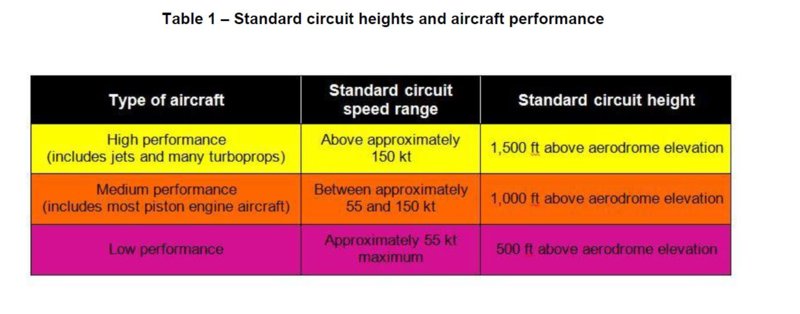
3.6.1 The term ‘ultralight’ applies to many small recreational aircraft including trikes, powered parachutes and other small fixed-wing aircraft that cruise at maximum speeds of up to about 55 kt. Pilots of these aircraft should conduct their standard circuit at 500 ft above aerodrome elevation.[/QUote]"About" being the operative word, but certainly a long long way from 100; regardless, it's up to CASA what they want to do with cases like this.
-
 1
1
-
-
I think you've got a good point with government salaries.It may be possible in private enterprise to show performance above the industry average and therefore earn big money.Personally I doubt it and the example of Joyce and Quantas does not impress me. People who will do nasty things to others are two a penny.BUT I was referring to government salaries, which have no relation to the sort of performance measure referred to. The only performance which counts is how good you are to sucking up to those above you.
I know one clueless head of a department who has spent the last ten years travelling the world to "conferences" at my expense.
I know a Council CEO who is a sponge on $330,000.00/year + expenses+luxury car and isn't worth $45,000.00/Year
-
 2
2
-
-
You'll really appreciate the benefit of today as you progress towards solo. Quite a few people go through most of their training in smooth weather; a day like this then comes as a ig shock and there's no one there relaxed beside them showing how to handle the weather and change circuits etc. Shocker circuits can be worth their weight in gold.Hi All,Completed another lesson in 7440 at YRED with Peter from Fly Now, flying conditions were anything but normal today, winds were playing havoc with us today, one circuit we would be using 07, then the wind shifted and then next we are using 25, we were also getting a little bit bashed about with crosswinds as wellToday was hopefully going to be about completing my first solo, but due to the conditions, I got to practice crosswind landings instead, first circuit was a shocker, but after the proverbial clip around the ears from Pete, I managed to get mostly everything dialed in properly and notched up some half decent crosswind landings
Brent

-
1
-
 3
3
-
-
Australia is probably not going to turn to Socialism any time soon, and payment based on skinning so many cows per hour, or putting in so many hours per day have given many in many areas to payment for improved efficiency which results in us being able to buy lower cost consumables; just go to K Mart or Target and compare what you pay for a work outfit including boots compared to 30 years ago. I've been able to graduate to buying my clothes instead of picking up discarded clothing three sizes too small from park benches.Don't forget that this money has not been earned by producing any consumables. It has been taken from mostly poorer people using menaces.Facthunters salaries usually reach that level provided the person meets some near impossible Key Performance Indicators, and that will usually mean he has been able to ensure the company has both increased its profit and kept its prices stable.
Take a look at what Alan Joyce has done at Qantas; there's no way a turn around of hundreds of millions of dollars, from some tough decisions which were extremely unpopular with just about everyone, should be held to a salary of $95,000.00, just isn't going to happen.
-
We've all been through it Deb.
-
The CAAP says about 55 ktsYou are assuming that my circuit speed is 55kts or less....it isn't. I've read that CAAP countless times.I took your advice and looked up a Maxair Drifter Manual which specified a Cruise at 55 mph (48 kts)
And maximum cruise at 70 mph (61 kts).
Other publications quoted the cruise speed for Drifter at: 52 kts, 52 kts, 43 kts, 48 kts
Cruising speed in the 1000' circuit is a long way away at about 100 kts.
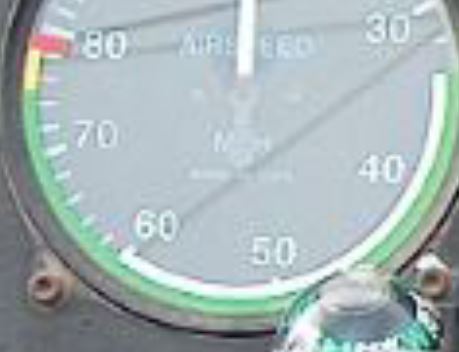
What may be causing some confusion is that the Drifter ASI may be like this one, reading in mph, not knots.
-
Can you two give any examples of these obscene salaries?A culture of a sheltered workshop of an "authority" that hasn't responded to numerous audits reviews, over many years now. Without action from a competent minister, with a clue about aviation and the desire to change things, nothing will happen. Nev -
Well they don't at Pittsworth; they say 500 feet for a Drifter and they refer to 55 kt speed.Not sure what you mean there....the regs state that I should be at 1000 ft. simpleHere's a link to CAAP 166-01 v4.1, April 2017, The Circuit heights are shown in Clause 5.3, page 21; The references to the applicable Civil Aviation Regulations are on Page 7
166-01.pdf | Civil Aviation Safety Authority
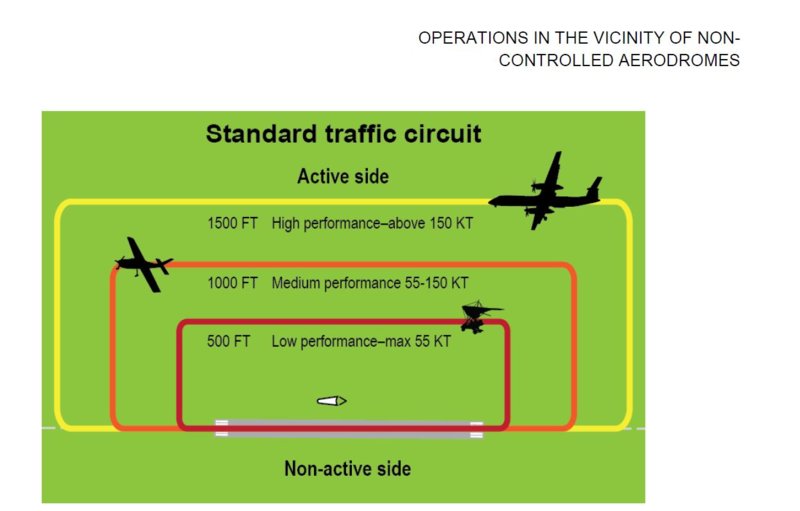
If you are flying at 500' there will be aircraft behind you, and you will be below their nose, but there's a clear 500' between you, and they don't have to expect you to come into vision until they are on late final, when you could be on Base, or final well within their vision envelope.
If you are flying at 55 kts at 100', firstly in a crowded circuit there would be faster aircraft spearing out of he circuit trying to avoid hitting you, but the one most likely to get you (LH Circuit example) is the pilot letting down on to downwind, with his eyes on a fast aircraft which has started to track downwind.
Here's a chart and diagramme from the CAAP which makes it clear.
-
1
-
-
Easy decision for CASA, don't follow the rules and you'll find out soon enough.The other issue is that do I really want to be lower and slower with faster aircraft above and behind me, that have me totally obscured with their nose high cowl? -
Not so fast there Kasper; we had a long thread on this with a number of trike people saying the same as you. The theory among some of the trike operators is that it hangs from the pivot, so it doesn't matter what you do with the body.With a single hang point the centre of downforce on the wing is fixed, like it is in a fixed wing aircraft.And good luck with either a CASA ramp check or even RAAus tech on W&B if you happen to fly a weightshift ultralight.And for those with no experience of this group the answer is The concept of B does not and cannot apply just W and hang point ... which for any factory manufactured machine is mechanically limited to ensure controlled flight within any permitted take off weight.Some models offer two or three hang points, and that changes the centre of downforce on the wing.
The body hangs from the hang point in a pendulum arrangement which leads to this apparent thought process that you don't have to worry about balance.
This belief is reinforced because manufacturers have been doing the balance calculations, then simplifying them into loading instructions.
So I needed to reverse engineer these instructions to get back to a point where I could produce an envelope which would allow loading other than the Pilot or Pax.
I found a CASA Type Certificate for a particular trike, and included in it was:
Number of seats: Solo flight permitted from front seat only
Maximum weight in rear seat: 100 kg
Maximum Baggage: 4 kg in and around front seat
Maximum Pilot/Pax weight: 200 kg
Front seat pilot weight range: 55 - 100 kg
Rear Seat Pax weight: 0 - 100 kg
All of those requirements include a moment arm, each weight relates to a specific point from a datum, just as it would in a Jab or Cessna, but in this case the manufacturer is doing the work for you.
Why? Well go to your wardrobe, find a couple of steel coat hangers; Hang one on your finger; it should be hanging in the pendulum configuration and be sitting level. Pull one end down, it returns to level. Get another coat hanger and hook it over the base of the first one in the centre. The two coat hangers should be level. Now hang the second coat hanger out at the end of the first; base of the first hanger is now pointing up at an angle, representing the change in prop thrust line of the body of a trike, which has changed in relationship to the wing the coat hanger would be hanging from. Turn your finger in a yaw motion with the second hanger in the centre of the first one, then out at the end and you'll notice some inertia and run on.
So while fundamentally a trike hangs down like a parachute hangs down, its prop is supposed to thrust at a predetermined angle and to control geometry allows for the yaw momentum set by the designer.
The discussion turned up pilots who were going away on fly ins and camping trips with camping gear stuffed into the wings changing the COG of the wing, and some people had welded brackets on to the side of the body to carry jerry cans to increase range. Neither of these significant changes were expected by the manufacturer.
In the more vertical seats of trucks I can get a very accurate driver/passenger mass by using a body COG of 50 mm from the undeflected seat back, but I needed to get the COG position used for the trike calculations, because the body is at a different angle. This would then allow me to back calculate all the above limitations, so, for example, you could position a jerry can bracket so the fuel would not exceed the rear seat maximum etc.
However, before I could get to this an Instructor brought the discussion to an end when he was killed in an unstable takeoff.
-
CAR 233 Responsibility of Pilot in Command before flightSure, but CASA wants to see evidence that the passenger weighs 80 kg not 90 or 100, and that you determined that before flight.Calls up CAR 235
CAR 235 says: "The Pilot in Command must ensure that the load of an aircraft throughout a flight shall be so distributed that the Centre of Gravity of the aircraft falls within the limitations specified in its certificate of airworthiness or its Flight Manual.
The Flight Manual I looked at invites you to insert your own weight and all pax weights at the appropriate moment arms.
So based on CAR 235, you need to put the exact pilot/pax weights into the W&B envelope if you are to get the exact result to compare with the envelope graph.
The graph usually has quite a big "Normal Category" envelope, so unless you were right up one end or one corner of it, there could be a substantial tolerance.
So it would be interesting to search a bit more for any specific instruction to handle that situation, or whether anyone from CASA has told you what you suggested.
-
OK I'll be more specific; a tinkerer who has NO previous mechanical experience other than a short box ticking exercise, who buys a standard 1974 Cessna 172N for $15,000.00 to fly in this theoretical RAA world, NOT A SAAA EXPERIMENTAL AIRCRAFT maintained by someone with mechanical experience.Yes, a big difference between a LAME who has spent his entire life working on Cessnas/Lycomings/Continentals and an enthusiast who has built and rebuilt many engines, runs a non standard engine, perhaps even something a LAME has never seen before. I used to fly my Cobra with a Subaru engine, aftermarket computer from the states, gearbox from New Zealand. Who is going to understand that? This is experimental, I love tinkering, I get help from others, I spend a lot more time on things than I could possibly afford to pay a LAME to do. We are recreational, fun, experimental, yes tinkerers even and that's what I like about it. I am not flying in CTA, I don't take passengers, I fly over countryside devoid of kindergartens, children's playgroups and huge shopping centres. I want to be able to my own thing! -
Your earlier calculation becomes your calculation, particularly if you're doing the same route over and over again with the same pax and the same baggage and the same fuel.I have enough knowledge of what affects the W & B of my aircraft, that I will know when an actual weight is required. That is through doing many calculations to see when the limits will be approached. For example I know that an 80kg passenger with full fuel will be no problem, but a 90kg passenger with part full tanks and I would do a quick calculation.What usually catches people out is someone absent-mindedly putting a machine part on board in the wrong place.
-
You don't think there would be a difference between an aircraft maintained by a LAME and an aircraft maintained by the local tinkerer whose life's work was the coagulation qualities of blood cells?Probably about the same amount as we have now. The HF/maintenance issue ratio is about he same everywhere in the western world. They aren't complex, and they are more structurally sound.. -
I can show you a nice prison cell if you've got a torch.Show me "ramp check" in the regulations. Anywhere. Anyone? Your time starts.........................now.Ramp checks are part of Compliance and Enforcement action. I listed the most common methods earlier; Compliance and Enforcement covers the sticks and carrots bodies use to enforce regulations.
However, you raise an interesting point, and that is what the powers of a body are to conduct ramp checks and where.
-
1
-
1
-
-
That's where I got to this morning; standard weights can be used from 7 seats to above 500.CASAs ramp check guidance sheet says:The inspector will check:...
Evidence of pilot and passenger weights (standard weights should not be used in
aircraft with fewer than 7 seats)
The guidance sheet quotes CAO 20.16.1 however on a quick look that doesn't support the guidance sheet. Which is my main beef with ramp checks - the CASA list of what is required seems to be far greater than what is in the actual regulations.
-
I missed this point; the members are the customers, the services are the price and the annual fee is the payment. Just like a subscription for software or leasing a car.Yes, good point. But to take your analogy further, do 'shareholders' in other companies have to pay the company annual fees? Remember, we are members of an organisation that is being run as a business, but the purpose of the business is to run the organisation for its membership. Without the membership there would be no company, surely?The Company decides how it will do business and what products it will offer and what prices it will charge.
The only input you have into that is whether the customers have the ear of a director or two, and they are not bound to follow what you say.
By Comparison, the skeleton of an Incorporated Association is its members.
-
I had a quick look for the CAR earlier in the day and couldn't find it in the time I had. If you can find it, we'll then have the wording exactly.Otherwise I'll keep looking. I've been lucky enough to have scales where I was picking up.I'm not denying the importance of W&B - although I would agree that W&B training in RAA is poor to nonexistent.If they are ramp checked, have they legally calculated W&B if actual passenger weight must be used?Many people e.g. flying a C172 would have done a generic W&B and know that with one passenger of any reasonable weight, they will be within W&B limits. However, is it legal to fly without determining the actual weight of the passenger? Can CASA ask to see a W&B calculation using actual weights, or are you safe saying "Well we're obviously NOT overweight".
-
I agree with you; I think this has virtually reached the stage of negligence.I don't have a very high opinion of CASA, because they have been forever re writing the rules, so that now it is hard to find out what is actually legal.
That's about the mix that I'm hearing too.I have been ramp checked at a fly in and found it a non threatening experience. I was treated with courtesy, not bullied, and as I was fully conforming I was thanked for participating. At the end of that fly in one pilot and his passengers died in an aircrash that should not have happened. I don't know if he was ramp checked there.At another fly in a pilot asked me if I knew where CASA were as he wanted to get away without being ramp checked. He admitted that he had flown in from SA to Temora, with no charts, relying solely on his GPS. That was before the days of Oz Runways and legal electronic charts.My experience with CASA has all been good. I find those I meet to be enthusiastic and knowledgable pilots.
Both Countries are committed to complying with ICAO regulations now, and last time I looked we would be no better off these days in the US system.The pity is that CASA as it stands is just not achieving anything worthwhile. It has been all this century spending vast amounts, twisting the paperwork, so that it is not understandable.They would be better off just adopting the FARs and their field officers would be able to cope with any problems.This compares with about 30 years ago when I phoned up and booked an aircraft in Las Vegas, saying I was from Australia, went out the next day and the Instructor threw me the keys to a Cherokee without any discussion.
-
Well based on your definition a few days ago, if you flew into the circuit in a Drifter, at Jabiru height, you'd probably attract attention right from the start; that's not interpreting an uninterpretable reg.And people wonder why aviation is dying out.......We are NOT participants unless there is some kind of competition, we ARE recreational pilots, showing up at social events.If they actually allowed us to have competitions as we used to have, I would have no problem with scrutineering prior to competing. You've used a very poor analogy, and you make assumptions of guilt that are typical of regulators, which demonstrate rather clearly why people avoid them.CASA and RAA have killed off many good fly-ins, no one wants to show up when you have the cops watching everything you say and do, whether it's a party or a fly-in. People feel like they just can't relax and enjoy the event, so they don't go. Organisers see smaller and smaller crowds until it's just not worth the effort any more.
Generally pilots are highly compliant with regs, being the risk averse bunch that we are, CASA and other regulators add another layer of risk. Risk that you will end up with a fine or in court over interpretation of uninterpretable regs.
There's no "competition" trigger to differentiate between a spectator and a participant; if several people go for a walk together, they all participate in the walk.
I think we all have a fairly good idea why some people stay away when we know there's a ramp check on.
-
At a Fly In you are a participant in the Fly In; if you are stressed about being under scrutiny, yes, you have the option of staying away.I don't want to be a participant, just a spectator. If merely arriving makes me a participant, I will pass.That is probably true, there is a lot of truth in the joke that the regulations are written in a way that means every flight is breaking some rule.
For example, for aircraft our size we are required to use ACTUAL passenger weights for weight and balance.
How do you get ACTUAL weight without weighing your passenger? Do you weigh every passenger? Or at least ask them their actual weight?
I weigh them; they go on the scales and their weight goes into the W&B calculation. It's very important that the inputs into a W&B calculation are correct, or the outputs will be incorrect, and you face the risk of a very uncomfortable trim situation when the wheels leave the ground, or even a return to earth by one end of the aircraft.
Remember that almost all single engine aircraft can carry full fuel, full pax, or full luggage, but never all three, and often, if you are planning a long trip and need full fuel, you will have to compromise baggage, 1 passenger or make a no-go decision, which is why it's better to do the W&B calculations with plenty of time up your sleeve. The other issue you don't want when you are off on a long trip is to turn up at the airport and find someone has filled the fuel tanks when you had to do the take off with half tanks and short legs.
The quite interesting subject of Performance & Operations just doesn't seem to be taught well in RAA, and that's a pity because it is so much more critical:
Remember the case when Slarti put a 15 kg tool box on the floor next to him, and almost lost control of the Morgan on take off.
Or the spectacular flop in front of the DAS, apparently caused by a barbecue.
I think one of the main reasons this subject doesn't get air time, is that during the training phase, the Instructor long ago worked out what size student he could take up on a full tank, so it is out of mind during the training.

Delorean Aerospace (yes really)
in AUS/NZ General Discussion
Posted
We criticise Australian Politicians, but the major parties have ensured low unemployment in Australia for nearly half a century
Over the years we've re-tasked tallow processors, milkmen, nightmen, shearers, wool processors, garment makers, navvies, wharfies, steelworkers, grape pickers, train shunters, car builders, milk bar owners, fruiterers, butchers and a whole lot of other professions.
We have built service industries like home stays, coffee shops, theme parks, and have made ourselves one of the key tourism countries in the world. We've been lucky enough to have entrepreneurs smart enough to set up mineral and coal mining in areas once considered to be remote and non- productive.
Where we may be heading is away from privately owned farm land.