

ayavner
-
Posts
1,704 -
Joined
-
Last visited
-
Days Won
10
Content Type
Profiles
Forums
Gallery
Downloads
Blogs
Events
Store
Aircraft
Resources
Tutorials
Articles
Classifieds
Movies
Books
Community Map
Quizzes
Videos Directory
Posts posted by ayavner
-
-
-
wow thanks for that Mike, I wish all aviation docs were this clearly written. So in absence of a computer or chart, i could probably start with the following from this document:
An increase in density altitude, therefore,
has a two-fold effect on the takeoff:
• An increased takeoff speed (TAS) is
required.
• Engine power and propeller efficiency
are reduced.
• The approximate effect of these two
components on takeoff and landing
performance are:
• The takeoff distance is increased by one
percent for every 100 feet of aerodrome
pressure altitude above sea level, and
the landing distance by one percent for
every 400 feet.
• The takeoff distance is increased by
one percent for every 1˚C above the
standard temperature for the aerodrome
elevation.
• Rate-of-climb and angle-of-climb are
noticeably reduced, as is obstacle
clearance after takeoff.
-
mate if there's a way, I'll find it

-
 1
1
-
-
on the Jab fuel cap, what is the thing that pokes up into the airstream, is that meant to provide ventilation?
-
I am thinking that Sporty's rig looks like the go, as it also factors in slope and wind and surface etc... Thanks everyone!
-
Nope, see what i mean? So what would one reasonably do in this situation, if there is no way to calculate it? I presume "hope for the best" isn't an option
-
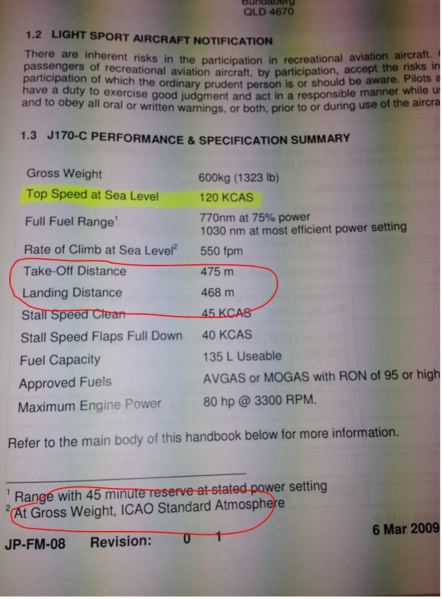
Sure thing HH, thanks! there isn't anything in the POH other than this info, so a bit stuck, though I did find something called a Koch chart on the FAA site...
Cheers!
adam
-
Hi there,
Hoping someone can jog my memory as to where to get started figuring this out. I have tried googling it, but so far have only come up with some very complicated articles using maths symbols I have never seen, or links to apps to do it for me - I seem to remember having learned this at some point, something to do with calculating pressure and density altitude, but having trouble remembering the connective tissue that ties it into the takeoff and landing distance.
POH just shows the distances at ICAO std atmosphere, but say I want to know what it is at 30* and 2500' AMSL?
thanks, all help gratefully received :)
-
I like the title of the photo on your desktop LOL
"bugger.pdf"
That's about right. I guess it was just a prop strike from "sh*t.pdf"
Glad everyone's ok...
-
Weird, spring came off on a rudder pedal last landing of the day on my last lesson in a 170, couple weeks ago. something new to watch for on the preflights i guess, might need to bend the hook in just a bit with some pliers...The spring on the rudder pedal came off on a landing on that aircraft on Saturday. I hear they are having a few teething issues with that aircraft. People tell me 7314 was a handful when new but she fly's beautifully now for me. LOL -
What would be the chance you could rig up a video camera just over your shoulder with a view of the panel and out the front, or have your CFI video the approach from the right seat? Might be that if you watched it after the fact from a more 3rd person POV you might see exactly what is going on. Just a thought.
-
man I can't wait! Might be a few weeks, but will update this thread when I do it. I know I need another expensive hobby like a hole in the head...
-
good to hear bigfella! still waiting to go solo myself, good to know the jitters do subside over time! Be sure and let us know when you do area solo too!
-
Think i'll give Camden a go and see if i like it (which I can only imagine I will LOVE it). I feel like this may also help my confidence in the air overall in the event of engine failures or forced landings.
-
cool thanks guys!
-
Hi all,
This would be a tangent for me, just would like to experience a flight in a glider. Anyone know of a good place to get set up with a TIF to have a go? I am in Western Sydney area, but don't mind a bit of a drive.
-
Well that is true Nev, guess I did get off on a tangent there regarding the forecasts etc. I would love some sort of book that could take all of the above and present it in an easier to understand, visual format! Obviously the deeper understanding could then be researched on specific topics of interest.
But i would still think that while decoding the forecast may not be the same as understanding weather, nevertheless you need to understand what it is you have decoded - so why make that pat of it hard when the important part is IN the understanding? What happened here is an example - I got myself wrapped around the axle on the decoding bit, and completely missed the point of the topic!
-
There was an article along these lines in this month's Sport Pilot, and I am glad to not be the only one who is thinking like this... in this day and age, I really can't think of any good reason not to have forecasts and reports in plain English. I can (sort of) understand the need to standardise the time with UTC, but really... how hard would it be to simply say "From 6 am UTC on the 24th, the winds will be from 240 degrees at 5 knots, temperature 18, dewpoint 8, visibility 8 km and QNH 1013. Possible turbulence below 5000 ft." I am sure I am missing some pedantic points, but you get the idea...
As it is now, by the time i get to the end, i've forgotten the beginning! As the author of the article pointed out, there would not be so many apps and services offering to decode the weather info if it weren't a problem...
-
 1
1
-
-
My RAA school is one that teaches to the GA syllabus, and has relationships with some GA schools. The idea is that I can get my RAA cert + pax + nav, all to the GA standard (but cheaper) then go through sort of a "warm handoff" to another school where it would more or less be a matter of building up the required hours in a GA reg plane, PPL test, and checkride. Much cheaper than going GA from scratch, and you get to experience both worlds. And as pointed out above, you can choose to hire whatever is appropriate for the type of flight you want to do. I think its a great way to go, and its what I have planned.
Main thing is to be sure your RAA school teaches according to the "Day VFR Syllabus". PM me if you have questions from a student POV as it is what I am currently doing... others can advise from a school or CFI POV.
adam
-
Fair enough... wouldn't be much of an ambition if everyone achieved it
-
 1
1
-
-
Just stepping back in to say thanks and keep it up, I not only got the original answer to my question, but tons of other great stuff i hadn't even considered!
-
pretty sure it was just a joke.
-
Suck, Mary, suck! "Blow" is just a figure of speech!!!
-
Hrm, well obvious to me at least in that most outfits are going to find that their bread and butter lies with the jumbo pilots keeping current, not with people like myself looking to brush up on single engine VFR on rainy weekends.
i think?



Lismore accident
in Aircraft Incidents and Accidents
Posted
yeah... i just wish my mother wouldn't feel the need to text me about them day before my lesson... HOW does she see these things before I do??