
Garfly
-
Posts
3,141 -
Joined
-
Last visited
-
Days Won
74
Content Type
Profiles
Forums
Gallery
Downloads
Blogs
Events
Store
Aircraft
Resources
Tutorials
Articles
Classifieds
Movies
Books
Community Map
Quizzes
Videos Directory
Everything posted by Garfly
-
Dingo – Future Vehicles s.r.o. WWW.FUTUREVEHICLES.EU The original features in this new video about 5 vintage ultralights: 00:24 Ultraflight Lazair 03:19 Mitchell U-2 05:58 Wood Skypup 07:56 Hovey Whing Ding 10:10 Diehl XTC
-
These four films cover the trip as far as Darwin (a series covering their flying within Australia is due later).
-
-
 A new film about the AW 15 Atalanta from 'Rex's Hangar':
 -
-
- 2
-

-
SkyEcho 2 - ADSB light doesn't come on...
Garfly replied to Philster2001's topic in Instruments, Radios and Electronics
Another issue to keep in mind (which others have mentioned here) is that it's fairly easy to inadvertently turn the unit on as you stuff it into a flight bag or whatever. It doesn't take much pressure to operate that barely recessed button. I've taken to gaffer-taping an old credit card across the whole face of the SE2 to guard against that happening. -
Another great trip vid • RV12 takes off for a big lap
Garfly replied to Garfly's topic in Trips/Events/Seats
Actually, not such a big lap this time (I took the title too literally at first ;- ) But still ... a witty, well made movie of a little two-day lap around the Mangalore - Echuca - Griffith track. You really get the feeling that you know Oleg and Dina personally by trip's end. In this way, the vids are a lot like the "Flying Around" series by Scott Hendry and his wife Chris. https://www.youtube.com/user/thecscotthendry -
-
-
SkyEcho 2 - ADSB light doesn't come on...
Garfly replied to Philster2001's topic in Instruments, Radios and Electronics
Whereas ADSB-OUT is mandatory for all IFR a/c (so we should see all of them, with our SE2/EFBs) there's no requirement for them to be equipped with ADSB-IN and CDTI (Cockpit Display of Traffic Information). So there's no guarantee they will see our SE2s. (Many can and do though, it's hard to know; same with ATC - the situation is complicated and fluid.) IFR ops often have TCAS but the SE2 (and other EC devices) are not visible to TCAS - which only sees and reacts to proper transponders. But I think that state of affairs, too, is evolving as we march towards mandatory universal 1090 IN and OUT. P.S: These are good reads (but also might need updating) advisory-circular-91-23-ads-b-enhancing-situational-awareness 2.pdfVFR and visible _ Flight Safety Australia.pdf -
SkyEcho 2 - ADSB light doesn't come on...
Garfly replied to Philster2001's topic in Instruments, Radios and Electronics
Yeah, the SE2 works on Pressure Altitude so, in effect, it's always sending Flight Level, not AMSL. ACAS systems all use PA since they're only really interested in own-ship's vertical relation to nearby targets; high or low, trending up or down. -
Max Holste MH.1521 Broussard - Wikipedia EN.WIKIPEDIA.ORG
-
- 3
-
-
SkyEcho 2 - ADSB light doesn't come on...
Garfly replied to Philster2001's topic in Instruments, Radios and Electronics
And maybe find a white hankie to shield it from the sun's heat. Your buyer's remorse is sure to lessen the first time it saves your bacon. (Or even just saves some needless worry once in a while ;- ) -
Sure, if an airline pilot hasn't done any GA flying in 30 years then they'd probably want and need some transition training before going over to RA. But that's a process they've been used to their whole career. These days, though, a pilot leaving GA for RA might be going, say, from a draggy old Maule to a slippery Pipistrel. (Or a thirty-thousand hour ag pilot going over to ... well, anything). Not exactly what the regs had in mind. So, yeah, while transition training is always advisable, it no longer makes sense to mandate a fixed number of hours for candidates who don't need it. Competency based testing is now fairly well accepted in aviation. P.S: An interesting FAA take on transition training: https://www.youtube.com/watch?v=TpxJIr4dsF8 "The lack of transition training has been cited as a causal factor in many GA accidents. Accidents frequently result from pilots being unprepared for challenges presented by the new, or different, aircraft they are flying. Even when pilots are legally certificated to operate aircraft within a specific category and class, significant differences can exist among different types of aircraft within that category and class — thus necessitating the need for effective transition training."
-
What?! RAIM is a concept used in IFR ops. Anyway, even if the whole GPS system did drop out (ever happened here?) you'd still have your (approved) iPad charts to read - easier to handle (and enlarge for detail) than finding and unfolding paper ones in a hurry. You'd use them with your compass and watch and paper flight plan you have as back-up. If your iPad dies then you fall back on your phone and/or spare GPS and the paper charts you do have in your flight bag. Well, at least you have a fix on where you were a minute ago - before the sky fell in - as it's so wont to do. I don't suppose this CASA guy would be asking if you'd considered taking up the feds offer of a nice new half-subsidised SkyEcho2. Of course not! They don't believe in all that 'distracting' tech stuff. Never have. What's wrong with the Old Eyeball v1.0!? Worked for him (if not, sadly, for everyone).
-
And, in some cases, much less, I guess.
-
Yeah, there's a fair bit in OzRwys that wasn't in my old Garmin12 from the early 90's. It had one of those much maligned GoTo buttons, though. The GA establishment was not impressed; certain that the sky would fall in if ordinary aviators ever got access to such thingies. Stories abounded of hapless GoTo navigators blundering into airspace and mountains, blindly following their diabolical handheld GPS thingies. Few of those stories were true but the suspicion of GA GPS (despite the obvious benefits) hung around for a good long while. Now it's ADS-B. Go figure.
-
I'm a bit surprised that you would - or even could - be required to undergo such a demanding, costly and wrongheaded BFR. In my opinion, their insistence on your having to use way-out-of-date, and demonstrably less reliable, less safe nav methods seems weird. Some kind of confirmation rite of yore. That's no way to test for competence and safe airmanship in today's complex aviation environment. (Even if there's still a case to be made for ab initio training in the old ways.) I'd be interested to know which arm of CASA did the deciding on this - and on what basis. Is this normal? In any case, AFAIK, you'd not be required to do any nav test as part of your conversion to RAAus. So I guess you'd be trading in your Mooney, then, for something more on the ultra end of things. ;- )
-
SkyEcho 2 - ADSB light doesn't come on...
Garfly replied to Philster2001's topic in Instruments, Radios and Electronics
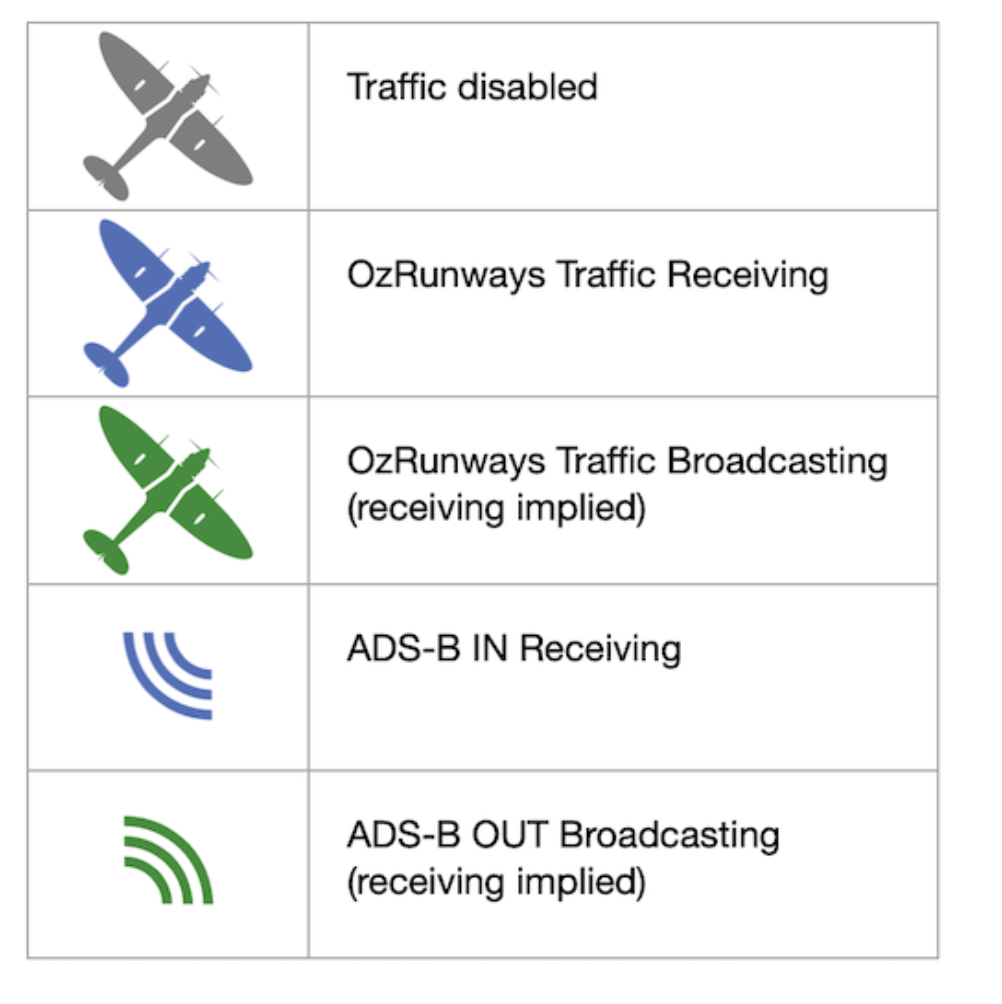
Philster, As soon as I turn my unit on, the middle green "ADS-B" light starts flashing - even before it gets networked to the iPad/OzRwys. So that suggests to me a problem with your SE2, itself. (There are tech savvy folks on-site who'll know more.) In any case, OzRwys does have an indicator on its main map page (upper right corner) confirming the traffic IN/OUT status (both of its own [cell-tower based] system and any integrated ADSB device.) So if you're not seeing the green radio-wave symbol (see pic) together with your ID 1234 and '1200') then you know your SE2 is not transmitting. More info here: OzRunways Knowledge Base - SkyEcho 2 ADS-B IN/OUT SUPPORT.OZRUNWAYS.COM
-
Yes, Skippy the Ping gives you the same info as the SE2 and in the same format (at least within reasonable range of your own ship). But anyway, not all Mode S transponders transmit ADS-B so if yours does not send the "extended squitter" bit, as I understand it, you'd be good to go with using an SE2 to its fullest. That way you would have both the poor man's ADS-B IN/OUT solution as well as the rich man's proper transponder. That means you could continue to operate in Class-E, you would have the benefit of surveillance by Centre, you will be more likely to be detectable by TCAS and you will probably, when the time comes, be entitled to request clearance to transit controlled airspace, even in an RAAus craft on an RAAus ticket. (If I have anything wrong, I trust I will be corrected.)
-
Further to the above, F10, maybe I missed the drift of your question. By "just" Sky Echo, did you mean without it even being paired to an iPad (or similar)? In that case, the answer to your question would be yes, as long as the other aircraft had IN as well as OUT (and was set to show "conspicuity" type targets). But pretty much everyone who uses a SkyEcho2 links it to an EFB (which they likely have anyway) so that they can "lookout" for all the ADSB traffic within Cooee. Nowadays, of course, all IFR aircraft show on screen plus an ever growing percentage of the rest. The more the merrier, and safer.
-
Negative, re that SkyEcho question, F10. Heaps of discussion/information on the topic here on the forum. But, yeah, I reckon your old RAF mate was damn right to be paranoid. Heck, anyone who goes out of their way to get a SkyEcho is paranoid too. (Especially the ones who've learned not to fully trust their lying, limited eyes. )
-
By a disease analogy ADSB is, to me, not about treating symptoms nor causes; it's a prophylactic. (And a pretty cheap and effective one, too.)
-
F10, would you care to expand on that "knee-jerk" comment (especially in light of the frequency issues we're hearing about)?