


skippydiesel
-
Posts
7,613 -
Joined
-
Last visited
-
Days Won
73
Content Type
Profiles
Forums
Gallery
Downloads
Blogs
Events
Store
Aircraft
Resources
Tutorials
Articles
Classifieds
Movies
Books
Community Map
Quizzes
Videos Directory
Posts posted by skippydiesel
-
-
Oooooh! selective with our arguments, aren't we???
I think my point is clear enough - if a highly respected certified aircraft, advisory organisation, can recomend parts from a hardware store, the principal of substitution (where appropriate), is well and truly established.
"It's only plugging off a cabin heat ducting ." - so? How do I know that the "plug" will not deteriorate rapidly, allowing toxic fumes to enter the cabin or fall out & interfere with the aircraft control systems, etc etc??
".........for use as critical flight components" - what might the definition of "critical" be in this context?? Could it be a part which meets/exceeds all of the published (in my situaton by Rotax) specifications OR as you would have - supplied by the manufactures representative (dealership/agent) on trust with a bit of documentation attached & a high price tag???
😈
-
 1
1
-
 1
1
-
-
I am an advocate for using less costly, non aircraft/certified/OM supplied parts, in the maintenance of experimental/homebuilt aircraft (particularly Rotax engine service components) subject to appropriate research of the proposed part.
I am often receive very strong opposition to my advocacy, so its with some delight that I reference a small section of advice from a highly esteemed/respected organisation - The Bonanza Air Safety Foundation, "Detecting and Preventing Future Aileron Cable Damage Recommendations for Voluntary AD 2019-23-10 Follow-On Actions ABS Air Safety Foundation";
"If you do not require heat in the baggage area or aft cabin behind the 3 rd and 4th seats, remove the original ducting completely. Install a 2” PVC plug (Home Depot SKU 741 264) inside the plenum to which the original duct is attached, then use a #36 stainless steel hose clamp (Home Depot SKU 100 494) to tighten the hose around the plug. The clamp and plug may also be purchased from any of the building supply stores. You will need to sand the plug’s outer diameter down slightly to install it inside the flange with a tight fit."
I believe "Home Depot" to be a hardware store chain.🤣
😈
-
 1
1
-
-
13 hours ago, gareth lacey said:
It came with a job lot i got from a guy selling aitcrafy stuff probanly sceet i will take pic in the morning and send it to you
Thanks mate!😈
-
7 hours ago, gareth lacey said:
Hi Skip, i have some about a mtre long its black with a wire outsde 50mm its yoursif you can use it
Cheers Gareth
Hi Gareth - which type do you have, SCEET or SCAT ?
-
42 minutes ago, turboplanner said:
We've been on these treasure hunts before. The information keeps changing.
??????????😈
-
What!!! Not a one with a bit of leftover SCEET ??
What about SCAT?😈
-
Looking for a short length of SCEET ducting , ID 2" , often referred to by Dash Number -8.
300mm/1 ft would be ideal. Will consider longer/shorter.
Living in hope 😈
-
It is almost certain, that manned fighter/bomber aircarft are close to being redundant - the future will be drones & rockets of all shapes & sizes.
This trend is also going to happen on/under the sea - so much for billion dollar subs.
Military personnel will be a long way from the front line and relative, to past/current conflicts, few in number.
The featured aircraft, if it isn't a computer generated fraud, is but part of a game of one upmanship - a distraction/propaganda 😈
-
 2
2
-
-
1 hour ago, Blueadventures said:
There is no description of the flap your moving. Maybe it’s pressed up hard in its track that then act as a break. You need to provide more info and image of what’s not working.
Cowl flap is the full width of & conforms with, the shape of, the underside of my cowling and aproximately 150 mm wide. Hinged at the afte edge of the cowling (no possibility of jamming).
When closed, conforms with/looks like, an extension of cowling bottom.
When open, goes to about 45 degrees down,
Will try & find a photo
-
 1
1
-
-
5 minutes ago, sfGnome said:
The stall will occur if the actuator can’t reach the limit switch for some reason (eg too much load).
Ah! 😈
-
2 hours ago, RFguy said:
Skip you are going to have to put some numbers on the requirement.
Force - I cannot beleive much unless it is acting as a bucket scoop ,But it WILL have some of the pressure of the cowl insides... You would be able to make a reasonable estimate of the upper limit of the pressure on the cowl flap.
Travel ? .
Many Model RC-servos will do the job you want , since I gather you are fine if it doesnt work.
I don't follow.
I have been using LA's with a claimed 19kg extension force - many times what might be required to open a small flap, to say 30-45 degrees.
The pressure, on the closed flap is minimal, as its function is a "choke' or restriction, not shutting of the air flow completely.
The lower closing force of the LA is equally of no concern, as the air pressure against the flap will assist the retraction.
The LA's, for their short life, have worked well.
As earlier mentioned - a post-mortem of the first LA found that the motor still ran, the extension/retraction system still worked, however the stroke limiter circuit had failed, thus not allowing the reverse of current polarity to retract the system.
The following are the specifications I have been working to:
· Some resistance to moisture, dust & temperature. The actuator may be inadvertently exposed to water, during cleaning and in operation, air temperatures to 600C.
· Extension range 20-25mm.
· Working speed 5-10mm/sec (negotiable)
· Thrust 20kg (negotiable)
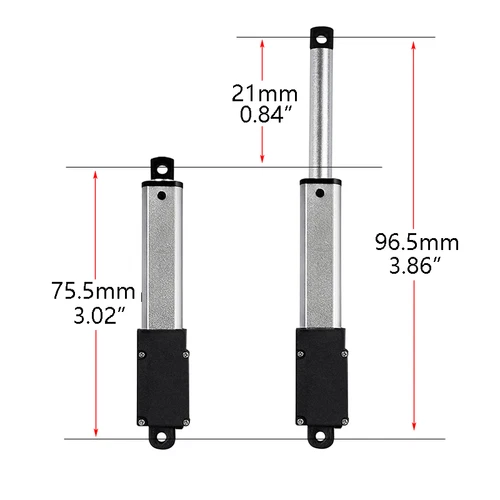
· Installed length (retracted) 75 -80 mm
· Fully extended/retracted, built in, electronic limit switches (existing remote switch to reverse polarity/direction of movement)
· No power “lock” in fully extended/retracted position.
· Constructed of corrosion & vibration resistant materials
· Current mountings 4mm ID both ends but could be modified.
· Automotive standard 12V electrical cable
The extension of 20-25 mm, will give an approximate 45 degree flap movement.😈
-
1
-
-
18 minutes ago, onetrack said:
The data sheet for a typical 20mm stroke Actuinox Motion Device linear actuator, is linked to, below. Note that the "maximum duty cycle" is only 20%, and they also note that "repeated stalling of the actuator against a fixed load will shorten the life of the actuator".
This indicates to me that the micro linear actuators are not really "industrial grade", nor really suitable for full-size aircraft use, where you'd normally expect a substantial degree of durability and reliability.
"repeated stalling of the actuator against a fixed load will shorten the life of the actuator".
I do not understand.
The LA's I have been using have two wires.
Switch down - current drives motor - system extends - "hits" stroke limiter and cuts off current.
Switch Up - current reverses motor - system retracts - "hits" stroke limiter and cuts off current.
Note: There is no need for an interim position ie its either fully open or fully closed
The above system can not repeatedly stall, as stroke limiters shut of current/drive at the end of each stroke movement.
😈
-
1
-
-
Nice one Garfly! 😈
-
1
-
-
Hi onetrack. This is the smallest 25 mm LA that MOTIONDYNAMICS have on their web page:

This is dimensional idea (not the actual unit) of what I am after:
-
1
-
-
53 minutes ago, onetrack said:
Skippy, have you tried the company listed below? Despite your (and my) abhorrence of Chinese-made parts and components, it's becoming extremely difficult to find anything that is not manufactured there now.
I've tried in vain recently to acquire bearings that are not made in China, and despite buying "quality, brand names" (including the finest Japanese and European bearing names), I've continually been upset to open the "quality" box, and find "Made in China" stamped on the bearing!! They have won the manufacturing war by sheer volume, by constant "competitive" pricing, and by being able to supply parts/components rapidly, in vast numbers.
The car industry is next. Chinese cars will dominate the world within 5 years, I reckon. I read where BYD have 1,000,000 employees, and 110,000 engineers!! FFS, why would anyone even try to compete??
Linear Actuators, High Quality and Low Cost
WWW.MOTIONDYNAMICS.COM.AU
Explore our premium range of Linear Actuators (12V-24V), offering high performance with force capacities from 200N to 7000N and strokes from 100mm to 500mm (IP65 rated). Comparable to top global brands...Correction: I am great admirer of the Chinese and their work philosophy. Industrially, scientifically & possibly militarily we have much to be concerned about - they are consigning us (the West) to history.
In my lifetime I have seen the rise & rise of Asian industry. Look at the high quality products from the Japanese & Koreans - in my youth much sneered at. The Chinese & Indians have put rockets/satellites into space. Sure they give the World cheap low quality products but they can & do, deliver as high a quality as we are willing to pay for.
Thanks for the WWW.MOTIONDYNAMICS.COM.AU - I have written to them asking for their recommendation - Unfortunatly my browsing of their website, suggest even their smallest actuator is likly many times the weight/size of what I would like.😈
-
1
-
-
21 minutes ago, BrendAn said:
i think nev has hit the nail on the head. simple is best. a cable or rod is nearly foolproof and you don't have to wonder if your chinese electrics are going to fail.
My friend, is it possible, that you did not read the proceeding comments, from me?
The traditional system(s) of Cole Flap actuation, present a series of chalanages, I do not wish to address.
The electrical solution, long since adopted in the automotive world , is my proffered concept.
The concept has been tested - It works! - fact!
Unfortunatly I have yet to find a suitably robust Linear Actuator of the correct specifications, that will give a durable service - this is why I asked the question in my opening comments.
So I ask you again -Are you able to recomend a supplier of quality linear actuators that may suit my purpose??😈
-
21 minutes ago, onetrack said:
Direction reversing cam?? A complex device? Surely you're joking? It's normally referred to as a "direction reversing linkage" and I could knock up a simple one for you, in probably less an hour.
Thanks for the correction in terminology.
".......I could knock up a simple one for you in probably less than an hour."
As for simple - perhaps I am overcomplicating, the system, in my mind;
Ratios to be considered - Input length of actuating button movement : reversing arm linkage length & location of input/output cables : flap movement
- Acquisition of suitable button & double acting cable system
- Will button fit in switch location on panel
- Measure button movement
- Dont have a reversing linkage, but like you could probably make one. Unlike you would take several hour/days (after acquiring materials) & include method & location of mounting.
- Mounting location may take several days to sort out, IF practical at all.
- I guess the position of the firewall hole, for the cable to Flap, would arrive as part of installation process - not happy with the idea of additional holes in firewall.
- I do have a flap that is capable of moving through 90 degrees (I will limit to Max 45 degrees) - a suitable mounting for the actuating mechanism to attach, would have to be fabricated
Simpler (to me) to mount a two position reversing polarity switch (JayCar)
Run a suitable 12V wire to power source (via fuse JayCar) and to Linear Actuator (have wire on hand)
Mount Actuator (seeking advice on supplier of reliable unit) such that it will open & fully close Cowl Flap
What's not to like???
Thanks for the "The Bullet Series 23 Cal. " suggestion from Firgelli - I had looked at these, unfortunately the closed length is around double what I require (see opening specifications). IF the Bullet is the only viable option, may have to reconsider existing mounting system. Firgelli used to do a much shorter/smaller range of Actuators (have one on my desk but seem to have dropped them). Firgelli (Canadian) likly have their actuators made in China & charge about x 10 the price of the very similar looking eBay offerings (see my opening comments).
😈
-
1
-
18 hours ago, RFguy said:
Sean, as you are aware, anything you buy on ebay from China- you got to plan for a failure in flight, but you know that.
Check if they live up to their specs etc. if it says 20kg, try 20kg, then try 30kg. and try pulling as well as pushing...they will be different.... and see how much there is in hand, and be sure to do it at 12V, not 13.8V etc on the bench , as wire volt drops are not insignificant near stall.
You want about 2:1 at least on whatever it needs. Can you monitor the DC current during deployment at Vfe with the wing loaded ???
In the datasheet
- notice the "Duty Cycle: 10%" - you should treat that as a red flag- that tells me the motor is very underdone for the job- avoid or substantially lower the load.
-" Full load current: 0.2~0.3A at 12V" . you need to measure this at Vfe in flight (with the wing loaded) and see what current you are pulling. SUggest at Vfe, no more than 50% of full load current for whatever size you choose.
- Note the very important spec "and the pulling force is less than pushing force." - the spec is pushing force (19kg). the pulling force might be 1/2 or 1/4 etc ......
Thanks for all that RF
Duty Cycle: Not sure how this translates in this context. The flap goes from fully closed/open in about 1-2 seconds. Current only flows between fully closed/open when limit switch activates.
I thought a claimed 19 kg extension (pushing) force would be many times the effort required to open the flap ie a conservative capacity. Closing the flap (pulling force)will be assisted by air pressure, so much reduced effort required.
Linear Actuator RS! so not able to perform any tests at the moment - do you know of a quality Linear Actuator supplier?😈
-
Why did I decide on a linear actuator to operate my Cowl Flap??
Perhaps at odds with the concept of mechanical/traditional operation of a small aircraft cowl the linear actuator present's as an easier/simpler way of the pilot opening/closing the flap.
I can just hear you now - Naa! pull/push cable (traditional) must be the simplest.
The traditional system would require;
- Another hole in my firewall
- For intuitive action (In for Close/Out for Open) a direction reversing cam would have to be made/purchased/mounted - not simple!
- A suitable location, on panel, for the Cowl Flap button would have t o be found (Sonex panel real estate in short supply).
Reliability - Almost failure proof.
Linear Actuator;
- Electrical wires to control/energise Actuator pass through existing firewall hole - no modifications.
- Two way toggle switch on instrument panel, Up for Close / Down for Open - small LED to one side of switch red for down/green for up.
- No issues with working out cam rotation/arc ratio to flap movement. Actuator extension movement must be matched to Flap movement - not hard.
- Linear Actuator - looks like a small hydraulic ram - is mounted in the exit air hole at one end & on cowl flap at other. System works very well, that is until Actuator stops working.
Reliability -
If I can find a suitable Actuator (hoping you can help) the system should be reasonably safe.
Fail open - There is a small amount of extra drag/reduced/ engine systems may stay cooler than optimum performance - barely noticeable.
Fail closed - There is the potential for increased engine system temperatures during Climb. The pilot may notice LED stayed green - abort TO. If in Climb should be able to manage this by reducing engine power, leaving prop pitch in Fine and returning for a landing.
In the absence of a suitable Linear Actuator, I think I will move to a very simple system - Summer: Exit Ait Open / Winter: Exit Ait Choked (partially closed)
-
13 hours ago, Red said:
Vibration?
???????
Please explain 😈
-
59 minutes ago, RFguy said:
How much thrust is required when airborne at Vfe ? - you need to know this. Sonex aircraft will know.
how much room do you have ?
did you get a ball screw, rack or lead screw type ?
Hi RF,
I thought that supplying the web page would have given you all the info. you need.
I am not well versed in all of the options you have listed - short answer - don't know suspect "ball screw"
The units(s) I selected appear to have all the characteristics I need to do the job - they just don't last. Both failed in the open position, which may be a good thing.
On dismantling the first failure, it seems that the electronic limit switch failed - which in my understanding meant that the electrical polarity could not be reversed ie no retract action. The electric motor ran perfectly when connected to 12V. The screw mechanism extended retracted when a screwdriver used to provide rotational force. Circuitry so small - beyond my capacity to repair.
They claim a near 20kg extending force, which should be more than enough for a small cowl flap.
Sonex don't fit cowl flaps as part of their plans/kit offering - previous non conforming enquiries have not gone well.😈
-
1
-
-
Happy New Year to the Forum Brains Trust
I have had bad luck in the use of linear actuators, to operate my cowl flap. The first one lasted about 30 hrs before failing to retract, the second an hour.
I have been using the following (12V variant) supplied by CarryMart.
I was attracted to CarryMart because they have comprehensive specifications for their products (unlike identical looking ones on eBay). The specifications of the above unit fit my application.
FYI: By the time a received the actuator, it cost about AU$100, x4-5 the price of an eBay similar product and it took 30 days from order to dispatch and another 10 days to arrive. Comprehensive specifications & cost, are not a reliable indicator of a quality product/service.
I am hoping some of you may have been down this track and can recomend a supplier of reliable actuators.
😈
-
1
-
-
40 minutes ago, Garfly said:
"..................in conditions of reduced visibility ......................."
airplaneacademy.com |
AIRPLANEACADEMY.COMThe key statement in that whole paragraph😈
-
"People can make up their own mind about lights. I happen to think they can be useful at times. Even without that little episode, I would have put them on my plane anyway just because I like them. The extra switches on the panel look nice too."
The only part of your statement I agree with.😈
-
1
-



Non Aircraft/Certified Materials
in AUS/NZ General Discussion
Posted
You guys - you want your cake and then when it suits a non certified cake. 🤣
It is now a fact, that you, will use a non certified/non OM supplied item, when/ where it suits you to do so. Your rigelling smacks of hypocrisy.😈