

sfGnome
-
Posts
939 -
Joined
-
Last visited
-
Days Won
7
sfGnome's Achievements

Well-known member (3/3)
-

Life Safe fire extingushers
sfGnome replied to Blueadventures's topic in Aircraft General Discussion
Here’s an idle thought. What if the bottles was mounted on the engine side of the firewall with remote activation from the cabin (Bowden cable or whatever). More likely to hit the source of the fire, and not going to incapacitate the pilot. Fire in the cabin would most likely be electrical, and (from my singular experience), they tend to be short lived, though producing vast quantities of smoke. Of course, the 50C limit would be normally exceeded with this particular extinguisher, but I assume that there are others which aren’t pressurised. -
Yep.
-
I’ll give you a call, but for clarity for people reading this, I’ll add a couple of points. My comments up to this point only apply to Group G experimental. Group A still have the same restrictions & liberties that they always have. Getting a Group G experimental into the air is almost exactly the same as getting a VH experimental up there. The process is the same. As an aside, if you want to have someone else do your first flight, then finding a test pilot with an RAAus Group G license is somewhat difficult. As T510 has noted, currently, someone purchasing an Experimental cannot do their own maintenance, regardless of whether they are registered VH or Group G (with the caveat that if the purchaser has already built an essentially similar aircraft, then they can do their own maintenance).
-
As I am building a Group G aircraft, I have been in constant contact with RAAus. I’ve done the SAAA course, and RAAus have accepted the qualification (including weight & balance). This relates to full maintenance, not just pilot maintenance.
-
If you are the builder and you have done the required maintenance procedures course (SAAA are the only approved supplier of an MPC at the moment) then you can do your own maintenance under Group G (<760kg). In fact, the reason for the LAME-only stipulation (with the exception of the above) is that CASA has made Group G almost identical to VH experimental, so it’s a coin-flip as to which way you go. It’s not what RAAus wanted, but CASA makes the rules.
-
My TC wanted to see the wings prior to skinning. I’m pretty sure that’s the SAAA requirement.
-
Ok. The ETX900 has a warning led output which tells you the internal state of the battery beyond just the voltage and current. It’s well worth connecting up to a led on your panel. The EarthX user manual gives a table of actions to take if it starts flashing, ranging from keep going to land now.
-
I don’t know which Carmo regulator model you have, but the one that I looked up had an output voltage of 14.5 +/- 0.5V. EarthX say that the maximum regulator voltage is 14.6V. What was the battery led doing while all this was going on? Flashing?
-
Dan's melting moments- an apology
sfGnome replied to danny_galaga's topic in AUS/NZ General Discussion
Spoken like a true heathen! 😝 Personally, I’m easy this year whichever team wins. Swans are out, and there’s no Victorian teams there to hate. 😂 -
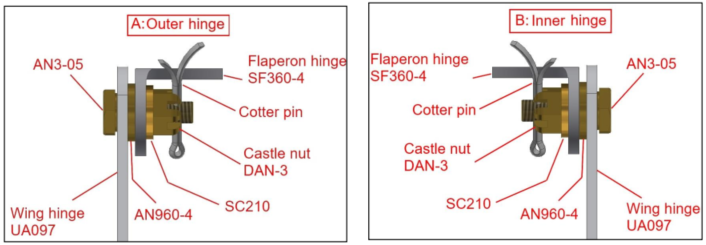
This may possibly add more confusion (sorry if it does), but here's the hinge bolt setup on the Ventura from the latest manual chapter dated April 26. I have no idea whether it is the same as the Savannah, but the two planes are very similar in many respects. "Inner" and "Outer" in this context are referring to each flaperon, so there's 2 pointing one way and 2 the other way on each wing. On this setup, presumably the bushing is fixed in the flaperon hinge, and the bolt is fixed in the wing hinge so, as Kyle said, the bolt would be rotating inside the bush. On a related point, I asked ICP about an Australian equivalent to the specified white grease, and they said "It is just a white grease, anti-corrosion, water resistant, very dense, protective. No other relevant properties, anything used on boats it will be perfect."

-
Yes and no. In the long run, the builder is totally responsible for the airworthiness of their build. The AP providing the ‘airworthiness’ certificate is only saying that the paperwork is done. They don’t certify the actual airworthiness.
-
Serendipitously, I came across this article tonight which has some useful stuff to say about this.
-
I learned on a 160 (some years ago), and was taught to cut to idle when I was guaranteed to make the field. When I did a check flight in a 160 earlier this year (because it was the cheapest aircraft to hire), I dumped it on the ground for the first few landings. Turns out that it drops like a stone when you get too slow. The issue wasn’t that I was gliding; it was that I was letting the speed bleed off too soon (ie I was flaring too soon). That’s the fun of a high wing - no cushion of air between the wing and the ground - and flying low wing had got me into being a bit lazy.
-
Ok, dumb question (dumb, bearing in mind your extensive experience). Is there a hole in the side of the breather tube so that oil isn’t being pulled out by the Venturi effect?
-
Ok, I won’t, but if I was allowed to, then I would. 😜