
kgwilson
-
Posts
4,892 -
Joined
-
Last visited
-
Days Won
142
Content Type
Profiles
Forums
Gallery
Downloads
Blogs
Events
Store
Aircraft
Resources
Tutorials
Articles
Classifieds
Movies
Books
Community Map
Quizzes
Videos Directory
Posts posted by kgwilson
-
-
Thanks for hunting this out,
I'd forgotten the authors name & hadn't spoken to Dave (Geoff is his wifes Uncle) and an internet search came up blank.
-
 1
1
-
-
I read a book loaned to me by a neighbour called "Flying Backwards". It was quite fascinating. It was written by an uncle of his who was a tail gunner in an RAF Lancaster during WW2.
Another great book is Chickenhawk by Robert Mason who chronicles his experiences from learning to fly helicopters & as a Huey pilot in Vietnam and experiences following the war.
-
2
-
-
In the 2018 Annual report from Ra-Aus there were some interesting stats. They did not produce such a report in 2019
The following are the numbers of 3 axis aircraft on the register for the top 10 brands
Jabiru 886
Thruster Aircraft 216
I C P 184
Tecnam 186
Aeroprakt 159
Austflight ULA 158
Skyfox Aviation 133
Howard Hughes Engineering 128
Zenith Aircraft 103
Rand 67
This will of course have changed somewhat in the last 18 months but it does show there are a lot of Jabirus out there. If you add the VH registered Jabirus and all of the other aircraft flying with Jabiru engines, I would guess that there are at least 1200 Jabiru engined aircraft in Australia which is not an insignificant number.
-
2
-
-
Mine is a Gen3 3300A. Always run on Mogas. Originally I used BP 95 but that has become difficult to obtain as the BP stations around here no longer supply it but have in its place 94 which has ethanol in it so I switched to 98 which I get from a petrol station just around the corner from the aerodrome & it is a busy station on a main road. Starts first time every time, runs smooth and the engine is clean. I change the oil (3 quarts) & filter every 25 hours with Shell W100 plus. The oil stays fairly clean & I never have to top up between changes. I've used Avgas only once when away as that was all I could get. I didn't notice any difference.
I just completed a 100 hourly & the compressions are 75 - 80. I got a miss after 2 hours running & traced it to a dud new plug. I like the engine for its simplicity and easy maintenance & it is direct drive. Getting the mixture right on both banks has been a tricky exercise with one side running slightly richer than the other. I put a vane in the cobra head which I can bend in order to direct air and getting this spot on is a mission so I have given up. I only monitor CHT on 1 cylinder & have moved it around but the difference is relatively small & I monitor EGTs on the rear 2 cylinders only. My engine runs quite cool & the EGTs are very close. I get 18-20 lph cruising at low altitude at around 2800 rpm. Up high 6-8000 plus it is around 24 lph at 2850-2900 rpm
-
1
-
 1
1
-
-
Why are there are so many fuel exhaustion/starvation forced landings? Is it because of false readings, failing to dip the tanks, dipping on uneven ground, poor fuel burn estimations/calculations, headwinds/environmental issues, diversions, failing to swap tanks etc. When I tested my main tank I kept a log of litres and the gauge reading which is on the panel. Even this is not accurate as it depends on attitude and bank angle as well. As a minimum my reserve is 20 litres which is an hours flying at about 2800 rpm but I consider it 45 minutes. The law now says 30 minutes but from a personal perspective that's not enough. At 20 litres my gauge is showing just above empty.
It is very difficult to get a good read with long thin wing tanks and if the ground is uneven it is worse and in many designs fuel can transfer from one to the other & even leak out the overflow on the low wing.
I have 2 wing tanks of 35 litres each which I rarely use except on long trips. There are no gauges on these and I don't even get a dipstick reading until there is 15 or more litres in the tank.
-
YSGR, South Grafton. My problem was getting used to the sensitivity of the stabilator. I flew a PA28-181 Piper Archer for 20 years & the setup was the same. The difference is the weight and inertia. With the Piper it was just cruise in over the fence flare & let it settle. It just landed itself. Now I fly all the way to the ground reducing speed from about 55 over the fence to 40 about a foot off the tarmac, gently flare & it greases on. Well that's the plan but no 2 landings are the same.
-
Takeoff roll was a bit better when the pitch was fine. Not a lot though. If I was running a smaller engine the difference would be more noticeable. I've never measured the roll length though it is supposed to be about 180 metres which is probably close. The strip is 1200 metres long, I rotate at 40-45 knots & I am usually close to 400 feet by the end when there is little or no wind. Speed by then is about 70 knots & I reduce climb angle to achieve 80 knots for the remainder of the climb.
-
1
-
-
Got to my hangar by 9:45 this morning & it was stinking hot. Swapped the leads to have the Mags on different plugs & the crook side changed as expected. Good, Mags & leads are all OK. I then swapped plugs in order with a good (old) one that had performed flawlessly for 100 hours & did a check run each time. Murphys law was alive and well. I spent half the time wiping stinging salty sweat out of my eyes 6 effing times. Yep it was No 1 Mag, plug 6 that was the problem. New plug, all fixed, running like a Swiss watch again.
-
1
-
-
What about al the other problems???
Here we go again. Putting a cork in it would seem quite apt.
-
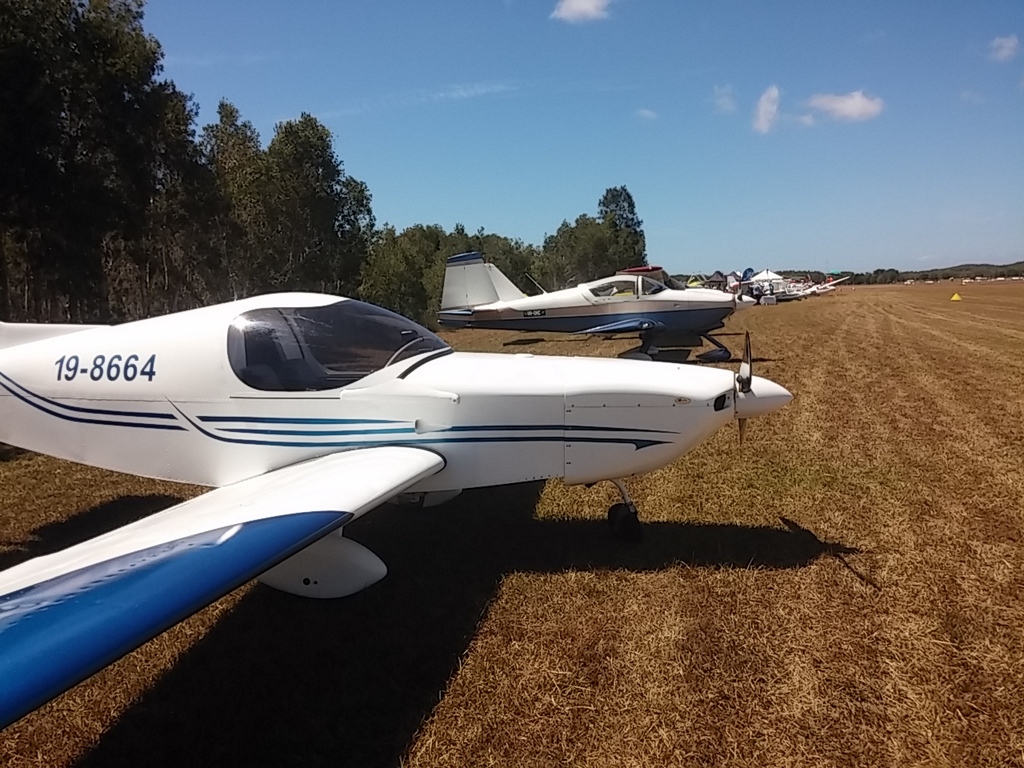
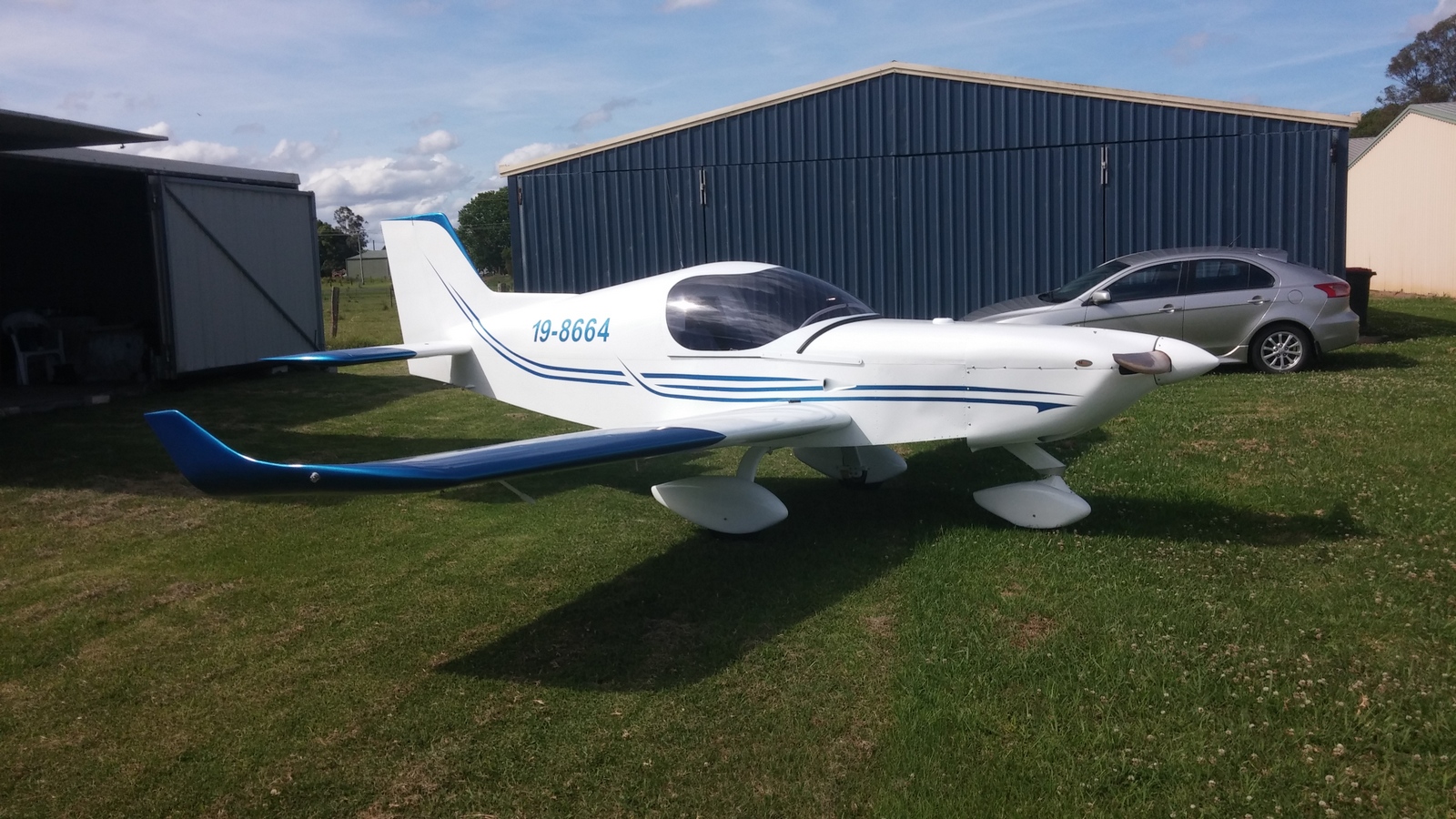
Yeah, 12 brand new plugs & 1 is a dud. Well I hope that is the case anyway. I remember your aircraft. I flew it on 13th of April 2011 with Garry Morgan before I bought my kit & decided on the 6 cylinder engine at the end of May that year. Garry's kit was really the supply of plans and materials but that meant it was a complete build from scratch not just assembly as most kits are these days. I spent over 4 years building but also built a hangar and made lots of house alterations in that time as well. I did everything including painting & I'd never spray painted anything before. Landing took a bit to master & I broke a prop. Now I can almost land it blindfold. I love mine and its excellent performance yet its stall speed

1 up is 32 knots full flap. Similar colour scheme too. The metallic blue Dulux FX paint cost $450.00 for the minimum 4 litres & I used less than half of it.
-
3
-
-
It is almost always something simple. I recently completed a 100 hourly & installed 12 new plugs as required. I started the engine and it ran like a Swiss watch. Test flight was great then after a couple of weeks managed a flight in between the rain events. On the shutdown mag check, No1 Mag (LH) the engine was rough. I suspected a HT lead but all are good. I ran out of time on Friday and on Monday I plan to swap Mag leads over & check. I suspect a plug so if correct, running on only No 2 (RH) mag (on No 1 plugs) the engine will now run rough, then I just need to do the same as you by replacing each of No1 Mag plugs 1 by 1 till I find it. If that't not it, it will likely be a distributor issue.
-
Are you sure it's not the angle of the dangle of the dingle arm that has caused the thronomister to fall off.
-
Jabiru composite props are manufactured by Bolly to Jabirus specs. I replaced my wooden prop with a Bolly Bos 5 carbon fibre/kevlar/composite prop on my 3300A engine. This is not the same as the Jabiru model & has a completely different hub. The old wooden prop was always getting stone chips & nicks from just about anything. I'd put some leading edge tape on it but it still kept on happening. At first I had the pitch too coarse, then too fine. After 4 adjustments got it so WOT straight & level was 3300 rpm. Top speed increased by almost 30 knots, cruise by 20. Full power climb at 80 knots is 1100-1500 fpm 1 up depending on the conditions. One major benefit is the torus curve at the root which has reduced temperatures quite noticeably even though they were good with the wooden prop. The Jabiru spec prop does not have these. My big issue was having to modify the cowl so the torus didn't hit it.
I have 50 hours with this prop and no nicks or chips at all. Fantastic prop from an excellent Australian manufacturer.
In saying all this the old wooden prop which now decorates the wall of my hangar was not much chop. I got it for nothing after destroying the first wooden prop & it was not as good as the first one even though it looked identical.
Jab owners around here reckon the Jab spec composite props are way better than wooden ones. There have been a number of delaminations of Jab wooden props.
-
1
-
2
-
-
He conspired with Mallory to get rid of Dowding and Park who disagreed with the Bader/Mallory Big Wing concept during the BOB. It was lucky that Dowding & Park managed to deal with this at the time or the battle may well have been lost.
-
 1
1
-
-
If you find that after you have painted it you don't like the correct colour all you have to do is find another correct colour and repaint it. Simples.
-
2
-
-
WOW!! talk about sweeping statements!! ALL European LSA's ????
Who said ALL?
-
2
-
-
Matte black is best from a reflective perspective and each instrument stands out better. Have a look at most modern cars. The dash is almost always black. It does get warm though in the hot summer sun. Matte black is also easy to touch up by hand if you get marks or scratches on it.
-
Yes it is illegal to add unapproved makings to an instrument in a permanent fashion.
So adding strips of tape to the glass face of the instrument is OK as that could not be construed as permanent.
-
About 14 seconds from deployment to impact & he took some time to pull it after the engine stopped. Is the throttle in the centre console between the seats? Initially he pushed the stick forward then all over the place including fully back. I couldn't detect any change in the engine note until it stopped. Spin recovery by the normal procedure looked impossible which tends to indicate that this aircraft can only be recovered from a spin via a BRS.
-
Never seen a clip like this on any Jabiru engine. I have no idea what it would be used for.
-
-
I know of one instance of a structural failure in a motor glider when one wing failed at the root and folded over the top of the canopy pinning the pilot & passenger to their seats and forcing the throttle wide open. Neither the pilot nor passenger could reach the handle for the ballistic chute. It happened in mountainous terrain at around 11,000 feet and the aircraft pitched straight up & came down tail first onto a scree slope. No-one was hurt. Lotto tickets all round I'd say.
-
1
-
-
The Sport cruiser and the Piper Sport were the same aircraft. It was rebadged by Piper & AFIK the relationship between Piper & Czech Aircraft Works went South for some reason & Piper stopped rebadging. There is a striking resemblance between the Bristell & Sportcruiser which may be a bit like the reason the Zenith & Savannah look the same.
-
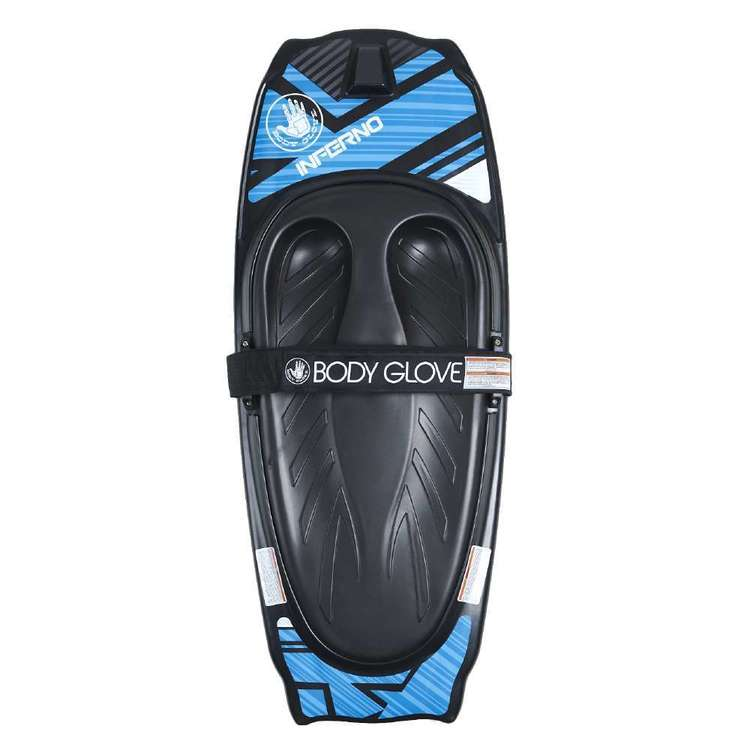
This is the only kneeboard to have.
I always draw my desired track on the map & have a flight log with frequencies, alternates, fuel checks, tank changes, waypoints, reporting points, ETAs, EET etc on a pad a bit smaller than A5 I get free from CASA. I run Airmate on my phone & use it to keep on track & work out the crosswind component. The phone is on the panel & the pad on the seat along with the map. If I have a passenger then I have a map and pad holder, spotter & scribe as well.
-
3
-
A Message from the Queen
in Aviation Laughter
Posted
It was an oldie & goodie in 2015 & still warrants a chuckle in 2020