
onetrack
-
Posts
8,096 -
Joined
-
Last visited
-
Days Won
101
Content Type
Profiles
Forums
Gallery
Downloads
Blogs
Events
Store
Aircraft
Resources
Tutorials
Articles
Classifieds
Movies
Books
Community Map
Quizzes
Videos Directory
Posts posted by onetrack
-
-
The ABC is reporting a double fatality (two males) in a gyrocopter crash into the sea, off Forrest Beach, North of Busselton, W.A., around 14.00hrs WST today. The crash site is closer to Capel than Busselton.
My sympathy to the deceased mens families. No names have been released yet.
Gyrocopter crashes into sea off Busselton, two killed
-
Skippy, you've put up a link to their water bladders. I presume you meant to link to their fuel bladders page.
The 4-Wheel-Driving set are keen on their bladders. I'd really like to see if their fuel bladders are tough enough to provide satisfactory service without rupturing, in the somewhat more testing aircraft environment.
I'd hate to think what the result would be, of a fuel bladder rupturing in flight, due to severe turbulence and possible impact with something that punctured or tore the bladder.
The seller says they are made from reinforced TPU (Thermoplastic Poly Urethane), but they fail to state what material they are actually reinforced with.
-
Ken, you've obviously "managed" to survive because you're one of the luckiest blokes around - or else you're a brilliant manager!

It's all about managing the risks, isn't it? Just keep reminding the "strict rule followers", the quaking pax, the nervous nellies, and the nosey inspectors, about the 100 times sudden death risk level, involved in just driving to the airfield!
-
I'm looking forward to something driving the fan up front that doesn't vibrate, has a huge amount of torque from rest, and which is highly efficient as it turns all its inputted energy into constant rotary motion with no reversing moments - and which doesn't lose 60% of its inputted energy to heat loss. Oh, and the silence is just a bonus.
-
 1
1
-
-
Remember that sealed bearings come in a variety of types - just with steel shields, with steel-encased felt seals, with moulded rubber seals - in contact and non-contact style - and seals made from molded Viton, glass-reinforced PTFE and Teflon.
Each type is designed for a specific use or position, or temperature range, or specific contaminants that it needs to cope with. The tighter the seal lip, the more drag on the rotating component.
Some small bearings designed for high speeds need a non-contact seal to keep drag to a minimum.
When replacing sealed bearings, always ensure you acquire the correct type of sealed bearing for your application.
Wheel bearings can also suffer from "brinelling" - the indentation of bearing rollers or balls, or races, caused by heavy or repeated impacts when the bearing sits in the same position without moving.
Further to that, you can have "true" brinelling, and "false" brinelling.
If you drop a bearing from chest height onto a concrete floor, you have probably incurred "true" brinelling of the bearing.
This is shown as indentation marks in the rollers, balls or races, where they were severely impacted in the one spot.
New vehicles transported by rail or truck used to commonly suffer from wheel bearing "false" brinelling, particularly in the 1930's and 1940's as transport speeds increased.
The "false" brinelling was caused by rough road surfaces, heavy springs with poor compliancy, and transported vehicles rocking back and forth slightly whilst in transit. Heavy vibrations from rail tracks and train diesel engines caused the problems in rail transport.
The "false" brinelling led to noisy bearings in new vehicles, with accompanying shorter lifespan. It caused consternation amongst vehicle manufacturers before WW2, and GM even commissioned a study into the problem.
The problem was reduced by improved greases with anti-brinelling properties, tighter tie-downs of equipment and vehicles being shipped, better (more compliant) springing in transport equipment, and better road and rail surfaces.
Continuously-welded rails were a big improvement in reducing "false" brinelling in rail transport - and smoother roads with improved paving systems played their part in road transport.
Regardless, the problem of "false" brinelling still appears occasionally, usually due to poor transportation techniques, extremely rough remote roads, and wheel bearing grease becoming degraded with age and high kms.
A brinelled bearing exhibits excessive noise and roughness when in operation, and is warning you it needs replacement, sooner rather than later.
-
1
-
 1
1
-
 1
1
-
-
Grease seals really are the weak point in wheel bearings. I always use a minimum of double-lip seals, and triple-lip seals, if they're available.
Once a small amount of water gets inside a bearing housing, it will create corrosion on the exposed surfaces of the rollers and races, when the bearing is sitting still for an extended period, and when it goes through regular temperature and humidity changes.
I've always had a great deal of success with protecting trailer wheel bearings by fabricating a thick felt washer that is then coated with grease on one side, and slid (with a tight fit) onto the axle, prior to hub assembly.
The thick felt washer is positioned with the greased side against the inner bearing seal, and it thus acts as a simple additional labryinthine face seal, to further protect and enhance the regular lip seals performance.
This is particularly effective on trailers used on unsealed roads as the stones flung up by the towing vehicle really hammer the regular lip seals. I'm not sure if it's possible to do the same for light aircraft wheel bearings, lack of room might be a problem there.
-
1
-
-
It's interesting to see how comprehensively the crash investigators reported upon the positions that the aircraft instruments were stuck at.
I'm surprised at this, it seems to indicate a lack of understanding of just how unreliable those damaged instrument readings could possibly be.
Gauge needles could fluctuate wildly in the crash forces, before they were jammed by impact from flying debris, not necessarily jammed from ground impact.
-
Hi Folks - Below is an interesting article on electric motor development for aircraft, by the Magnix company, from "Wired" magazine.
On the same page is a fascinating video about the mind-boggling Stratolaunch space rocket launch aircraft - and if you get to the end of that - a video about the new Gravity Jet Suit development!
https://www.wired.com/story/magnix-electric-plane-motor/
-
1
-
-
-
Yenn - Jeffreys Bay is West of Pt Elizabeth, and faces the Southern Indian Ocean, to the best of my knowledge.
-
Greases are basically lubricating oil with additives, held in suspension in metallic soap compounds (thickeners), or silica gel, modified urea, or clay-based compounds.
Every grease type is designed for a specific use, temperature range and specific lubrication abilities.
Greases must pass a minimum of 9 basic tests - more, if it is a grease developed for a specialised application.
Aviation applications are particularly severe, with extreme temperature ranges, and aviation greases must be highly resistant to water, which is often sprayed up at high speed, and therefore high pressures.
Shell explain it better than I ever need to do, in the link below.
There are two major important factors associated with poor grease performance - oil separation, whereby the oil drains out of the thickener base - and mixing of greases that contain incompatible bases, which leads to chemical reactions which reduce performance.
-
1
-
1
-
-
I still remember vividly the disastrous crash of the RFDS Piper Navaho, VH-KMS on 30th April 1981, when it collided with the Chaffers Gold Mine headframe upon approach to Kalgoorlie.
The pilot elected to land after last light during a particularly bad storm over Kalgoorlie. These Goldfields Summer storms often contain violent squalls and mini-tornadoes.
The pilot was qualified for night flying on single engine aircraft, but not on multi-engine aircraft.
It is not known precisely what happened to VH-KMS, but at low level on the approach path, a violent squall of some type flipped the aircraft upside down.
The pilot recovered skilfully, but ended up at very low level and off track, and a wing of the Navaho collided with the top of the Chaffers headframe, shearing it off and bringing the aircraft down.
https://aviation-safety.net/wikibase/wiki.php?id=27164
https://www.pressreader.com/australia/kalgoorlie-miner/20150512/281651073679197
-
Definition of "kit" is what is being bandied about here. A "kit" is invariably and universally recognised as being the materials to build the aircraft - LESS the engine, prop and instruments.
There are very few aircraft manufacturers offering a "complete kit", because one manufacturer rarely builds the airframe, the engine, the prop, and the instruments.
The engine, prop and instruments have to be purchased from other manufacturers, so an airframe manufacturer is not going to supply engine, prop and instruments in a kit, without getting a finger in the pie.
99% of kit builders prefer to keep open their individual choices of engine, prop and instruments - and keep their costs down by negotiating directly with manufacturers of the individual components.
Possibly the only exception to the general kit rule, is Chipper, who manufacture instruments as well as airframe kits, and who will offer you a special deal to buy their airframe, with their instruments.
-
1
-
-
Judging by the amount of beach sand splattered over the underside of the cowling, the prop was still rotating at touchdown.
-
1
-
-
Old Koreelah - Gus claimed he damaged two Zeros, but only one was actually credited to him, as a possible kill. Warrant Officer Osuma Kudo was officially recognised by the Japanese military as being killed in the Broome attack.
W.O. Kudo initially attacked a USAAF B-24A that was taking off from Broome. This B-24A had 20 military personnel on board, it had reached somewhere between 200 and 400 feet altitude, and after Kudo's attack it crashed in the sea about 7 miles off Cable Beach.
Two survivors from the B-24A made it to shore, but one of the survivors was in particularly bad condition. He was flown to Perth and died a couple of days later, leaving only one survivor from the crash.
Kudo returned to strafe the aircraft on the airfield after shooting down the B-24A, and that was when Gus peppered his aircraft with the .50 cal he was wielding.
Kudo's Zero was seen to be on fire after Gus's attack, and it most certainly crashed somewhere not far from Broome. Peter Dunn's good WW2 website says it crashed on the beach near Broome, but I can find no verification anywhere for that statement.
A second Zero, of the nine Japanese Zero's that attacked Broome, certainly did run out of fuel due to a punctured fuel line, on the way back to Java, and was listed as crashing into the Timor Sea.
It is more than likely that this was the second Zero that Gus claimed to have hit. However, at least one other person fired a machine gun at the attacking Jap aircraft from one of the Dutch flying boats.
I have no idea what happened to the pilot of that aircraft that ran out of fuel - one would presume he bailed out, but his chances of being picked up would be slim.
Gus was actually awarded the Bronze Star for his attack on Kudo's aircraft, and this award was later upgraded to the Bronze Lion.
An interesting story on the ABC in 2015 and 2016, tells of local Aboriginals finding W.O. Kudo's body in a tree in the mangroves near Broome, hanging by his parachute. The Aboriginals claimed they buried him nearby, and this story has only recently been revealed.
It seems strange that it took so long for this story to come out - but as the Aboriginal elder said, "No-one asked us about it!" It is quite possible their story is true, they have little to gain from making it up now.
http://australiagallagher.weebly.com/attack-on-broome.html
https://www.abc.net.au/news/2015-10-13/plan-to-exhume-wwii-pilot-in-broome/6850350
https://www.ozatwar.com/wa12.htm
-
2
-
-
Answering emails in a week or three?? He must be singing about CASA, surely?
Fast forward to 48s to get straight to the lyrics ...
-
 1
1
-
-
KGW - That'd be a Torus, not a Taurus. Watching this helix torus in action will do your head in.
-
Hmm, just read the reviews on Amazon for "Bomber Boys", and they are not conducive to purchasing the book. The author, Marianne van Velzen, is pummelled for her glaring lack of knowledge about her subject.
I knew from a quick glance through the pages, when in the P.O., that it was written in a "novel" style of writing, but the reviewers are all disappointed with the general inaccuracy of the information in the book.
-
Harv, in the Aug 2014 edition of Sport Pilot, a bloke in NSW is wrecking a Gazelle (bottom of page 59). Might be a long shot, but he could be worth a call.
-
I went into my local P.O. this morning to post some parcels, and spotted several other assorted WW2 aviation history books, besides the Qantas one on the rack.
"Bomber Boys", the story of the 18th Squadron, took my eye, and there were two more there, the names of which, I've forgotten already.
"Bomber Boys" is the story of the NEI blokes who escaped from the East Indies, who then merged with a group of RAAF blokes, to form the amalgamated Australian-Dutch 18th Squadron.
One of the members of the 18th Sqdn was the legendary Gus "Wild Bill" Winckel.
Gus was the bloke who, during the course of the Japanese bombing of Broome, whipped out the .50 cal machine gun from his Lodestar, that he'd been servicing - and bracing himself against a handy tree, managed to wing several of the attacking Zeros, and bring down one of them down. The Zero was never recorded as a kill, because it was seen to be on fire and never returned to base - so it obviously crashed - and no-one knows where it crashed.
Gus fired the .50 cal with its barrel resting across the crook of his arm and incurred some deep burns as a result. He died in NZ in 2013, just a couple of months short of his 101st birthday.
-
1
-
-
Have to agree with Kaz, the story of QANTAS and their pilots during WW2 is one of the stories of unsung heroes of the War.
The three worst QANTAS crashes ever, were the shootdown and total destruction of the three Short S-23 Empires, G-AETZ, G-AEUH (ex-VH-ABD), and VH-ADU, by Jap fighters.
The fatalities from G-AETZ totalled 20 people (no survivors) - from G-AEUH, there were 13 fatalities out of 18 POB - and from VH-ADU, it was 13 fatalities out of 31 POB.
These were unarmed civilian aircraft that the Japs shot down, and the level of atrocity involved, is equal to the torpedoing of the hospital ship, the Centaur.
-
I cannot believe someone actually claims they watched Gyrocopter Girl for the aviation content - and expects us all to believe it!!
-
Yes, I've noticed the site is a little faster since the changeover. I'm using my desktop with an i7 Intel 3.4GHz CPU, on pretty new NBN (FTTC), about 5kms out of Perth CBD.
I just did a quick test of Internet speed at 22:25hrs WST and I'm getting 35 Mbps download speed and 12 Mbps upload speed, from a Sydney server.
-
Riley, once you get the items into Sydney, go to Temando to get a competitive freight quote. Temando are a freight agency who put your order out in the freighting marketplace, and the interested parties come back with instant quotes.
You get multiple quotes instantly, and you can either select one, or ignore all the quotes - or come back another day, to see if the quotes have improved.
Be aware that quotes are cheaper if you specify a business address both ends - cheaper if you tell them you have a forklift on site both ends (when boxes/crates are over 25kgs) - and the quoted prices vary from day to day, depending on how full the truck is, and how keen the freight operation is.
I have used Temando for several years, and have no complaint with their operation.


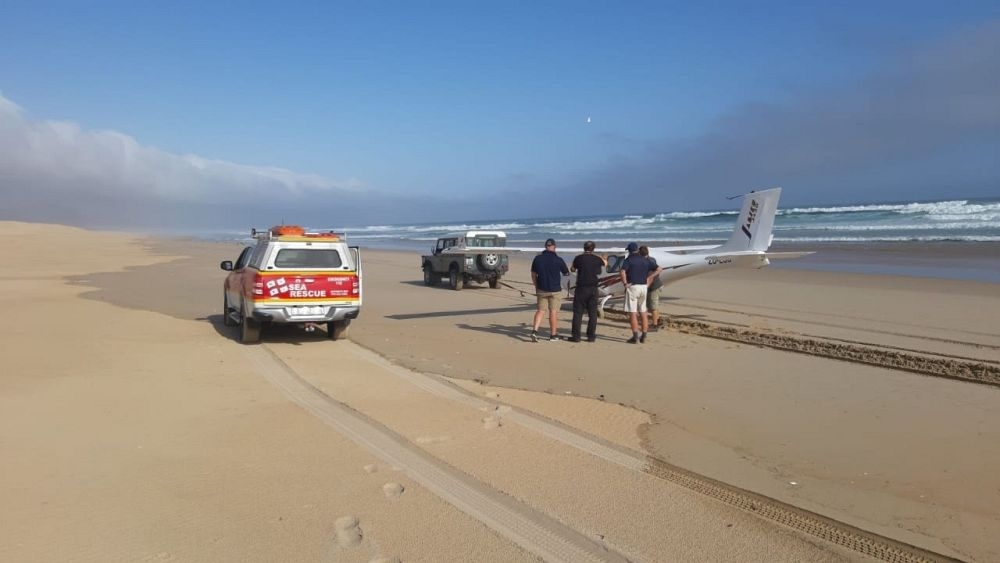
Double fatality in Gyrocopter crash into sea, Busselton, W.A.
in Aircraft Incidents and Accidents
Posted
I'm going out on a limb here - but from the little I can glean from the limited amount of photos, it appears that this machine is a Titanium Autogyro model.
If I am correct in my ID - of some concern, is the report from a previous Titanium Autogyro crash on Oct 31, 2018, at Spring Hill, NSW - which crash also resulted in a double fatality.
This gyrocopter crashed whilst doing training circuits, and touch and goes, at Orange regional airport, killing the instructor and the student pilot.
Investigation of this serious crash is currently being carried out by the ATSB - and investigation centres on structural failure of some of the (folding) rotor mast components, which appears to be the major reason for this crash.
Whether the failure is a design fault, or the components were overstressed in operation is something that the ATSB is no doubt pursuing.
ATSB Investigation AE-2018-073
I note that all Titanium Autogyros fitted with the folding mast option, were grounded shortly after this crash, by ASRA, after the release of an ASRA Safety Directive. That Safety Directive reads;
"A preliminary investigation into the circumstances surrounding the (Oct 31, 2018) accident has been completed by Officers from the Australian Sport Rotorcraft Association (ASRA). The investigation is continuing. ASRA Officers completed an inspection of the accident gyroplane and reported that the gyroplane was fitted with an optional two (2) piece folding mast. There was evidence to support that the cheek plates locking the folding mast in the flight position, had failed. This possibility represents a major risk to flight safety. DIRECTIVE: With immediate effect, all Titanium Autogyro (TAG) gyroplanes that are fitted with a folding mast option are grounded until further notice."
I have no information as to whether the grounding has now been lifted on all affected Titanium machines, or if individual Titanium machines with the folding mast have been checked, and deemed safe to fly.
It is going to be interesting to find if;
1. This Busselton crash Gyro, actually was a Titanium model;
2. If it was fitted with the folding mast option;
3. If the crash was directly caused by a similar component failure, as in the Spring Hill crash Gyro.