

onetrack
-
Posts
8,094 -
Joined
-
Last visited
-
Days Won
101
Content Type
Profiles
Forums
Gallery
Downloads
Blogs
Events
Store
Aircraft
Resources
Tutorials
Articles
Classifieds
Movies
Books
Community Map
Quizzes
Videos Directory
Posts posted by onetrack
-
-
...Captain was just the man to see about them - seeing as he lived only a stones throw from the Kapooka Rifle Range stop butts - and there was little doubt he would be able to pick the lock on the Armoury, after hours. This lock-picking ability was a skill Captain was rightfully proud of, seeing as he was directly descended from the first convicts in NSW, coupled with some inbreeding from a certain number of well-known bushrangers of the Blue Mountains. Captain got excited about this gun-stealing adventure, it was quite a while since he'd been involved with anything important as busting into a military Armoury - well apart from that failed bank job, that he managed to blame on his illiterate bank robber companions. Captain whipped out a grubby notebook and pencil (actually, it was the back of his flying logbook, but no-one noticed) and proceeded to draw diagrams of the gun mountings. But Turbo had to explain to Captain, that the guns on a Corsair had to be specially fabricated for the Corsair, not just ex-Army SLR's attached with twitches of fencing wire, as Captain was proposing.
"But what's wrong with fencing wire?", whined Captain - "It's held everything in the world together, long before duct tape and silastic came on the market!" But Turbo, as the senior member of the group, was not to be swayed, and he ....
-
When there's no beer, that's a real drought.
-
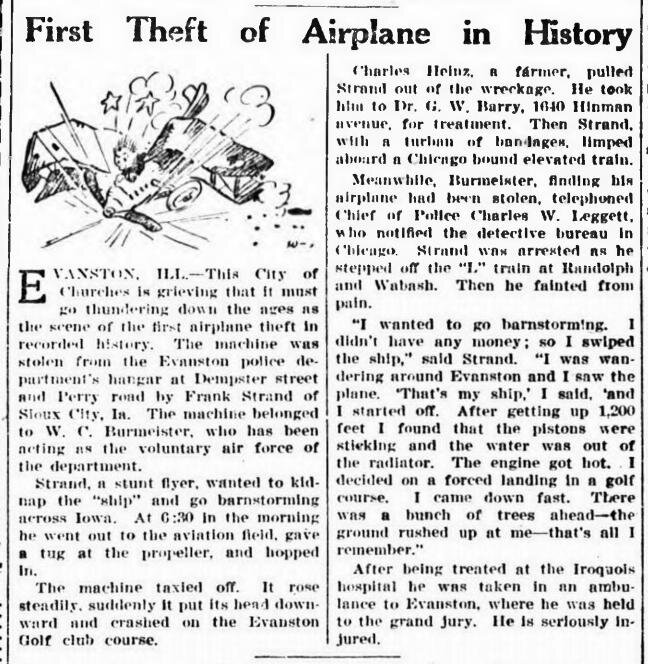
I did find another delightful little news article about Frank Strands aircraft theft, from the equally-delightfully-named paper, "The Chatsworth Plaindealer", of Chatsworth, Ill.
It appears Frank was really keen to go barnstorming, but he had no money, no decent-paying job, and little hope of carrying out his hearts desire - except by stealing an aircraft!
Frank actually stole the aircraft in January 1921, the first article I picked up was a reprint from the New York Herald in Australia - a year later!

-
 1
1
-
-
This is one of the earliest stories I could find, of someone only partly-trained, stealing an aircraft (in the U.S.). There may have been earlier thefts that didn't make the newspapers.
From January 1922, in the exact words of the journalist of the day (note the breathless journalistic flair) ....
"STOLEN AEROPLANE.
MOTOR FAILS IN THE AIR.
TWELVE HUNDRED FEET PLUNGE.
A jobless young aviator, from out of the West, beat the most spectacular of long-standing records of city criminals by stealing an airplane (says the New York "Herald").
It was the first time probably in the whole history of aviation when a civilian aircraft was stolen by flying it from its hangar.
Twelve hundred feet in the air, a mile from the start, the motor of the stolen plane sizzled and then ceased popping.
It was up to the outlaw pilot to bring it down as best he could.
The ship descended in wild sweeps, steered for the Evanston golf course as the only practical landing field, missed a grove of trees by a hair's breadth, and buried its nose in the tenth green.
A terrified farmer rescued the trapped and injured aviator, and helped him to a doctor's office. Then the Westerner boarded an elevated train for Chicago.
In the meantime it was learned that the Wrecked plane had been stolen.
The farmer and the doctor presumed the injured man was its rightful pilot.
Evanston police flashed word to the Chicago detective bureau to be on the watch for an elevated passenger with his head draped in cotton gauze.
Four detectives found him on a train as it pulled into the Randolph-street station at Wells-street.
At the Iroquois Hospital, after his foot, leg, and head had been cared for, the young buccaneer of the air confessed frankly and fully.
His name, he said, was Frank Strand, of Sioux City, lowa.
He is 28 years old, an automobile mechanic, an aviator with eight hours' flying experience under a civilian instructor in Great Falls, Montana, where he lived until recently, when his family moved to Sioux City.
The stolen plane, which was damaged to the extent of $4000, belonged to W. C. Burmeister, one of the owners of the Burmeister Airdrome, and was semi-officially, part of the Evanston police equipment."
I cannot find what Frank Strands punishment was, but no doubt his keenness for flying was crimped somewhat, by this event.
-
A Slav immigrant by the name of Milan Iskra, stole a new Cessna 175 from Maylands Aerodome in W.A., in June 1962. His stated aim was to fly back to his native Yugoslavia from W.A., because he was homesick.
With little training, he managed to take off on the night of June 24, 1962, without being seen, and he managed to crash land successfully, early next morning, in the Little Sandy Desert, around 110kms N.E. of Granite Peak Station.
He stumbled into Ethel Creek Station (SE of the town of Newman, which didn't exist in 1962) about a week later, having survived the approximately 255km desert trek with little food or water.
He was arrested and charged with the theft of the aircraft - being the first person to have ever been charged with aircraft theft, in W.A.
But from mid-July 1962, after his last court mention, Iskra is never mentioned again, in court reports.
Milan Iskra virtually disappeared off the planet - but there is one further report in May 1965, that one Milan Iskra - reported as having escaped from the Claremont Mental Hospital in Perth - was found wandering in the grounds of the Fremantle War Memorial park, the next morning, still in his khaki hospital clothing.
It appears quite likely that Iskra was deemed mentally unfit to plead to the aircraft theft charge, and was thereby detained indefinitely in Claremont Mental Hospital, under W.A.'s Mental Health Act.
http://www.edcoatescollection.com/ac1/austmz/VH-RDT(1).html
https://trove.nla.gov.au/newspaper/article/131727323
https://trove.nla.gov.au/newspaper/article/105843561
I understand this stolen Cessna, is still in flying condition today.
-
2
-
 1
1
-
-
Meanwhile, back at edge of the airstrip, while Onetrack and Takata-San were immersed in the more technological aspects of drones (with Turbs looking over their collective shoulders, as the maths and physics involved with hi-tech drones, was something he was struggling to grasp), there was a rush of wind, and a swishing and cracking of branches, as a glider dropped out of the sky, and made an untidy crash landing in the outer limbs of a large River Gum, whereby it promptly fell to the ground. Onetrack, Takata-San and Turbs gazed on, open-mouthed, as the canopy opened, and out stepped the Captain!
"Claptain!! exclaimed Takata-San. "I thought you were going to klill yourself!! You are offlicially licenced for that thling, aren't you?? To onlookers, it looks like you tlaught yourslelf!!"
"Licence?" exclaimed the Captain. "Of course, I've got an official-looking licence for it! I paid good money in brown paper bags for my licence, to the best-connected mates around! - the same way as you get licences and approvals for anything in New South Wales!"
"It's been that way since 1788, so why would we change the system now? Anyway, who needs things like formal training and licences? These things are a cinch to fly! I just need to practise my landings a bit more, I've only done 2500 hrs in it so far, so I'm bound to get a landing right, eventually!"
Meantimes, Turbs had disappeared to acquire a few litres of Jet-A1 drainings. He always kept a few litres on hand in the bathroom, and used it for aftershave, fully convinced that the fumes would attract any slashing-looking, big-breasted fly-girl he came within a few metres of, and trusting that the effect of the fumes on her would make Chanel No 5 look pathetic by comparison, and she would gravitate towards him like a 13 yr old schoolgirl gravitating towards a pop star.
While the Captain was ruefully examining the crumpled composite of the glider, and thinking about how many brown paper bags of money this would cost, to avoid incident reporting, and to cover the cost of repair by Dodgy Bros Quick and Dirty Aircraft Repairs, there was .....
-
"Trial flying lessons" says the sign. Learn here, via "trial and error"?
-
News media are saying the W.A. owner sold VH-DJU to a Gold Coast buyer, very recently. Ownership doesn't appear to have been updated in any online records, but that doesn't mean much.
-
I didn't even know there was an aircraft missing. Doesn't look too promising for the people on board, with that rugged terrain and no communication since 07:30HRS yesterday.
-
editedf...mod
-
edited...mod
-
...no-one less than Takata-San! "Good God!", exclaims Turbo, as he pulls himself and Takata-San to their respective feet. "What are you doing at a B&S Ball, Takata-San??"
"Shhhh!!", said Takata-San, looking around nervously. "I was told that B&S Balls are where you can get some stuff that really puts a rocket up your a***!
I was hoping to acquire some of that product to fuel my new design drones, which are fully capable of....
-
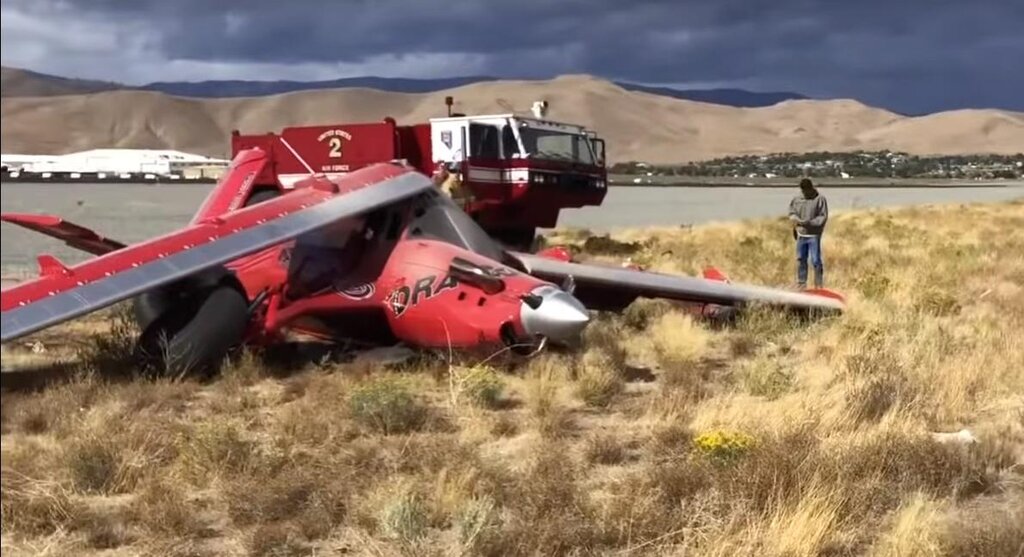
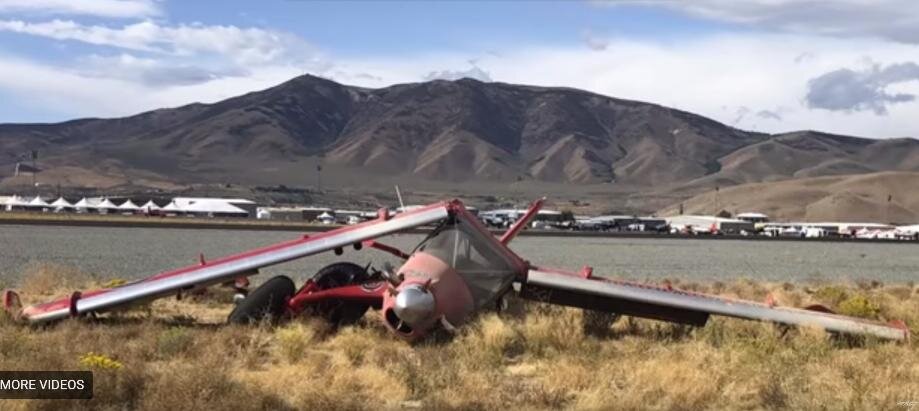
I missed the nose dive bit.
Well, perhaps it wasn't a nose dive, in the true sense of the word. But when he was going sideways, and the port undercarriage leg collapsed, he certainly nosedived enough into terra firma, to reduce the prop to stubs.
I guess the lack of struts on the wings is a big factor in why they broke so rapidly.
-
...an additional twist that he added himself, that he calls "Pissed/n/Wobble". However, he slips on a large spot of steak grease accidentally dropped on the smooth floor, and promptly....
-
was more then just a low-speed nosedive, the whole aircraft rolled
Sorry, I can't agree with your opinion. The aircraft didn't roll, it nosedived lightly, then did a quarter roll to the left, whereupon both wings and the LH landing gear broke off, and the fuselage roll stopped.
I'm of the opinion he wasn't really going all that fast, when he ran off the runway and nosedived (maybe 35kts?), and I would have though the wing attachment strength would have been higher than what it is.
The starboard wing fracturing downwards and breaking right off, with a simple quarter roll to the left, appears to make the wing strength look weak.
I know the direction of the fracturing is being caused by some serious negative G forces, but I would have expected the starboard wing at least, to be able to handle that quarter roll.
-
Gee, the way that Draco fell apart in the relatively low-speed nosedive, would give me little confidence in the basic strength of the aircraft.
-
 1
1
-
-
There are switch mechanisms and there are switch mechanisms. The design of many switches is just simply deficient, in their construction, and in their operating principles.
Too many switches are too complex in their construction, with too many moving parts. Others are built with inadequate strength in the switching components.
Too many have inadequate mechanism sealing against dust and moisture.
I prefer simple push-pull, or good quality well-sealed toggle switches. Rocker switches are generally nothing but trouble.
Horizontal Rocker switches are the worst - dust and general debris falls straight into them, and can't be got out without regular vacuuming.
I've got a 230mm Hitachi angle grinder that has a particularly bad design, on-off switch. It's poorly designed and made of weak components, and it fails regularly.
But the worst part is, when it fails, it stays on!
There's nothing worse than wielding a bloody heavy, 230mm angle grinder with a powerful motor, and lots of centrifugal force thrusting it out of your grip - without it not shutting down when you expect it to!!
-
 2
2
-
-
Aw, C'mon shafs64 - the operational losses of the Hueys in 'Nam have to be taken into context with the style of use and abuse.
There were little operational limits on the Hueys, they were used as troop carriers, resupply carriers, gun platforms, medevac choppers - and suffering from overloads more often than not.
Miniguns and M60 MG's applying constant recoil vibrations to the airframe. Hard landings under fire, constant small-arms damage, which was often just patched and then the Huey was sent out again.
The Huey had weights in the rotor tips to facilitate vegetation slashing - and vegetation slashing, they did, virtually every day. Imagine the impacts to the airframe and rotor head, as the rotor tips slash tree branches?
You need to read Chickenhawk, by Robert Mason, if you haven't already. And if you have, you need to read it again.
-
3
-
-
Gee, that landing in Shiroles, Costa Rica (6m 30s in) is pretty hairy, with horses all over the strip!!
-
Facthunter, are you trying to say that the age of this Huey (1966 build) had a major bearing on the crash? I think that may be a little premature.
I see a pilot who pushed on beyond any reasonable weather and light limitations. But I guess the ATSB report will produce any evidence needed.
-
2
-
-
"Get-there-itis" is a common factor in many aircraft crashes. It's all related to good judgement, and good judgement comes from experience and good training.
As the old saying goes, "good judgement comes from experience, which comes from poor judgement".
But the other factor is the human factor of personality. Too many people suffer from poor judgement simply because of their personality traits - which traits can be very difficult to counter.
In the hard-rock underground mining industry, an exceptionally-risky industry where good judgement and adherence to important safety rules and regulations is the difference between life and death, researchers have identified the "risk-taking mentality", as a primary feature of hard-rock mining deaths. And the "risk-taking mentality" is directly correlated with the individuals personality traits.
These type of people regularly ignore rules and regulations that are designed to prevent death, because they're in a constant hurry, they consider they have "better knowledge than the people who set the rules", and they indulge in dangerous "short-cuts" to achieve a result, because they are intent on fast results.
No better example of this type of personality exists, than the PIC who destroyed the Metroliner at Lockhart River. Despite being a supposedly experienced and capable pilot, his downfall was his constant risk-taking and "short-cut" mentality.
These people are known to enjoy "living on the edge". That may be an acceptable approach for adventurers who love "pushing the boundaries" - but it's an unacceptable approach when other peoples lives are in their hands.
I can recall discussion centred around how Qantas used to source its pilots mostly from the RAAF. But RAAF pilots are taught to take risks continuously - the exact opposite of RPT aviation.
As a result, the ex-RAAF pilots had to undergo extensive re-training with Qantas to take no risks, the exact opposite of how they were originally trained.
Angel Flight would be best served by simply weeding out the risk-taking variety of pilot, by simple examination of the professionalism of their chosen pilots, and the attitude of their approach towards flying management.
-
1
-
1
-
-
I find it incredible that a pilot with a supposedly 30 yrs of experience would do this - push on into deteriorating weather and dust conditions that he obviously never studied in depth, pushed on after last light, and pushed on over water, when he had a machine that could land virtually anywhere. As a Vietnam Veteran, I know what Hueys can do, they are virtually unbreakable.
-
1
-
1
-
-
I was always led to believe that cold engines were "tight" engines, with lowered component operating clearances, and therefore you kept engine RPM's down, until the engine warmed.
However, air-cooled aircraft engines suffer from lots of WOT operation and a fickle operating temperature environment, that encompasses a very wide range of temperatures.
As a result, air-cooled aircraft engines usually have bigger operating clearances, particularly in piston-to-bore clearances. If your aircraft engine is big-bore, the clearances are even greater.
However, I would have thought that the water-cooled Rotax 912 would have had fairly tight clearances when cold.
Rotax talk about being able to build the 912 with tighter clearances, simply due to water-cooling.
Here's a very well written and informative article about pistons, by a gent from Wiseco, U.S. forged piston manufacturer. It goes into detail as regards piston-to-bore clearances, for every type of engine.
http://blog.wiseco.com/piston-to-wall-clearance-myths-mysteries-and-misconceptions-explained
-
I don't know how many remember, or knew about, the 80 yr old lady in the U.S. who landed a Cessna twin, after her 81 yr old husband collapsed and died at the controls.
She didn't ever hold a pilots licence, but took some flying instruction around 30 yrs before, at her husbands insistence, that she try to learn how to take over, if he ever collapsed at the controls.
One engine was out of fuel as she landed, so she landed on one working engine that was spluttering, as it ran out fuel, too.
She did a hard landing and collapsed the nose gear, but got the aircraft down in one piece.
I reckon that would be very difficult to keep yourself composed under the stress of both trying to land an aircraft with little flying experience, and knowing your life partner of 58 yrs was dead beside you.
The lady passed away just 3 years later in 2015.


Chipper2 - Fire-sale of Belite's Design/Business
in AUS/NZ General Discussion
Posted
That's very saddening to hear. As someone who lost his home to fire (through no fault of mine, it was a power company fault that created overvoltage throughout the house), I know just how devastating a fire can be - financially and emotionally. To add to your misery, you are immediately grilled by arson detectives as a matter of course, to determine if there are any suspicious issues that might have led to arson.
This is the end of Chipper Belite aircraft. James & Kathy Weibe had everything invested in their business, and they have received a partial payout for the damage, which is inadequate to cover their losses.
In addition, the Weibe's had no business interruption insurance, so they are effectively finished as aircraft builders.
https://www.facebook.com/BeliteAircraft
This is a very timely warning to make sure you are fully covered for all potential fire losses. In my case, my house was under-insured and I lost out badly.
My house was not completely destroyed, but it was so badly damaged it was not economic to rebuild it. I demolished it, and it was never rebuilt.
I moved into other transportable accommodation I had on the property at the time, and a couple of years later I moved off the property to another region, because of a change of work style.