

willedoo
-
Posts
1,233 -
Joined
-
Last visited
-
Days Won
2
Content Type
Profiles
Forums
Gallery
Downloads
Blogs
Events
Store
Aircraft
Resources
Tutorials
Articles
Classifieds
Movies
Books
Community Map
Quizzes
Videos Directory
Posts posted by willedoo
-
-
Thanks, Spin, that Australian connection sounds interesting, will have to check the book out. It would be interesting also to know the US/RVN mix of helicopters that went overboard. I think the majority that went overboard around that time in general were RVNAF ones, so it would be an easier descision to make knowing someone else had paid for them .A lot that went overboard on the Midway that day may have been RVN choppers that hadn't been there all that long, as opposed to US owned gear. Fairly sure all that old footage of the ditchings were of South Vietnamese pilots.Believe it or not there is a minor Aussie connection to that story - the aircraft concerned is one flown extensively by Garry Cooper, an Aussie attached to the US forces in Vietnam. He has a bit more about the story including a photo of the note dropped on the deck, in his book "Sock it to em Baby", which is well worth a read anyway.Must have taken big ones on the Capt's part to order the equipment scuttled like that, far easier to say; "ok ditch alongside and we'll have choppers waiting to drop rescuers."Cheers, Willie.
-
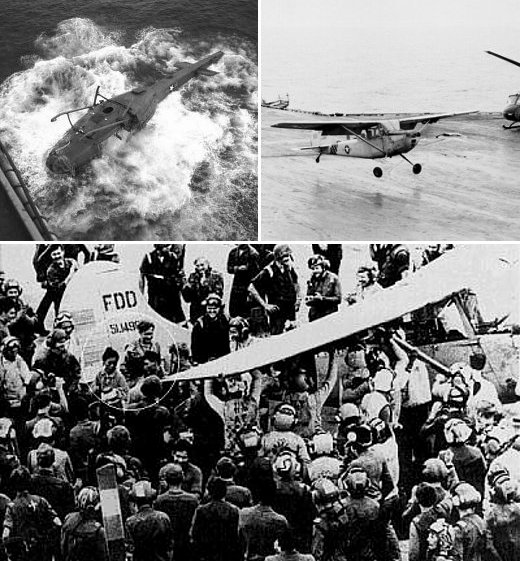
I was reading the post on the Auckland chopper crash ( http://theaussieaviator.net/threads/chopper-crash-auckland-viaduct.33811/ ) when Spin's comments on the energy in the rotor system reminded me of footage seen over the years of RVNAF chopper pilots ditching in the sea beside the US carriers & the resulting mayhem with the rotors striking the water . To cut a long story short, while looking for some of the photos, I dug up this story I hadn't heard before of RVNAF pilot Major Bung-Ly landing a Bird Dog on the USS Midway, during the fall of Saigon evacuations :
' On 29 April 1975, South Vietnamese Air Force Major Bung-Ly loaded his wife and five children into a two-seat Cessna O-1 Bird Dog and took off from Con Son Island. After evading enemy ground fire Major Bung-Ly headed out to sea and spotted the USS Midway. The Midway's crew attempted to contact the aircraft on emergency frequencies but the pilot continued to circle overhead with his landing lights turned on. When a spotter reported that there were at least four people in the two-place aircraft, all thoughts of forcing the pilot to ditch alongside were abandoned - it was unlikely the passengers of the overloaded Bird Dog could survive the ditching and safely egress before the plane sank.
After three tries, Major Bung-Ly managed to drop a note from a low pass over the deck: "Can you move the helicopter to the other side, I can land on your runway, I can fly for one hour more, we have enough time to move. Please rescue me! Major Bung (Ly), wife and 5 child." Rear Admiral Larry Chambers (then Captain) ordered that the arresting wires be removed and that any helicopters that could not be safely and quickly be relocated should be pushed over the side. To get the job done he called for volunteers, and soon every available seaman was on deck, regardless of rank or duty, to provide the manpower to get the job done. $10 million (US currency) worth of UH-1 Huey helicopters were pushed overboard into the South China Sea. With a 500-foot ceiling, five miles visibility, light rain, and 15 knots of surface wind, Chambers ordered the Midway to make 25 knots into the wind. Warnings about the dangerous downdrafts created behind a steaming carrier were transmitted blind in both Vietnamese and English. To make matters worse, five additional UH-1s landed and cluttered up the deck. Without hesitation, Chambers ordered them scuttled as well.
Captain Chambers recalled in an article in the Fall 1993 issue of the national Museum of Aviation History's "Foundation" magazine that "...the aircraft cleared the ramp and touched down on center line at the normal touchdown point. Had he been equipped with a tailhook he could have bagged a number 3 wire. He bounced once and came to a stop abeam of the island, amid a wildly cheering, arms-waving flight deck crew." Major Ly was escorted to the bridge where Captain Chambers congratulated him on his outstanding airmanship and his bravery in risking everything on a gamble beyond the point of no return without knowing for certain a carrier would be where he needed it. The crew of the Midway was so impressed that they established a fund to help him and his family get settled in the United States.The Bird Dog that Major Bung-Ly landed is now on display at the Naval Aviation Museum in Pensacola, Florida. '
http://www.navalaviationmuseum.org/AboutMuseum.aspx
I read somewhere that Major Ly had never laid eyes on a carrier before, so it was a good effort to land on pitching decks with the wife & 5 kids crammed in the back.
Cheers, Willie.
Short clip of the landing:
[ATTACH=full]860[/ATTACH][ATTACH=full]861[/ATTACH][ATTACH=full]862[/ATTACH][ATTACH=full]863[/ATTACH]

-
 1
1
-
-
Apologies to Dexter, looks like the Wellington has tried to hi-jack the B17's thread. Typical British. Getting back to the OP, an excellent story with a good ending, and reminds me about this recent article about a German airman assisting a crippled Fortress.
Cheers, Willie.
http://benlovegrove.com/2009/06/24/charlie-brown-b-17-called-ye-old-pub-german-pilot-franz-steigler/
-
Looked it up & you're right, it is the Loch Ness one. Being restored at Brooklands Museum, Surrey.is that the one which was dredged up from Loch Ness, I wonder..Cheers, Willie.
http://www.brooklandsmuseum.com/index.php?/explore/vickers-290-wellington-1a-n2980-1939/
-
Thanks, Spin. I'd forgotten all about that. Fairly sure I've got that old movie somewhere in the dvd collection. About time to watch it again, I remember it as a good story.That would be Barnes Wallis. Always loved the line attributed to him when he was battling to get an aircraft to air test the bouncing bomb; "Do you think it would help if they knew that I designed the Wellington?"Cheers, Willie.
-
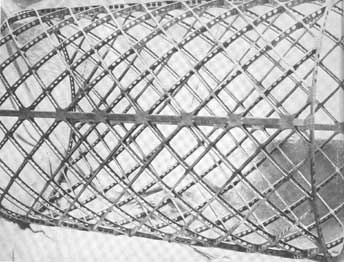
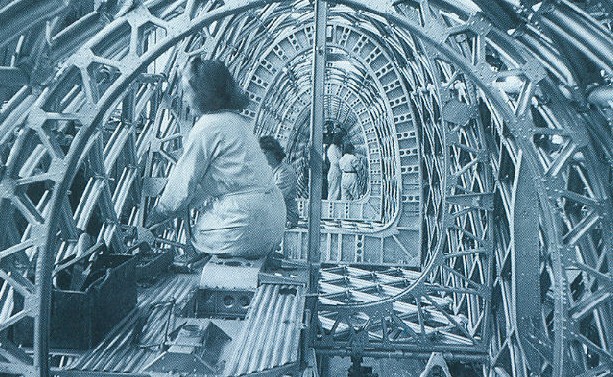
You had me thinking for a minute there, Siz. Some geodetic designs are like you say, but looking at some higher res photos, the Wellington definitely has longitudinal stringers or battens. As far as them being wooden, I can't say 100% for sure, but every reference to them I've read describes them as wooden battens. Here's some photos of the frame & a couple with the battens showing through the fabric. Last photo, I think is of an early experimental design by the designer of the system; can't remember his name offhand, he designed the Dambuster Bomb as well. This is more like the design you mention with the spiral.Correct me if necessary, but I think the stringers were spiral, rather than longitudinal, and were not wooden.Check out geodetic/geodesic in Wikipedia: there's a superb photo of a Wimpie which made it back with most of its aft fabric missing.Cheers, Willie.
[ATTACH=full]855[/ATTACH][ATTACH=full]856[/ATTACH][ATTACH=full]857[/ATTACH][ATTACH=full]858[/ATTACH][ATTACH=full]859[/ATTACH]
-
It's a great story. They say the crews liked the B17 for it's survivability, as opposed to the Liberator which wasn't very good in that department. Another bomber which could still fly with large parts of it missing was the Wellington. It was constructed a bit like an airship, with aluminium 'w' beams tied with longitudinal wooden stringers. The skin was doped fabric. Apparently it could sustain a lot of damage & a few stringers & a bit of framework would still hold the tail section on.
Cheers Willie.
[ATTACH=full]854[/ATTACH]
-
A bit off topic - there's been a lot of talk about Russia's new global positioning system, Glonass , recently. It should be fully operational soon, after recent satellite launches & Nokia announced today they'll be using it in their phones & software for the international market. It'll be interesting to see what bearing it has (no pun intended) on future aviation.
Cheers, Willie.
http://www.en.rian.ru/business/20111118/168813972.html
-
Some good reading there, Peter. That's a lot of home-grown aircraft for a small nation like ours. I found that CAC Kangaroo interesting, it's easy to see a bit of P51 in it. Guess it just came along a bit too late to be a going concern, same as those Martin-Baker prototypes I mentioned earlier.Here is another interesting link. It is a listing (incomplete, some photos, little text or detail) of aircraft designed in Australia, not overseas designs built in Australia unless greatly modified, but has links to further information on many of the types. Contains about 60 types.Cheers, Willie.
-
Found this very handy link for all aviation history buffs. Has a listing of aircraft by country of manufacture & photos. It's interesting also for the fact that it lists a lot of rarer prototypes that never made it to production, or limited production only. The UK section has over 900 aircraft listed, a bit of an eye opener. I never knew Martin-Baker had a go at building fighters during the war. On each page, clicking on the aircraft name opens up another page with a photo & brief description.
Cheers, Willie.
http://www.aviastar.org/index2.html
-
The big scandal over there came to a head a few months ago. Apparently the exams to go from co-pilot to pilot were compromised & quite a few got certified with cheated results. The big name airlines were affected as well, with some pilots arrested, I think one of them even absconded & had the police after him. Scary stuff. There was also something to do with flight schools alledgedly issuing forged Indian certification upon payment by pilots who had done basic training in the US & Canada.Wasn't there some scheme operating in India where you could buy your Pilots Licence?Cheers, Willie.
http://www.indianaviationnews.net/careers/2011/04/tests-stare-at-4500-pilots.html
http://theaussieaviator.net/threads/man-refuses-to-fly-with-female-pilot.28084/#post-55007
http://theaussieaviator.net/threads/india-to-audit-commercial-pilots-licenses.28808/#post-55823
-
Also some links to the WW2 Japanese ship graveyard at Truk Lagoon, Micronesia. They say there's a lot of aircraft there, these photos only seem to show a Mitsubishi Betty & an Emily flying boat:
Original source:
http://www.flickr.com/photos/gh0st/tags/wreck/
Cheers, Willie.
-
There's a lot of WW2 stuff north of Moreton, but too deep for divers. A lot of old munitions & some aircraft parts. A friend of mine pulled up a large propeller in his trawler nets in the early 80's. Unfortunately, he didn't get to keep it as he had to cut it free to stop the boat rolling over & I doubt he got any photos. The story I heard back then was that it was all supposed to be dumped out past the continental shelf, but they cut a few corners & dumped it prematurely on the shelf. All I ever saw was a few mortars & mustard gas cylinders, but larger bombs were regularly trawled up. From memory, they usually only worked that area when prawns were scarce elsewhere. I was told it was dropped by air, so I don't know if ships also dropped anything like airframes there. Too deep for us to see, anyway.Great photos thanks - now how about a couple of derelict airframes for somewhere off South Stradbroke Island?Cheers, Willie.
-
Make sure your apples are secured before takeoff:
http://avindia.blogspot.com/2011/11/pulled-up-for-panic-braking-ai-pilot.html
-
Some photos of sunken warplanes, a Corsair, P38, Jake Seaplane & a F4 Phantom in Subic Bay:
Better quality photos of the Phantom from the original source, looks like it's been stripped of parts & pushed overboard:
http://www.colours.dk/anders/diving/wrecks/f4/f4.html
Cheers, Willie.
-
Here's a 727 hotel suite in Costa Rica:
http://www.stormclimb.com/2011/08/31/abandoned-boeing-727-becomes-exclusive-costa-rican-hotel-suite/
-
Yes, & it's a shame to see this sort of thing happening, instead of selling to someone who could do something better than scrapping them:I managed to rescue a bunch of prop blades from the scrap merchant and am slowly restoring them to display condition, however I would kill for access to a couple of scrap airframes to recycle - or even a defunct radial to turn into a coffee table:)http://www.urbanghostsmedia.com/2011/09/derelict-a1-lightning-fighter-jet-xn728-scrapped/
-
Here's a link to an interesting UK website that archives former British registered military aircraft around the world. The section on Australia is informative, just found out there's a Gloster Meteor in Woomera & we drove straight past it a couple of years ago without knowing. There's always next time.
Cheers, Willie.
http://www.demobbed.org.uk/overview.php
-
Five 747's converted to a hostel, restaurant, house, simulator & Smithsonian display:
http://www.urbanghostsmedia.com/2010/06/5-creatively-recycled-and-diy-747s/
-
Yes, you're right there, Lyle. Just a shame we're not a rich enough nation to have done something of our own years ago. The problem with the JSF is that we don't have too many other choices & seeing how they've put all their eggs in one basket, it's sink or swim for us and the U.S. with the F-35. Historically, they've always had a selection of designs in the pipeline, this is the only time they've got just one in this role. Apart from drones & UAV's, there's not much happening & it will probably be decades before unmanned flight can fill the present role. The F22 is a great fighter just in the wrong place at the wrong time & was in danger of being obsolete before it reached it's potential. There was talk of retro-fitting some F-35 avionics into them to extend their capability. Their problem is that they're too expensive to buy & maintain, which is one of the many reasons they were canned. It will be interesting to see when our F35's reach IOC here, I'd guess 2018 at the earliest. The Defence Minister recently left open the option of getting another block of Super Hornet's & cutting back the F35 to 50 purchases if the delay is going to cause a capability gap. The talk was of buying & not leasing the Rhinos. It will certainly be interesting seeing how it all pans out.Awesome plane, looks lots of fun.I'm glad I don't have the responsibility of choosing which warplane to spend all our money on. A decade's investment and no guarantee that some other design is not going to make it obsolete before we even take delivery! The technology is changing so fast, and the types of wars we get mixed up in are so different to what was anticipated. Will we need pilots? Will avionics be reliable?Add to that the news that Chinese-made chips are the heart of many weapons systems and many are fakes- which means the damned thing won't work when you need it to. Is there a way to test all weapons without destroying them?
All arguments for a home-grown industry that we can trust.
Lyle
Cheers, Willie.
-
As Dazza said, it's normal, especially for transports, which mostly have shoulder mounted wings & low centre of mass. They're all generally fitted with yaw dampers, but looking at the front view of the C-5, it appears to have a very low centre of gravity with that profile, so that would probably require a coulple or 3 degrees more anhedral than some other transports. The anhedral is to increase the roll resistance & decrease the roll restoration force, so as to avoid roll-coupling or a Dutch Roll. Quite common with high mounted, swept back wings. Like the An-124 & others, they're wider & fatter on the bottom to accommodate loads; this lowers the centre of mass more than a more standard fusilage profile & correspondently increases the need for more downward slope on the wings. If the C-5 had straight wings, it would roll & restore too easily, at the same time losing directional stability & result in a Dutch Roll ( roll-coupling & roll convergence are other terms for it), excessive yaw & roll combined. Hope this helps.Geez, do they normally have that much negative dihedral on the wings?Cheers, Willie
-
Seems to be a term getting around a bit now days, Dazza, but I'm like you, always known it as anhedral.Thats a new (Negative dihedral)lI think you mean Anhedral.Hey hey. Yes that is normal.Other examples are the F104 Starfighter,C17 GlobemasterCheers, Willie.
-
Have never seen a diagram of how they actually work & often wondered, I guess they'd have to be tubless.The Bushmasters the Army has now have a similar system, I think. I don't know much about them, but seem to remember reading that they can travel quite a way with a flat tyre with their inflation system.Yeah, whatever the case is/was for the Il-76, the in-hub hose thingo recalls to me the ability of the "DUKW" ("army duck") to ajust its tyre pressures on the go ... while it was actually travelling, do you mind!Cheers, Willie.
-
The reference was to the amount of tyre wear, down to the canvas & treads separating. It was apparently common practice among a lot of the smaller independant operators to run them till they blew. Not much time or money was spent on maintenance. The Il-76 could adjust tyre pressure in-flight from about 2.5 to 5 bars to suit the airstrip, paved or unpaved; the original design brief stipulated unprepared dirt or snow strip capability. I'd say being a hub feed system, the hose would be a plug-in fitting to adjust the pressure while on the ground at a guess. It doesn't look like it would be there in flight.They're flat (so?). But what's the hose emerging from the hub centre - air or what?Cheers, Willie.
Raaf F4 Phantom
in Military Aviation
Posted
Heard something a couple of weeks ago about the possibility of an ex RAAF F4E being available to the heritage centre at Amberly, if the money could be found. I was wondering if anyone has heard which one it is. From what I can figure out, there are really only 2 possible survivors, 69-7212 & 69-7216, both ex 1 Squadron. The fate of 69-7206 (1 Squadron) is a bit unclear, it was an instructional airframe at Nellis AFB & taken out to the range back in the nineties. It was supposed to be the only one left as an original F4E. Numbers 12 & 16 were never converted to drones & were located to the AMARG graveyard in Arizona. #16 was still listed there about a year ago & was to be preserved in Idaho or so the story goes. #12 was on the list in 2008 so may be still there as well.
Both 12 & 16 were Desert Storm veterans as F4G Wild Weasels & it's just lucky they never got their tails painted red when they were retired. The one available might be #12 if it still survives, or #16 if the plan to send it to Idaho was dropped. There's apparently already an F4G on display there. It may never happen, but it sure would be great to have an original RAAF Phantom in Australia.
Cheers, Willie.