

Dafydd Llewellyn
-
Posts
1,513 -
Joined
-
Last visited
-
Days Won
43
Content Type
Profiles
Forums
Gallery
Downloads
Blogs
Events
Store
Aircraft
Resources
Tutorials
Articles
Classifieds
Movies
Books
Community Map
Quizzes
Videos Directory
Posts posted by Dafydd Llewellyn
-
-
Ooohahhh, Graeme Mudie (note spelling) would be rather sad to hear of his demise. I'm pretty sure he's alive and well still, I had a chat with him not all that long ago, and used to rent space in his hangar, so I know him and his lovely RV6 very well. I can't find his contact details MM, but I'm sure you'll find him easily through the GCSFC. I'm sure he'd love to chat, he's a very affable fella, formerly headed up the the SAAA chapter called SAOG (Sport Aircraft Owners Group) near Brisbane. I seem to recall you're visiting up here at Christmas, would be a good time to visit Heck Field at Jacobs Well and see Graeme's RV perhaps? It's the nicest one I've had a look at, he builds some lovely one-off replica historical sports cars too.Ah - very glad to hear that.
-
 1
1
-
-
I'm a retired professional aeronautical engineer - what the industry used to know as a "CAR 35" engineer - i.e. I held a CASA design signatory authority for aircraft modifications and repairs from 1974 to 2011, when CAR 35 was superseded. I have also been involved in the certification flight testing of several Australian aircraft. I've always been in the capacity of a consultant; I have no commercial interest in any aircraft manufacturer or importer. I'm 73, and simply trying to pass on some of what I have learned, on the basis that there is no point in repeating other people's mistakes; you should find some fresh ones for yourselves. My main interest is to see an Australian grass-roots aircraft manufacturing industry get up and going; I was the chairman of the QLD Aircraft Manufacturers Association for the few years it existed. I have been involved in the investigation of a number of aircraft accidents.Simple, Asmol. Just spend an hour or two and read thru Dafydd's posts. Then you might figure out who he is and what he's on about.-
4
-
 2
2
-
 2
2
-
-
No, I don't; I do know of one or two that are abominably bad in this regard. The attitude of the manufacturers is that incorporating these features will add to the cost and reduce the payload, which means the product is less likely to sell, in a very competetive market. "It's no use building the World's safest aeroplane if nobody buys it".Daffyd, you make a very valid point in that in considering an aircraft purchase it must be designed from the outset with safety in mind. There aren't any homebuilts or LSA varieties that I have seen that really can claim this. New certified "safe" aircraft are simply priced too high for us recreational pilots. I.E new 172 is close to $500k, and just how robust and safe is it really? Granted, a lot safer than a RV, Zenith, Tecnam etc, but a high impact accident I think is a hard thing to survive regardless of aircraft design.Clearly, operating a Drifter or Thruster carries a higher risk than a 172, protection wise that is. But the pilot must be aware of this and operate them accordingly.Is there any recreational aircraft available, for a reasonable price, that has a higher crash worthiness inherently built in, that is readily available?
However, I think you can see that most of these features need not add much to the design cost or weight, they mainly need a different philosophical approach in the initial design stages.
-
Sorry, I don't; it was Graham Moodie, in Brisbane; he was doing this about ten years ago. I suspect he passed away a few years ago. Look up some RV6 owners in the Brisbane area, there was quite an active group there, so most of them will know more than I do, and there will be a number of aircraft that have this mod.Dafydd would you have contact details for the guy doing the RV mod, I'd be interested to have a look at it-
1
-
-
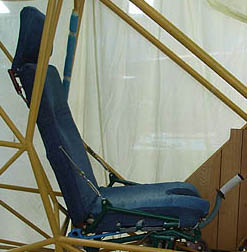
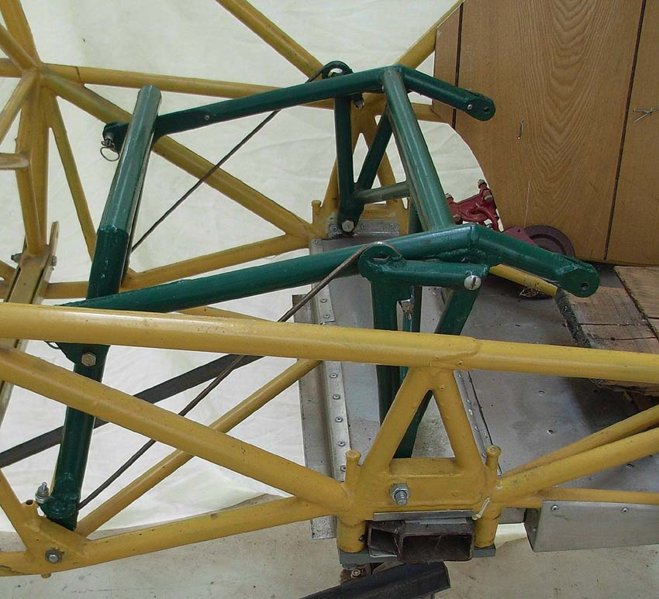
The best single reference is the USAF Crash Survival Design Guide; it's available on the web.Agreed, the seat structure has to be fixed so as to design the front of it to be sufficiently durable to not deform in the worst crash event. I wasn't aware of the danger to the ankles of the welded L shaped pedals so that's certainly a consideration for incorporating a different kind of pedal structure.In respect of the need for adjustable pedals, and for the adjustment to be easily made, inflight without risk of compromising control if possible, and independent for each seat of course, I have come to the conclusion that the adjustment method employed in some gliders is probably the best and lightest, see picture below. I'd be very interested in other methods that folk may know about, and systems where the geometry remains the same regardless of pedal adjustment are clearly preferable. Some systems merely move the foot-bar back and forth and that means that the pedals arc downwards when adjusted for long legs and arc upwards for short legs. Brake cylinder attachment/adjustment is another important consideration too.[ATTACH]32079[/ATTACH]
Yes, though I'm doing mine a little differently, using an 'under-structure' to carry the gear legs, and having the front part of that raking up to the firewall, that rake is then extended further forward as part of the engine mounting.
Thanks for the numbers and other info, interesting point about the body ... what do you think about foam, if it's used for the energy absorption? There seems to be two distinctly separate schools of thought, those who suggest the foam should collapse as it does its job i.e. does not return to original shape after overload, and those who see a benefit in rubberised foams which very quickly return to their original shape. The main discussion seems to be centred around the likelihood that a crash that involves the preferred 'skipping' arrival involves several separate impacts and if the first one flattens the foam there's nothing left, and slack belts, for the ensuing ones.
I think so too, and the point you made about the door pillars is very relevant. A couple of notable events in the US have seen the far-too-flimsy front pillars of one particular design buckle, following which the entire airframe just collapsed around the occupants. I'll see if I can find the images. I think the front pillar(s) (I'm using four plus bracing) can also benefit by being resolved to the aft fuselage by more than just a single inter-spar member, I'm planning on using a small truss (possibly triangular) at the door head, to resist buckling in that region - still toying with that one at this stage.
Other matters for consideration regarding crashworthiness - the energy absorption value of the landing gear. In combination with your excellent Seabird Seeker concept of keeping the crash attitude more horizontal than vertical, then a lot can be gained from long travel and progressive suspension, something which my new design has, albeit that the plan was for STOL reasons rather than unintended sudden arrivals -
Here's a sneak preview -
[ATTACH]32080[/ATTACH]
I'm out of time again, thoughts about flail arcs and distances will have to wait for next time - do you have any numbers/references on that Dafydd? I've based mine on Bill Whitney's testing for the Boomerang.
.
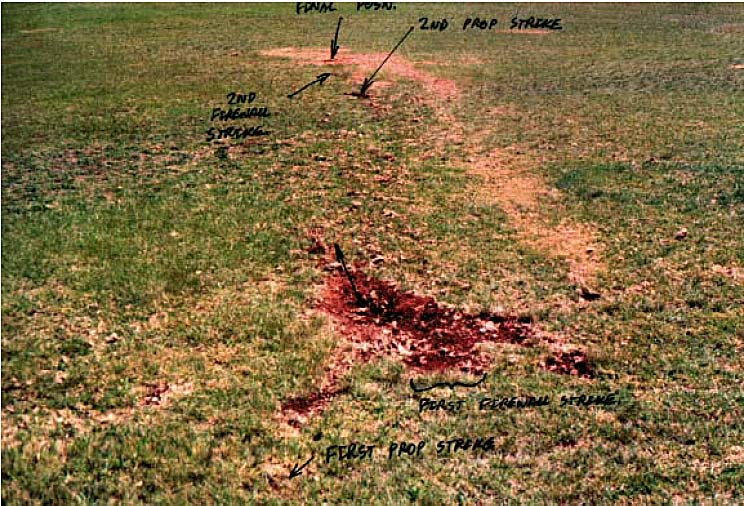
Re the bevel or chamfer at the lower front corner of the fuselage frame, see the attached photo - it shows the initial impact gouge from the RV-3 at Toowoomba. The Goulburn Sting made an almost identical gouge. The front lower corner needs to be shaped to try to avoid this sort of dig-in behaviour. Both those aircraft "bounced" after the initial impact; the patch of dead grass in the background shows where the RV 3 ended up; but this initial dig is what caused the high initial deceleration.

-
I tried this with four beer cans on end; once they started to buckle, they crumpled at just about the ideal force; however they needed about double that force before the crumpling commenced, and that would provide precisely the lethal spinal load that the ARL work set out to eliminate. Drilling a 10 mm hole transversely across the can at one end largely eliminates the high initial load. There's considerable scope for experimentation, but do NOT put anything under the seat unless you have first measured the force at which it compresses; it the total force for the seat as a whole goes over 700 Kg, it will not provide protection. Ideally it should start to compress a little below that figure, and then maintain close to 700 Kg until it's fully collapsed. If the crumple force of individual elements - say of one beer can amongst a group of four - starts out high and then falls away, there's a risk that the seat pan may collapse on one side rather than uniformly - and that will do you spine no good at all.Just to throw this one in, empty aluminium drink cans are awesome "crumplers", so good some years back a University competition for a bumper bar design for a crash test actually won over all the scientifically designed and built at great cost crumple designs. They bought a number of drinks and merely spiked a hole in them to drain them then taped them together. Apparently the tab opening gave way at 'X' pressure allowing the can to crumple after offering an initial air cushioning and worked a treat. Might be worth looking at to put under your seats, weighs nothing.So if you want to play about with such options, build yourself a test rig and make sure it collapses nice and evenly, with the correct load.
-
1
-
-
Yes - well, the thread was supposed to be about what car manufacturers term "secondary safety"; and the overall message on that is that there's considerable scope for improvement; and that it would be more widely applied by recreational aircraft manufacturers if:
(i) The means of qualifying an energy-absorbing seat were greatly simplified from those that apply to FAR 23.562;
(ii) The consumers indicated that it is a significant factor in their purchase decision.
Of course, overall safety is what the consumer looks for, to the extent that he considers it a priority, and that has to take into account all the various accident causes that are not simply pilot error. Engine reliability is a major aspect of that. But that's been hammered to death and I doubt there's any benefit to be gained by re-visiting it right now.
Going back to "crashworthiness" , it's obvious that is cannot readily be an "add-on", though there may be some things one can do to improve it in specific aircraft types. But to make a major improvement requires that it be designed in to the aircraft from the outset - and one does not see that in most recreational types. I hope this thread will give people some ideas as to what to look for in the detail design of the aircraft on their "short list".
-
Same situation in the Auster III I used to fly to work in, when I worked for H de H at Bankstown. You won't find that in many modern certificated aircraft - but it's still being done in some homebuilts.
Fuel system safety in an emergency landing situation is a major issue; in fact whether of not the fuel tanks rupture is probably one of the deciding factors in defining whether an accident is "survivable".
-
Look at the Log Book Statement - first page of the log book. That normally specifies what the maintenance requirements are for the aircraft concerned.
-
1
-
-
Thank you, gentlemen. Looking at this thread, especially posts #4, #5 and #9 - and also that somebody found post #18 funny - and also the limited number of respondents - shows me that whilst there are a minority of people who do care about " secondary" safety considerations, and some serious thoughts there, the majority of people really aren't interested. This demonstrates yet again what Edsel Ford found out - safety is not a marketable commodity.
I wonder what % of the readers of this Forum would buy a somewhat more expensive aircraft, if it offered a higher level of safety? Not a sufficiently significant percentage, I suspect, to make it attractive to manufacturers to put out more than the most basic product; but to make manufacturers place some importance on styling.
So we get what we deserve - stylised garbage.
-
2
-
-
Quote: "In simple terms it is a seat which is effectively a box without hard items inside it. The top of the seat is designed to break/crumple/deform/distort so that your backside breaks through the 'lid' of the box and has room to travel into the box."
There are two questions that arise from this simple concept:
Firstly, how do you keep the safety harness tight whilst the seat is crushing? Simply putting a crushing element under the pilot's backside will normally allow the seat belt to slacken when the think crushes, which allows "submarining" - i.e. sliding forward under the belt.
Secondly, how do you prevent the control stick from injuring the pilot? AS OK says, a side-stick is a bit awkward on a single-seat (or tandem) layout.
My answer to the first question was to mount the stick pivot under the front seat cross-member, so the stick goes down with the seat. It requires some tricky design in the linkages, but the geometry takes the stick down and forward as the seat collapses. There may be a simpler way; the seat gets quite complex.
My answer to the second question is to put the lap-strap anchorages on the seat - and make sure the seat structure will not tear loose from its base pivots as it collapses. The shoulder harness anchors to the airframe in the usual way, which means it pulls tight as the seat goes down.
This approach seems likely to provide excellent occupant protection, but it's very labour-intensive to build - and not at all suitable for retrofit into an existing design.
-
Look at automotive racing harnesses.My rudder pedals don't cause me to lose sleep. They're ply laminates with little scope for injuring me. That CM steel fitting in front of the CJs is the problem. Let's hope the harness doesn't let go!-
1
-
-
Nope - over the bluebush. Around Quirindi there are heaps of landmarks - the Liverpool range, and the Breeza plains, and the ridge running north through Werris Creek. If it's down to minimum VFR visibility, almost anywhere will do.Somewhere near Quirindi Dafydd -
Griffith to Swan Hill
-
HITC, you are right on the money. Having set out to design a "collapsing parallelogram" seat base for my pet project (not the Blanik) it immediately became evident that you have to design the cockpit end of the control system around the seat, otherwise the stick is likely to spear the pilot under the chin. Also, you need adjustable rudder pedals, rather than a seat on adjustable seat rails. So things like the Cessna approach of sliding the sear right back in order to get your legs in the door, are right out. You really have to start with the cockpit, and design the rest of the aeroplane around it.
The RV study that we did, was started in order to assess the effect of the rudder pedal design on lower leg injury; I had hoped to get some inkling of the maximum deceleration loads that could be safely applied to the feet, because once you save the fellow's spine, the next question is, will he be able to get out of the wreckage or will he be incapacitated by leg injury? In the event, all we learned was that the common form of rudder pedal, , like an inverted L shape in welded steel tube, is NOT the right answer; in the RV accidents, both occupants had both their ankles fractured by the twisting of the rudder pedals.
The "bevel" at the bottom of the firewall is vital.
The criterion for a stroker seat is 1500 pounds force in the lumbar spine - which means the seat should collapse at not much more than that load. If you do a simple Newtonian physics analysis, assuming the human body to be a rigid mass, you will come up with a required seat stroke of about 300 mm. However, most interestingly, an early experimental seat test done, I think, by Steve Soltis - I have the report in hard-copy format - showed that about half this distance suffices, because the human body has considerable energy-absorbing capability itself.
I agree that a properly designed welded steel tube "crash cage" (and I do not mean something made from boiler tube) is the most cost-effective answer for a small-volume production aircraft.
-
1
-
1
-
-
Air bags may well be the least-worst solution for intermediate-seat passengers if there are three or more rows of seats, for whom shoulder harness (other than normal 3-point automotive type) is very difficult to provide. However they do not help if the cockpit collapses; and they do not help the spinal impact case. I'd agree with bex about their dangers they present. I don't think they should be the solution of choice for two-seat aircraft.Seems that latest car technology relies to a degree on air bag safety. Can this be adapted to low wing aircraft successfully?I mean incorporated into the construction, rather than just the add-on seatbelt type that is for sale.-
 1
1
-
-
Well, if you do find a source, I'd love to hear of it.Correct....... Sikaflex 295UV ($30.00 a cartridge) but the catch is it has to be used with their Primer 209N to achieve a good surface bond, and after searching high & low I could not find an Australian stockist for the primer. -
There's a Sikkaflex product specifically for this application, I believe.
-
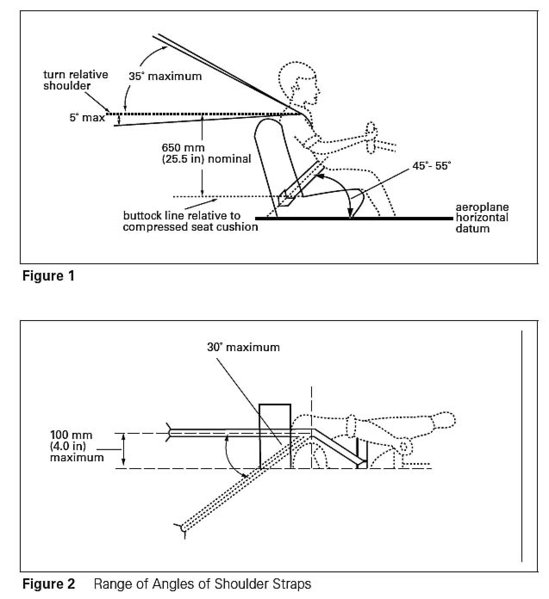
Agree completely about the five-point harness; but when one uses an energy-absorbing seat, you find the cockpit has to be designed to cater for it. You can't just buy one off the shelf and slap it in; unless perchance your aircraft has a side-stick.In my opinion one of the greatest safety items is a 5 point seat belt. when I started flying many years ago Cessnas and Pipers had a lap belt only. A sudden arrival almost guaranteed your head would hit the panel. My Corby Starlet, which was designed before experimental aircraft has a 4 point harness and relies on the turtle deck to hold the shoulder belts. I would think the shoulders would be restrained, but the front of the fuse would collapse with dire results to your legs and feet. The RV4 I fly seems a lot more crashworthy, but if the tail folded up, the shoulder harness would slack off. I just hope that it happens later rather than sooner. The semi stressed skin with a load of rivets would I hope give a reasonable crumple rate. I have built what I hope will be a crumllable seat base out of riveted .032" sheet aluminium, topped with a temperfoam home made seat.To get the benefit of a five-point harness in the RV, I would suggest that it would need some pieces of 25 x 25 x 2 mm Grade 250 or 350 square mild steel tube tucked under the canopy sill rails - and then move the shoulder harness anchorage to structure that is connected to them. You need to get the shoulder harness attachments at the right height - see attachment
-
Erhm - There's a trick or two to mounting a heavy engine on a pylon behind the cockpit; if you do it the simple, obvious way, what you have is a sledgehammer.Great post, HITC. I am one of those who followed your design on the other forum without mentioning any safety issues.My love of having the command centre up front probably stems from the Blanic. (They say your first flight has a profound impact.) They still have a safety dividend in terms of excellent visibility, but forward cockpits will have to wait until we can get that heavy engine out from behind our heads. Electric may be the only safe way.One way to avoid that, is what Thurston came up with for the Colonial Skimmer and the Teal - which is to use a couple of struts angled well forward at their base. The pylon is designed to fail first at its rear attachments, whereupon it will do a "pole vault" on the struts, which in effect throw it clear over the top of the cockpit. The way I'm doing it on the Blanik, is to have two attachments at the rear, and one at the front, arranged in an isoceles triangle. The rear attachments are designed to fail first; but they are extremely unlikely to fail simultaneously; so the pylon will pivot forward and sideways around an axis through the remaining rear attachment and the front attachment, which are eyebolts set to facilitate this pivoting - so it will go to one side or the other of the cockpit. The pylon and its attachments are designed to withstand 18 G forward inertia load.
The thing is to forsee these eventualities and design around them.
-
The reference I was trying to remember is (Australian) Dept. of Supply Aeronautical Research Laboratories Structures & Materials Report No. 316, by A. P. Vulcan and S.R. Sarrailhe, July 1967. I have it in hard copy only. It shows what one can do (given a suitable basic design) for a few dollars. The Chipmung seats were designed to accommodate a WW2 style seat-pack parachute, so they had a suitable "bin" under the pilot to accommodate a crushable element. It was normally filled in civil use with two abominably hard Kapok cushions; and the natural frequency of a body resting on those resulted in a lethal 30G "spike" going up the pilot's spine. Instances of the two occupants being found dead in an undamaged aeroplane, sitting in a paddock with the engine still ticking over, were not unknown.
-
I agree; but it won't help if the engine dies at 50 feet and you have to get across a six-lane road and a ten foot high cyclone wire fence, to reach the school playing field on the other side. That's what caught the RV 3 pilot.
-
2
-
 1
1
-
-
Well, I've been thinking about this since before I looked at those RV accidents; and along the way some additional experience has led me to the following; see what you think of it:
Firstly, in regard to energy-absorbing seats:
These are a proven life-saver then the aircraft hits the ground flat, rather than nose-down. A normal fixed undercarriage (to FAR 23 standards - a lot of Exp Cat ones are way under this) is designed to a limit descent velocity around 10 feet per second; it will collapse at anything more than about 12 feet per second. A seat pan that has six inches of controlled collapse at close to but not over 1500 pounds, can increase the survivable descent rate (i.e. keep the load in the lumbar spine below 1500 pounds) to over 25 feet per second. The first attempt at this of which I am aware was the Chipmunk Safety Seat devised by, if my memory serves me, Vulcan & Sirrahlie, (Australian Aeronautical Research Laboratories) which used four blocks of polyurethane foam between to squares of plywood. You have to get a specific grade of foam, and the long-term durability is questionable, because such a seat may have to last decades before it is needed.
It is possible to design an energy-absorbing seat that uses a form of energy-absorbing device whose crush characteristics are not affected by how fast it happens. If the design standard allowed a simple force-deflection curve analysis from a "static" crush test - the area under the force-deflection curve represents the energy - then energy-absorbing seats would become vastly less costly. Not as good as a FAR 23.562 device, but much, much better than nothing. My first attempt at this was a seat base essentially comprising four empty beer cans between two pieces of plywood, with a hole drilled through the walls of the cans, just under the top, to prevent a high "starting" load. It was even less durable than the polyurethane blocks, but the raw materials are not a cost issue, so one could replace it every year, I suppose. This sort of thing needs to be installed in a "bin" that can carry side loads; and one of the problems is getting it to always collapse without tilting. Now that "memory" foams such as Temperfoam are more readily available, they offer a better answer. Gliders use this approach, but it needs more crush distance than is commonly available in a glider, to be really effective.
Obviously, sitting on the mainspar of a low-wing aircraft is NOT the way to address this problem.
Secondly, a non-deforming cabin structure:
Large, stabilised box-sections members either side are an obvious way when frontal impact is the principal issue, as in cars; but increasing the fuselage width of, say, an RV 6 by 240 mm is not likely to be attractive to consumers. It can be done with smaller members, but the added weight is also an issue. However, a non-deforming cockpit also needs something ahead of it to do the crushing - and that's a major problem in most aircraft. High-wing aircraft can achieve an adequate cabin structure provided they use hefty windscreen pillars, but even they can't cope with a direct head-on impact.
So the answer is to prevent the aircraft from impacting on its nose. The Seabird Seeker showed me how that can be achieved; what it needs is for the stalling characteristic to be changed from the "classical" form, where the nose drops uncontrollably until the aircraft regains flying speed, to a "minimum steady flight speed" situation, where the stick hits the back stop before the wing stops flying. If the pilot tries to stretch the glide, the aircraft will develop a high sink rate, but it won't dive into the ground. A high sink rate is also lethal - unless you have effective energy-absorbing seats. If you combine these two strategies, the "RV type" accident could be made far less lethal. The "ground aversion" response of pulling back as hard as possible will result in the aircraft arriving "flat" and hopefully sliding along on its belly, so the won't be a massive nose-on impact.
Thirdly, overturn protection / escape:
The simplest way to achieve that, is to choose a high-wing layout.
-
1
-
-
The general reaction of manufacturers to new technology in regards aircraft safety, is "we don't mind doing it if everybody else has to do it" - except that each increase that requires special testing, adds another barrier to new entrants. The dynamic seat testing issue has been a watershed because of this; in effect, the applicant had to provide several test specimens, and the only accredited test facility was at one time located in the U.S.A.. Each test cost something like $US 25,000 to run, and destroyed the specimen in the process. There are at least two tests, so if the applicant's design managed to pass, compliance with FAR 23.562 might cost as little as $100, ooo - but the problem with dynamic testing is that it's not merely a case of firing the specimen at a " brick wall" - the test must achieve a reasonable approximation to a defined acceleration / time history (referred to as "pulse shape") - and that is as much a result of the crush behaviour of the specimen as of anything else - that requires trial and error, so in practice the cost is likely to be several times that.
This sort of thing has forced some manufacturers to turn their back on "mainstream" aviation, and instead focus on marketing experimental kits, or on recreational aircraft whose design standards do not include things like dynamic testing or overturn safety, or fatigue life aspects. That market demands short build time, good looks (which often involve "styling" features that are counter-productive to safety) , and performance. Generally, safety takes a back seat, because the average consumer neither understands what is missing, nor wishes to do so.
We have now had fifteen years of experience with experimental amateur built aircraft in Australia; whilst that's not really very long, given the build time of most kits in the hands of the average consumer (if there is such an animal!) - we are starting to get a glimmer of an understanding of what their advantages and disadvantages are.
How important are safety considerations to you?
-
3
-
Small aircraft crashworthiness
in AUS/NZ General Discussion
Posted