


Dafydd Llewellyn
-
Posts
1,513 -
Joined
-
Last visited
-
Days Won
43
Content Type
Profiles
Forums
Gallery
Downloads
Blogs
Events
Store
Aircraft
Resources
Tutorials
Articles
Classifieds
Movies
Books
Community Map
Quizzes
Videos Directory
Posts posted by Dafydd Llewellyn
-
-
-
Simple: It's not fire-resistant. Admittedly engine fires are rare, nowadays, but that is largely the result of good practice in regard to fuel systems as a result of WW2 experience. Fuel system fire resistance is built in to aircraft certification design standards:DDayfdd , could you explain briefly why its not advisable to use the aluminium fuel fittings in the engine bay ?I can understand that ally fuel line isn't a good idea due to vibration in the engine bay .Mike
§ 23.1183 Lines, fittings, and components.
(a) Except as provided in paragraph (b) of this section, each component, line, and fitting carrying flammable fluids, gas, or air in any area subject to engine fire conditions must be at least fire resistant, except that flammable fluid tanks and supports which are part of and attached to the engine must be fireproof or be enclosed by a fireproof shield unless damage by fire to any non-fireproof part will not cause leakage or spillage of flammable fluid. Components must be shielded or located so as to safeguard against the ignition of leaking flammable fluid. Flexible hose assemblies (hose and end fittings) must be shown to be suitable for the particular application. An integral oil sump of less than 25–quart capacity on a reciprocating engine need not be fireproof nor be enclosed by a fireproof shield.
(b) Paragraph (a) of this section does not apply to—
(1) Lines, fittings, and components which are already approved as part of a type certificated engine; and
(2) Vent and drain lines, and their fittings, whose failure will not result in, or add to, a fire hazard.
Normal practice is to use a steel bulkhead fitting through the firewall, and run fire-resistant lines from there to the engine.
("Fire resistant" is defined in FAR Part 1 - from memory, it requires the item to be capable of resting 1100 degrees F for 15 minutes)
Good practice is to minimise the fuel system components forward of the firewall, (e.g. fuel filters, electric fuel pumps, etc), and to use hose that is essentially high-pressure hydraulic line - which takes a while to burn through - with fire-sleeve over it; and make sure the hose end fittings are steel, not aluminium. I know this may seem futile, when the engine-driven fuel pump and the carburettor are both aluminium, but in point of fact they are much more massive than the fuel line itself, and also they are protected to a degree by the latent heat involved in boiling the fuel out of them. The fire sleeve also serves a secondary purpose, in that it converts a pressurised fuel spray from a split in the hose, to a dribble of fuel from the end of the sleeve. The older grades of hydraulic tube go hard after about six years, so they are a nuisance-value maintenance item. They have largely been superseded by PTFE (Teflon) lined tubes with braided jackets, but although this will resist higher operating temperatures before it goes brittle or melts, it does not survive as long as the older type in a fire, so good fire sleeving is still essential.
This is what you find in GA aircraft, though it has taken manufacturers a while to wake up to the fact that the electric pump, gascolator etc should be either under or aft of the wing (where the fuel tanks are) in order to minimise the risk of vapour lock.
This standard is difficult to achieve in recreational aircraft, because the carburettor etc are much less massive than in GA aircraft, and they use a simple hose barb for the fuel line connection; but you can still approach the standard by appropriate choice of the fuel line and correct use of fire sleeving.
Transport category aircraft no longer use aluminium tube, because it does succunb to vibration unless it is adequately supported; they use stainless steel.
-
 1
1
-
 1
1
-
-
Well, one can - but I don't think I will, thanks all the same.
-
Well, AVGAS is mainly straight iso-octane, i.e. NOT an aromatic - so it's much less likely to damage the hoses.I tried sourcing hi press hose for the SDS, i spoke to lames at parrafield and they suggested pirtec hose , CBC stock a similar orange hose , the specs are on pirtecs web site . Seems to be the stuff they use in motor racing , .i think ill go for the teflon hose when time to replace .Pirtec wouldn't recommend avgas but said ethanol was ok in their product .It seems to go hard if you let it dry out ,
Mike
-
 1
1
-
-
Aluminium line does not care whether it's 98 or E10 or AVGAS. So that reduces the problem to the fuel pump diaphragm and the carbie float and any fuel filters - and I don't use paper-type fuel filters.Guys.....those using 98 and suffering bad smells......Dafydd suggested that its the aromatics passing through the fuel lines....In previous threads we have also discussed the fact that full tank sloshing isn't as good at handling aromatics as we might wish. Once the sloshing is removed then the tank is likely no longer fuel impregnable and no matter what fuel you put in it you will likely have the same issue unless it is resloshed assuming your manufacturer supports such an approach.My L2 had his J230 with passenger seat header tank exhibit exactly this behaviour when he switched temporarily to 98 and he determined that the only approach to solve this problem once the sloshing was damaged, that was acceptable to him was to replace the header tank......not exactly a minor undertaking IMHO so I'll stick to the Avgas for the moment. Also the things added to 98 to make it move from 95 to 98 read like the who's who in cancer inducing chemicals......best I not be breathing these if I can avoid it...... Toluene is not good stuff! http://en.wikipedia.org/wiki/Toluene_toxicityAndy
-
So you go to the bike shop & say, can you sell me some of that black, braid sheathed fuel hose, eh? I'm sure CASA would be very relaxed about that, if a design signatory approved it . . .
-
 1
1
-
-
Great. Now tell us how we buy it.
-
If Bex was trying to be clever, he's going about it in a strange way. The information he's gained, he could just as well have obtained by looking at the Jabiru website, and listening to Ian Bent at Temora. Almost all of it is in the public domain, or will shortly be. Fishing on a forum like this is a bit silly when you can get that sort of info direct from the horse, simply by asking politely. It would be completely futile for a manufacturer to seek to hide this sort of information, when anybody can easily get it by examining one of these engines. What you will NOT get is the drawings, process specifications or work instructions.
-
Agreed. But it's one white cross at each end, NOT two white crosses near the windsock.
-
1
-
-
Clue to what, Turbs?Well, well, well, another little clue perhaps?-
 1
1
-
-
Do you have a specification for it?I have left (this year ) mogas in my tank for 16 weeks with no ill effects. ( BUT not in the carb!) If you care to check, Japanese motorcycle fuel lines are ok at 20 years plus. No hardening , no cracking. It's available from wholesalers. BUT it's black....... -
Yes, well that Bex's guess a load of nonsense.last time I looked the pistons were cast. being holden parts. forged pistons would go a long way to reducing piston problems! neither have I ever seen forged piston pins! machined from drawn round at best...Cast Vs forged pistons is a strength issue, which is principally a concern for high RPM, to my understanding. The Holden pistons with wire circlips gave very little trouble, I thought; was there any other piston problem apart from the circlip trouble? It all seemed to start when Jabiru stopped using the Holden piston - but I was not following the history closely, back then. The Jab. engines do use a fairly "tight" piston to bore clearance, and because of that they are little affected by the gudgeon-pin offset. The CAMit engine has greater piston/cylinder clearance, the gudgeon offset the opposite way (as becomes necessary with increased piston clearance), and piston cooling. Plus they use the wire-type circlips. All little points, but the cumulative effect should be considerable.
-
1
-
1
-
-
Bird strike with a vengeance . . . but there's a thought, now - could we use drones to chase the 'roos off? They don't take any notice of the wedge-tailed eagles that have a nest on our place, within a couple of hundred metres of the airstrip. Drones with whistles? And if we did, would that satisfy the duty of care?
Maybe we should stipulate that all aircraft using the strip must be equipped with whistles and air-horns (all that would be missing is the bells). Or paint a large kangaroo sign on the ground (but don't make it look like the QANTAS emblem, or who knows what might happen . . .)
-
 1
1
-
 1
1
-
-
Well, that's interesting; maybe you've got lucky with the fuel line. If it's a polyurethane type, I'd expect it to last longer than some of the other grades. But with aromatics in the fuel, who knows what the situation will be from day to day. Goulburn's pretty cool most of the year; that would help, too. Given the problem with composite fuel tank sloshing compounds, I think I'll stick to welded aluminium tanks and aluminium fuel lines, at least outside the engine fire zone.I have used Caltex exclusively after being warned away from BP and Shell about 9 years ago when I built my aircraft. I test the fuel (95 and 98) all the time and have not had any problems. I use flexible fuel lines and have not had any degrading in that time (haven't changed them either and they are still flexible. (one of the "experts " at Natfly a couple of years ago gave me the benefit of his vast experience and told me I should change the fuel lines every 2 years or ..."you will be sorry one day"...) The fuel lines are blue plastic and mostly mounted externally. I have fibreglass tanks. I use oil injection in the 2 stroke motor and use a mineral oil. I was told that if the aircraft is going to be sitting for extended periods then the mineral oil sticks to the upper cylinders better than the synthetic types. So far no problems. Just my 0.2c worth... -
Not part of the engine, I suggest. I don't know who's making those.The scimitar prop hub?Laurie -
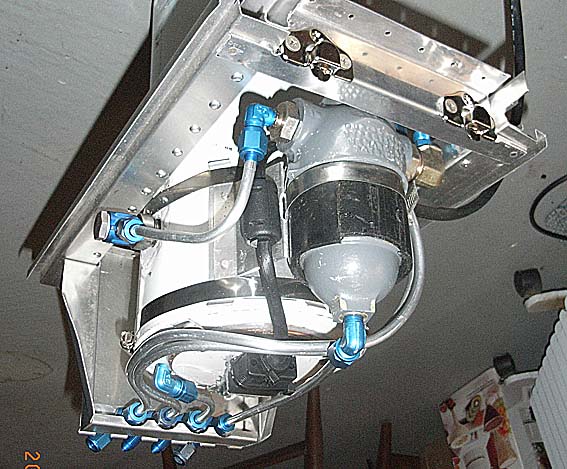
Yes - well, that's one of the ways manufacturers make those aircraft "affordable". Here's the collector tank for the Blanik engine conversion:

-
1
-
-
If you've never flown a tailwheel aircraft, go do a couple of hours in a glider first - that will get your feet working. MUCH cheaper that $375/hr. You need go no further than Gawler.
-
2
-
-
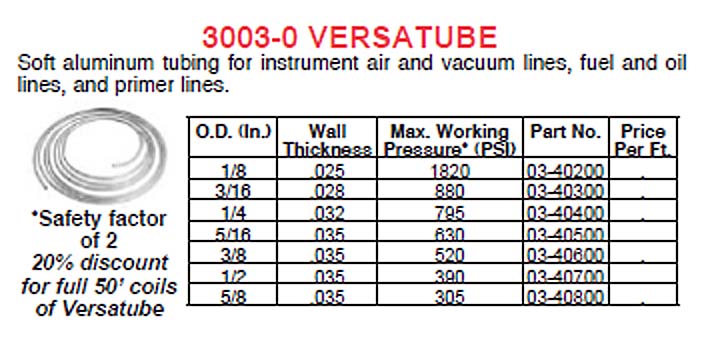
Maybe there's a reason why Cessna etc don't use flexible fuel line where it's not necessary. The alternative is to get yourself a 37 degree flare tool and use aluminium tube, in accordance with FAA AC 43.13-1. You need to learn about AN hydraulic fittings; the aluminium (blue) ones are OK outside the engine fire zone. Inside the engine fire zone, use steel fittings (the JIC series are compatible with 37 degree flare, but they are not cheaper than the AN steel fittings, in my experience. For fuel containing alchohol, use stainless steel fittings in the fire zone). This option is much more labour-intensive, but you only need to do it once, and you won't be poisoned by the aromatics etc that leach through flexible lines. If you're getting fuel smells through your flexible lines, this means the plasticisers in the lines are being lost; the lines will become brittle. Flexible lines do not have an indefinite life. Use them only where relative motion exists, e.g. between the engine and the firewall.
-
1
-
1
-
-
One out of six - the pistons. You people do not know what you're talking about.
-
1
-
-
What forgings? Last time I looked, jab engines had billet-machined crankshafts, connecting rods, crankcases, cylinder barrels and cylinder heads. The pistons were no doubt forged.FT, I mentioned that some raw forgings are Chinese derived, but machined to the fine tolerances in Oz - the rub here is those Chinese forgings are most likely Australian sourced steel or minerals anyway.I don't know why you insist on playing the Chinese card with this one and note that Jab bottom ends seem to be as good as it gets by any World standards, Chinese forgings or not and the airframe is without doubt as good as it's peers, ZA or not.-
1
-
1
-
-
I've yet to see a Chinese derived Jabiru engine; please enlighten me - have any of these yet reached the market place? They cannot replace the Jab 2200 C, in Jabirus up to & including the 160C, unless they achieve Type Certification. Also, how do you know that they will be cheaper than a CAMit engine?Oscar, how do you think Ian going to go selling those Camit engines at a higher price than genuine [albeit Chinese derived] Jabiru engines?The cost of an engine is not known until it gets to the point of its first major overhaul. From what I've seen to-date, I'd expect a longer overhaul life from a CAMit engine than from a "genuine Jabiru" engine, no matter whence it is derived - but time will tell.
-
No, indeed - no need.Wouldn't dream of bagging them. -
Thanks, Gandalph; your comments are very much to the point. Now, if FT will be as forthcoming?
-
Are you assuming Gandalph has some financial connection with Jabiru? I think it's about time people declared their pecuniary interests; this thread is starting to smell rather fishy. I'm not hiding behind a pen name and I've made my position perfectly clear on other threads on this site.
-
1
-
Fuel treatment?
in Engines and Props
Posted
Most motor vehicles of my experience use Bundyweld tube http://en.wikipedia.org/wiki/Bundy_tube from the fuel tank to the engine compartment, and then go to a flexible line. I've used Hypalon-lined hoses in motor vehicles for the flexible lines, and it's been generally satisfactory - before unleaded fuel. Nowadays, I'd use a teflon-lined hose, such as Aeroquip 666 or equivalent.
I do not see any good reason to use other than a metallic line up to the firewall; however if you do, it needs to be installed IAW FAA AC 43.13-1. In general, the fuel tube should be some distance below any electrical looms rather than above them.