

Old Koreelah
-
Posts
6,237 -
Joined
-
Last visited
-
Days Won
55
Content Type
Profiles
Forums
Gallery
Downloads
Blogs
Events
Store
Aircraft
Resources
Tutorials
Articles
Classifieds
Movies
Books
Community Map
Quizzes
Videos Directory
Posts posted by Old Koreelah
-
-
Back to laminar flow wings: I've talked to pilots of aircraft with them, including Moonies and P51 replicas. None have been too concerned about their stall behaviour. Either they stay away from that airspeed or their wing hasn't got full laminar flow, as an earlier post said of the P51 wing.
I wonder whether our props have a laminar flow cross section, or is prop stall a possibility with fixed pitch?
-
Alan I can't help you, but I'm very interested in what you learn. I too have the same problem. I'd hate to remove any of my apps, because I use them all.
I have, however, cut down some files to save space. Why download maps until you're about to fly to that area?
I also dump my pix to the Cloud to save space.
As my iPad is 8 years old it's nearing the end of its useful life, so I'm putting aside a few bob each fortnight for a new one, which will have lots more memory.
-
 1
1
-
-
...I seem to recall one fatality where the pilot failed to utilise a formal checklist, and this was noted as a common habit of his.
Good point, 1T. One of my flying mates is even older than me and has done the opposite.
For years he used mindfulness (or some similar approach) which served him well, but recently he detected a few signs of forgetfulness, so wisely decided to go back to following checklists.
-
 2
2
-
-
Good call, Dsam. I’ve never had my family and friends to watch me take to the air; too much distraction and pressure to over-rule patient preparations.
-
1
-
 1
1
-
-
Spot on, PM. A great exercise to decide where we fit on that graph.
-
2
-
-
The boundary layer at the leading edge is very thin and a tiny protrusion can trip the laminar flow into turbulent flow. The turbulent flow spreads and it makes those tracks.
There is quite an effect on performance, since turbulent flow is about ten times the drag of laminar flow.
So I guess we should try to keep our props glassy smooth like sailplane wings.
-
1
-
-
I got in the rotor flying my Hang Glider back in 1976 & crash landed behind the hill. I wasn't hurt but the glider was. It was very scary as I had absolutely no control. I have a healthy respect for mountain ranges when there is a lot of wind now especially when it is straight in & up to 45 degrees off. If the range is 3000 feet high I want to go over at a minimum of 5000, preferably 6000. If there"s cloud any lower than that it is a no go.
Wise words, KG. That Bonalbo-Urbenville-Woodenbong-Koreelah-Boonah country has lots of isolated peaks which, no doubt, create crazy turbulence in strong winds.
That's supposition because, although I've climbed some of them, I've never achieved the dream of flying around my home district- I'm too much of a wimp.
Back south where I now live, we cross the Liverpool Range frequently. Its a low, continuous barrier and it doesn't take much wind for it to cause problems. We often find strong turbulence miles past the crest, and thousands of feet higher.
-
1
-
 2
2
-
-
Very sad outcome for all of us.
He came down in my home country, better known as Yowie country because there are precious few places to put down a quick aeroplane and almost none you'd get out of again.
-
1
-
-
To visualise airflow NACA researchers had to build expensive wind tunnels and introduce smoke streams; these days we just go a for a fly.
-
1
-
1
-
 1
1
-
-
-
What an appalling statistic. The scale of US losses in spy missions is out of all proportion to the threat posed to their nation. The paranoid Americans covered up so much skullduggery, yet claimed to be so much better than the evil commies.
The only positive is the wonderful cooperation by a few dedicated men from both sides trying to bring some closure to the families of lost airmen.
A related story: it was years after that war that we learned the US had about 900 of its aircraft shot down over North Vietnam. Pawns of the wealthy warmongers.
-
1
-
-
No drama, almost nonchalant calls.
-
1
-
-
Boeing is a major component of the Military Industrial Complex that Ike warned about, and therefore complicit in the "never ending wars" that Trump was going to stop. Given that and the nasty things America has done to Iran over the years, I don't blame them for not asking for Boeing's help.
-
1
-
-
Another incredibly sad tragedy. Lots of human potential snuffed out in an instant.
-
1
-
-
It's located on the top and max suction part of the wing KR.. You a cannot fly with a fuel cap off...
Nev I discovered this to be true after being distracted by onlookers while refuelling. Somehow I forgot to secure the cap, which is just behind max low pressure point. Several litres of expensive juice was sucked out during the climb out. The noise didn't last long after I switched from Both to the uncapped tank.
-
1
-
-
...What happens when you dump 50 tons of fuel only 12,000 feet above Zurich?
That question has always intrigued me. In the biography of Charles Ulm there is mention of Kingsford Smith having to dump a couple of tonnes of petrol after an aborted takeoff. One of his backers quietly paid compensate to lots of housewives for the damage to their laundry.
-
1
-
-
Although I'm a land lubber, my one experience with life jackets might be useful.
My otherwise impressive instructor was not as his best when he took me on a Nav that included some flying over the ocean. As we climbed into the plane he tossed a couple of cardboard boxes behind the seats. Being an inquisitive young bloke, I asked what was in those boxes.
His nonchalant reply: life jackets.
That was the entirety of my briefing. Luckily we didn't end up in the briny.
A bit like some farmers I know who take off their seat belts when they leave tar roads; what's the point of having this expensive life-saving equipment if we aren't practiced in using it?
-
...The AOA is a terrific resource. I have seen a few working and they really do make a difference especially if you do the Outback Stol country pilot flying...like on the video series. There is a guy making one here its not finished yet but close. The main thing is the dual input pressure sensor and the pitot tube...
I've come across some inexpensive electronic pressure sensors which lend themselves to use in an AOA instrument.
Is that what he is using?
-
Good to see. I should check the date of posts more carefully...
-
MN good on you for sharing a resource! As a lifelong map addict, I hate to see them tossed out. Hopefully Martin (above) can PM you.
I use OzRunways but always have a paper map and flight plan as backup, but my old maps are getting tatty and out of date, so I'll be buying a new set soon.
-
2
-
-
...They may be there but I don't see much evidence of CO monitors...
Good point, Skip. In Post #3 mine is to the left of, but obscured by the weather display. A hand-sized CO2 monitor from Canada, mounted behind the panel, with holes so I can see the display.
To speed the warmup I keep the cowl flaps closed and enough monoxide leaks in to show a significant reading- in effect, a pre-takeoff check of the monitor.
After I open them that reading drops to zero.
-
...the lithium will most likely end up being a 4000deg fireball...
Mark I might have missed something, but which sort of lithium battery are you talking about?
It is my understanding that Lithium Ferro Phosphate batteries don't just not burn, they cannot.
Lots of aviators have been flying with LiFe PO4 batteries for years without drama. As you say, the charging system might need a new regulator. I fitted a Qld-built PowerMate and I'm happy.
-
At the time, the Savannah with the slats had a very slow cruise speed...
The VGs made a huge difference for cross country flying.
Coming home from Temora one year I was surprised to be overtaken by a Sav;
he was cruising at around 90kt, so presumably had VGs.
-
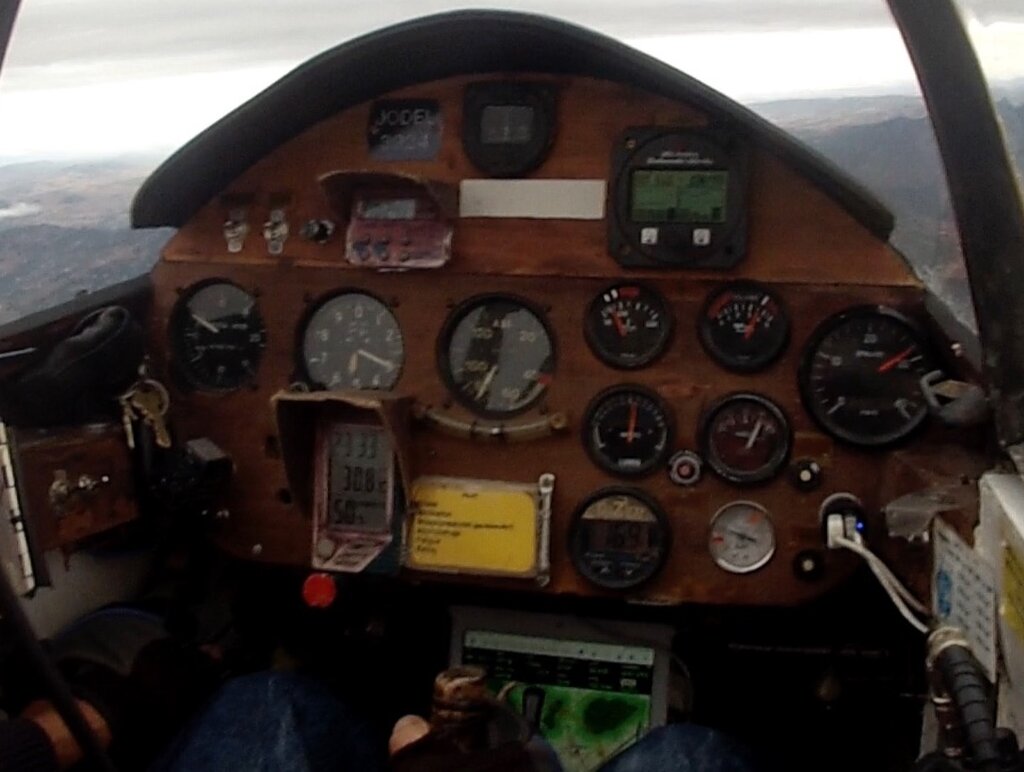
I too cannot afford a glass panel, but their lightweight and simplicity intrigue me.
My plywood panel is meant to match the handles for throttle, trim and stick, made from Rosewood I inherited from my father, who cut the timber from a tree that fell in the 1930s.
As well as long-lasting, it's heavy timber, but I like to be holding a nice momento of my dad while flying.
Flying instruments on the left, with engine gauges in the right. It's meant to flow from the bottom: fuel flow and fuel pressure, then electrical flow and electrical pressure, oil temperature and oil pressure, with burn readings on top.

-
6
-
Jabiru cooling
in Engines and Props
Posted
An intriguing story, Bruce. I'm a little confused about your LHS- as seen by pilot from behind, or as seen from in front, as the pic suggests?