


skippydiesel
-
Posts
7,622 -
Joined
-
Last visited
-
Days Won
73
Content Type
Profiles
Forums
Gallery
Downloads
Blogs
Events
Store
Aircraft
Resources
Tutorials
Articles
Classifieds
Movies
Books
Community Map
Quizzes
Videos Directory
Posts posted by skippydiesel
-
-
Me thinks this conversation might have strayed, just a a tad.
-
Nev ; No concerns regarding possible differences in expansion/contraction between very hot tail pipe and relatively cool bracket ? (this was why I was thinking along the lines of a spring (or two)
-

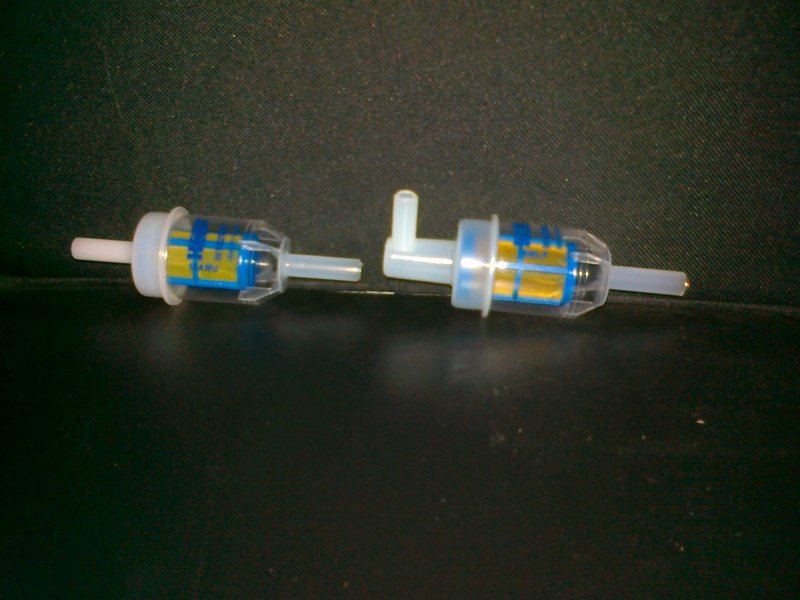
Hengst, In Line, 8mm IN/OUT, Gauze Fuel Filters
Part No - H103 WK (90 degree fitting one end)
Part No - H102WK ( straight)
-
Finally got the chance to use a borrowed "Master" oil pressure gauge to check out my system.
Master gauge has analogue dial face at one end of a short flexible oil pressure pipe and selection of screw adaptors at other end for connecting to engine oil pressure reading port.
- Removed oil pressure sensor.
- Screwed in Master gauge fittings & secured gauge on top side of engine.
- Unable to see gauge from cockpit
- Volunteered eldest son to read gauge at 2000, 3000, 3500, 4000 & 4500 RPM.
- Secured aircraft to immovable object and applied wheel brakes.
- While hand "burping" the engine, noted oil pressure rise to approximately 10 psi (good sign) as this is close to the minimum oil pressure of 12 psi Rotax requires for an engine at idle.
- Commenced extended ground run to warm system before taking readings.
- Cold day - 14.3 degrees C
- Even after many minutes @ 2-3000 RPM & two WOT cycles, only able to warm engine Oil Temp to 60 degrees. Heads to 70 degrees
- Commenced readings
- 2000 RPM oil pressure readings fluctuating too much to be meaningful
- 3000 RPM 45 psi
- 3500 RPM 45 psi
- 4000 RPM 45 psi
- 4500 RPM not read - prop blast too strong
I think my oil pressure falls well within the Rotax requirement of 29 - 73 psi above 3500 RPM.
My "el cheapo" Speco oil pressure gauge usually reads 30 psi in flight - Engine temperatures would be in the normal range (not as for the test) so the Speco is probably under reading by about 10 psi (allowing 5 psi drop for hot oil) . I think I can live with that.
You may also be interested in:
- My oil pressure sender has no legible markings of any kind. I believe it is the original one fitted to the engine in 2000/720+ operating hours ago & still functioning.
- I am informed that Shell has placed some sort of a stop on sales of any remaining AeroShell Oil Sport PLUS 4 (Black Bottle). All aviation oil has a finite shelf life, any remaining stocks would likely be past its "use bye" date.
-
 1
1
- Removed oil pressure sensor.
-
Thanks Nev - the photo is a little deceiving as the pipe bends away fro the photographer toward the centre line of the aircraft.
I take it you don't think a spring from each exhaust (or list from the LH) would do it?
-
-
When I used to ride motorcycles the exhaust systems were all fairly well mounted/supported. As with the Rotax 912 set up, the muffler(s) were the largest/heaviest part of the system and in both cases well mounted.
The glaring difference between my exhaust & that of a motorcycle is that;
· motorcycle exhausts have the muffler at the end of the exhaust system (little or no tail pipe)
· should a motor cycles exhaust system fail you get a bit more sexy sound.
· should my aircraft system fail I risk an in flight fire and or CO2 poisoning
My set up has a relatively long, unsupported tail pipe, hard joined (welded to muffler) that will resonate/vibrate.
The concern is that this resonation/vibration will cause premature failure of the tail pipe to muffler join and/or the end wall of the muffler (this is how the last system failed, after 16 years & 720+ hrs).
Resonation/vibration can cause rapid (a few minutes/hrs) failure where circumstances conspire to magnify the effect.
As I have no way of testing/predicting the performance of my assembly I seek to minimise the resonation/vibration thereby hoping to reduce the chance of premature failure.
-
Check out the ATEC aircraft - excellent short field capability (100m TO on grass, full fuel), climb out @ 1000+ ft/min ), fly all day at 60-70 knots (8 l/h), cruise 100 - 120 knots (13-18 l/h). Lovely flight characteristics, super quiet, comfortable, easy to maintain, unleaded fuel, long service intervals, Rotax powered. Way cheaper than most of the real (European) competition.
-
Thanks MB for the dissertation - but what to do? If anything?
I was half inclined to weld a bracket/strut between the muffler end and part way along the tail pipe but don't like the unknown effect such an innovation may have on the harmonics and expansion/contraction of the system.
I have an idea:
· I have some stainless half loops, left over from the Rotax muffler kit.
· On the muffler, (tail pipe end) I could weld a loop to one (a) or both (b)of the bracing plates for the exhaust sockets.
· I could weld another loop © close to where the 60 degree elbow starts.
· I could bridge the spaces a-c & b-c with unequal length coil springs (approximately 90mm & 130mm).
· This would give the tail pipe a slight upward force in two slightly differing directions while allowing expansion /contraction.
Would this tend to "dampen" any tendency for the tail pipe to vibrate?
-
Man Baby (MB?) not junk but I would like to make a more elegant system.
Update - Have completed new tail pipe fabrication & attachment to new muffler.
· I purchased a 60 degree, stainless steel, 38 mm automotive elbow (noticeably thicker walled & consequently heavier than Rotax pipe).
· A local muffler shop (thanks for your help, skill & patience Peter) stretched/flared the appropriate ends of the pipes so that they would "dry" fit together, but still rotate for alignment.
· I test fitted the Rotax 90 degree pipe to the muffler exit stub & cut to length
· Shortened both sides of the 60 degree bend to minimise weight
· Plugged remaining strait Rotax pipe into other end of 60 degree bend.
· Temporarily fitted the lower engine cowl to facilitate adjustments of tail pipe to the cowl exhaust hole.
· Used craft clay "blobs" to space the pipe from the inside of the cowl wall.
· Marked all joints for reference (I use a liquid paper "pen" to do this).
· Removed tail pipe.
· Using a TIG welder, put two small tack welds on each joint.
· Assembled tail pipe to muffler to recheck fit.
· Removed muffler & tail pipe to tack weld tail pipe to muffler stub.
· Reinstalled full exhaust assembly to check for final fit.
· All good.
· Removed assembly and my son, who is a much better TIG welder than I, permanently welded all joints in place.
· Final install with new system with new springs, anti seize lube, high temp silicon on springs & safety wire.
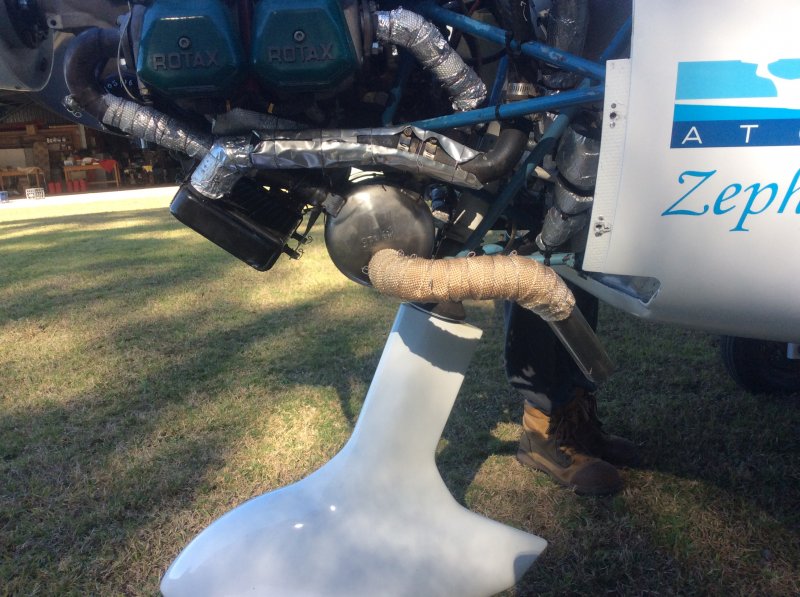
· As a precaution against heat damage to cowling, I have wrapped tail pipe in automotive heat bandage.
· Ground run of aircraft - system all good.
(Like to show a photo but not sure how to copy to this system)
Q: Tail pipe quite long, must make it and/or connection to muffler, particularly prone to vibration damage - any thoughts on the matter??
-
Of course you are correct, I completely forgot about RAA arrangements for training and aircraft hire. Just shows how inconsistent the whole regulatory system is.Most RAA "24" aircraft have the "non-certified" Rotax UL/ULS as far as I'm aware. These can be used for hire/reward.Perhaps in the GA/ VH world this is true.....and you need the certified engine. -
If I recall correctly (its been a few years since I did flight theory) , non certified aircraft can not legally be used for hire/reward. You can be trained in a non certified aircraft, if you are its owner (subject to instructors agreement). No other restrictions apply within Australia
-
 1
1
-
-
Existing (auto stainless) tailpipe welded onto muffler. Yes I could remove it, but then would have to excavate remains of muffler stub - all a bit messy. Probably end up with a loose fit, extra welding (weight & mess) to stabilise. Would like to do a neater/ more professional job than what was there before.
-
Okay ! Got my new muffler kit. All the exhaust pipe holes/sockets & spring loops seem to line up well. So far so good.
The big problem now is the tail pipe.
To fit my application, I need a 60 & a 90 degree bend both of about 220 mm outside radius. The 90 comes off the muffler stub. The 60 comes of the 90 and exits under the cowling
The Rotax muffler stub has an OD of 40 mm (as does the supplied L shaped bit).
I can get automotive stainless exhaust elbows of 38 mm ID that will "do the job" but the wall thickness is considerably thicker than the Rotax stuff & consequently heavier.
Q Anyone know of an Australian supplier of stainless exhaust bends of the same specification as Rotax ?
Q What do other Rotax 912 operators do to "plumb" a tail pipe ?
-
Thus sayeth the gospel according to Saint OneTrack - your words have the sound of truth .
-
1
-
-
It would seem to me this idea that 98 RON (or any fuel) will degrade down to about 91 RON in sealed container (not a vented fuel tank) in two weeks, needs to be explored with much more rigor.
I understand & accept that many materials will exhibit a degree of permeability to certain gases/liquids .
I find it hard to accept (without experimental data/proof) that a sealed plastic container, designed specifically to carry/contain petrol, in normal earth climate/conditions, will exhibit such a degree of permeability, that the fuel contained within will degrade in such a short a period as 2 weeks.
Osmosis is the process a process by which molecules of a solvent tend to pass through a semipermeable membrane from a less concentrated solution into a more concentrated one. This does not sound much like a fuel can to atmosphere exchange.
-
1
-
-
The tangential debates arising from the most humble of topics are most fascinating.
I would like to assure all those concerned persons; I will watch my weight & its location (not sure that this will change my eating habits) and that I have signed away a goodly slice of my Super to purchase an original Rotax muffler/exhaust kit from a well known Australian Rotax agent. I hope the new unit will last at least another 720 hrs + and it should keep my W&B as perfect as ever.
-
Nev - All true.
I apologise for making fun of your irrigation example
In my humble fuel related opinion;
- THE most important thing (after correct type/grade) is that the fuel you put in your tank should be free of contaminants.
- NEVER assume that the fuel about to enter your tank is clean.
- USE A FILTER FUNNEL (or similar devise) to make sure this is so.
- Down steam (in line) filters will have very little work to do, if you just take the time to ensure the fuel is clean in the first instance.
- THE most important thing (after correct type/grade) is that the fuel you put in your tank should be free of contaminants.
-
Scott - make sure you get the authorisation in writing for your aircraft logbooks . You may also need to lodge a copy of the authorised modification with RAA.
-
1
-
-
Hi Scott
Not sure if this constitutes a "foot in mouth" observation but my aircraft is in the RAA 19 (kit built) category, which I believe means that it is essential an experimental aircraft. Most of these aircraft fly with the old metal & glass screw together filters - prone to leaks, heavy, bulky and relatively expensive (they do work & the filter tube/media can be cleaned or replaced).
After I found the Hengst type filters (there are other manufacturers but I believe Hengst is the only one with a clear body/casing) I discovered the aircraft maker specifies the same filters for their factory built version of my aircraft - happy coincidence.
Scott, if an alternative filter is available in Australia, there is no reason why you can not explain the situation to the manufacturer & request a written authorisation for the alternate filter. Of course they are not obliged to do so but most will, as long as the new filter meets or exceeds the specifications on the original.
-
Hi Nev - I agree, that water is the most common contaminant of fuel. You sound like a person of some considerable (agricultural?) experience so you know, but many don't, that water can enter your fuel at almost every stage, from the refinery, bulk transport, fuel retailer, drums & your own fuel tanks. The fuel enters as the result of condensation, poorly fitting or faulty caps/lids, ground water seepage, (don't start me on the hygroscopic character of ethanol) etc etc. That's why we drain a sample from our fuel sump(s) before the first flight of the day and a little time after refuelling. Those of us who care about such things, keep sampling until no more water appears in the sample cup.
Avtur (aviation turbine fuel) - hmm not often used in small aircraft. Similar in may ways to automotive diesel that can be contaminated by bacteria. The bacteria can be controlled by good fuel hygiene (keeping water out), fresh fuel & a number of fuel additives that claim some efficacy. Appropriate filters will prevent entry to injector systems but the aim should be not to put contaminated fuel in your tank.
I am not sure of the relevance of an irrigation system (yes I know unfiltered water will block sprinkler systems and this can be a big pain in the A...). I have never been on the lookout for a suitable paddock to land in when operating a centre pivot or travelling irrigation.
I do not agree that it is safe to remove filters from the tank to carburetor delivery system of an aircraft (what you do with an earthbound engine is another matter) Even if you start with clean fresh fuel in your aircraft tank so many other contaminants can still enter your fuel system; compost tanks shed fibres, metal tanks & fuel lines have been known to deliver "swarf" & the products of corrosion, seals & gaskets can & do shed bits, paint flakes appear as if by magic and even highly rated flexible (rubber) fuel lines can shed the odd particle/fibre, even insect & plant parts have been found in fuel filters. I would rather keep all these things out of my carburetor/injector.
-
1. Putting clean/filtered fuel in your tank is the only way to minimise the chance of a filter blockage.
2. Filters should, if at all possible, not be located in the engine bay (mine are located under the instrument panel).
3. All aircraft should be fitted with an alternate fuel supply in the event of the primary system failing (this system should have its own dedicated filter).
4. Filters should always be fitted on the upstream/tank side of pumps.
5. Gascolators are okay but a bit "old hat" when you can fit a modern high flow/gauze, disposable/low cost, lightweight, leak proof, filter & carry spares (which I have never had to use in 700 hrs)
-
Thanks for the replies - Have been doing a bit more research:
- Could not find any evidence of an embossed/engraved part number on my original muffler, sooooo seems likely my muffler was supplied/built by the kit manufacture and may not be a Rotax original.
- It costs about as much to purchase the exhaust parts kit Part No 973676 (including pipes doughnuts, springs, etc) as it does to just purchase the muffler on its own.
- There is a fully fabricated Rotax exhaust system Part No 973387 - quite a bit more in cost and it may not fit my application. Interestingly the tail pipe on this system is spring attached (not welded) this may indicate that Rotax feel that a solid welded tail pipe may be subject to fatigue cracking.
- Could not find any evidence of an embossed/engraved part number on my original muffler, sooooo seems likely my muffler was supplied/built by the kit manufacture and may not be a Rotax original.
-
Hi All,
This 912ULS has done 720hrs/16years.
Just found what looks like a fatigue/vibration crack in the ring weld that holds the "tail" pipe on my muffler/silencer. (small sign of exhaust leak drew my eye). On closer inspection I also found a crack radiating from the ring weld about 1/4 of the way across the slightly domed end of the muffler/silencer.
Vigorous shaking of the tail pipe did not result in any discernible movement of the cracks.
Q: Is this a reasonable operational life expectancy for a muffler?
Q: Do I replace muffler/silencer?
Q; Do I get muffler welded?
Your collective thoughts on the pros/cons will be much apptreciated.
 Thus sayeth the gospel according to Saint OneTrack - your words have the sound of truth
  .
.
USAF declares first squadron of F-35As combat ready
in Aircraft General Discussion
Posted
"When will they ever learn". "When will they ever learn" ------ DRONES & SAM's are the now & the future for fighter & surveillance aircraft. Why hall/lift a life support system & a pilot when you can replace all of that with fuel, equipment & or ordnance.