


skippydiesel
-
Posts
7,611 -
Joined
-
Last visited
-
Days Won
73
Content Type
Profiles
Forums
Gallery
Downloads
Blogs
Events
Store
Aircraft
Resources
Tutorials
Articles
Classifieds
Movies
Books
Community Map
Quizzes
Videos Directory
Posts posted by skippydiesel
-
-
I kinda liked the term MoGas, bit classier than ULP and I didn't know MoGas was a USA term - will stop using it.
I think you have overstate the E10/ethanol matter - it would be a rare pilot indeed, who knowingly filled her up with E10. Its potentially negative features would introduce an unnecessary element of uncertainty. From my perspective its the potential for ethanol contamination of 95/98 RON, so probably way less than 10%. To guard against this I have done all I can to make my fuel delivery system ethanol resistant.
You have made a good point about freshening, your potentially stale, in aircraft fuel. I am fairly sure that this has been a recommend practice in other conversation on this matter. I certainly top up with fresh fuel after my aircraft has been sitting for any more than a week - so far never had a start problem.
-
 1
1
-
-
Great achievement Robin - there are only a very few aircraft, in this (light) class ,that are claimed to be able to achieve 150 knots. I think all are retractable/CS " fast glass" from Europe. I did see one, ultra sexy unit, that appeared to eclipse your achievement but when I double checked, it is using the Rotax 915 engine. Further investigation revealed that the same airframe powered by 912ULS, was still way behind SGS & SRS.
If there was a way to follow your build (even to get a 150 knot cruise) I think I might buy Sonerai 2 plans/kit tomorrow.
-
True! true! - my craven apologies however that old urban myth about having to use MoGas within 30 days was debunked quite a long time ago now - but it must be in a gastight, fuel container & almost full to "keep" in good condition.
-
Fair comment - will take that on board
-
Walrus - we almost agree on every point (soo disappointing 😂).
Regarding ethanol:
Being a tad skeptical by nature, I dont use it BUT I would point out that Rotax have now approved up to 10% (E10) in their 912 range SUBJECT to the rest of the fuel system being ethanol compatible. In this context the rest of the system is the tank and fuel delivery (hoses, pumps, etc) system.
I agree with your observations on water absorption and the need to be extra vigilant if using E10. In my most recent 5 year rubber replacement I made a point of ensuring the new hoses are E10 compatible - composite tank may not be however. This is not to enable my use of E10 but to reduce the chance of problems should some ethanol find its way into my fuel system.
Like you its been about 25 years since I experienced fuel adulteration, in my case diesel that smelt like paint thinners- and like you I had stupidly used a cut price servo just outside Camden NSW. No lasting damage just lots of smoke & down two gears going up the hill to home. Drained tank as soon as I realised the problem. Never went back to that servo and 25 years later still tell the cautionary tail, so on going loss of custom to that business.
-
5 hours ago, danny_galaga said:
Nope. The manufacturer has made their money. Whatever someone wants to retail it at is another matter. A retailer can sell it under the RRP if they want, or even below cost, or give them away. What you are saying is that all these disparate sources, in unrelated regions around the world are for some bizarre reason colluding on the retail price of an engine. To what end? If there is one supplier magnitudes larger than the rest (and I bet there is) then why would they agree to fixing a price? They would just undercut everyone else and rely on higher turnover.
Friend - your naivety is breathtaking to think that somehow the market will dictate in all situations. Commercial history is full of suppliers that dictate retail price (check out De Beers) - you just have to have a commodity that is sufficiently in demand that the retailers will agree to the suppliers terms.
-
2 hours ago, Roscoe said:
Jabiru say Mogas is ok but recommend avgas due to quality control issues.
My recommendation.... jerry cans of mogas which should be well known providersor put into your lawn mower.
I know you will come across owners who swear by Mogas and say their engine runs smoother and cleaner, but for me, Not being Mechanically astute, I prefer to take advice from the Engine Builder and fill up with Avgas and plan my flights where I know Avgas is available
No offence Roscoe but -
- I dont think this is a Jab/Other discussion its about making the use of ULP/MoGas safer using portable quality a assessment devise (if a cost effective one exists at all??)
- Jabirus comment (which I have heard befor) has all the hall marks of a, "cover all the bases/arse" & "sit on the fence" remark. Analyse it and I suggest you find: Its okay to use MoGas & its okay to use AvGas. So in the proverbial "nut shell" Jab are saying the choice is the pilots/owner - all good - no further debate.
- Your final comment makes no sense as Jab (the engine builder) have already stated (according to you) that they accept both Mogas & AvGas - so good on you! you have decided to go with AvGas - no prob!
- As for your "mogas which should be used within 30 days or put into your lawn mower." - this Forum has hosted several extensive debates on this subject - it is now accepted (by most) that MoGas, stored in an approved, sealed container at above 70% (or was it 75%) capacity, has a shelf life of well over 6 months - may I suggest that you are doing a Donald on this matter.
.
-
26 minutes ago, danny_galaga said:
Manufacturers always set a RRP. The retailer can then either follow that or charge whatever they like. Charge too much and the customer goes to the guy who followed the RRP. You can't say it's 'rigged' unless there are say two MANUFACTURERS colluding to fix a price.
Can if the supplier has a monopoly - Rotax 912/914 & now 915 have no real competition - at least in my mind - being unique in the market place, with partially liquid cooled geared & muffled engines.
Lycombing & Continental on the other hand are in competition over most of their range and at the lower end of the market competing with a host of wonabee's. There are also a number of uncertified competitors to LyCon in the 150-250 hp (a guess) range
-
40 minutes ago, onetrack said:
Skippy, as recently as 2016, 6 NSW servo operators were caught and penalised for mogas adulteration with Toluene.
There have possibly been more adulterated fuel prosecutions since, that I have not come across.
When you have tight fuel margins and very high prices for fuels, the potential is increased for shonky behaviour in the fuel retailing industry.
https://m.drive.com.au/motor-news/adulterated-fuel-sold-to-drivers-20100823-13gkx
No matter what the law(s) is there will always be a criminal somewhere who thinks its okay to rip off the public - just part of life's rich tapestry I guess.
I still dont think the risk is significant, as long as the pilot follows your advice regarding purchasing from well known brand/high turn over outlets.
Its only the truly desperate & dim witted, that will knowingly supply bad fuel, as word will spread rapidly (Facebook/Twitter/etc) and they it will loose their local customers, for a long time, completely negating any windfall profits that they may have made Its not in the interest of larger brands to supply dodgy fuel either, so I am happy not having a testing device other than the eye - colour and the nose- familiar "clean" smell and following your above recomendations.
-
2 minutes ago, Yenn said:
Skippy I agree with you that raising the undercarriage would not change the drag while you are flying, but I think you are looking at a sea plane and the drag would be excessive with the wheels down on the water.
Absolutely correct - just me being picky.
-
1 hour ago, onetrack said:
Hi Glen - T................................................................
The primary dangers in mogas are cheap, unauthorised, low grade additives by unscrupulous independent service station owners (paint thinners, toluene, etc), contamination by dirt and water via old underground tanks, and poor venting and sealing systems, and low fuel turnover by servos in areas where fuel sales are minimal.
Accordingly, the best mogas comes from company-owned, new servos in high-traffic areas, where you see road tankers delivering fresh fuel every day or every couple of days.
The newer servos have fibreglass underground tanks that eliminate the corrosion problems of the old steel tanks.
Glen - I would suggest that the need for a portable quality assessment tool is overkill - I have been using MoGas in my 912 for about 11 -12 years now, without any issues. I prefer 98 RON (probably psychological) but I am happy with 95 RON. As per OneTracks advice, I try hard to obtain my fuel from fuel providers that are well known brands, that appear to have a high turn over .
OneTracks advice is sound, if a little dated regarding the adulteration of fuel by "independent" servos (though they would be my last resort, coming after a top up with the penultimate AvGas) as fuel quality has improved markedly over the last 20 -30 years. I understand this to have been in response to Australia's need to meet the needs of the vehicle manufacturing industry, that in turn is under from overseas legislation to force them to higher standards of fuel econamy/pollution - lower quality fuel in makes for higher fuel consumption pollution out. Consistency of fuel quality allows for tighter "tuning" of engines so as to perform as expected.
-
3 hours ago, Thruster88 said:
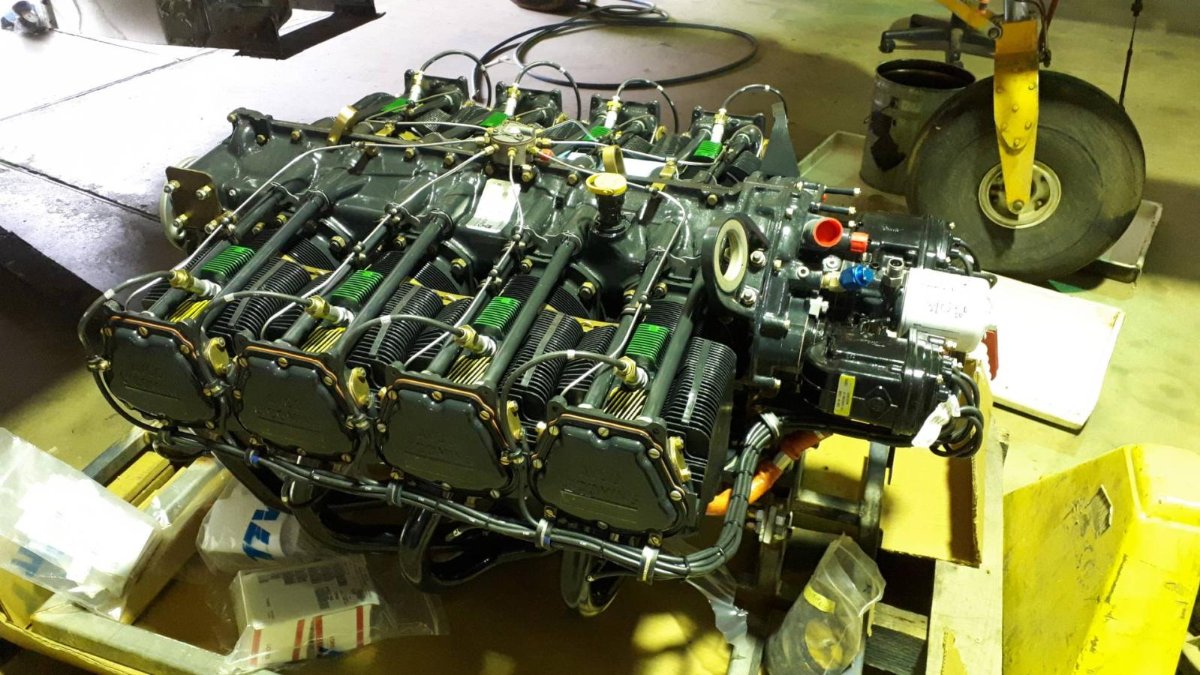
For some aircraft it is not about nostalgia, there are not any viable alternatives in the higher hp class. This 720 lyc will soon be making music with its 4 in 1 headers on each side. The prop makes the most noise. The rotax 912,914,915 are absolutely fabulous engines in their class.

Great looking engine - certainly "presses my buttons" .
The thing is, liquid cooled, high revving (geared) high horsepower, aircraft engines have been around for ever (I am fairly sure Continental had at least one).
Nev will know for sure but the now accepted horizontally apposed air cooled donk has only been around since WW2. Unlike the automotive world little pressure & relativly small market have combined (with liability concerns) to make innovation in this area glacial.
Rotax did not invent this wheel, however their popularity (despite high acquisition cost) proven ability to make an acceptable TBO, lower fuel consumption/reduce pollution, quite running continue to demonstrate what could be, in the rest of the market.
In my simple mind it is the overwhelming influence of the USA market that is holding up development in this area. Your average "Septic Tank" seems to be besotted with the big bore (made in the USA) engine to the exclusion of all else.
The Europeans on the other hand have, at least since WW2, been focused on fuel efficiency (in their land and air vehicles) and this seems to have driven their development efforts. In more recent times noise & air pollution have also been high on the agenda.
-
7 hours ago, turboplanner said:
You asked: why do we persist with the big bore, slow revving, air cooled, unmuffled (very noisy), thirsty/polluting, aircraft donks.
I gave you an answer to the big bore, slow revving part of that question.
Armed with that you ten switched to 4 cylinder car engines, so:
(a) the number of cylinders doesn't equate to piston travel
(b) it's quite normal for todays 4 cylinder car engines to make one million km, but that dosn't alter the principle I gave you.
The origination quote (Revs = Rebores) was about car engines, as an illustration, I merely continued in that vain but then went on to show that small capacity high revving aircraft engines can also meet (& exceed) the generally accepted/applied market standard of 2000 TBO.
I would not dispute your logic, only how it applies to the real world ie so your slow revving big bore could (in theory) out last a small capacity high revving engine but in reality other factors seem to come into play, impacting on the potential that the theory alludes too.
-
You may speculate about the real motive for selling off airfields (& I dont disagree) but the reason so often given is the impact (noise) on quality of life of the late arriving suburbanites - why give them any ammunition?.
-
Love it! - more!
Oh! & bye the way your perfectly reasonable logic regarding wear (rev-rebores) isn't born out in the real world.
A well maintained 4 cylinder can easily do well above 500,000 ks - I have one that is in the 700's and never been opened. Oil consumption only slightly higher than when new and does not require toping up between changes - in most cases body/chassis/spares availability is the life limiting factor ,not the engine.
As for Rotax - me thinks the 2000 hr TBO, easily achieved & exceeded for most, is at least equal to the big bore air cooled jobs (many of whom will require life extending surgery well befor their TBO)
-
Good video - very clearly articulated.
Off topic question: Why did he raise the undercarriage ? My guess, just habit, because I wold surmise that on this aircraft it can not make any difference to drag.
-
2 hours ago, turboplanner said:
Obtain the stroke of your favorite bores, and the rpm at cruise.
From that work out the piston speed, and the distance the piston covers in 1000 hours.
That should remove any lingering doubts.
Cause I'm thick as a short plank, I would invite you to expand - preferably with some emotive fighting words, to support whatever it is you might be trying to say.
-
(The Forum seems almost comatose – this is an attempt to prompt life)
Nostalgia - a sentimental longing or wistful affection for a period in the past or in this case an obsolete technology.
Have always been an admirer of the concept of doing more with less (hence my admiration of Robin Austin achievements VH -SGS & SRS)
Many years ago, while waxing lyrical about the performance of a Fiat 124 Sport Coupe (for those who don’t know - 1.8 L naturally aspirated, twin overhead cam, 5 speed 2 door sports sedan) – the first car I ever took to over 100 mph, cornered “on rails” and looked the part (plus “built in corrosion”). A listener butted into my verbosity with the statement - “Revs Equal Rebores” and a look of extreme contempt on his face. As you may have guessed he was a supporter of the big bore V8 (we clearly occupy different parts of the solar system).
The above is by way of illustration of my position – why do we persist with the big bore, slow revving, air cooled, unmuffled (very noisy), thirsty/polluting, aircraft donks that have served us so well but are now an anachronism???
I live under a training area for Camden, Bankstown & The Oaks. It’s also on the arrival flight path for many of the aircraft going into Sydney. I get to hear a lot of different aircraft engines – the rumble of big “jets”, the buzz of commuters, angry twins practising engine outs, the roar of aerobatic Pitts/ex “war birds”, Cessna/Pipers stalling, the occasional high-performance roar of RV /Lancair type aircraft, down to Jabs & the occasional 2/. What I rarely hear are the Rotax 912 powered aircraft – Foxebats, powered gliders and others that, are also to be seen, but little heard, overhead.
All too frequently I see articles in this Forum about airfield closures/operational restrictions – often arising, at least in part, from noise complaints – as a community we need to take note of what has happened in Europe, where aircraft must meet stringent noise standards.
You may love the sound of straight through short stack exhaust systems and wistfully compare it to the other high-profile noise polluters - Harley Davidsons and old style American derived trucks (sans working mufflers) but the rest of the world just hears noise pollution.
Is it not about time that we embraced the proven concepts of higher revving, turbo charging, gear reduction and mufflers to achieve the required thrust to motivate our airframes, while meeting community expectations for lower fuel/emissions and noise pollution?
I hope this has stirred the blood and there will be many passionate responses.
Go for it!!!
-
43 minutes ago, facthunter said:
Two problems there. Hypoxia and the OAT which is around minus 40 C, frequently. Nev
AND the negative effect of low atmospheric pressure on the body's ability to process gasses
-
44 minutes ago, facthunter said:
Tuft of wool in a glider count? Nev
Getting there!
-
1 hour ago, facthunter said:
Turbo charged P & W 1830s operated above 30,000 ft. It's all going funny for pistons at that height. HT ignition leakage and oil freezing. the prop has less drag in the thin air and may need more blade area so it doesn't end up too coarse a pitch angle.. Nev
To say nothing of the effects on the pilot/crew
-
Mhalc - Sorry mate - Got your e-mail contact but being an old fart cant seem to find out how to return comment.
Only 4% improvement in cruise and a deterioration in ground role/TO - that would concern me greatly.
-
12 hours ago, spacesailor said:
You need a Bigger turbo for top end revs in thin air,.
spacesailor
Qualified agreement - The sizing of turbo chargers is very much on engine application.
In the high speed sports automotive world, where acceleration is the objective, a single turbo is unable to spool up (accelerate) fast enough to supply the required "boost" from low engine rpm to high, so a staged system is used where a small (mainly refers to diameter of turbines) responsive turbo gives initial response, with a larger turbo "taking over" at higher rpm.
Some aircraft applications use two equal sized turbos but I would speculate that this is for minimising space under the cowling in a boxer engine application, rather than further power enhancements.
In a near constant rpm application - aircraft/pumps/tractors/boats etc, single turbo's are sufficient and are usually sized to give the best response over the optimum (quite narrow) rpm range. Where a particularly constant rpm is projected, a waste gate may not be required.
I have no personal experience of sizing turbo's for aircraft (or anything else) but would speculate that the turbo would, as you say, need to be sized to give an acceptable level of boost at the projected maximum effective altitude. The waste gate is a vital component of any aircraft boost system as an over-boost would likely see an engine failure quite quickly.
Further - While all turbo charged engines will have improved altitude performance, it seems to me that an aircraft engine, of a given capacity, can also be designed to be turbo charged/enhanced as a way of increasing performance (volumetric efficiency) and therefor better power to weight ratio. Turbo Normalised engine do not have greatly improved performance BUT there advantage is to be able to maintain sea level performance to much higher altitude than a naturally aspirated equivalent.
-
Turbo normalising is a technique almost exclusively use in aircraft.
Normally achieved using a turbo charger (exhaust powered turbine) to compress the air entering the engine, so as to maintain sea level (or slightly higher eg Rotax 914)) fuel burn efficiency at altitude.
To prevent over boosting a "waist-gate" is employed to reduce the amount of exhaust gas flowing over the driven turbine. Waist-gate opening/closing is controlled automatically by the pressure changes in the inlet manifold or manually by the pilot with reference to an inlet manifold pressure gauge.
This system has no effect on propeller/wing (airfoil) performance at altitude.
I suspect the speed "wall" you mention can only be changed by reducing drag on your airframe. Air density will be a factor in this. So I would expect that you would see significant improvements in air speed using an engine that will be relatively unaffected by altitudes into the mid to high teens however you may also need to have a propeller that can adjust to perform well in a thinner atmosphere.
You will also need to take steps to mitigate the effects of reduced O2 and air density on yourself and
MOGAS fuel freshness test kit ?
in AUS/NZ General Discussion
Posted
Yenn - Reference mowers.chainsaws, etc - I am able to do the same. I assume this is because I use 91 RON (cant get 95 RON from my local servo any more) that has fewer volatile components and that in general these engines are lower compression.