


FlyingVizsla
-
Posts
1,700 -
Joined
-
Last visited
-
Days Won
14
Content Type
Profiles
Forums
Gallery
Downloads
Blogs
Events
Store
Aircraft
Resources
Tutorials
Articles
Classifieds
Movies
Books
Community Map
Quizzes
Videos Directory
Posts posted by FlyingVizsla
-
-
-
The comment wasn't meant to be part of a manifesto. It is a CASA thing, and most likely one of the compromises that would have to be made. It would be nice to transit Controlled airspace any time in anything, but the political reality is that there will be too much angst from the Big Boys about anything less than certified and instrumented, LAME maintained, aircraft sharing "their" airspace, or flying over intensely populated areas. I can't base that on accident statistics - I strongly suspect the incidents, accidents and fatalities by GA (certified LAME maintained) proportionally outnumber non GA in controlled airspace. You could argue that we are safer, but then it would be argued that's because the unsafe planes have been kept out. There's a permit system now that will allow aircraft not fully compliant to access CTA - for example the disabled trike pilot who few unassisted from England to Australia was escorted so that he could complete the re-constructed historic route. But Joe Average wouldn't be allowed to fly his trike into Sydney. I was last into controlled airspace in 1995 - Archerfield, but can't go there now - although the C152 is NVRF and nearly IFR, I only have Mode A and therefore my altitude can't be read by other aircraft. None of our other aircraft would be allowed. CTA is a low priority for me, but it might be essential to others nearer regional centres.Sue,...CTA should be Lame maintained?????????????? On what is this based????? Accidents or incidents????????Certainly no agreement for this suggestion from me.
FrankM
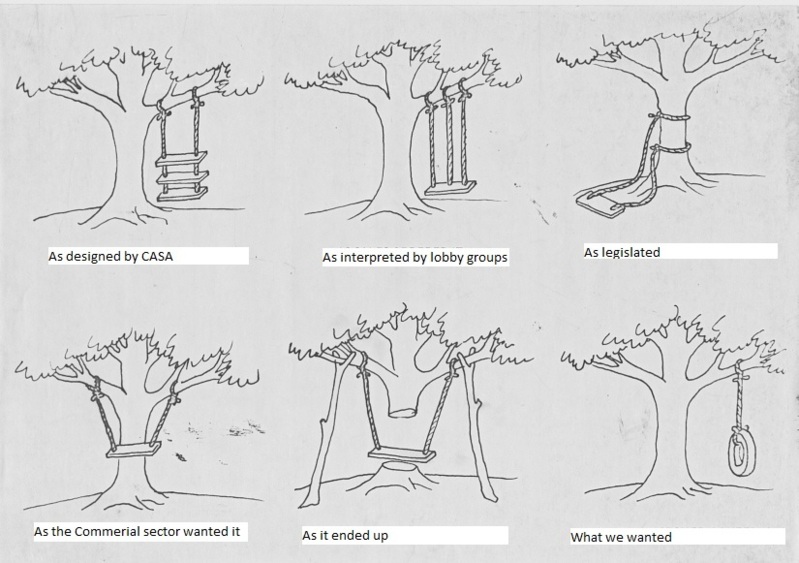
My suggestion is to look at simplification before starting on more categories. It is a pipe dream. In reality there will be compromises (as above) and cut off points eg No.seats or kgs as I don't think they would allow private jets to be maintained by L2s or owners. But now we have a growing number of categories - 10, 19, 24, 25, 28, 32, 55, LSAs, experimental, GA, 450kg, 600kg, 5,700kg, RPL, PPL RAA. Too confusing. Politically we will be up against airlines & commercial users (who pay for ATC enroute services), Safety lobby groups, bureaucrats who fear loss of control, LAMEs (loss of business), Airport owners (loss of revenue - RAA doesn't give out addresses for sending bills) and the NIMBY people protesting at possible increases in noisy polluting dangerous flying lawn mowers.
What I was dreaming about - All non commercial planes licensed, registered and flown under one simplified delegated system. I really don't want to argue about the finer points.
Sue

-
 5
5
-
-
Have already done my proxy, got another and spoken to the only other RAA member I know here. The flying club I belong to - rarely get to meetings - but 8 of them are on this forum and I have urged the club to get involved. They are revisiting their own constitution, so I got a bit more of a response from there. But on the whole, about half are willing to leave it to "someone else" to sort it out. They will only get involved when something they don't like hits them fair in the face - grounds them or fines them. By then it is nearly too late.Well you can help now by getting people in your area to submit proxies for the three current motions, which will clear the way for more paricipation to members to do the things you want to do FV.Once that's done, then you can get into groups etc and come up with these ideas and more readily get them up at meetings for discussions - the Constitution amendments are the starting point, and they are going to need a lot of votes.I wish more would get in the driver's seat rather than sitting up the back of the bus.
Sue
-
My personal opinion - ALL private and recreational planes & pilot quals should be removed from direct governance of CASA (let them look after the commercial & fare paying passenger sector). More than one Governing Body to administer the standardised delegated authority. Remove distinctions between categories of aircraft for registration - that will stop the nonsense of removing seats & equipment, pretending to fly with a teaspoon of fuel, and fudging stall speeds to fit a category. One licence (certificate) for all, endorsements to cover type, like gliders, and "extras" like higher levels of skill, PAX, cross country, controlled airspace, night etc. Maintenance based on engine type and usage eg if doing Controlled Airspace or NVFR it should be certified and LAME maintained; training or hire by L2; otherwise - your choice - as per manufacturer's specification - by LAME, L2, yourself. The RAA syllabus is getting more like the PPL but the licence/certificate is determined by the plane's rego - VH or 55 - despite being the same make & model. Even the medical is now similar. There's a lot of room for simplification, but we seem to be going down the path of more complication. It seems to be driven by fear that some inadequately trained, medically suspect pilot flying a poorly maintained contraption will take out a bus load of voters.
I am dreaming .... it is a complex issue. I didn't vote because I think it really needs a complete overhaul rather than more "categories" and "authorities".Sue
-
3
-
-
Hi Ian,
Does the current software support quizzes?
If it does, I was thinking of developing some multi-choice qns from the John Brandon tutorials, ATC Phrases, basic aeronautical knowledge, human factors, etc, as well as some humorous ones. "Resources", would be the best place for it, I guess. There were quizzes a couple of years back, but it never got off the ground for lack of content.Sue
-
4
-
-
The plans are not for the faint hearted. We decided not to build because the maximum take-off weight is lower than we wanted. In Australia retractable undercarriage can't go into the ultralight category so it requires a PPL to fly, which was another consideration.Hello,how is the building of your Asso Whisky going ? I am considering buying the plans and would like your opinion of them.Thanks
You need to study the plans thoroughly. There is no instructions on where to start, the process to follow, or exact materials to use. A lot of it is left up to you, including selection and use of tools and working out how to achieve the end product. If you have experience building it will be easier. The finished aircraft as an impressive look. It is mainly wood and birch ply with a few parts in chrome-moly, flaps, ailerons and rudder are dacron covered. The usual engine is a VW 80HP, wooden propeller, 50 litres (in 2 tanks), dual controls, tandem seating.
Sue
-
Avington Station near Blackall. It would be at the 4 hours limit, but worth the trip. When I lived in Longreach we used to fly down for lunch. 1600 strip, accommodation in the 1870's homestead or take over the shearers' quarters. Andy & Jane Dexter (07) 4657 5952. No website, but google it for reviews from happy campers.
Sue
-
Well I ticked "started flying also" but in reality when we met we were both already pilots and plane owners. He was a plane builder and I was only dreaming of it. Have since finished that one and he's mooning over plans and designing the next and we spend our free time and holidays (and the honeymoon!) in hangars working on planes.
Sue
-
3
-
-
Hi Jenkin,
Up on the top right - click on (or hover over) your name. Then choose Personal Details. You can update things there. The Avatar can be accessed directly from the same list under "Avatar".
Good to have you here - look forward to hearing your story.Sue
-
Going through Uni is not cheap. A quick look at Swinburne's Bachelor Aviation (3 years full time) HECS fees = $24,150 + $88,720 minimum to get you to Commercial Pilot's Licence (CPL) but not the full ATPL (you get theory only). That's $118,000 (allowing for inflation & texts) and all the costs of being a student for 3 years. Then you usually have to get an instructor rating (more expense) to start building hours and then lots of traveling around looking for a start.
From one of those job websites that keeps statistics on job adverts and surveys on job earnings - Commercial / airline pilots earn $31 to $127K full time. Few jobs are advertised. There is an Award for pilots. Read it here https://extranet.deewr.gov.au/ccmsv8/CiLiteKnowledgeDetailsFrameset.htm?KNOWLEDGE_REF=216338&TYPE=X&ID=9697368489278942188889912894&DOCUMENT_REF=363770&DOCUMENT_TITLE=Air%20Pilots%20Award%202010&DOCUMENT_CODE=MA000046 The pay rates are at the end.
Although there is an Award with minimum rates - you may end up working as a casual contractor on what ever rate is negotiated.
My advice to young people wanting to fly - get a career and use your flying to support it - eg flying vet, mechanic, financial adviser, civil engineer (you can claim it on tax etc) or FIFO job and fly yourself. Then it won't matter if you lose your class 1 medical, you fly with a PPL and Class 2 and if the worst happens, you drive or work from an office. If the bug really bites you can do your CPL while you earn and fly and then present yourself to employers with hours and experience and another skill (your other career) and a good insurance track record - and maybe even your own plane.
Other "cheaper" ways to get your licence - try through air cadets, Australian Scouts, various religious groups (training missionary pilots), cadetships through various regional or domestic carriers (Rex, Qantas, JetStar). Build hours flying gliders, tugs, RAAus, etc. Find an employer like the flying engineering consultancy that is willing to get you through your PPL so you can service their remote clients.
There's no easy answer - some people fall on their feet - a mate of mine got his PPL, went as a Jackaroo on a property where the owner paid for his CPL and then his Helicopter CPL and let him build hours in both until he left to set up his own charter business. Another mate did everything right, knocked on endless doors, worked his tail off, borrowed off his family, did every job no matter how lowly and still ended up broke with a huge HECS debt and jobless.
My humble opinion is that our airlines are going to, increasingly, source their pilots and cabin crew from overseas on much lesser conditions and Australians on the Award will be a minority. It is happening now - see the Qantas pilots for Qantas planes campaign responding to lower paid New Zealand pilots being kitted out in Qantas uniforms. For lots more discussion go to Pprune.
Sue
-
1
-
-
I am on Firefox 13.0.1 and not experiencing any problems now. I bought a new laptop with Windows 7 Professional (64 bit) and have had enough problems updating drivers. At one point I had to reinstall my mouse every time I started up, but it seems to work. One thing that fixed some of my problems was the compatibility option. Even though I had uninstalled the Visa version (if it had come across from my old computer via the back-up) and installed the Win 7 driver, some things (mouse, printer, webcam and wireless modem) reverted to older Win versions. The devices & printers would report the thing was working properly when it blatantly wasn't. Troubleshooting was suggest things like installing Win XP service pack 3. I had to manually reset to Win 7. Fortunately there is a "compatibility" button that allows you to choose from a drop down list of OS. I have other minor annoying things like the webcam turns on after a few minutes of keyboard inactivity and turns off 2 seconds after I move the mouse, as if it is slaved to the power save. Took me forever to get my Thunderbird email copied over and working. Changing OS can be so painful. But at least my mouse works on Aircraft Pilots - scrolls without clicking etc.
Sue
-
I saw one at Maryborough Qld with the head controlled by the rudder servo, so when the rudder moved, so did his head. I married into a family heavily involved in models, but I haven't had time to get out and try my hand at it (yet..)
Sue
-
2
-
-
Emerald Qld has just been upgraded security wise to meet this deadline. When there's a Q-Link or Virgin plane in, there are people in fluorescent yellow vests standing around everywhere, watching the car park, pedestrian crossing, drop off points, entrances & exits and patrolling the terminal, decked out with ID, ASIC, & other tags. Inside they are scanning everything. But the silly thing is that the Council (who own the airport) are planning a separate area in the terminal for charter passengers so they don't have to go through security, even though these flights go to Brisbane and other regional airports. I got off a charter flight from an unsecured airport this afternoon and we just all trooped to a side gate at the Emerald terminal and wandered off unchallenged. I regularly pick up & drop off to this airport - the staff numbers have gone through the roof. What I don't get, the people who have easy access to explosives (mine workers & drillers) are the people who won't be checked because they get on a chartered jet. The Mums & Dads going for medical treatment, holidays, weddings, conferences, business trips, public servants, trainers, - these are the ones getting the full treatment that means booking in an hour before the flight and sitting in a "quarantine" waiting room for ages. My other beef is that there are few places that you can see planes through the fence, and these have "no standing". The airside is being screened off from the land side around the terminal & parking areas.
The charge for each adult passenger getting on or off an RPT has gone up to $19 (children $9.50), RPT charges are $12/tonne (Fokker 100 = $552, Dash 8 = $228), security for passengers is "contract + 10%" what ever $$ that is. So all this protection, although farcical, is not cheap. It is added to the cost of the ticket. Charter used to be the dear option. I priced the 2 RPT flights to get me near to where I needed to go - $806 to $1,166. The charter seat on the company plane cost us $505 and got me right to the town I needed. Charter used to be the dear option. I despair.
Sue.
-
2
-
-
The following is my feeble attempt at a translation (thanks to a dictionary or two, and several web translators). Could do more, but I am working away for 10 days.
The small inset picture in Figure 7 shows the plane AS-37, Andre Starck’s amateur building project with unique features, intended to have a top speed of 180km/hour, minimum of 70km/hour and a flight distance of 1500km.
The originality of this small bi-plane consists, first of all, in the fact that the two wings are much (some letters missing..) offset from each other, (some letters missing ana) faja (root of ‘face’ ‘surface’) and two propellers are inserted between the wings evenly (in plan view). Through such an arrangement is an unusual layer objine (root of to obtain, derive, extract ..) limit of intake manifold on the upper wing and a (extradosul – no idea) construction of this layer on the lower wing in this way, the critical incidence angle increases, yet it maintains the capacity to control the device, micsorindu (derivative of to make smaller, micro inputs, ) - accordingly the minimum flying speed and the length of the takeoff-landing (DAS category aircraft). It is lovirit (root is to strike, percussion ) and the danger to the ground by the blades of the propeller and to people passing by. You may notice the aerodynamic surfaces sloping at 45 degrees and extremitatile (root added or external,), which connect the wings and also hold an eleroanele (eleron = aileron). Through such an arrangement reduces losses due to the reduced vortices of their wings (at the end), you get a dihedral effect (without it being necessary for the wings to be arranged in a “V”), increases in the resistance to inconvoiere (?) and torsion of the two wings. In addition, both increases the efficiency of eleroanelor (eleron = aileron, plural?) due to their spacing towards the maximum longitudinal axis (rolling) of the machine, as well as because the steep droop (infundare) their incidence is less than the actual incidence of the wings. In other words, these allow a kind of eleroane (aileron-ish?) coborire (to descend, to droop) (parachute like), without loss of control. This miniavion (light plane, ultralight, small plane) is equipped with a motor car 4-cylinder Citreon G-12 C.P. 60. Fuel consumption is 9 litres per hour or 6 litres/100 travelled in flight. The construction of the timber frame is spruce, covering contrapjacaj (no idea). The wing profile is constant throughout the length of the two wings and rectangular in plan (the 34 ribs are identical). Pilot seating is double, with transverse (cross-ways, side by side) arrangement of the two pilot positions.
-
Like any language with a grammatical structure different from ours, it takes some creative work to arrive at a translation. Using several web translators and a Romanian dictionary, some aviation knowledge and paraphrasing like mad - the first part reads:
The inset small picture in Fig 7 shows the plane AS-37, an amateur building project of Andre Starck with unique features, intended to have a top speed of 180km/hr, a minimum (stall?) of 70km/hour and a flight distance of 1500km.
Here's the issue with languages:
Postul de pilotaj este dublu, cu dispunere transversal a celor doua scaune ale pilotilor.
The computer translates it as
Pilotage station is double, with transverse arrangement of the two positions of pilots.
I paraphrase it as
Two seat, dual controls - but 'transverse' could refer to the seating positions (tandem, side by side?) rather than the controls can be crossed over to either pilot.
Sue
-
It's Romainian
-
If you're feeling lonely ......
Post any of these:-
1. GA's taking over RAA!
2. Jab engines are best!
3. Something's crook (but I'm not allow to say wot)
And you'll have more mail than Readers Digest.
Sue
-
REPORTING & REMOVING
There are some people who are drawn to aviation with a personality that seeks risk, and little will stop them. The difficulty for RAA, CASA, other flying groups, and medical examiners, is how to identify them and preclude them, without discriminating against others who are able. The men (no women) I know who have been killed or very seriously injured mainly fall into that category.
1. A bombastic bloke, from the moment he started training, no one could tell him anything. He died flying an unfamiliar aircraft shortly after he got his licence. We still don't know if it was structural failure, low flying, aeros or a mishandled practice forced landing. He had left his ELT in the car, so it took days to find him.
2. A man in his 60's with a "Who cares - I know what I am doing" attitude to training, licencing, work and family. In defence of the man - he was hit on the head with a propeller that started unexpectedly while he was working on it. After that he divorced his wife, went off on various wild business schemes, alienated his family - but no diagnosis that said this man should not fly. His erratic flying, constantly getting lost, doing beat ups, was reported many times to CASA who were tired of it. The only way to catch him was to be there. Eventually they had enough but decided to only restrict him to a remote geographical area. Shortly after, he crashed, and took his best friend with him. He was flying at night, for which he was not licenced and ran into the ground short of the airstrip killing both instantly. He was RAA too with various overseas licences.
3. A RAA student, son of a GA pilot, bought a Bantam. Under the influence of a guy who was doing aeros in an unregistered plane, he started practicing low level aeros on his property. His father caught him at it and sternly warned him, as did his CFI and FI, but he was in awe of the guy. He mishandled it and broke every limb, lucky to be alive, but unable to support his young family, he was physically and financially unable to fly again.
4. Son of GA pilots, mustering on their property in an aircraft not certified for aeros, crashed on the short trip from muster to base. Suspected he was horsing around at low level and stalled it with insufficient height to recover. Knew he shouldn't be doing this in that aircraft, but liked showing off. Had a "can-do, done it before" attitude. Did his training on the coast with people unfamiliar with him and the flying he intended to do.
5. Pilot was influenced by a commercial pilot who taught him how to fly IFR in clear weather (despite not being trained himself). He set out on a business trip through cloud, crashed in the fog, miles from where he thought he was. The commercial pilot was the subject of many reports, but it was difficult to define what was a personality spat, business jealousies (other charter op & school), and what was serious infringement. He wielded great influence over people who similarly flouted the rules - regarded them as applying only to lesser mortals - mostly those new to aviation. He was finally grounded when CASA mounted a case against him for not recording flying hours and using car mechanics to work on his charter aircraft.
How would you identify and preclude these rouge pilots? Notice that, in two of the cases, the rogue is not the one who died, but the one who influenced the behaviour of lesser pilots.
I strongly urge people to read Anthony Kern's book "Darker Shades of Blue : The Rouge Pilot" McGraw-Hill 1999 where he makes a study of risk taking in aviation and defines a rouge pilot. Then ask yourself, how are we to "legislate" them out of aviation. We can't, not without banning a lot of other people who have a right to participate. I think we need to understand human factors - not just the eat breakfast, plan carefully stuff that RAA pedals - the psychology which Tony Kern (and others) have researched. Our Instructors should be familiar with it and how to identify and remediate a rogue.
Another good read is "The Naked Pilot - The Human Factors in Aircraft Accidents" David Beaty, Airlife Publishing Ltd, England, 1995. This focuses on the heavy end but has lessons for light aircraft pilots.
A few years ago nearly every aircraft accident was 'Pilot Error'. Dissatisfied with that Robert Cohn wrote "They Called it Pilot Error: True Stories Behind General Aviation Accidents" It is a good thought provoking read that highlights other reasons why the flight ended in a fatal. He tries to put the story in the words of family, friends, witnesses (but it sounds a bit same-ish ie his words) and looks to the sequence of events before the fatal accident. Take him with a grain of salt though, he does admit that some of it is fiction - ie dramatisation of cockpit conversations where there are no witnesses or recordings, and tends towards calling for more "nanny" rules. He also has some glaring aviation mistakes. They are USA events under FAA rules, so students could be confused.
Tony Kern is particularly good - his job and passion are human factors and pilot training, coupled with education and research skills. The culture of flying has to change to make the rogue unwelcome. Only we can do that.
Sue
-
4
-
-
The boss is seriously considering attending as he is off work over those days. I am working, but might be able to wrangle some time off. He loves Narromine. We will be driving. Also planning to attend Monto in October and flying a couple of aircraft in.
Sue
-
1
-
-
RECOMMENDATION
1. a) RA-Aus reinforce to its members that there should always be positive obligations on all members to report any illegal or dangerous flying that might be in contravention of the Operations Manual and/or Regulations.
b) RA-Aus reinforce to its members that any evidence suggesting illegal, dangerous or unsafe flying on a passenger-carrying flight requires a member pilot, Instructor, Senior Instructor, or Chief Flying Instructor, to make an immediate mandatory notification to the Operations Manager.
2. RA-Aus review its system for receiving and handling complaints about member pilots that relate to flight safety issues, including:
a) developing a procedure for documenting these complaints;
b) developing a procedure for investigating these complaints;
c) developing procedures to protect a person who lodges a complaint, including an anonymous complaints system if appropriate.
RAA already has an informal system - you can phone, write, email the Tech/Ops Manager with concerns. What they lack is the funds and manpower to be everywhere, and maybe the investigative skills to properly mount a case. We might end up with a REPCON (CASA's anonymous reporting system), which, from their reports in the magazine seems to be they contact the company or pilot to see what their explanation is. Another difficulty is deciding what is dangerous flying and how that can be worded. To make it mandatory to report will put RAA requirements above those of CASA. As far as I know there is no Aviation legislation mandating a GA pilot (instructor or higher) to report other GA pilots. I think we will end up with a "policy statement" and a database.
The other issue is that RAA has no teeth. The worst they can do is cancel the membership (and hence the pilot certificate). They can't impound the aircraft, ban the (ex) pilot from airports, stop him getting in a plane or training for another type of license. No one checks licenses when you walk out on the tarmac and I daresay they could not publish him on a blacklist because of privacy concerns. I can't see this recommendation working in the form the Coroner intended. Not without a legal tome and a bevvy of inspectors, and the membership increase to pay for it.
I think our best strategy is to educate, applaud good airmanship, condemn risk taking, mentor young pilots, and get all the Coroner's reports, accident & incident reports, digest them and live.
Sue
-
Very good to hear first hand, and from a credible witness (good on you Trish), that this Coroner's inquest wasn't just a bunch of non aviation types showing their ignorance. Well done to all concerned!
People, we need to be very clear on who we direct our comments to. Trish is not the Coroner who made these recommendations which we are beginning to debate. These recommendations will be passed to RAA / CASA to debate, action, legislate or ignore. Put your thoughts out there on this forum in a logical and sensible way, then convey them to your board members, reps, CASA etc. Participate in the Notice of Proposed Rule Making (NPRM) process with CASA, have input to the Tech Ops Manual, Get involved, have your say, but don't attack the family - and fight fair amongst yourselves.
My considered opinion will follow.
Sue
-
Trish,
Thank you so much for the information from the Coroner's Inquest. This is what we have been sorely lacking and gives us a chance to discuss what really did go wrong and what we could do better, as people, plane owners, pilots, members and stakeholders in our regulatory bodies. There have been calls to see more of these. You have great courage and concern, which I deeply admire and a staid honesty and logic which defies the tragedy you have endured. Please don't be offended as we now discuss the implications of some of the recommendations. Without such robust discussion there cannot be a workable solution.
Thanks again. I too, have lost friends in "preventable" accidents. Would love to meet you one day.
Sue
-
2
-
-
I agree with you Windsor, the cost of living in these towns is beyond the average person. I am working & living in Emerald in a non mining job - fortunately the company pays the $600 a week for my one bed unit and rents other houses up to $1,256/week. The sad cases are the people who don't work for a company that provides accommodation. Also near impossible to get a motel room on a Tuesday night as some mines do not provide a room at the end of the shift, so workers have to sleep in town before flying or driving home. The regular mining commuters snap up the discount air fares. So planning any event is difficult. Getting "ordinary" workers - cleaners, shop assistants, admin etc is terribly hard. I see the flying school building is being demolished for more car parks - not sure where the school is now located.
Sue
-
The old Crash Comics were fantastic for the real life stories. We left them lying around the smoko table for pilots (and students) to read and learn from other's mistakes. People who could empathise with the writers picked up on the concepts without having to go through the risk of experiencing the problems themselves. The writers conveyed the terror of having the cloud, valley, night, fuel starvation, closing in on them and ended with a "I'll never do that again" moral.
I also knew a man who never did learn. He diced with disaster so many times he considered he was charmed (naturally lucky, never happen to him). He had been taught correctly, but chose to do things unconventionally. He wouldn't plan or get weather, relying instead on drift, or follow roads in the rough direction. He told everyone his stories - how he was running out of fuel, and daylight, lost in the outback, when he saw an airstrip - the family told him he was 100Nm off track, gave him a roast dinner, bed, fuel and directions while he regaled them his flying exploits. How he flew a defective aircraft to save freighting it. How he took off for one airstrip but ended up at another. Beat up his hangar, lost his door, got gear wrapped round the tail, etc.
I flew with him when he got lost and had to land and ask for directions and again when he exhausted one tank "to see how long it would last" and then couldn't reach the selector, when he kept playing with the Johnson bar on take off and we porpoised up the strip, close to the stall, so frightened his passenger that she wouldn't get in another plane ... and the list goes on.
What happened to him? Countless people tried to reason with him to no avail. I flew with him, especially if he had a passenger, to get him out of trouble, until I realised it wasn't going to improve anything. CASA looked like they would rescind his licence but relented and issued him with one restricted geographically, outside controlled airspace and within a confined radius of his base so he could continue his business. I was the last person to see him alive. He was heading out with a passenger (an old friend) and I pointed out he was still choked, I also told him he was leaving too late to get to his destination, but he left anyway and did a quick beat up of our hangar. No night licence or night flying experience ... ended up a CFIT 20km from the runway end killing himself and his best mate. You can read about him on the ATSB site under VH-TCN. The report is only the tip of the iceberg. He was heading to another destination to overnight, but changed tack and headed direct despite nightfall and no moon.
What more could we have done? CASA could have taken his licence off him and he would have continued to fly, he had access to aircraft as part of his business and those he owned, he wouldn't listen to anyone - friends, family, CASA inspectors, instructors, fellow pilots. Council staff tried to stop him flying but he simply moved to landing at the back of his house in an ultralight and using my call sign when going to town.
Some battles we never win. But WE can learn from it.
Sue
-
4
-


Who is going to Monto?
in Trips/Events/Seats
Posted
We (Alf & Sue) are attending from Friday. Coming from different directions - look for the white Corolla and F250 towing a plane trailer (honeymoon shack). Unfortunately we are not flying in as we both have to be heading our separate ways to our respective jobs on Monday. Looking forward to putting names and faces to Forumites. Have we got a place to catch up?