

Admin
-
Posts
9,322 -
Joined
-
Last visited
-
Days Won
110
Content Type
Profiles
Forums
Gallery
Downloads
Blogs
Events
Store
Aircraft
Resources
Tutorials
Articles
Classifieds
Movies
Books
Community Map
Quizzes
Videos Directory
Posts posted by Admin
-
-
Reading about it nowIt seems you should have a chat room ID...ill cut and paste the app text if I can get it back...here 'tishttp://www.123flashchat.com/mobile-chat-id -
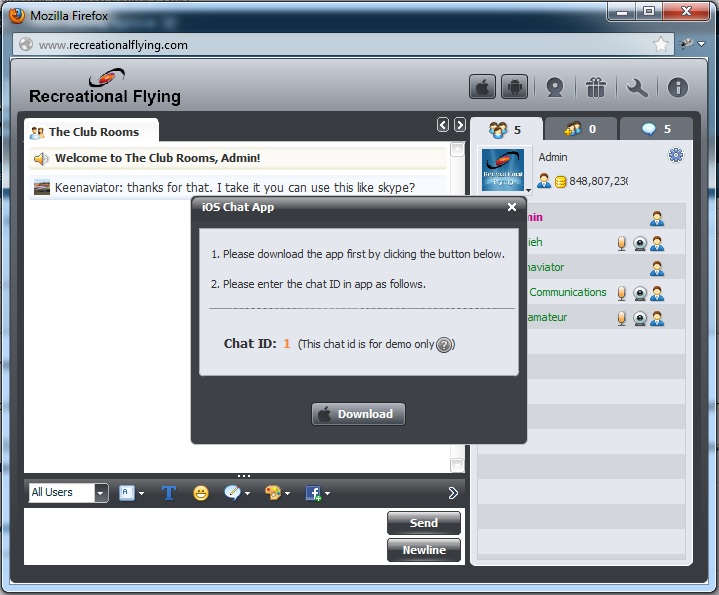
Kaz, it is saying Chat ID: 1 BUT it is saying for Demo OnlyWhat is the Chat ID please, Ian?Kaz
I'm not sure how this part of it works as this new to me so I may have to do some homework on it
-
No because it uses Flash but you can download the app:Obviously not meant to be used with an iPad ?https://itunes.apple.com/us/app/123flashchat/id517139646?ls=1&mt=8
-
Tell them all to come here
-
Hi All
I am "finally" pleased to announce that the Recreational Flying Text/Audio/Video Chat Rooms are now back and working without any known issues. I have just tested the video and Whiteboard interaction with Sue (FlyingVizsla) and all is working great.
At this stage there seems to be little impact on the overall site performance however I have cable internet connection with high speed so perhaps I am not a good indicator but hopefully if anyone has any issues they will let me know.
Hope you enjoy a greater interaction and enhanced community with the Recreational Flying Chat Rooms
-
Please when requesting access to the Instructor's Forum, provide details like your full name and where you are an instructor so they can be verified.
Just saying "request access for instructor forum, I am an instructor." and expecting it with that will not see access granted...sorry
DEMANDING ACCESS, as one user with an attitude has done will be met with the same attitude back.
It may not happen immediately that minute so please allow for a break in my work load to grant the access...I do always get around to doing things but please understand that sometimes there are other priorities in running this site.
The point is, give me some information so I can verify that you are an instructor and when you do get access I hope that forum is of help
-
 1
1
-
-
True story...
A blind man and his seeing eye dog were on a flight which was having a stop over in a US city. The pilot suggested to the blind man that as the stop over was just for dropping off and picking up passengers he may as well stay on the plane. The Pilot then asked the blind man if he would like him to take his dog for a walk. Half the passengers cancelled their flight when as they were boarding they saw the pilot walking around the plane with a seeing eye dog
-
 3
3
-
-
It is on the drawing board for a complete Classifieds and Auction System but suitable software that can be integrated with the site hasn't been found yet...although I must say that it hasn't been a high priority focus as yet
-
Number of new aircraft registrations processed since November 15th (when CASA reinstated our renewal approval) - 79
Number of aircraft registration renewals processed since November 15th (when CASA reinstated our renewal approval) - 1345
Number of aircraft registration renewals processed during preceding week (ended 24/05/2013) - 48
Number of aircraft registration renewals awaiting the provision – by owners – of additional information - 150
-
Yesterday (Sunday), Corrine and I were cleaning out the garage and found many of our old keepsakes. One that we found was a video from the mid 90's when Corrine and I were living in New Zealand. Corrine worked for Saatchi and Saatchi in Auckland and for those that don't know who they are, they are the world's most recognised advertising agency and are known for creating the best commercials that many of us have seen.
The video is inspirational and it so much portrays the ideals of this site and what it was created for so please next time you go to post, just think about this video...turn your speakers up, watch it full screen and perhaps there is something that we can all learn from our fellow aviators of the feathered kind:
Honk...Honk...Honk....
-
That doesn't stop or assist in the problem some people cause...then again I could just remove the Classifieds forum...which means a few would have ruined it for all. I could also make the forum that threads only have one entry...again a few would have ruined it for all.A few website I have seen use a template for advertising to give the ads a bit more information. -
I have had to delete many posts in several Classifieds threads. Threads placed in there are done so by users wanting to sell something of their own (private sales). If you do not have anything nice to say then don't post in those threads because your post, the one that you took the time to create, WILL BE DELETED.
If you do have some constructive criticism then do so to the user selling the item by the private message system.
A relaxing 7 day holiday from using the site is in the ready and waiting
-
1
-
 1
1
-
 1
1
-
-
It was in reference to the question of Share Vs Hire and:
so when you add the CapEx you may well be up at the same price as that Tecnam you referenced that you can hire$107 per hour( it does make the $150 per hour for our local Tecnam look pretty good)If I've missed something in the figures ,do tell,
Cheers Met
-
You have looked at OpEx (Operational Expenditure) you also now need to look at CapEx, Capital Expenditure...Finance Costs, Opportunity Costs (i.e. the return you could get using that same money for other opportunities like investment, etc)
-
1
-
-
Asd soon as it happens again Sue please give me a ring so I can have a look at a few things...sounds like a security issue
-
Thanks Rank, I have sent you a PM to see if you can help fault find for mejust after I talked to you I clicked the button to try video chat again and killed it exactly the same as before. Tried ever since to get back into the site and only just now got in. By the time I tried the refresh you suggested it was dead. -
Seems we have a slight issue with the display of the number of users in the red balloon next to the Chat link on the main menu...I have reported it and now need to wait for a reply
-
Try it again and let me know if the problem persists...I was working on it this morning and not sure whether it was something that I was doing at the time...thanksDid we break it? About half an hour ago Sue and I were in the chat room trying to get into video chat, and it all stopped working and I couldn't even get back into the site when I tried to refresh my page. -
Ok, the Char Room implementation is completed...to access the Chat Rooms simply click "Chat" on the main menu. At any time that users are in the Chat Rooms, you will see a red balloon notification indicating the number of users that are in there or no display if there isn't anyone. It takes just one person in there to start the ball rolling in that others can then see that there is someone to chat to. So if there isn't anyone, still go in there and wait as the red number will tell others.
Please, the chat room was once heavily used but then dropped of but it is there now for you to make use of, create new friendships, chat with others who have the same interest whether it be aircraft type, belong to the same club or anything...enjoy
-
That's true...users can select to receive PMs, receive PMs from only those that they follow or not receive PMs at all...same goes for viewing your profile...all these can be set in your site settings under PrivacyI think what may be confusing people about the P.M thing, is that if the member they want to message has their privacy set so that only some members can see their profile, then there is no option to P.M them..........Regards Bill -
Ninja'd by Dazza
-
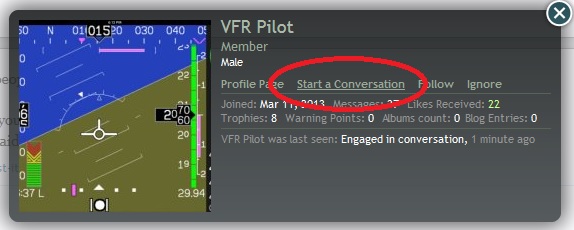
To start a personal conversation with another user simply click their username and a box opens up and you click "Start a conversation"Maybe some more how to videos for less computer savvy people like me.For the life of me I can't figure out how to PM someone ?Also possibly a time delay on the post reply button to edit your comment in retrospect.
Sometimes I have thought oops maybe I should not have said that........to late
There will be some more How To videos coming once the site update is completed and the new Help Desk is added.
You have 20mins after making a post to edit it
-
May 2013
From the Director of Aviation Safety
John McCormick
I am aware there has been some comment recently about CASA’s role as Australia’s aviation safety regulator, particularly in respect of how we arrive at decisions to vary, suspend or cancel authorisations. As you would expect, these decisions are not taken lightly and they are made only in accordance with CASA’s rigorous enforcement processes, which include review at the most senior levels of our organisation. As with all of CASA’s safety-related decisions, affected parties have a right to have such decisions reviewed either by the Federal Court or the Administrative Appeals Tribunal. Consistent with our obligations to ensure fairness and propriety in the conduct of our enforcement processes, CASA avoids engaging in any public discussion of the issues that are before the court or the tribunal. Unfortunately, this does not prevent others from doing so. Comments and remarks about CASA’s actions often appear in various news media that are incomplete, inaccurate and sometimes misleading. I believe this is unfair and unhelpful. Despite these comments I am confident that CASA’s enforcement and safety-related decision-making processes are rigorous, transparent and fair. We are held to account for our actions by the Federal Court and the Administrative Appeals Tribunal and this means the propriety of our actions are routinely and independently tested, and rarely found to be deficient.
CASA is often criticised for not taking into account the impact of its decisions on the livelihood of industry participants. Consistent with this perspective, some members of industry and representative bodies assert that CASA and its predecessors had, or should have, a ‘dual mandate’ - to conduct the regulation of aviation safety and to actively promote and advance the commercial aspects of the aviation industry. Frequently, these critics claim the US Federal Aviation Administration has this type of mandate. Let me assure you that CASA has never had such a ‘dual mandate’. In fact, the legislation establishing CASA was deliberately formulated to make it clear that we do not and should not have those inherently incompatible functions. Significantly, the Federal Aviation Administration’s own legislation was amended in 1996 to remove the ‘dual mandate’ from its remit for the same reasons. The Australian Parliament clearly set out the main object of the Civil Aviation Act-that is, to establish a regulatory framework for maintaining, enhancing and promoting the safety of civil aviation-which is quite different to ‘promoting civil aviation’. It is in everyone’s interest that the robust aviation industry in Australia continues to flourish; however, CASA’s statutory functions are specified in accordance with the object of the Act.
Best regards
John F McCormick
Get to a fatigue briefing in your city
A series of briefings are being held to give people in the aviation industry an opportunity to learn more about the new flight crew fatigue management rules. Changes to the Civil Aviation Orders relating to fatigue management took effect from 30 April 2013. Air operators have three years to transition to the new requirements, which provide a three tiered approach to the management of fatigue. The breakfast briefings are aimed at people from air operators who are responsible for fatigue management in their organisation. At the briefings CASA is providing an overview of the rule changes, setting out the flexibility offered under the new requirements and discussing the responsibilities of both operators and flight crew. There will be a question and answer time to allow people to focus on the aspects of the changes relevant to their operations.
Five fatigue management breakfast briefings are scheduled during late May, June and July 2013. They will be held in Adelaide, Darwin, Melbourne, Sydney and Brisbane. The briefings run from 07:30 to 09:30. Bookings are essential as places are limited.
Find the fatigue management briefing in your city and book now.
SIGMETs are changing – make sure you know all about it
The Bureau of Meteorology is making changes to the format of its SIGMETs - Significant Meteorological Information - from 30 May 2013. A SIGMET gives a concise description of the occurrence, or expected occurrence, of en-route weather which is potentially hazardous to aircraft in areas over which a meteorological watch is being maintained. Most of the changes have been made to align Australian SIGMETs with International Civil Aviation Organization's specifications. The Bureau of Meteorology says the changes will make it simpler to enter SIGMETs into flight planning systems and will make the training of international pilots easier. The key changes are the description of vertical levels at and below 10,000 feet, the format of the SIGMET sequence number and the format of the last line of each SIGMET. After 30 May 2013, the vertical extent will be given in feet for levels below 10,000 feet, instead of the current practice of using the abbreviation A (altitude) for levels up to and including 10,000 feet. Vertical levels at and above 10,000 feet will be given in hundreds of feet. The second change is to the sequence number of a SIGMET. The new SIGMET format will adopt the International Civil Aviation Organization three-character sequence number format and will be nationally assigned for each flight information region. A location reference will no longer be included in the sequence number but will be given in the last line of the SIGMET. The third change is to the format of the last line of the SIGMET, which will now be referred to as ‘RMK' (remark line), instead of the current practice of using 'STS'. There will also only be one SIGMET current for each event in each flight information region, instead of the current practice which can have multiple SIGMETs current for one event.
Read more about the SIGMET changes.
We make learning even easier
People in the aviation industry can now manage their CASA delivered professional training and development using a new online tool. The tool is known as AviationWorx and it supports CASA run seminars, courses and elearning. AviationWorx is accessed through CASA’s web site and is easy to use. Users need to register before entering AviationWorx – a process that takes a couple of minutes and is even simpler when you already have an aviation reference number. Once registered users have a personal profile that logs and tracks professional development undertaken through CASA delivered learning. This personal profile provides a record of individual learning achievements. AviationWorx features a calendar of CASA events and a catalogue of courses to ensure users can choose the right activity. Currently the elearning courses in AviationWorx cover ageing aircraft and fuel management. Registration for briefing sessions for aviation organisations on the new fatigue management rules are also currently being managed using AviationWorx. Over time more courses will be available through AviationWorx and all future CASA seminars and events will be managed using the tool.
Go to AviationWorx.
Clock ticking on maintenance regulations transition
The time to complete the transition to two key elements of the new regular public transport maintenance regulations is running out. By 27 June 2103 all regular public transport air operators and all maintenance organisations that maintain regular public transport aircraft or components must complete their transition to Parts 42 and 145 of the Civil Aviation Safety Regulations. Part 42 sets out the continuing airworthiness requirements for all aircraft used in regular public transport operations. Part 145 introduces a uniform set of national requirements for organisations providing maintenance services to regular public transport operations. The new regulations took effect in June 2011, giving aviation organisations two years to make the transition. There has been steady progress in organisations making the transition, with CASA providing support through documentation, training, guidance and advice. Recently Qantas’s maintenance and repair organisation obtained their Part 145 certificate – a significant step as this is the largest and most complex aviation maintenance organisation in Australia. The new maintenance regulations that are now in place only apply to regular public transport operations. CASA is in the process of developing a set of updated maintenance regulations for charter, aerial work and private operations. A set of discussion papers about these proposed regulations was issued late in 2012 for comment.
Find out more about the maintenance regulations.
Aircraft registrations pass new high
There are now more than 15,000 aircraft registered in Australia. The milestone was passed earlier this year, with about 50 new aircraft being added to the Australian aircraft register each month. Registration of Australian aircraft began in July 1919 when the International Commission for Air Navigation allocated civil aircraft registration prefixes to each member nation. British Commonwealth countries were allocated the letter 'G' with the next one or two letters indicating the countries within the Commonwealth - Australia being allocated 'G-AU'. Australian Certificate of Registration No.1 was issued on 28 June 1921 for an Avro 504K aircraft registered G-AUBA. From January 1929, Australian aircraft began displaying 'VH' as a prefix to the registration mark. The first machine to be registered under the new system was a Gipsy Moth that bore the marking VH-UKF. The register increased gradually after World War II, reaching 1000 aircraft in the late 1950s and 10,000 in the early 1990s. By 2003 the number rose to 12,000. CASA regularly publishes a list of available registration marks and people are able to reserve a particular mark for a 12-month period. Large airlines reserve blocks of registration marks, so a certain model of aircraft can have consecutive marks.
Aircraft registration information and forms is on our website.
Improvements to aircraft registration forms
Improvements have been made to aircraft registration forms and supporting guidance material. It is important everyone who is registering an aircraft understands the changes to the forms and follows the advice in the guidance material. Old registration forms will not be accepted by CASA after 31 May 2013. Under the changes aviation reference numbers are mandatory fields on all forms. If the aviation reference number field is not completed the registration application will not be accepted. Some forms now include a section to nominate an alternate address for the delivery of the new certificate of registration. The certificate of registration will only be sent to a different address if the address details are completed in this section. Applicants no longer need to provide address and contact details in all sections on some forms – these details are now only requested where it is specifically required by the regulations. There are also changes in the forms relating to transfer of ownership, requests for ferry flights and replacement registration certificates. Forms can be completed on line and then should be printed and signed. To be able to save the data entered on a form online applicants will need to use acrobat reader version 7 or later. A saved form can be reused and previously entered data can be changed.
Find out more about aircraft registration form changes.
Video sets out latest on simulators
There’s a quick and easy way to keep up to date with the latest changes in the regulation of flight simulation. A short video has been released on CASA’s You Tube channel which explains new simulator requirements, the strategic approach to simulator regulation and the benefits of simulator training. The video features CASA’s manager of Flying Standards, Roger Weeks. Roger outlines CASA’s flight simulator operational plan, which is current until 2014, as well as setting out the new simulator training requirements which took effect from the start of April 2013. These requirements mean it is mandatory to use simulators for high risk, emergency and abnormal flight training and testing for certain types of aircraft. In the video Roger says this is a significant advancement and enhancement of safety in flying training. The move to increase the use of simulators for pilot training and checking was driven by a serious incident and a fatal accident which took place during training exercises. Under the new requirements conversion command training for pilots, as well as training and checking for pilots working for an air operator required to have a training and checking organisation, must be carried out in a simulator in clearly defined circumstances.
Watch the flight simulation video now.
Engine welding warning
A warning has been issued about potential problems caused by weld repairs to engine crankcases. Reports of failures and cracking of weld-repaired crankcases in the region of cylinder retention studs continue to be received by CASA and are attributed to inadequate welding repairs. Limited welding repairs to certain crankcases may be permitted by engine manufacturers under approved schemes used by appropriately approved specialist repair organisations. However, if there is inadequate pre-weld crack detection and poor cleaning or welding technique there will be an overall degradation of the crankcase material. Where there is weaker or softer crankcase material in the region of the cylinder retention studs this can result in a loss of stud torque. Fatigue cracking is soon initiated and this can eventually result in separation of the cylinder from the crankcase. In the United States there have been two accidents involving an in-flight loss of power due to separation of one of the cylinders from the crankcase. In an airworthiness bulletin CASA makes six recommendations to avoid problems caused by weld repairs to crankcases. CASA says the recommendations will assist in detecting “potential catastrophic engine failures”.
Read the crankcase welding airworthiness bulletin.
How to operate a safe off-shore helideck
New guidelines have been published covering the development and operation of off-shore helicopter landing sites, including vessels. The guidelines are contained in a civil aviation advisory publication which includes information on designing and siting off-shore helidecks, off-shore helideck operations, lighting systems and meteorological equipment. The information is vital for all helicopter air operators using off-shore helidecks or vessels, operators of oil and gas platforms, shipping operators and helicopter pilots. Under the Civil Aviation Regulations it is the responsibility of the pilot in command of a flight to determine if a place to be used for take-offs and landings is safe. However, the regulations do not set out all the factors that need to be taken into account to determine if a landing area is safe. Due to the unique nature of the off-shore environment and the number of people carried to platforms, the oil and gas industry commonly requires specific standards to be in place for off-shore landing areas to reduce risks. The new guidelines provide criteria that should provide a safe area for the landing and taking-off of helicopters as long as procedures are followed and pilots have sound skills and airmanship. These criteria include physical characteristics of helidecks, design data, loads, location and size of obstacle protected surfaces, visual aids and rescue and fire fighting facilities.
Read the off-shore helicopter landing site advisory.
-
The Recreational Flying Chat Rooms are now open for you to use. To access the Chat Rooms, simply click "Chat" that is on the right of the main menu bar.
Currently, the users that are currently in the chat rooms are displayed in the right column of the main forums page in the same box that displays all currently logged in users. I am waiting to receive a code change that will allow me to display the number of users in a red box next to the Chat link on the main menu and when I receive that, it will be the way for you to see how many users are currently chatting in the Chat Rooms.
Remember that you can just use text to chat with others or if another user has a Webcam and/or Microphone, little icons are displayed next to their name in the chat rooms...just click the icon to see their webcam and hear them speaking. To turn yours on if you have one, simply click the webcam icon at the top right of the chat room window.
Enjoy


[Jun 1, 2013] Aircraft Showcase (Temora NSW)
in Trips/Events/Seats
Posted
Aircraft Showcase
Cost: Adult : $20.00
Start:Sat 01 Jun 2013
End:Sat 01 Jun 2013
Aircraft Showcase Days will be held on the first and third Saturday of most months with the aim of providing visitors with a personal, interactive and in-depth experience with some of the Museum's aircraft. Visitors will witness the aircraft being towed from the hangar and watch the pre-flight inspection, servicing and refuelling as it takes place in front of them. The pilot will strap in and start the engine and then the flight will take place. The flying display will vary from a simple handling display to aerobatics or formation flying. The aircraft will land and taxi back to the visitors where they will have the chance to have a chat with the pilot, take photographs, and inspect the cockpit and engine. Audio visual presentations both in the cinema and the Display Hangar will enhance the stories of veterans who will be invited to share with our visitors their wartime experiences. At the conclusion of the flying activity, the Engineering Hangar will be open to all visitors. We have rarely allowed access to the workshop areas, but now visitors will be able to take a closer look at the most diverse range of aviation engineering activities anywhere in the world. Our Engineering Team will demonstrate the projects they are working on and the unique processes, materials and techniques required to keep this fleet of vintage aircraft flying.