

onetrack
-
Posts
8,094 -
Joined
-
Last visited
-
Days Won
101
Content Type
Profiles
Forums
Gallery
Downloads
Blogs
Events
Store
Aircraft
Resources
Tutorials
Articles
Classifieds
Movies
Books
Community Map
Quizzes
Videos Directory
Posts posted by onetrack
-
-
Blueadentures, I can't get any details of the case, it's all behind a paywall. Do you have a summary?
Seems to me that the drugs charges are just a minor part of the aircraft crash story, I believe he's yet to face 17 charges related to aviation offences?
-
Yes... but it was largely ethnic Ukrainians who were the drivers behind improved Russian aviation products, and space exploration major gains.
They don't have the luxury of Ukrainian support in those two areas today.
-
 2
2
-
 1
1
-
 1
1
-
-
I fully agree with minimal construction costs for a suicide drone - but I'd be concerned the Rooskies would be inclined to use many of the drone components in their aviation engine, primarily for fast profits.
-
1
-
-
Would this be the engine powering the Russian-built Shahed drones being used against Ukraine?
The Ukrainians are saying that the Russian Shaheds they've managed to down fairly intact, and where they've been able to examine the engines, that the engines show signs of low quality construction.
QUOTE: "Based on examinations of recovered, relatively intact Russian-produced Shahed (Geran-2) drones, Ukrainian experts have reported signs of low-quality construction, including simplified bearings, substandard materials, and, in some cases, makeshift engines.
These deficiencies appear to be the result of forced design changes for rapid, large-scale domestic production, aiming to reduce costs.
While earlier versions used higher-quality components, newer models, despite having some upgrades to warheads or guidance, have shown signs of rushed assembly and poorer manufacturing standards.
Key findings regarding the quality of Russian Shaheds include:
Engine & Part Quality: Reports have highlighted a shift to simplified bearings and direct-rod assemblies, indicating a move away from the higher-quality, often imported components used in initial Iranian-made drones.
"Fly it as is" Approach: Kyiv Post reports that the focus is on quantity over quality, with manufacturing changes sometimes necessitated by supply shortages, leading to lower-grade, but still operational, components.
Engines are designed for a single, short-term use, made with materials not intended for long-term durability.
Upgrades vs. Quality: Despite lower-quality construction, these drones have seen improvements in electronic warfare resistance, increased warhead sizes (90kg), and the use of Starlink terminals, say Ukrainian investigators and Serhii Beskrestnov.
One of the major problems that Russian engine manufacturers face, is the effect of war sanctions and their inability to acquire quality Western country materials and components to build these engines.
They are reliant on China, Iran and Nth Korea for supplies, or reliant on trying to acquire critical supplies from the West, via very roundabout methods, which involves purchase by third parties, or by small countries that are favourable towards Russia.

-
 1
1
-
 1
1
-
-
It is true, that a strobe light on, in very sunny, clear, daylight conditions does very little for visibility. But it may reduce the risk of bird strike, because birds are very alert to anything different in the sky around them.
-
1
-
-
I would imagine a student panicking at the controls, and keeping the controls held in the wrong directions, would be a major problem, for even an experienced instructor. Vital seconds could be lost trying to get a student to let go.
-
1
-
1
-
-
I was expecting the full-sized frozen chicken! Doesn't everyone else hit frozen flying chickens on takeoff?? 😄
-
Jabiru7252 - Sorry, no, it was a bit more than a broken spring. The door has triple locking latches, with the top and bottom latches cable-operated from the main lock. The top latch actuating mechanism broke, a piece of diecast fell into the main lock assembly and jammed it completely. I couldn't get the door open, and when I finally managed to do that, I couldn't get the lock out of the frame! I had to destroy the lock to remove it!
When I presented the old lock to the young bloke at Comsupply, he said, "Geez, it looks like someone tried to break in!" I said, "No, that was me, trying to get out!" 😄
Not to worry, the door has been installed for close on 30 years, so I think we got our moneys worth out of it. If this one lasts for another 30 yrs, I won't be around to see it!
-
 3
3
-
-
Just keep saying to yourself, "The gold price is over $7,000 an oz!" 😄
I just forked out $185.00 for a new lock mechanism for the back security screen door. Money doesn't buy what it used to.
-
.......anyone whose skin looks a little scaly gets a recommendation to use a good masking cream, to reduce the obvious lizard-like appearance, and to avoid being suspected as a reptilian alien.
Of course, Canberra is full of shape-shifting reptilian aliens, with an amazing ability to crawl up anything and anyone, and none more so, than the Great......
-
Fake AI photo.
-
1
-
-
It may have been a medical episode, if the older pilot was flying - and the younger men either had little idea on what to do, or couldn't take control fast enough.
But if it was one of the younger men flying, perhaps the crash was a lack of spin training. We will no doubt get all the important details from the ATSB shortly.
At least they have good video footage of the crash available to them. It appears there were quite a number of witnesses relatively close by.
-
ABC News and SAPOL have confirmed three men aged 57, 18 and 19 are deceased as a result of the crash.
 Three men dead after light plane crash near Goolwa South, police say - ABC News
WWW.ABC.NET.AU
Three men dead after light plane crash near Goolwa South, police say - ABC News
WWW.ABC.NET.AU
Police were called to the Long Bay area near Goolwa South on Friday afternoon after reports of a light plane crashing into the ocean. -
Flyboy1960 - In cooling systems, the reinforcing internal spring is always mounted in the bottom radiator hose. This is because in most systems, the coolant travel is from the highest point of the engine, to the top of the radiator, then down through the tubes, to the bottom of the radiator.
The water pump sucks the coolant from the bottom of the radiator, and any restriction in the flow through the radiator tubes creates negative pressure inside the bottom radiator hose, thus leading to its collapse, if unsupported by an internal reinforcing spring.
Facthunter is simply pointing out that intake vacuum has the potential to make any intake hose collapse, if it is long enough, and unsupported by an internal spring.
-
1
-
1
-
-
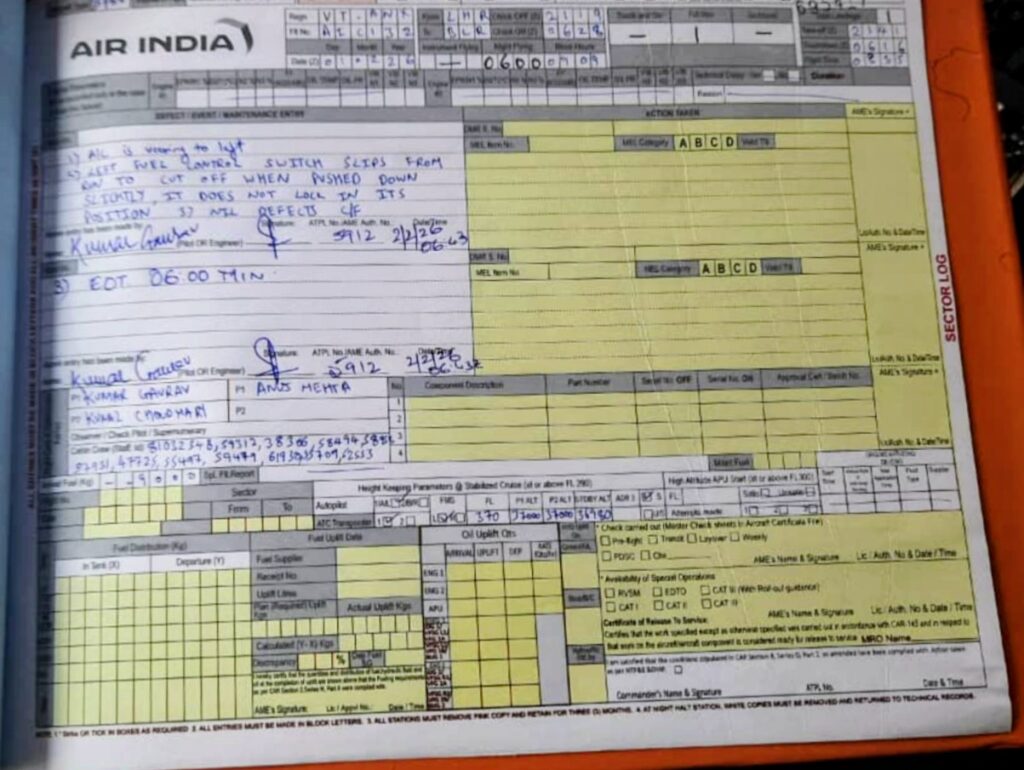
The website, livefromalounge.com, has acquired a photo of the sector log report by the pilots of the Air India B787, who reported the fuel control switch problem.
The pilot wrote, "Left fuel control switch slips from run to cut off when pushed down slightly. It does not lock in its position". Note that only one fuel control switch is listed as having a defect.
-
The U.K. CAA has written to Air India, asking for a full detailed report with regard to the incident where Air India pilots reported they had problems with the B787 fuel cutoff switches at Heathrow, but continued the flight to India, where the aircraft was grounded for inspection of the switches.
The Air India inspection revealed no fault with the fuel cutoff switches, and the aircraft was cleared to fly again. The U.K. CAA is demanding a full report on the incident from Air India, within a week.
One has to suspect that if the pilots report was correct, and the switches failed to latch into position (twice) at Heathrow, but were then found to be fully functional once back in India, then the problem could possibly be caused by foreign debris becoming lodged in the switch mechanisms.
But the simple fact remains, that the preliminary Indian Aircraft Accident Investigation Bureau report on the crash of AI171, in July 2025, stated that the fuel cutoff switches were moved to engine shutoff position, and a number of seconds later, were moved back to engine run position. This is not the same as the latest report, that indicated the fuel cutoff switches failed to stay latched, when moved.
However - I guess the possibility remains that if the fuel cutoff switches on AI171 failed to remain latched in the run position, and were then accidentally bumped by the Captain (PNF) to the shutoff position - then that does remain a potential cause for the AI171 crash.
Against that likelihood is the point that the two switches would both have to remain unlatched - as both switches were moved on AI171. The likelihood of both switches suffering from the same fault simultaneously, seems like a 100 billion to one chance.
In every manufacturer report (switch manufacturer, and Boeing), their constant message is, that the design of the switches ensures that they can never end up failing to latch into position.
https://www.facebook.com/reel/1398078697977349
-
....do battle with protestors, using his girded lions. It hasn't been previously mentioned, that due to Moorabbistan being a particularly dangerous neighbourhood today, with the immigrant invasion, that Turbo keeps a pride of girded lions roaming his property, to deter the crims who want to steal his prized red Corvette.
And when it suits him, Turbo takes the girded lions with him in the Corvette, to ensure that even ordinary people don't touch it - let alone the crims. So it just happened, as Turbo arrived at the protest in his lion-filled Corvette, he saw an opportunity to give the lions some extra-curricular training, by releasing them onto the protesters.
And I can assure you, dear NES readers, when you see a girded Turbine lion in full flight, you don't want to hang around, and Turbos release of his girded lions, soon saw the whole area..........
-
1
-
-
Quote
Speculation: There are not many engines designed specifically for generators/bore pumps. Most will be the same engine used in a range of commercial applications eg truck, dozer, tractors, marine, etc
Wrong. Caterpillar have 7 specific categories of "engine application" - industrial, automotive (on-highway), marine, tractor, agricultural, power generation, and firefighting.
Each engine application, despite using the same basic engine, can have multiple dozens of subtle design changes and different internal components - and vastly different power ratings, RPM ranges, and fuel settings, and even engine timing.
I've seen the same basic Cat engine have 17 different crankshafts alone, depending on application. Conrods are different, fuel pumps are different, injectors are different, cylinder heads are different, valves are different materials and part numbers.
Camshafts have different profiles dependent on the RPM operating ranges. 50Kva gensets have to run at a maximum of 1500RPM, whilst some of the on-highway engines run at 3200RPM. Some engines have oil cooled pistons, some don't.
Automotive and tractor engine have governors with up to 10% droop. Genset governors run at a maximum of 3% droop to keep voltages within specified ranges under varying loads.
The list goes on and on, and every major engine power unit manufacturer has a different system of identifying their different engines and applications. Cummins have CPL - Control Parts List, a list of the specific internal components used in every one of their engines.
Cat use "Arrangement numbers". You acquire and use the parts book applicable to the engine "Arrangement number", or you're working blind, and looking for engine damage with incompatible components.
Lister (Petter-Lister) use "Build number". There is a number on the engine serial number plate that advises exactly which components went into that engine, even to the direction that it runs (CW or CCW), and the application for which it was designed.
You are showing ignorance and an overwhelming belief in your own "knowledge", which is different to the manufacturers advice and systems.
-
1
-
1
-
3
-
-
Unfortunately, many car owners have highly selective memories when it comes to their vehicles. They have a tendency to forget about numerous repairs in the history of their ownership.
I've owned, pulled apart, and repaired many hundreds of engines over 60 years, and been involved with repairs and problems with many other owners of vehicles, engines and equipment.
And I can give you a specific list of design failures that caused heartache and serious unnecessary cost to many car, engine, and equipment owners - even though they basically loved their machines.
There are people out there who think God himself designed and built BMW engines. I can tell you, from first-hand experience, BMW engines are largely crap construction, with excessive use of cheap plastics in the engines, horrendous layouts, bad engineering designs, and parts costs that require you to take along a large tub of vaseline every time you need even a simple a BMW part.
-
2
-
1
-
-
It's a copy of the Ukrainian-produced Aerokopter AK1-3 helicopter - which used a Subaru EJ25 engine.
It appears the Chinese think using two dubious Chinese engines is a better idea than using a dubious Japanese car engine, known for reliability problems.
At the end of the day, it still only has "experimental" certification in China. We know nothing of the Chinese requirements, rules and procedures, for experimental aircraft certification.
I would imagine they're somewhat looser than Western countries certification requirements. I would consider this design on a par with the OceanGate Titan submersible for durability, so I think I'll give it a miss
-
1
-
-
Never forget that car engines are manufactured in huge numbers, at great production speed, to keep costs low to be competitive, and they are recognised as having a much higher failure rate in use, as compared to a specifically-designed aviation engine.
The car manufacturers rely on parts sales to make their profits, they make little profit selling new cars, so they're happy with a percentage of engine failures. That's the reason why you'll always find new crate engines in stock at your local dealer, they fully expect to sell more than a few, every year.
Add in the fact that car manufacturers source their engine components from sub-contract suppliers - in places that still have less-then-stellar QC. Slovenia, Argentina, Brazil, China, South Africa. Even the main factories have regular QC fails. Just look at the Toyota engine failures several years ago. There was a lapse in QC that allowed machining swarf, or RTV beads from component tightening, to remain in the engines.
The warranty claims cost Toyota a lot of money, and a lot of new engines. Ford and GM engine recalls for manufacturing/QC slip-ups are the stuff of legend. Numerous GM V8 petrol engines suffered thousands of early failures due to the manufacturers incorrect oil recommendation, in an effort to reduce friction, improve fuel economy, and to reduce emissions.
The GM L87 V8 has suffered from tens of thousands of engine failures due to simple manufacturing defects in conrods and crankshafts.
If you ever watched a Ford production line manufacturing valves, you'd never buy another Ford again, they punch them out by the hundreds a minute. This is a critical part in any engine.
Ford have already issued a recall for the inlet valves in their 3.0L V6 diesel for a defective hardening process. Ford issued a recall for camshaft sprockets that could fail with no warning, in the same engine, due to manufacturing defects.
Nissan has had constant 2.5L YD25 engine component failures due to faulty manufacturing processes and QC failures. Nissan use "powdered sintered metal" for numerous critical gears.
It's a process designed to save money, pure and simple. Instead of forging or machining the gear, they manufacture a mould, fill it with powered metal, then compress and heat the mould to a high temperature.
This results in a gear with a substantial variation in strength. Many of these Nissan powdered sintered metal gears have failed early.
Nissan and VW have had regular timing chain failures, due to bad design, poor quality timing chain adjusters and guides, and inadequate timing chain strength. In numerous cases, they either used a single chain that was inadequate, and had to redesign to accommodate a duplex chain - or they used a duplex chain initially, then went to a single chain, in a cost-saving drive - and that single timing chain promptly became unreliable.
If you took a car engine and dismantled it, and examined all its internal weak points, and altered/redesigned/revised them to racing level upgrades, then you likely would have an engine internally suitable for an aircraft.
But then you still have the problem in that all the accessories are built by the cheapest subcontractor. Injectors and coils and leads and electronic components that fail regularly, due to poor design or cheap materials. Wiring harnesses with cheap connectors and poor layout. There are always recalls for wiring harness faults.
At the end of the day, there is no such thing as a cheap and reliable aircraft engine. Aircraft engines cost serious money because of their extensive levels of QC, extensive testing, quality materials, and designs that are specific to aircraft, to ensure that an engine failure in flight, minimises the risk of the engine failure turning into a major disaster. An EFATO is something that keeps every pilot awake at night.
-
2
-
-
It's worse when you come across undated "news" articles - and that's not confined to "backyard" journos. There's some pretty sloppy journalism around today.
-
Ahh, isn't this ancient news? Like 9 mths old?
-
1
-
-
You have to remember that an EGT gauge is the only way to ensure you don't melt valves with extreme combustion temperatures - as well as being very useful in combination with a mixture adjustment, to set the most economical fuel burn.
CHT gauges and water temperature gauges react slowly to combustion changes, whereas an EGT gives you instant combustion temperature readings.
-
1
-
2
-


Light plane crash at Ball Bay, north of Mackay Qld 24/12/2021
in Aircraft Incidents and Accidents
Posted
Moneybox, unfortunately, this pilot hasn't done the right thing by anyone, and especially his mate that he killed.
He purposely chose to fly without abiding by any aviation laws, and he especially chose to fly without a licence, as he deemed no Australian laws applied to him, as he claims to be a "sovereign citizen" and above all that.
He also ignored a directive that required seatbelt tongue replacement - which was supposed to be carried out a couple of decades ago.
As a result, CASA is taking him to court on multiple aviation offences, and the charges are yet to be heard, so it's better to keep comments to a minimum until the legal outcome is known.