

JG3
-
Posts
735 -
Joined
-
Last visited
-
Days Won
23
Content Type
Profiles
Forums
Gallery
Downloads
Blogs
Events
Store
Aircraft
Resources
Tutorials
Articles
Classifieds
Movies
Books
Community Map
Quizzes
Videos Directory
Posts posted by JG3
-
-
With the new module on A side, it starts every time - so far.....
So I guess the old module is marginal and intermittent at low revs.
The old B module starts now, but didn't before, so maybe not quite as marginal, but needs to be replaced as well....
At least neither one ever even hesitated at flight revs.
Now the question - why???
I don't think it was ever cranked with leads off and nowhere for the spark to go, but maybe.... That's just the sort of thing that could do the damage....
Sure be good to get flying again!
JG
-
This morning it wouldn't start on the old A module, but did start on the old B.
Once running it wouldn't run on the A side at lower revs again, but after less than minute of running then it would run on A right down to idle, and restart again only on A..... Not running near long enough for temperature of the module to change....
Thinking now that the significant clue to follow may be that the new module didn't show a spark at first cranking, so maybe it's not this old module that keeps changing it's mind, but something in the wiring after all. Maybe the running engine makes a contact re-establish...
But that doesn't really explain why it would run above 2500pm but not below, and then a few moments later run fine right down to idle.....
Probably two intermittent problems happening, independent of each other, which makes logic really confusing....
Sure wish I could find something broken and just replace it....
JG
-
Yesterday received a new module.
Installed on 'A' side.
Saw no spark at first while cranking......
Then more cranking and a good strong spark, but also now a spark on the B side with the original module which didn't spark before....
Engine now started immediately on A alone, or B alone, and mag checks good at all revs from 1400 to 3000rpm.
Replaced the original module on A side to check it again. Wouldn't start.
Started on B side, and wouldn't run on A side at less than 2500rpm, mag checks good above that speed.
After about one minute of running, 'A' side decided to run well right down to 1400rpm...
Now starting easily on A side old module alone....
These clues don't help narrow the mystery, but make it even more confusing.....
???????????????? Puzzling......
Going out to the airfield soon to see what surprises today will bring....
JG
-
Arkaroola??
Very welcoming to all flyers. All fuels available. No town and airstrip a long way from the resort, but the resort usually offers great transport service. Some accommodation as little as $15 a bed or campground facilities. Good food, but bar prices high (they have to make it somehow).... Absolutely the most spectacular mountain scenery, with real desert and salt lakes all round - great 'adventure' country. Celestial observatory.
I'd really try to make it all the way from Queensland for that destination....
It's great to hear this talk of regional Fly-Ins. I think it might be a winner! A chance to meet everyone in a region, so worth a long flight. A lot more 'grass roots' fun and not so commercial as NatFly is becoming.....
JG
ps- Your comments on clubs thinking they own airstrips is so sadly true....
-
Good point, I've now heard of another that had a similar problem in the wiring in that shield.
But now that I've tried one of the suspect modules on another aircraft and find no spark there as well, I think it's pretty much focused on the module itself now. Just waiting for a new replacement to arrive.
JG
-
Nope, waiting on a new module from the USA...
-
Yep, real good point.
I once repaired a much dinged 701 that had used Sikkaflex as well as rivets on some.
An extremely strong method of construction.
The glue by itself is even stronger than the rivets.
Had to destroy the parts to remove them, even after drilling the rivets.
With normal rivets and no glue, it was only a matter of unriveting the parts until all was straight and then replacing.
JG
-
I'm not convinced that corrosion really is an enemy with 6061 alloy. I just cleaned up my aluminium scrap pile (all 200kg of it). Much of that had spent up to 10 years buried in moist leave litter under rainforest trees. Not one bit of corrosion to be found..... I've helped repair three 701's that had been built years ago, and never found any corrosion. 6061 is not at all like 2024, the so-called 'aircraft aluminium'. A piece of 2024 round stock stored inside my workshop is covered with white corrosion, but none of the 6061 has any at all....
On the couple of Savannahs we built we just etch primed the contact surfaces that will be riveted together - that is essential. By all means go ahead and do the interior surfaces if it makes you feel better, but I reckon it makes no difference at all. I'm not even sure that etch primer on its own prevents corrosion on aluminium, it certainly doesn't on steel! I think etch-prime is somewhat permeable and it really needs a sealing topcoat to really isolate the metal.
Of course etch-priming the outer surfaces is essential, but that's only to make the paint adhere properly. Just use locally available Wattyl SuperEtch.
JG
-
Good to hear of your decision Mark. You'll never regret it.
Looking forward to seeing you fly in to Kilcoy, any day now....
JG
-
It now appears that the Savannah incident it didn't happen on a public road, but rather on a private property track. The property is owned by friends of the pilot, and he was visiting and giving family members rides. On a landing he clipped one of their parked cars, and so came to grief. No one injured at all.
-
The ongoing story.....
Sent the ignition modules to B Flood, checked OK on their test bench.
Got them back and installed one of them on another engine - NO SPARK there either......
I've now heard of another engine that had no spark on both sides, modules tested OK by B Flood, but engine still wouldn't start until modules were replaced by new ones.....
So I've just ordered a new module from a friend in USA who used to service Rotaxes and has it in surplus stock. ONLY A$850.........
-
I reckon the average age at that airfield was 162! Is this a trend in RAA?
I guess the kids have left the nest, the mortgage is paid off and you have a little more money to flash around.
That's exactly correct. And it sure is good to have such a fun hobby that soon becomes a passion, to take up the attention after all that other stuff is behind...... It's a heck of a lot better than playing golf on Tuesdays and bowls on Thursdays, and generally just sitting around waiting to die.....
-
Yes, many are pricing themselves out of the market. Can't count the number of beginners just finishing training, and dreaming of a $xx,xxx sexy speed machine, and I've suggested they should first get a single seat U/L and fly that for a couple of years. In that time they'll really learn how to fly, rather than just 'drive' an aircraft around, and fly to local fly-ins and mix with other aircraft owners, and very probably change their view of what it is that they really want own. But no, they keep to their unaffordable dream, and finances don't get any better, and years later they're still dreaming.....
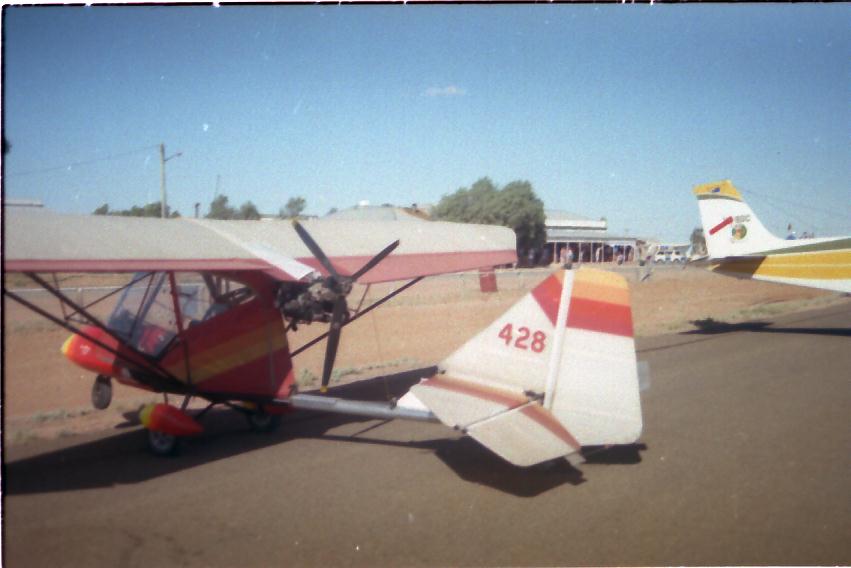
In the last RAAus magazine there's a single seat Beaver, 100 hrs since complete overhaul and new 447, for $6500 ono. They're well proven aircraft, very forgiving, handle very well, and really easy to land - just perfect for a beginner. This one is even enclosed, so comfortable in cold weather. Fly right now for the running cost of about 11 litres/hr of regular unleaded plus oil. Now that's real value for money!!!
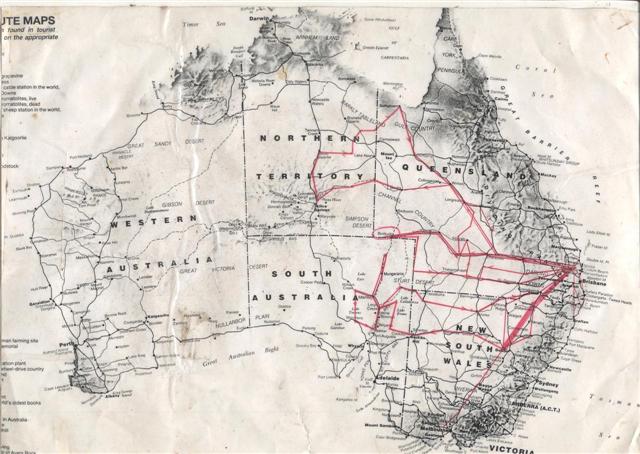
My first aircraft was a brother to that one, and I flew it for 1000 hrs, and loved every minute of it. It's only retired now because the skins are perished after 18 years and all that use - it didn't just sit in a hangar. The attached map shows the trips that I made in it. Not everyone is interested in such long trips, but it does show the capability. It was just perfect for the early morning buzz around, and a bunch of touch-and-goes, and trips to surrounding airfields to join in the tire-kicking and aircraft gossip, at such an affordable cost.....
Yes, the Savannah is pure luxury, and that's the problem... I much prefer adventure to luxury any day. And I do mean adventure, not mis-adventure which is do to poor planning and lack of judgement. X-country in the Savannah is like touring in a LandCruiser, comfortable and easy, but not nearly as much fun and the tingle of excitement, and feeling of satisfaction on successful completion, as it was in the little Beaver, which was more like riding a small trail bike. As a matter of fact, I used to call it my 'High-Clearance Trail Bike'.
So, beginners please consider flying a rag-and-tube aircraft as your first move. and save up for your dream machine while flying every Sunday instead of sitting dreaming.... Pay a proper market value for it, and you'll get your money back later, unless you fall in love with it and decide to keep it because you've discovered that it's really what's the most fun for the buck!
Of course I'll keep the Savannah if I can afford to, for long easy trips, but my dream now is for a basic rag-and-tube that folds easily into a trailer that can be towed around behind a camper vehicle and fly the sights locally wherever when the weather is right. I reckon there sure is a market for such an aircraft.....
JG

-
Five years ago, before I built the Savannah, and I was still flying my single seat Beaver U/L, I couldn't count the number of 'old hands', by then flying Lightwings or Jabs or similar, who stated that they had more fun when they were flying Drifters or whatever.... They don't seem to have done anything about it, but I know I'll be flying a Drifter or similar again soon!
JG
-
Time to start a new thread on this one.
Rotax 912S won't start. .No spark at all. A real mystery for two independent systems.....
I realize that it can be difficult to see a spark on some engines, but a couple of very experienced mechanics peering carefully inside a darkened hangar, looking for a spark across the plug gap. Also know that the other HT lead from each coil must be connected at the same time.
The mystery: It would seem strange that both sides of that ignition system could fail at the same time.
The clues: But thinking about it, they probably didn't fail at the same time. I had a Soft Start Module on the one side, so used to start with only that side switched on. A couple of months ago noted that it sometimes wouldn't start on that side alone, but fired instantly when switching on the other side. Thought it might be the effect of the SSM so disconnected it. Didn't really need the SSM any more, because I'd since installed an Odyssey battery right behind the firewall, with heavy leads direct to the starter motor, so the cranking speed was so fast that it overcame any tendency to kick-back. (I've been joking that it's just about fast enough to fly on the battery alone....) But those mis-starts might have indicated that the ignition system on that side was losing it's ability to generate a spark, even at that cranking speed. I've always done mag checks at 3000 rpm, so nothing showed up then. Without the SSM I was once again starting with both switches on, which would cover up the weak side, until the second side also started to lose it's effectiveness. And it was gradual, there's been several times in the last weeks that it was difficult to start, but finally did and then ran well with good mag checks at 3000, so the problem was blamed on flooding.... I now realize that a good procedure would be to occasionally start on one side at a time to test each side for such a starting failure.....
Disconnected and tested kill switch wires.
Resistance measurements of coils, pickups and charging coils, as per Heavy Maintenance Manual, are all correct.
Pickup gaps checked correct.
Ignition modules checked OK by B Flood.
Next will check the wiring inside the shielding between the stator and the modules... Have since heard of another intermitent fault that involved damaged wires in there.... It's just such a hassle to tear it all apart....
Only component common to both sides is the flywheel/stator.
Recently had a similiar problem on an 80hp on a Pegasus trike. Unfortunatly it did turn out to be dead stator for some reason. Wal called it a 'lazy' stator. It was so lazy it was dead !!. Also found one ign pickup completely dead. A lot of people will suspect the IGN moduals/boxes, but I haven't had too much drama with them over the years. Good luck.............................................. ...............................Maj..
Maj - That sounds very much like it fits the clues. How do you test that without replacing it???
JG
-
Yes that was Glenda Faint in the 'Little Tinnie'. She and Richard built two of them, beautiful workmanship. The 10K tag came from the originators of the design, who aimed to build an aircraft for less than $10K.
Word is she had an engine failure (503), couldn't make the paddock she was aiming for, and stalled and spun in while trying to extend the glide...... Seriously hurt..... A lot of us strongly wishing the best for her.......
JG
-
No can't go, Rotax won't start. No spark at all. Ignition module checked OK by B Flood. Cranking fast enough with this Odysey battery and heavy leads to fly on battery power alone.... Kill switches check OK. Resistance measurements as per Heavy Maintenance Manual all correct. A real mystery for two independent systems. Only common component is the flywheel.... Will start a new thread about it when I know more....
Have fun at NatFly.
JG
-
Just to let everyone know that it wasn't one of the Kilcoy Flyers.
He's from Gladstone, and the unofficial word is that he was landing or taking off from a road and clipped a car and flipped. No one injured.
-
Have a look at the nose wheel bungee in your Savannah.
We've checked the bungees on four Savannahs in our group and found all of them with partially broken bungees, 'necking' down in several places. These aircraft have anything from 100 to 700 hrs. None have had hard impact nose wheel landings, but considerable taxiing over bumpy ground. The breakages are not at the ends where the bungee goes over the attachments as you'd expect, but are midway down. Have to remove that aluminium shroud, to get a look. Don't seem to break suddenly, but strands break progressively until all the stretching is happening at that weak point. Won't last long after that.....
We got the replacements from Aircraft Spruce USA. Aircraft Spruce part number 06-00829 "Shock Cord ring 9010HD". Cost US$18.50 each, with postage shared on four units, landed cost was about A$30 each. Arrived in one week. Less than half the ICP dealer price.......
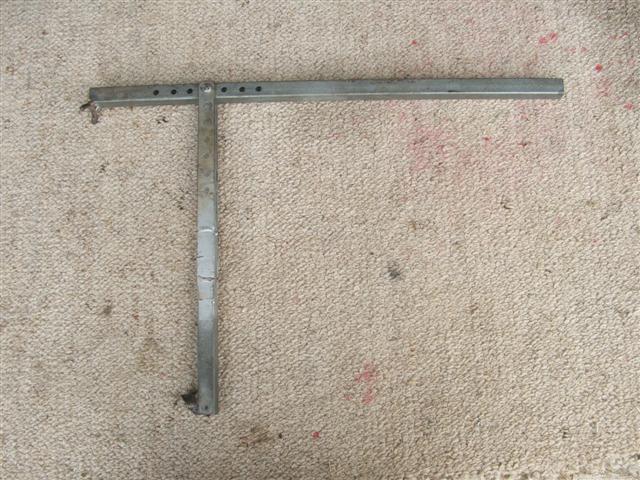
To mount the bungee I've made a puller which makes it really easy. It's just made from some 20mm RHS and some flat steel. Photo attached. I can't figure how to add dimension lines to the photo.... but the distance from the yoke on the left that fits over the top engine mount to the pivot is 130mm, and the distance from the pivot to the end of the handle is 400mm. From the pivot down to the hook is 330mm. The design of that hook is fairly important. It's made from a stub of tubing welded to the RHS so that it can fit over the attach stub on the nose leg. This way you can just push the tight bungee across onto the stub. If the hook is smaller diameter than the stub, it's really difficult to get the tight bungee across onto the larger stub.
JG
stolspeed.com
-
 1
1
-
-
One problem with UHF CB that you will find in the air, is that you are almost always on 'some one else's frequency'. To explain - UHF transmissions are line of sight, so on the ground very limited range, so regular users such as working crews find a quiet channel for their area and then consider it to be 'theirs', while other operators in that area find other quiet channels for their regular use, and so share them around. When we are at altitude we have very long range line of sight, and intrude into all those regulars down there who have become used to having a quiet channel to themselves. Brings lots of comments such as, "...go find another channel, you xxxx..." Sometimes it's hard to find a clear channel, and then it keeps changing as you move over different areas.......
-
Arkaroola has Avgas and PULP, and excellent hospitality.
JG
-
Use a sharp cold chisel to put a good nick in the outer edge, in the direction of unscrewing. If that isn't enough to loosen it already, use a pin punch in that nick to knock it loose. Works a charm, without any damage anywhere. The plug can be reused, and the notch is already there to tap it loose next time as well.
JG
-
Many years ago at a country show, a fund raising effort by a local service club was to drain the oil from an old Valiant sedan, and run it around the dirt track until it seized. Bets were taken as to how long it would run. Totally fouled up the scheduling for the events for the evening, cause they thought it would only go a few laps. Even worse cause they'd pulled the exhaust off for more dramatic effect, so it drowned out following events and kept raising a cloud of dust. Off course it wasn't at full power for that big engine, but going as fast as the track would handle. No 'magic' additives, just the remaining film of old oil. Three hours later, getting to the end of the evening, it was still going strong..... Finally they drained the coolant, and then it didn't last long.......
-
After many years of ultralight flying, much of it x-country adventures, I really envy you the excitement of those very first ventures away!Keep the posts coming, I'm taking all this on board. This is my first trip away after obtaining my pilot's certificate a couple of weeks ago.There's just nothing quite like the 'tingle in the tummy' of heading out over the horizon for the first time.
Enjoy!
Wishing you many memorable adventures to come.
JG
Rotax 912 Ignition Problems.
in Engines and Props
Posted
With the new module on A side, it starts every time - so far.....
So I guess the old module is marginal and intermittent at low revs.
The old B module starts now, but didn't before, so maybe not quite as marginal, but needs to be replaced as well....
At least neither one ever even hesitated at flight revs.
Now the question - why???
I don't think it was ever cranked with leads off and nowhere for the spark to go, but maybe.... That's just the sort of thing that could do the damage....
So it does appear to be the module after all.
Yesterday I was doing lots of flight testing of reflexed flaperon settings, so many shut-downs and start-ups. Always started on the one module, and never a miss....
I'm guessing now that at an oil and plug change I must have cranked the engine with one or more plug leads dangling. That can cause tremendously high voltage spikes that have nowhere to go, and surge back and damage the primary side of things. I know that we must always put a plug back in the connector and lay the base of the plug on the engine block so that the spark can go safely to earth. But there are 'seniors moments', always have been come to thing of it, never was all that smart........
JG