


completeaerogeek
-
Posts
104 -
Joined
-
Last visited
-
Days Won
3
Content Type
Profiles
Forums
Gallery
Downloads
Blogs
Events
Store
Aircraft
Resources
Tutorials
Articles
Classifieds
Movies
Books
Community Map
Quizzes
Videos Directory
Posts posted by completeaerogeek
-
-
CASA's Day VFR Syllabus wasn't too bad itself (of course, many people did not know how to correctly apply that element of the syllabus) but with its replacement by the Part 61 Manual of Standards they have definitely gone down the wrong track.33 years ago is 1981 by my calculations - only a few years after people like Garabedian & Korn developed the tools to enable the design of stuff like this
[ATTACH]31879[/ATTACH]
which became the wing of the A320.
I never compare apples with oranges. Lots of airliners without supercritical aerofoil sections. Some with semi-supercritical sections. Some just with classic sections from the book.

-
 1
1
-
-
Hi all, it is amazing to me that there are still people out there teaching silly ideas about how lift works.
Even CASA is still pushing things that aero professionals laugh at despite being told so many times that what they say is fiction.
As a 33 year aviation professional and University lecturer with an MSc in this stuff, it drives me nuts!
Here are several references that may embarrass your flying instructor (and a lot of professional pilots)
A clue: One if from NASA the other from Cambridge University so we can be pretty confident in what they say.
In reality there is NO DEBATE or 'alternate theories' about how lift works amongst aerodynamics specialists.
At the fringes in tiny percentages there is some weird stuff but for 99% of what is relevant this is the story...
If your flying instructor or aero guru tries to argue-tell them to write to NASA and explain themselves. Should get a laugh from the team at the Glenn Research Centre!
http://www.grc.nasa.gov/WWW/K-12/airplane/wrong1.html
http://www.219sqn.aafc.org.au/Flight/Simple%20Aerodynamics-How%20planes%20fly.pdf
Read/watch and enjoy.
In summary:
Lift IS NOT caused by two air particles racing eachother over the upper and lower surfaces. They never even get close. (watch the streamlines in the video)
A wing IS NOT A VENTURI. Once you take the top of a venturi is is not longer a closed system so that goes out the window.
Lift is caused by bending the air just like a ceiling fan. Both surfaces bend the air downwards causing a reaction force.
The pressure differentials ARE NOT caused by wing shape. They are caused because the wing is pushing and pulling the air in different directions.
If wing shape was the reason then how would a hang glider, kite,or sailboat work? They have single surface aerofoils with the same distance top and bottom.
They use exactly the same physics and formulas.
Also paper planes have flat wings, so to missiles and some aircraft like the F-104. Most military aircraft for a long time have had symmetrical wings (equal camber)
And here's the kicker:
Every airliner flying today has a supercritical wing that is curved on the bottom and flatter on top... How's them apples?
Please don't assume your flying instructor has any special knowledge that can refute the laws of physics.
A good pilot will always question things that sound dodgy. Oh and "You don't have to understand - it you just have to believe it" is nonsense.
This works fine for religions where there is no proof or evidence but not in physics...
Have fun!
The Completeaerogeek...
-
7
-
 4
4
-
 1
1
-
-
G'day all and Harro,On Mr. Bernoulli...aerodynamics 101G'day all,Time to weigh in on this, with a slightly theoretical bias, so for what it's worth...
Bernoulli's theorem is not really that difficult a concept to grasp. Bernoulli found that the 'total pressure' in an incompressible flow along a given streamline is constant! There, that wasn't so hard! But what does it mean?
In technical terms: for a given 'streamline', 'static pressure' + 'dynamic pressure' + a gravitational potential term = 'total pressure', which is a constant.
As applied to the 'low speed' aerodynamics of an aircraft (less than 1/2 the speed of sound), compressibility effects of air can be ignored, as can the gravitational term. This simplifies then to: static pressure + dynamic pressure = constant.
Knowing this means that we can calculate, for instance, IAS from a pitot static system, which is fortunate.
But can we use Bernoulli's theorem to calculate the lift (pressure distribution) on a wing? Short answer, no. However, to say that Bernoulli's theorem doesn't apply to the lift generated on an aerofoil is, imho, a non-sense. It certainly gives us some insight as to why the pressure varies accross an aerofoil. Where the velocity of the airstream changes, then the 'total pressure tango' between dynamic pressure and static pressure occurs, hence the possibility to produce a net lifting force if we are clever enough. Remember, the only force transmitted to the wing from the airflow is by means of 'pressure' acting on an 'area' of that wing. Force = pressure x area, so if we sum up all the respective regions of 'pressure x area', we end up with a resultant force, which in aviation we arbitrarily express as 'lift' (perpendicular to the 'freestream' airflow), and 'drag' (parallel to the 'freestream' airflow).
What we need is to be able to calculate these lift and drag forces. The whole concept of engineering is about producing 'models' to enable us to make a reasonable prediction of cause and effect. Bernoulli's theorem is just one such model, within its limitations. Mr. Newton's laws represent another handy and reasonably reliable model, within their limitations.
One way to calculate the lift and drag forces would be to map the pressure distribution around the aerofoil, and sum up the component forces to find the resultant. Unfortunately, Bernoulli's equation can't do that for us. Bernoulli's theorem only applies to streamlines absent significant 'viscous effects'. This 'inviscid flow' assumption breaks down in the boundary layer, and in the wake.
To get around this, we measure the lift and drag resultants (and pitching moment)directly in a wind tunnel, and establish 'coefficients' (CL, CD and Cm) to be used in calculations. This model works reasonably well because it bypasses the need to understand exactly what is happening in the boundary layer, and models only the measured outputs based on the measured inputs.
Another method might be to estimate the change in momentum in the wake (Newton's laws). This will tell us the 'reaction' necessary in the wing to produce the change in momentum of the airflow, but the reaction force on the wing is still the sum of varying pressures (Bernoulli again) acting on their respective areas. The change in momentum is an inescapable consequence of lift production... think of a propellor, or a helicopter rotor downdraft. The momentum method tells us only the total reaction, and nothing about the nitty gritty e.g. centre of pressure.
As stated earlier in this thread, lift can be estimated by either model, with the results in close agreement. The models don't change what actually happens, but are just our attempt to get a handle on it, so that we can design aircraft that fly!
Also... There has been some discussion about the 'fidelity' of adjacent air molecules i.e. do they meet up again at the trailing edge, or have a fling? I've never liked the 'longer path' explanation for increased velocity, and hence reduced pressure, because it presumes 'fidelity' (to carry on the analogy). Without doubt, in a three dimensional airflow around an aerofoil producing lift, the molecules do not meet up. The opposing spanwise flows on the upper and lower surfaces of the wing act to keep the previously chummy molecules apart.
As far as I know, aerodynamic theory does not require such a condition that the same molecules meet up at the trailing edge either. A gentleman named Mr. Cutta established a theory (model) known as the 'Cutta condition', which represents the only possible steady state solution for an airflow around an aerofoil. This has to do with the theoretical concept of 'circulation' superimposed into the airflow to account for the observed facts. Initially the rear stagnation point in an aerofoil (set to produce lift in the normal, upright sense) is forward of the trailing edge, on the upper surface. This creates what is called a 'starting vortex' at the trailing edge, forcing a unique 'circulation' value into the airflow around the aerofoil just sufficient to move the stagnation point to the trailing edge i.e. the upper and lower surface streamlines meet happily at the trailing edge. At this point, the transient starting vortex is cast off into the wake never to be seen again, and circulation is maintained resulting in a stable airflow. While there are numerous other constraints, there is no intrinsic requirement for the previously adjacent air molecules to meet up again at the trailing edge.
Any questions???
Regards,
Harro
Yes you can explain lift very well without knowing anything about Bernoulli. Bernoulli's theorems were base on Newton's Second Law. Lift is caused by turning flow or 'bending the air' if you like.
Google NASA Incorrect Lift Theories. The wing does not act like a venturi that to is a myth. The simplest wing is a flat plate and it works very well as up to about 8 degrees AOA. Lift quite simply is caused by AOA and wing camber (if any) which cause the air to be bent downwards invoking Newtons 2nd and 3rd laws. Any pressure differentials are a result of the wing physically moving teh air.
The air DOES NOT EVER meet up at the trailing edge if you are talking about the same 'particles' this is a myth called Equal transit time. On YouTube search how wings work Babinsky and watch the streamlines blow up this ridiculous myth.
The Kutta condition is a starting vortex flow at the trailing edge that detaches at about 3okts and is never seen again so it not relevant nor is Coanda which is in dispute as to whether it exists at all or is simply viscosity..
-
2
-
1
-

Debunking Lift Theories Still Taught
in Student Pilot & Further Learning
Posted
Yes your calculations are correct. I joined the RAAF in 1981.
Now on to business- Not that this is the point - I was demonstrating that a conventionally cambered wing is a lot less common than people think)
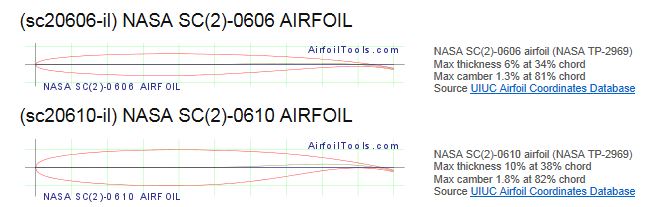
Which modern airliners do not have supercritical wings? The entire Airbus family does (unless you can find otherwise) and most certainly The A380 does. IN fact it is an SC(2) -0606 Airfoil (see attached)
All modern airliners use SC wings or MCrit would be lower than it is.. SC reduces the standing shock wave as the upper surface air flow approaches M1.0.
The M.1.0 issue is related to the density drop and the air 'turns the corner of the upper surface. Lower density, lower speed of sound.
Attached Files:
A380 NASA wing profile.JPG