


Oscar
-
Posts
2,485 -
Joined
-
Last visited
-
Days Won
67
Content Type
Profiles
Forums
Gallery
Downloads
Blogs
Events
Store
Aircraft
Resources
Tutorials
Articles
Classifieds
Movies
Books
Community Map
Quizzes
Videos Directory
Posts posted by Oscar
-
-
Geoff - I believe so - but it's only useful to you if you have an RPL or higher.So what would be the procedure to Convert one to VH Experimental and put a Camit in it, and then would it be possible to up it's MTOW to the 750kgs it was built for rather than the paper MTOW it operates under in RAA?Would all of that even be possible.Answers are in all probability available from Darren Barnefield, or Alan Kerr: [email protected]
In all seriousness, and not beating any Jabiru drum: from other posts of yours, you are not afraid to take on 'fettling' work, nor are you inexperienced in that. You have had first-hand exposure that just writing the cheque does not guarantee perfection - in a situation that would freak the hell out of just about any of us. I will take the cessation of noise up front vs. a cockpit full of smoke, any day.
Can I suggest that a VH-exp aircraft, with the hours on it to give it acceptance to CTA, might be a pretty good compromise for you and your GLW to happily tour just about anywhere in Aus?
-
 1
1
-
-
There are always compromises: if there weren't, we wouldn't all agree ( and I think we just about all DO agree, in general terms even if sometimes we get frustrated in specific cases!) with the old saw that 'you can have it light, or cheap, or reliable (substitute fast, good-handling, whatever floats your boat) - but you can't have all three.'
Even Bex - who may yet make a breakthrough, he has as good a chance as anybody - has indicated that his development engine won't be the 'lightest', because he can't afford to throw the resources that Bombadier have to that side of the equation. And fair enough to him, I say - that's a realistic and honest position to take, and one that I believe we can all agree on. There is NO silver bullet here, for anybody/company, and his engine, just like others, will represent the answer for some and not for others.
Using the MTOW as the Damoclean sword for acceptability for a class of aircraft is quite possibly the single most pernicious hurdle preventing a wider range of aircraft and engines to be offered, even within a generalistic notion of price-class and 'risk'. Already, we are (finally!) starting to see cracks appearing in the imperatives by the certifying authorities against this: witness the ICON, the weight allowance for installing a BRS etc. If there were some magic line of safety flowing on from the MTOW restrictions below which things are 'safe', then it is as simple as this: if the aircraft is 'safe' at the mandated MTOW without a BRS, then by adding a BRS it would suddenly become 'unsafe' for every damn take-off and landing with the added BRS weight.
That is an evident and palpable nonsense, just as 'zero-tolerance' application of speed limits is an evident and palpable nonsense. For that matter, a few kts +/- of VSo is a bloody nonsense: it has the implicit caveat that ALL pilots will be able to control their aircraft sufficiently accurately to achieve its VSo in order to achieve its mandated 'safe' speed. I believe it is fairly generally accepted that LSA-class aircraft are more demanding to fly than say a C172 - but I have not picked up that a C172 is 'unsafe' to fly into and out of MOST airfields that are routinely used by LSA-class aircraft. A competent pilot can get into and out of ANY airfield that all but the best of the STOL-type LSAs can in an Auster, a Citabria/Declathon/Champ, Super Cub, Tiger Moth..
Once again, let me point people to Phil Ainsworth's excellent exposition on why Jabiru embarked on producing its own engine: http://www.aeromech.usyd.edu.au/AERO1400/Jabiru_Construction/jabiru.html While this is specific to the whole Jabiru story, the general considerations Phil pointed out, are entirely relevant across the spectrum of Recreational-class aircraft.
Jabiru did NOT embark on engine manufacture because they saw it as an untapped 'goldmine'. Rod Stiff had designed an aircraft with certain basic parameters including the methodology of manufacture and the inherent safety of a particular design and materials specification. That basic philosophy produced - and has remained throughout its various incarnations producing - remarkably safe, decent-performing, good-handling and extremely reliable airframes.
If I may point people at the statistics fairly recently published from the USA: https://www.google.com.au/url?sa=t&rct=j&q=&esrc=s&source=web&cd=2&ved=0CCMQFjABahUKEwj1vNamgoDJAhVFoZQKHWE1Baw&url=http://flightdesign.com/wordpress/wp-content/uploads/2013/11/The-Aviation-Consumer-LSA-Accidents.pdf&usg=AFQjCNGtRIqF1hpBcB8i0THTv-5kgfVryQ&cad=rja
Jabirus come out extremely well.
The only aircraft immune to engine failure, DO NOT HAVE ENGINES. That statement is true for everything from Airbus A380s to Cri-cris.
As for the Bing: it has reasonable altitude mixture compensation. It doesn't afford the best mixture calibration, but the corollary of that is it doesn't require human intervention for adequate mixture control. Both Jabiru AND Rotax, have elected that that is the better option for the 'average' pilot skill.. On general experience of average pilot's ability to maintain LOP, that seems to be not silly. I know of one CASA-approved Test Pilot, very much capable and experienced in using mixture control, who has elected to use a Bing 64 on his Rotax 582 installation. His rationale: more damage has been done to Lycontintels by mishandling of LOP than makes up for the benefits you get from the advantages of mixture control. I just want to fly. The Bing takes that element of concentration out of flying.
-
Well, that's just nuts. It is in everybody's interests to gather data, and hopefully, to share it. It is the best way to gather real-life experience and be able to correlate both similar and different results, both of which will help point to areas for attention ( including the cooling effectiveness and 'real-life' operator experience), and develop greater understanding of what and why - thus allowing the refinement of 'how' to progress.
-
 3
3
-
-
I also agree that Jab. should have done more to optimise their cooling ( Jab USA and Jab SA have, I think, both progressed further than Jab Aus., though I'm not really across all of the Jab stuff from either country.)
From what I glean, Jab. has now bitten the bullet and includes a Dynon EMIS (EFIS, perhaps??) and full cht monitoring (at least) as standard. I'll join in the chorus of any choir singing 'Hallelujah' (Handel's version) to that. It is years overdue.
I think - though obviously we will need to see the runs on the board come in - that that will make a very, very considerable difference to the reliability factor, because operators will be getting the info. they have always needed to really know what's been happening up front. As a 'secondary effect', I think it will also point out to Jab themselves pretty forcibly, whatever changes they need to make - they can't argue with repeated instances of recorded 'poor' performance. Recorded performance from a factory-installed monitoring system removes the argy-bargy over whether it's 'operator' or 'aircraft' (lumping both engine and installation into one category here).
Why didn't this happen years earlier? Well - and only Rod Stiff could tell you for sure, but AFAIK he's always been very keenly aware of 'price point', and most people would agree that you got a pretty damn good airframe for the money; very, very good for the 230 in particular. 'Pity about the engine', you can well say with justification.
Here's a small story.
About five years ago, my co-owner was part of a proposed syndicate to buy an LSA. They looked very hard at a number of the leading options: Pipistrel, Sting, Flight Design, I think also Tecnam. Enough members of the proposed syndicate were dubious about Jabs so they were not on the 'list'. However, as it turned out, they had pretty much all mentally pencilled-in a purchase cost of around Jab. money - even if only subconsciously.
As they looked through the offerings, they found that to get the Euros actually in the state that they were presented in the glossy brochures, was tending to get into the $120K+ bracket, by the time some 'fruit' was added to the basic cockpit, you added insurance etc. (the $A was then I think about where it is now). To cut a long story short, that syndicate never progressed to any purchase.
For all of their 'problems', Jabs. were the mainstay of the training fleet, and most operators managed to keep in business even with handling 'the problems'. Some had a bad run, some had a great run out of them. We've all banged the drum about that to the point where I don't think it needs another rattle. However, I think it is not an unreasonable contention to say that on average, Jabs. have been - with all of their 'problems' - sufficiently cost-effective to operate that most FTFs could offer reasonable cost for training, that has seen the expansion of Recreational Aviation grow very healthily over the period when Jabs. were, in fact, pretty much the 'standard' for operating costs. With tongue firmly in cheek, one might say that students came away from training on Jabs. with a very firm idea of the necessity to be aware of and handle forced landings, and maybe that isn't such a bad thing..
 And, at least they DID come away from such training intact.
-
 4
4
-
-
Except... that I'd have to have a new engine mount engineered and built, add weight to the tail ( I only have 430 kgs MTOW, remember...), buy a new prop, etc., have it flight tested and approved... Ian Boag did the changeover with a second-hand 912 and he reckons $40K for the changeover..Agree ...what is your time worth...the time you have wasted Oscar is amazing...but in all honesty if you went and pulled beers for $20 per hour you could have purchased a rotax and flown the thing the entire way around australia , fuel and maintenance costs included ....And I'd still have to make a new cowl for the rotax. And with the extra weight, I'd be down to such a low max fuel load - even one up - that I'd be flying between refuelling points not much more than 2 hours apart, at best. Plus which - and I respect all of the good things that Rotaxes represent - I just don't like the concept of the shaft construction. A personal prejudice and I have no reason nor interest in spouting off against them, it would be silly anyway, but that's me. My engine has a lot of the good CAMit stuff in it already, and when we've done the work we want to do with at as a research platform for a few things, that engine will go full CAMit upgrades.
Plus which - I don't much like beer, I'm a red-wine man, myself.
-
1
-
1
-
-
Well, that is encouraging. Might drag out the BMW K100 motor I bought for Wig development and brush up on the latest stuff!.
-
There has to be a trade-off between just stuffing a lot of air in and getting it out, and cooling efficiency vs cooling drag. The air has to: a) be sufficient; b) have suitable velocity across the heat transfer areas; any more than that and you're wasting energy. Too much velocity will produce areas of stagnation.
People like to contrast the reliability of Lycomings and Continentals vs. Jabs, with Jabs coming a poor cousin at best - but most don't realise that Lycoming ( for one, I am not sure about Continental) will NOT guarantee any of its engines unless the installation has passed a Lycoming factory audit. And you can NOT change the approved installation.
-
Better cowl extraction is absolutely the first step along the way: better p-delta from the ram ducts results. Getting decently even temp across all heads, is important too and it needs fine tuning. Do you have full CHT monitoring? LHR head ( no.#4) is usually the lowest in most circumstances, and just your cold-junction location COULD be making a difference to what you are seeing reported.
And for ALL of that - we KNOW that some operators have consistently fine results with even entirely standard set-ups: what would be terrific to know, is exactly what conditions their engines are operated under: how they manage their ground running and climbs, their fuel, the ambients they operate under, their maintenance regime..
-
FWIW, I was involved in a fairly serious attempt to develop a small WIG about, gee, 5 - 7 years ago. I still find them fascinating concepts, but it's a fact that all of the attempts ( Lippisch in particular did a lot or work in this area) have found that operating in G/E is a very narrow 'window' for stability; what you don't want is a short-coupled device. Some of the Lippish devices operated pretty well, and of course the Russians had monster WIGS: e.g. the 'Caspian Sea Monster' that freaked USA spy resources:
There was a burst of interest in WIGS; even Boeing got into the act with its projected 'Pelican' project for a very heavy-lift logistic support beast:
The 'Volga'-class WIG was probably the most successful - able to 'fly' along iced up rivers for both passenger and emergency-services uses:
But - WIG development has mostly stopped, because it is a particularly difficult regime in which to get an effective device. A bit like Hovercraft: so very 'niche', that most people have succumbed in the face of the stability challenges.
I personally happen to think that WIGs would be amazingly utilitarian for servicing the top-end of Australia, combining efficiency with versatility - but the aerodynamics are exceedingly complex and under-researched. I don't think there are any of the Russian Ekranoplans still in service - or even flying. Just because they 'fly' at very low altitude, doesn't mean they are simple.
-
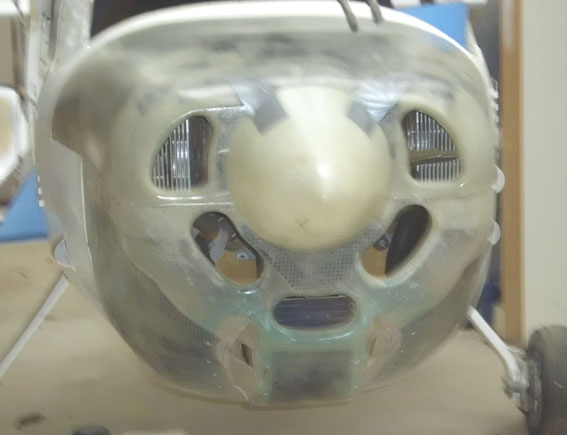
Actually, from dead ahead, it's more Munch's 'scream', to me: (this is the first test pull off the moulds, in polyester and using some Bunnings ute mat as a stiffener) - I think of it as the next evolution of a 'Howl Cowl':
We're going to use the 'long flange', so it's 50 mm longer than a standard LSA55 cowl. Our original cowl was designed for the 1600 engine, and then 'modified' to be used as the test mule for the 2200 - and it was a dog's breakfast. Rubbing on no 1 head and rocker cover; too tight for the exhaust tubes and muffler which had severe charring ( bloody wonder it hadn't caught fire, actually).
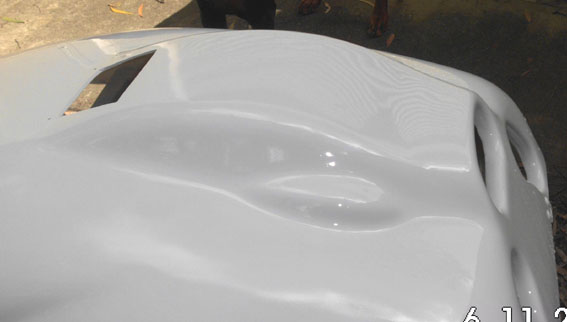
Was hugely more work than I anticipated - not from the changes to the intakes etc. but because the original ( very, very early LSA55 moulds - ours is airframe #50) were rough as guts, to be honest. Naively, I made the moulds accurate - and then found that there is as much as 10mm difference in the fuselage in various places, side-to-side, so had to do a whole heap of work to blend in the shape to the actual fuselage. As you can see in the previous piccies, we're using piano hinge to join the sides of the top and bottom cowl, which necessitates a pretty straight run for the hinge-pin - the original LSA55 cowls are very pinched-in, and held together by simple over centre catches. We've gone for camlocs for the top cowl for both speed of removal and an easy visual check of security on the D.I. - 6 at the back and two at the front, and with the hinge-pins inserted, the whole assembly is gratifyingly rigid. Made using 1.5mm Coremat and lc3600 resin with 25% aluminium trihydroxide on the final inner layer for fire-resistance, has come out about 1.5 kgs heaver than standard.
Found - fairly recently, and OF COURSE it necessitated more work in fettling the cowls - that the firewall is not particularly accurate in location, and the engine offset was nowhere near the 1.5 degrees of modern Jabs. Whether it came out of the factory like that or has been subsequently 'repaired', I can't tell from the logbooks, though I have a sneaking suspicion that the latter is the case. However, IF it is 'factory', that would explain some of the 'nervousness' for landing LSA55s, since power application in the final stages of landing plus the small tailfeathers (which we've also replaced..) would cause the things to squirm.
We've done a great deal of work in both repairing the crash damage and just upgrading things, and I have to admit that the early Jabs were really quite rough in construction - and yet, a vast number of them are still faithfully serving their owners. For whatever sins people wish to lay at Rod Stiff's feet, when you really get into the nitty-gritty of the things - down to cutting up the original mainspar laminations as we have done to manufacture new rear drag stub-spar fittings - you simply have to have admiration for the way in which he developed a philosophy of 'cheap, simple, safe and effective' structural design and construction methodology and carried that through into a hugely successful commercial venture, by the standards of the industry. I'll fly in ANY Jab happily, no matter how old.
About two weeks ago, I had a long session of examination and discussion with the owner of an almost brand-new J170D - and honestly, the fit and finish was really, really classy. It was like looking at a Honda S2000 by comparison to a Bug-eye Sprite of our aircraft, I nearly slipped and fell on my own drool. People get carried away with what George Markey called 'the paint': assuming that the final finish they see is a mark of quality throughout. However, the lineage of Jabs. is proof that what lies underneath is 'quality' as seen by an engineer - not 'quality' as perceived from the fabulous images in the glossy brochures.
-
 2
2
-
-
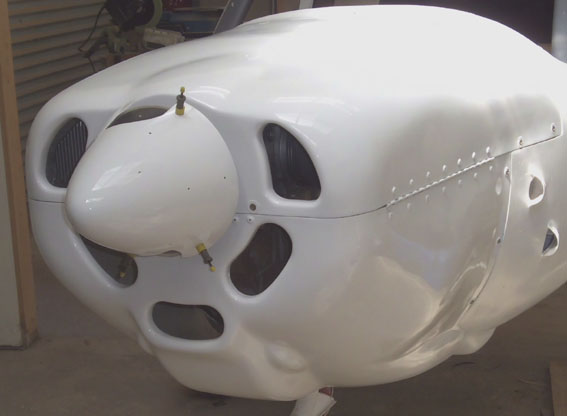
OK, here's a few piccies of what we've done so far - and it's all VERY theoretical at the moment, but I am taking advice from someone with a lot of useful experience. (paint isn't even hard enough yet to give a cut and polish, so please excuse the, ahem, ' average' nature of it).
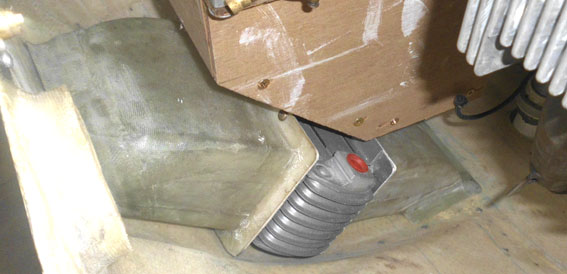
First: the lower cowl oil cooler intake, 'trough' to fit, and exit ( which will need an additional extractor lip but we'll do that through experimentation) Oil cooler is a 7-row Aero-classics.
This is how that earlier piccy of the cooler with the ducts attached fits: ( obviously, that's a dummy sump on my 'dummy' engine I use for development of the installation). The ducting dimensions are intended to achieve some pressure recovery through the cooler matrix; they're not perfect for dimensions or shape, but not wildly far off either.
The overall cowl pair is fairly different from standard LSA55, as you can see: I've tried to get the head intakes to capture more of the prop-wash from a bit further out on the blade than the standard ones, to feed the head cooling plenums, while the second (lower) set of intake nostrils ( which are WAY bigger than they will need to be, but again, we'll cut back by experimentation) will feed individual plenums for the barrels each side, which will ( probably!) have nasa under-barrel baffles as per the 'in-line air-cooled engine' research paper. There's an obvious influence on the overall design from the old Navion-style intakes, which are generally though of as fairly good for purpose. The new spinner is almost, I think, as large as yours!
-
1
-
1
-
3
-
-
FH, I think the 'jump' thing is intended to be the capability to use inertia and sufficient lift to be able to pull over obstacles, but not maintain sustained flight out of G/E. The 500 feet is ICAO simply using the legal definition that has been accepted for 'lowest safe altitude' figure as the line in the sand (air..) for classification purposes.
-
2
-
1
-
-
Very interested in how that works, Oscar. My installation works okey but I reckon it can be improved. I'm about to remove my ram-air ducts and replace them with a simple fence that seals against the cowl. If I can get the sealing right it should cool better, but I need to get as much suction below the engine as possible. Best way might be to totally separate air flow to the oil cooler and the engine, and have a cowl flap for each.I have heard from a source at the factory that someone put a lot of work into a similar setup but went back to standard ram-air ducts.
Would be nice to know more before I start cutting.
OK, with a TOCA ( CAMit) installed, you'd not need the flap for a dedicated cooler ducting ( one mechanical thing to go wrong / forget..) My (unproven as yet) set-up is based on using a completely different cowl arrangement to standard Jab; I'll try to get a couple of photos of what we have done later today and post them ( I only finished painting it a couple of days ago). We expect to be making quite a lot of mainly small (hopefully) changes as we test fly the thing, but that's quite a ways off yet before we'll even be able to start.
I understand the Bristell original plenum arrangement did indeed work well, but Jabiru were 'not happy' to endorse (??) anything but their cooling set-up. Probably understandable from both sides, that the Bristell distributors went back to the Jab. arrangement as they would have taken on, I suspect, additional liability for the installation that they probably do not need as a load on their resources.
As it happens, I spent some time a few weeks ago with the owner of a J160 at Camden who has been most carefully and methodically 'tuning' his standard Jab. ducts and cowl exit - fully instrumented including p-delta recording, and working through an admirably comprehensive set of testing at each change. He now has extremely good and even temps after months of patient work.
What I learned more than anything else from that, was that 'tuning' the cooling set-up requires a very large amount of subtle tweaking both to the ram-ducts and the cowl extraction extensions and just how much one needs to understand and work with the interaction between changes from end-to-end of the cooling system. It is of bugger-all use to just look at what has 'worked' for someone else and go with it, without testing and measuring each change along the way to get the balance correct. For example, his revised inlet baffles differ from side to side to handle the different airflow due to the prop rotation and cylinder positions relative to the intakes. He has added fixed extensions to the cowl exits; now is in the process of re-tuning those, as he's found that they are likely just a bit too big and causing a stagnation off the backside at higher climb angles - size does matter, and bigger is not necessarily better.
He had already put up 1000 hours with no problems on his first engine in the 160; decided to change to a new engine rather than just to the top overhaul, and added full CHT and egt monitoring with the new installation, that used the existing ram ducts etc.. Was shocked to find that there was up to 40C difference between cht's with the full monitoring - and that it was no.#4 ( the standard location for the single cht installation) that was almost always the lowest-reading pot!. That seems to be a familiar(ish) story from the several years of threads we have had here on Jab. cooling.
-
2
-
-
Ah, yes, apologies: SDS is multiport injectors BUT not individual inlet tract control. The 'squirt' is multiport, but the control is ( unless I am now out of date), mass.
-
And dragging this topic back (and I confess to being the one to have sidelined it!) to aircraft: Bodies have a fairly limited ability to absorb extremes of deceleration. To a significant degree, the real purpose of a harness is to 'suspend' the body inside the occupant protection cell so it does not come into contact with the rapidly-slowing bits of structure. The better it can do that, combined with the better the occupant protection structure actually performs, the better your chances.
Much has been made on this site and elsewhere, of the potential of BRS. Obviously, Cirrus aircraft are somewhat of a standard-bearer there - but few people consider that a Cirrus ALSO has ( it MUST have) FAR seat-compression compliance and FAR Undercarriage strength compliance. So, the vertical descent speed survivability under their CAPS is not just a function of the BRS but ALSO the aircraft and seat structure.
The best harness in the world won't save you if the airframe folds up and crushes your skull as has been seen for un-modified RV6s. The extremely rudimentary lap-sash harness in a Jabiru is ok for just about all crashes because the occupant safety cell remains very effective ( though as a Jabiru owner I want to maximise my chances with an improved harness). I suspect there is a very wide range of harness/occupant cell integrity 'solutions' across the range of Recreational aircraft. For example, the 4-point harness in a Carbon Sting TL2000 might be regarded by some as a confidence trick since the attachment points for the shoulder straps are useless and the occupant cell has - from personal observation - all the safety of a raw egg dropped from great height onto concrete on impact.
There is NO one simple answer to personal protection; however the combination of a good harness and an effective occupant protection cell maximises your survivability in the event of most crash situations..
-
1
-
-
The problem with mechanical FI ( or single-point EFI, for that matter, e.g. megasquirt Mk 1 or SDS) is that it does not correct for mixture difference at each cylinder and thus take out the varying difference with fuel/air ratio at different revs. The basic Jab. set up is extremely badly affected by swirl from the induction system feeding different air/fuel ratios to different inlet tracts through a very small plenum at different inlet airspeeds.
It is possible - by tiresome experimentation - to get reasonably even mixture throughout the normal rev. range, but add power load in and it's still pretty arbitrary.
Multi-point EFI would solve a huge amount of the fuel/air ratio problems for Jab engines - and they are ALREADY built - for Drone use - with individual injectors in the inlet tracts - but the regs. won't allow that to be used on normal aircraft. That is a hang-over from electronics reliability perceptions of about 20 years ago, and nobody - including the FAA - is prepared to undertake a sensible risk assessment of using readily-available EFI solutions vs. the problems of 'conventional' systems. The actual lowering of fuel quality for other than 100LL adds to this situation - whereas modern EFI systems can cope extremely well.
Frankly, it's a wonder that we have been able to progress - given the extreme conservatism of the relevant authorities - beyond flint-and tinder for ignition and drip-feed for fuel. Don't blame Jabiru for the state of the regs. under which they have to operate.
-
2
-
-
Last I looked at WIGS - which was some years ago - ICAO had ruled that for Type A (pure G/E machines), and Type B - (primarily G/E operation but capable of 'jumps', and not operated above 500 feet), they are 'Boats'.
-
OK - glad if I've been of any help. None of the re-webbing services is cheap, but then, your backbone is irreplaceable at any cost.
Also - FWIW, in the interests of one being a somewhat-bruised survivor rather than an attractive corpse in a crash: as I understand it, when Bill Whitney was designing the Boomerang, he did quite a bit of research on the bio-mechanics of whiplash - and found that it is a far more serious problem than one would think, even for a 'straight-forward' aircraft crash rather than a vehicle rear-end crash. If you can arrange a decent head-rest with some impact-absorption capability - that does NOT stretch your neck in action by rolling it over a low cushion-type arrangement - I reckon it's worth the effort.
If you watch the accidents that motoGp riders have - thrown along the ground, sometimes from over 2 metres in the air, at up to 200 kph - the crash velocities that the human body can withstand are staggering PROVIDED that deceleration is managed within tolerable limits. They now have air-bag suits that inflate and support the upper lumbar area.
Yes, he walked away from that one ( a bit unsteadily).
Or this:
Had a sore neck, I think this one was at something over 200 kph.
Conclusion: it's worth trying to get the best impact protection you can.
-
1
-
-
OK, I think this is the one Dafydd used recently for belts for the Blanik: http://www.aviationbelts.com.au/
-
 1
1
-
-
Incidentally, on the importance of getting the lap straps tight ( and following on from TP's advice):
I used to race Clubman-class cars, in which you are in a fairly prone position and there's sod-all seat shape, let alone padding, to stop submarining. This was way in the days before temper-foam, and with 2" harnesses. I saw a mate spear off at the top of the Esses at Oran Park south circuit beside me and hit the concrete embankment at about 70 degrees and probably doing maybe 80 - 90 kph. The back of the car went about 2.5 metres in the air, and I genuinely thought he would have been extremely mangled (or worse). Was a huge hit.
At the end of the race, when they dragged his considerably abbreviated car back to the pits, he unzipped the top half of his race suit - (we were amazed that he was even walking around) and he had two deep welt marks from shoulders down to beyond where anybody wished to see more. I reckon by next day, his torso would have looked like someone ready to star in Braveheart, but he was otherwise undamaged.
-
1
-
-
You might get away with triangular carabiner-style end fittings wide enough for the straps to wrap around, held on maybe with small lanyards down to the actual attachment bolt. A roller-style arrangement ( similar to a fibreglass roller, but obviously of just plain aluminium rod say about 8mm diameter on a triangular base on a lanyard would probably be better, but more complex to make.I can get waist straps reasonably tight, but it ain't easy. If I can't replace them with pull-up straps the next best option is to install a rigid "push down" extension or a change of direction pulley. -
Ah, ok. Alan Kerr was one of the two aero-engineers who re-worked parts of the original Skyfox so it would work properly, and got it through certification.
-
Yep, I agree with TP completely on that one. When I was racing, scrutineers came down the line of cars in Pit Lane and checked that you were REALLY strapped in hard - and it was a bit 'personal' regarding the lap-straps, if there was any discernible movement at the belt-buckle you were told to get it tighter, and that was the exact reason why. Depending on the brand, you may be able to get replacement lap straps.
-
1
-
-
Bruce, attached is a fuel flow test procedure accepted by CASA for several Australian aircraft certifications, including the LSA55 Jabs, the original Skyfox, and the carburetored Sunbird Seeker models.
Please Note: Southdown Engineering no longer exists since Dafydd Llewellyn retired as a CAR35 engineer. However, the procedure remains valid.
-
1
-
 And, at least they DID come away from such training intact.
Jabiru ?4784 mayday call landed paddock near Bordertown
in Aircraft Incidents and Accidents
Posted
Not only the tail tie-down, but the pilot had obviously taken off with what look very suspiciously like factory-built cowl plugs..
However, one has to say that the occupants were fantastically lucky to survive such a horrific crash, the damage and devastation...