

Old Koreelah
-
Posts
6,237 -
Joined
-
Last visited
-
Days Won
55
Content Type
Profiles
Forums
Gallery
Downloads
Blogs
Events
Store
Aircraft
Resources
Tutorials
Articles
Classifieds
Movies
Books
Community Map
Quizzes
Videos Directory
Posts posted by Old Koreelah
-
-
Tragic reminder:
-
I’ve done a few AFATO practices at altitude to see how much height I’d lose in the turn.
After takeoff from runway 14, the idea is to build up airspeed in ground effect; if things go quiet in this phase there is room to land ahead.
After hitting 70kt the idea is to climb steeply to get to about 300ft, from which it should be possible to turn 100 Degrees to make 24 cross strip. Drifting to the left (crosswind permitting) would be prudent to facilitate the turn.
After about 500ft it should be possible to do the turn back to 32; I’m already well to the left of the runway centre-line ready to turn.
-
 1
1
-
-
1 hour ago, turboplanner said:
...The fences in NSW are also roughly N-S.
Pretty much Mag N-S, as it was when surveyed in the 1830s.
-
1
-
 2
2
-
-
15 hours ago, RFguy said:
Rotax : Well, from what I read, similar issue with voltages going up with unloaded. The regulator is a bit slow. The 25,000uF capacitor slows everything down to some degree, and most certainly smooths out the high frequency components. but that cap is a BAD design fix if the regulator to battery circuit is switched, because if it is switched, when the cap gets connected across the battery, it will (almost) weld the contacts of that switch, be it a tooggle switch or a contactor/relay
Moat certainly, use a 105deg C rated capacitor. Not a 85 deg C one...
Glen when you write your recommendation for the Jabiru charging system, perhaps you could dumb it down a bit for blokes like me.
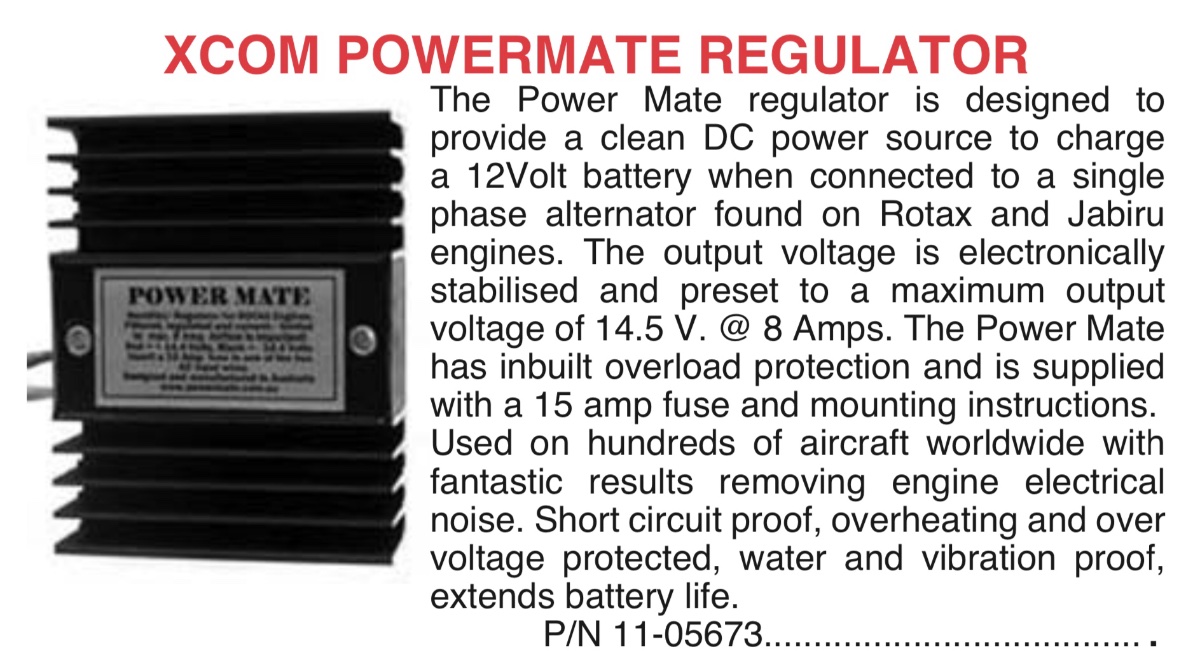
I have a fuse on one feed wire from the alternator, a PowerMate regulator, a Lithium battery and there is also a battery isolator. The maker of PowerMates seems to have retired and all I can find is the blurb below, taken from the Spruce cattle dog.
My understanding is that the PowerMate limits charge to 8A (about 100w) and the sort of spikes found with other regulators are ironed out, protecting sensitive instruments.
In the few years I’ve had this regulator installed with my LiFePO4 battery I’ve done a few longer trips without apparent damage. In recent times, no flights longer than an hour. The Battery voltage seems to max out at 13.7v.
I presume during those flights most of the 100 watts being delivered to the battery is used up by instruments, strobes, wig wags, recharging iPad, radio, etc. If so, my Li battery should be safe from “overeating”.
Now I need to know how to prevent damage to my Jab alternator in the event that, in flight, it gets disconnected from the battery.

-
2 hours ago, Yenn said:
...For most flying around the populated areas of Australia the VEC is a better chart to use. It took a lot of lobbying for several years to get the VEC charts for north of Brisbane published. When those charts came out originally they showed them covering right up to Cairns, but North of Brisbane as not published for years.
Haven’t come across VEC charts.
-
I rarely use paper charts, but buy new ones every few years as they become tatty and out of date.
Not as cheap as they once were, but nice to have when (not if) the flashy new nav screen lets me down. -
New Guinea deserves a thread of its own, Potty. I’ve read much about the Highlands in particular, including stories of adventurous Aussies penetrating the interior to make their fortunes.
Perhaps you could comment on the story that white fellas would look at the rugged interior from both north and south and assume they were the same mountains. WWII brought lots of aircraft to the area, and pilots discovered large highland valleys and an entire culture not previously contacted. -
5 minutes ago, pmccarthy said:
You were conned, as I am sure you know, the SE5A did not have a rotary. But I am still envious.
The story goes that Rolls Royce was ordered to produce an air-cooled motor for this aircraft, but quickly decided to stay with what they knew best. The result was this big, reliable water-cooled engine.
-
Lost?
Last night we used FTR to follow the progress across the Tasman Sea of a small 6-reindeer powered craft.
-
27 minutes ago, RFguy said:
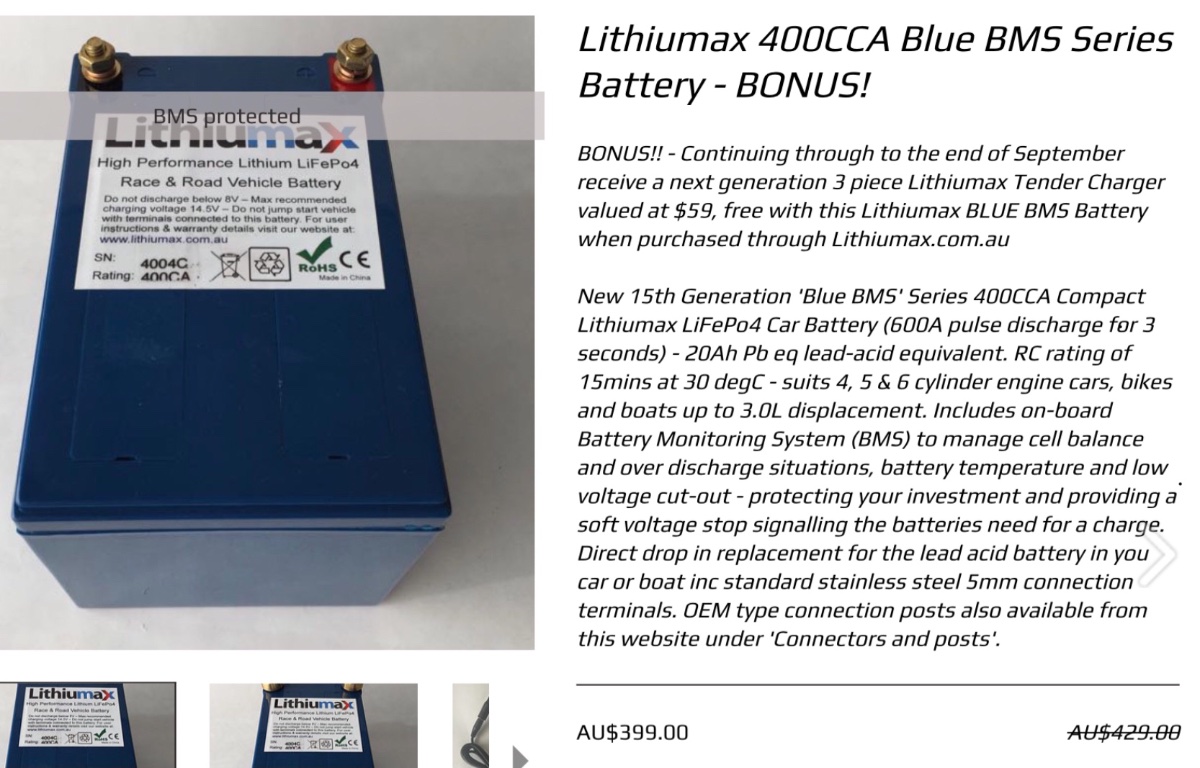
Old-K - That Lithumax looks like a good one !
yes on paper is excellent. The only think you DO NOT want in that battery is the on board low voltage cutout- remember- cannot have the jab charging system get disconnected from the battery with everythign else still connected. (over voltage scenario)...
Thanks for the advice Glen, but most of these explanations assume deep knowledge- which I don’t have.
As well as the normal switches, my installation has a Battery negative isolator. I have no idea what this would do to the system.
I presume you are saying that if my battery’s internal BMS disconnects it from the aircraft, the Jab charging system will overload, with nowhere to dump the power.
If that is the case, I’m open to suggestions about a remedy.
-
1 hour ago, RFguy said:
...Additionally, consider the starter current of 150amps will require a LIFEPO4 battery size of at least 75 AH...
Being an electronic simpleton, I’m very interested in this discussion. I hope to learn how to get the best out of my LiFePO4 battery, which is rated at 20AH and has been happily spinning my J2.2 for years, even on cold mornings.
-
On 23/12/2020 at 6:34 AM, IBob said:
In many early engines, the valve gear is exposed, so there is no way to capture and recirculate the oil that lubricates the rockers and stems: it is what is known as a total loss oil system. In something like the rotary Oberursal engine, there would be the added difficulty of how to get oil back from the heads, given that the whole engine is rotating. As Facthunter said, this oil blows back over aircraft and pilot...
This heroic pilot had to regularly use his scarf to wipe the castor oil off his goggles.
-
1
-
 2
2
-
-
Something I just learned: I put on my boardies and was ready to jump in the pool.
Ripped open the packaging of my new pair of swimming goggles and stretched the rubber straps over my head.
The eye pieces felt pretty sharp and uncomfortable. I discovered the plurry things come packaged with a rigid clear plastic molding to hold the soft rubber seals in shape!
-
2
-
-
A tip I came across somewhere, after years trying to find a magnetic sump plug (remember them).
I remembered that I had bought a couple of very strong button magnets, hoping that some day they’d come in handy...
I’d stuck them to my tool box (for want of somewhere to put them).
Stick them to the side of oil filter; after replacing it when changing oil, cut open filter with snips to see if any steel debris has accumulated under magnet.-
1
-
 1
1
-
-
I spent too much of my impressionable youth reading stories of carrier pilots.
What sticks in my mind is a bloke’s description of landing on a heaving carrier deck (difficult enough in daylight).
He said it was like simultaneously having a car crash and an orgasm.
-
1
-
 1
1
-
1
-
-
-
Cutting that airstrip and making all those gardens on precipitous slopes mean those people are no strangers to hard work.
-
On 11/12/2020 at 9:23 PM, rgmwa said:
Hard to see how the XP77 even got to the prototype stage if having the cockpit so far back you could see the undercarriage was considered a good feature in a plane intended to be an interceptor...
A far simpler and quite reliable design was employed on the Zero:
a small vertical indicator pops out the top of the wing when the wheels are down and locked.
-
1
-
-
22 minutes ago, onetrack said:
At that size (and weight, obviously), it's no longer in the realm of a model, and much closer to your average ultralight...
So why not go a bit bigger and leave the remote control on the ground?
-
3
-
-
17 hours ago, facthunter said:
The B 17 has a pretty high cruise speed as well as a high altitude capability. Up there you usually leave contrails which are easy to spot. Nev
A former Luftwaffe pilot I knew described often seeing the contrails of Allied bomber formations returning from daylight raids. They had a habit of deviating far north of track to be within range of neutral Sweden in case they were hit.
-
2 hours ago, Admin said:
Ok, @Ahmed Zayed is getting better so he has adjusted the listing of the leaders in the Quizzes to only show the top 3. I will also allocate more time per quiz...unfortunately once a quiz starts I can't change the allocated time. Hope this is ok?
Thanks Ian, I guess I’m happy to have my crappy quiz performance hidden from view.
Regarding the time limits, I didn’t realize when I started that I had to hurry thru, but if we want this to be some sort of test of our readiness to pilot an aircraft, it makes sense to put us under pressure.
-
Ian the concept is excellent: many of us need to learn new stuff or a refresher.
However, I agree with the comments above. I had a serious go at the quiz but got timed out, hence my crappy score.
(My ego took a hit, so I need an excuse!)
-
1
-
-
The best season our farmers have had in years. Harvesters have been working long hours, silos are full and long trains are carrying grain out of the district. In the middle of all this, a fire sprang up and was quickly spread by the strong winds. It burned out about 100ha of wheat before crossing into Plains Grass pasture, where it was more controllable. Lots of us rushed over with spray utes and several RFS units turned up. We moved cattle and stopped the fire before it jumped the road.
A water bomber came to snuff out a flare-up.
These pilots tell me that from the air, the burned patch is a big black arrow pointing to a d1ckhead...(This one wasn’t caused by a header; they’d stopped the harvest because of the ferocious winds. It seems a faulty electrical pump is to blame.)
-
2
-
-
Thanks for the reply, Kevin.
I’m still a bit wary of totally converting to ULP, so plan to have AvGas in the right tank and 98 ULP in the left.
Then I can use the certified fuel for critical phases (TO, climb and landing) and switch to ULP for cruise.
I hope that reduces the amount of lead buildup in the combustion chamber.


Light plane crash, Serpentine airfield, near Perth, WA.
in Aircraft Incidents and Accidents
Posted
I can’t find a wing loading stat for this type, but unless the quoted wing area means per side, it should glide like a roof tile.
“The wing of this aircraft has a chord as short as 0.80 m (31 in) and an area of 5.20 m². “