


skippydiesel
-
Posts
7,603 -
Joined
-
Last visited
-
Days Won
73
Content Type
Profiles
Forums
Gallery
Downloads
Blogs
Events
Store
Aircraft
Resources
Tutorials
Articles
Classifieds
Movies
Books
Community Map
Quizzes
Videos Directory
Posts posted by skippydiesel
-
-
Yes, it should be tapered.Just to confuse it more, a straight npt is called a nps....
Then bsp is only 1 tpi from npt, 28 vs 27...lol...
So there is probably several diffrrent sensor threads that could forced into the 1/8x27 npt Rotax oil housing thread ....
Okay just come from aircraft have removed and remeasured sender:
Length of threaded section 9mm
Width (over thread) at base 9.56mm - Width at tip 9.62 mm
Thread pitch 0.9 mm
SOOOO its parallel & has a metric thread.
To confuse matters: There is evidence of aluminium thread embedded in the sender threads. To me this is suggestive of incorrect fit.
Obviously I have been dwelling on this matter for some time - the comment by my VDO technical advisor that a VDO sender would drive my Speco gauge in reverse suggests to me that the sender MUST be compatible with the gauge - SOOOO the sender must be a Speco. The system has operated for 800 hrs/18 years without leaks but it does seem that the original builder must have either "forced" the sender to fit OR tapped the oil pump housing.
Current Speco senders are all 1/8NPT
Any chance you could give me actual measurements of the 1/8 NPT so that I might be able to guess at a likely fit or not.
-
Thanks Downunder - could have sworn mine had parallel, not tapered thread, but then again I am now (very) unsure, so I will have to get it out of the engine and carefully measure.
-
Thanks for all this - my aircraft was commissioned in 2000, so I assume the engine is 1999/2000. Further assumption, if no changes/mods to oil pressure sender fitting it should be a 1/8 npt. Unfortunately this does not seem to match my measurement (as above)The oil pump housing thread was changed by rotax in about 2013(I think) to the metric fine 10x1.00mm(from 1/8 npt) because they moved to the "keller" pressure sender(the current rotax sender). Previously the black "honeywell" sender and before that the vdo (with brass anti vibration ring).Your pump housing, being 10x1.00 would either have been tapped out previously or be a "new" type housing.As the oil pressure is probably the most critical indicator on the engine, I would recommend going with the Rotax keller sender and finding a gauge to suit.
My honeywell failed some time ago and the keller is working fine.
The vdo's although cheap have a history of failing when mounted direct to the engine but seem fine when remote mounted.
In my experience (limited to one) cheaper, still than VDO, Speco oil pressure gauge & unknown sender direct mounted, have stood the test of time (18 years/800 hrs) very well.
-
According to Dr Google -. 1/8NPT converts to 6mm. A long way from my 9.67mm.It is a 1/8npt x 27. Close to 10mm but not 10mm.3/8 is the closest imperial measurement to 9.67 mm but no pressure senders in this size.
I am almost illiterate when it comes to imperial measurements and wish that whatever Gods may be out there , change everything to metric - YESTERDAY!!
-
 1
1
-
-
Thanks Scott:I'm a bit puzzled by what you mean by "degrade". Are you seeing erratic readings, or just lower than normal readings? If they're just lower than normal, I'd have a look at other aspects of the engine to make sure that excessive wear is not causing the problem.To replace the sender, if Speco do not do a metric thread sender, it may still be possible to use one, by getting an adapter, either buying one or getting one made by someone.When I acquired this aircraft (about 8 years ago) I was worried by the 30 psi engine oil read out on my Speco oil pressure gauge - Bert Flood advised that all was okay.
After the 700 hrs service I notice, a small (2-5 psi) drop in indicated pressure (small gauge hard to estimate). Plumbed in a "master" gauge found that oil pressure to be about mid range for Rotax 912, 45 psi @ 4000 rpm, all okay, Speco under reading by about 15-20 psi. Small drop in pressure put down to change in AeroShell Sport Plus 4 formulation (black - red bottle).
Still I didn't like the small drop & the 15-20 psi under reading or the occasional unexplained momentary drop in pressure - decided to change sender @ 800 hr service. Tried to find sender to suit - no luck (as yet) and no off the shelf adapter to suit. Anyhow an adapter may extend the sender location, compromising fit.
My research suggests that amongst the indicators for a failing oil pressure sender & gauge are - low, erratic and small drop/rise in reading.
800 hr & 5 year rubber service just completed - engine runs very smoothly, no significant oil consumption (do not need to add oil) between services, plugs coffee brown, no change in running temperatures in climb/cruise, carbis balanced, etc etc & all operating indications within acceptable parameters.
Now you have full story.
I may have to "bite the financial bullet" & purchase a new sender & gauge (probably VDO as they sell 10mm metric senders,)
-
Had this request for advice under Engines & Props without any response - hope to get lucky this time.
Engine - ROTAX 912 ULS (100 hp)
After 18 years & 800 hrs, suspect oil pressure gauge or sender may be starting to degrade. Thought I would start by replacing the sender.
My existing (unmarked) pressure sender has what appears to be parallel male 9.67mm wide/thick (10mm?/) x 9mm long (measured using callipers) threaded connection.
This" drives" a Speco 0-100 psi gauge that is rated at:
0 psi - 240 ohms,
50 psi -103 ohms
100 psi - 33 ohms
Speco do not do a metric threaded sender.
Initially it appeared that I may need one of the two following senders:
VDO PN 360-022, 500 KPA, 75 psi, 10-183 ohms, M10 x 1.0, Screw 4mms terminal, (About $60.00)
OR
VDO PN360081032002C,0-5 BAR, (75 psi), 10-180 ohms, M10 x .0, 2 screw 4mms terminal, (About $150.00).
VDO advise little difference in the above other than manufacturing location and the more expensive one will drive a warning light from the second terminal.
Further, VDO advise the above senders will reverse the reading on my Speco gauge.
Have found advice suggesting a VDO PN 360-023 is the correct sender however this is not available from VDO.
Comments suggestions welcome and yes I realise I may have to replace both gauge & sender if compatibility continues to be an issue.
-
Seems I misread the Speco gauge specifications. It should be :
00 psi 240 ohms
50 psi 103 ohms
100 psi 33 ohms
VDO advise that their 10mm senders will make the Speco gauge read in reverse.
Advice comments urgently required.
-
Fair cop
-
Follow up - dont have the nerve to start the engine without doing the recommended PURGE. Went & got the compressor turned down the pressure to below 15 psi. Did the purge. All good. Engine running like a "sowing machine"
-
 1
1
-
 1
1
-
-
Finally got on to VDO technical advisor.
Seems, VDO PN 360-022 & VDO PN360081032002C do in fact have almost identical operating performance/specifications. The exception would seem to be the number of terminal and functions.
- VDO PN 360-022 - has one terminal and is made in India
- VDO PN360081032002C - has two terminals. The second is a light switch connection for a warning light and is made in Germany.
The manufacturing location explains, at least in part, the radically different purchase price.
The other little gem of information offered, is that if the sender has a resistance of between 0-12 ohms the system will run between 0-180 ohms. I dont [pretend to understand all this but my existing/old sender has a resistance of 3.6 ohms.
- VDO PN 360-022 - has one terminal and is made in India
-
Having just completed my 912 ULS, 800 hr & 5 year rubber replacement, maintenance/ service, I just thought I might share my hose supply experience with you:
My coolant, fuel & oil hoses come from only two suppliers Gates (Repco these days) and Bert Flood.
BF supplies my oil & small coolant hoses.
Repco supply my Gates large coolant & all my fuel hoses.
Gates specifications & Part No are:
Fuel
27349 - 3/8 (9.6mm) Barricade Fuel Injector Hose
27348 - 5/16 (7.9mm) Barricade Fuel Injector Hose
27347 - /4 (6.3mm) Barricade Fuel Injector Hose
Above part numbers are for 15 ft length, however Repco will sell it to you by the metre. (The FI hose is about twice the price of ordinary low pressure carburetor hose)
I use proper fuel injector hose clamps for a good seal without damaging the hose.
My fuel filters are Hengst H 102 WK (for those who might want an inbuilt elbow, try H 103 WK)
Coolant.
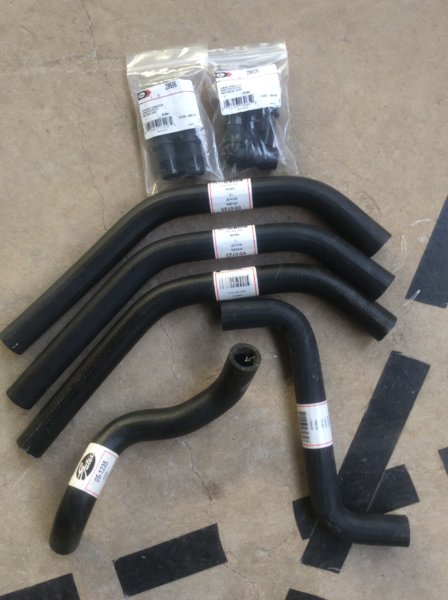
Radiator hose 05-0725 (x 3) . Three of these Holden Barina MF 1.3 L 1989-90 upper radiator hoses do my installation very neatly with minimal cutting & only one joiner
Joiner 90 degree elbow 28626 (x 1). These joiners come in a pack of two. They may look similar to 1" plastic irrigation line joiners but are properly heat rated and tested for coolant compatibility.
Coolant concentrate is Castrol Radicool mixed 50:50 with distilled water.
If you want straight joiners the PN is 28606.
I have attached a photo of the coolant hoses with two other hoses I did not use.
The unused hoses are:
PN 05-1797 Subaru Outback 3.0L 6 cylinder 1988-04 Upper radiator
PN 05-1235 Ford Lazer 1994-96 Lower radiator

-
 1
1
-
-
Hi,
Just completing my 800hr operation and 5 year rubber replacement. Last time I did this I had easy access to a nice compressor with good regulator (to get the pressure down to below 15 psi) to do the PURGE.
Accessing a compressor is now more problematic SOooo I thought (dangerous) is there a way to ensure complete uninterrupted oil circulation within 912 ULS after complete oil removal due to replacement of hoses & filter.
This is what I have done:
After replacement of all oil lines/hoses & oil filter -
Partially filled (not much) new filter with fresh oil before installing
I put 2 litres of oil in the crankcase, via crankcase to tank return line (& funnel)
Put as much oil as would gravity feed down tank to pump line (may be 200 ml). Took quite a while with much massaging/squeezing of lines for all air to escape.
Put remainder of oil in tank - only just showing on dipstick.
Left to settle overnight.
(Total oil removed 3 litres)
Total oil added 3 litres
"
Sloooowly turned over engine - started to get "THE GIRGLE within about 6 compressions. Continued to slow turn 20 + full revolutions (each compression producing the expected flatulence).
Checked oil level in tank - just below MAX - added 100ml to make up (probably filter capacity).
I have not started engine.
Question is - have I done enough to ensure oil circulation 100% complete with no air bubbles preventing adequate lubrication to some vital part?
OR
Should I go get that pesky compressore and DO THE PURGE??
-
Hi Jason,Vdo part number 360-003Plenty on eBay alsoJason
On the strength of your advice I went out and purchased the above VDO sender. It turns out to be:
700KPA, 100psi, 10-73 ohms, 1/4 18 NPT, Blade/screw 4mms terminal-
Decided to install it at next "heavy maintenance service" ( 800 hrs & 5 year rubber replacement) This has taken quite a while to come around hence the delay in writing.
You guessed it ! - VDO PN 360-003 doesn't fit my 912 ULS. (NOW FOR SALE - anyone interested??)
My existing pressure sender has what appears to be parallel male 9.67mm wide/thick x 9mm long (measured using callipers) threaded connection. This" drives" a Speco 0-100 psi gauge that is rated at 33 ohms (unable to get more detailed specifications)
It appears I may need one of the two following senders:
VDO PN 360-022
500 KPA, 75 psi, 10-183 ohms, M10 x 1.0, Blade/screw 4mms terminal
(This is about $60.00)
OR
VDO PN360081032002C
0-5 BAR, (75 psi), 10-180 ohms, M10 x .0, Blade/screw 4mms terminal
(About $150.00)
I have been unable to contact VDO or Howard Instruments both located in Vic (on holiday??) for advice.
All informed comments most welcome.
-
I have & continue to use Gates coolant and fuel hoses.
I know there are other reputable brands out there but I find that Gates products are readily available in my area (currently I purchase through Repco but have had other suppliers in the past).
My Gates rubber is still nice and flexible/soft without any sign of cranking when I do my 5 year replacement - this gives me peace of mind (I re use the "preloved" fuel hose on land based equipment.)
For my fuel, hose I prefer to use the fuel injection hose - Yes I know it is way over specified for the pressures likely to be found in a Rotax fuel delivery system but it makes me feel good to have "the best".
My small coolant lines are supplied by Floods/Rotax but the two larger bore hoses are Gates automotives pre shaped (from memory older Gemini car) that through experience/trial & error I have found will fit neatly with only one joiner per side, after cutting to length.
Couple of additional probably "analy retentive" additions -
- I use fuel injector hose clamps on all my fuel lines for a better more secure seal
- All my rubber assemblies (& subsequent disassemblies) are assisted by the addition of a very small smear of high quality silicon grease (Dow Corning Molykote 111)
Should you purchase through Repco, take my advise and negotiate hard for a lower than the recommended retail price. I have a good relationship with my local store and have regularly been able to get very large reductions even on ordered in/special products.
Further comment on coolant loss :-
It is normal/acceptable for a small amount of coolant to leak out of the coolant pump seal. When engine cool, get your eyes/hand on the bottom of the pump casing a small drop of green (if Castrol coolant) fluid is likely to be present. In my installation I will see about a 3mm drop in the coolant expansion bottle level over about 50 hrs of operation. To me this is acceptable.
Not sure if this has been mentioned - When engine cold, your overflow/expansion bottle should be between minimum and 1/2 full level . When hot the level must not rise above maximum. DO NOT OVERFILL the expansion tank. If you do fill above 1/2 full the excess coolant will be vented/lost. This does not mean the system in faulty.
-
2
-
1
- I use fuel injector hose clamps on all my fuel lines for a better more secure seal
-
........... Coolant also causes hoses to degrade and become brittle over time,..........
Sorry mate but your comment makes no sense and your Ford advisor is telling "porkies".
I have had automotive coolant hoses last in excess of 20 years without failing or going hard. I routinely replace my coolant at the required intervals at the maximum effective concentration (50:50) using good quality concentrated coolant mixed with rain water or in my Rotax, distilled water.
I replace my Rotax hoses at/about 5 years as required by "The Book" not because the hoses have gone hard (they have not).
If your coolant hoses are breaking down in under 5 years the likely reasons are one or more of the following:
- Your started with poor quality hoses - spend the money on quality hoses
- Your coolant is of poor quality - Purchase Rotax recommended coolant (Castrol) and mix with good quality distilled/deionised water @ the correct ratio
- Your coolant ratio is incorrect - 50:50,1:1, 1/2 & 1/2, call it what you will but this will give you the best mix of heat/cold/internal cooling system protection & seal lubrication.
- Your coolant hoses are being exposed to hydrocarbons such as engine oil/petrol - improve your maintenance/engine cleanliness.
- Your hoses run to close to unshielded exhaust pipes ie are being "cooked" by external radiant and/or convection heat - re rout your hoses and or shield the hot exhaust system.
- You are overheating your cooling system- clean your radiator core of chaff/insects/other blocking debris & make sure your in/out airflow is acceptable.Reduce your angle of climb/increase your climb airspeed & maintain a minimum of 5200 RPM in climb configuration. If using coolant, start by looking for leaks should not be hard to find as coolant at the correct ratio leaves "tell tale" deposits of chalky stuff. If no system leaks, try replace your "radiator" cap (cheaper if you purchase from Ducati motorcycle dealer). If you have a thermostat fitted, consider removing it (they are not necessary in most Australian climatic conditions)
- Your started with poor quality hoses - spend the money on quality hoses
-
CONSTANTLY particularly on turns. My final moments before touch down are head up but I like to see my targets speeds over the fence.
-
 1
1
-
6
-
-
My kit was "commissioned" in 2000 and is approaching 800hrs. I am the third owner. Each owner has "given" something to the aircraft.
I engaged the services of a knowledgeable aircraft LAME/glider repair person to do a pre purchase inspection. He understood the mix of materials that made up my future pride & joy. He did not give a completely "clean bill of health" pointing out a number of areas needing attention. The minor defects formed part of my purchase strategy and in time have been addressed/corrected.
I love it! its economical, and fun to fly. I have less doubt regarding its airworthiness than many of the "spam cans" a learnt to fly in.
-
1
-
-
In my experience you wont go far wrong with an SSB Powersport XR Series battery.wondering what type and manufacturer of battery most are using buying here in oz for the Sav 912 RotaxI dont know about the ultralight " Lithium Ferro Phosphate battery (the one which doesn't burn)" mentioned by Old Koreelah so wont comment further..
The battery I have been using for the last three years, is a modern development of the conventional lead acid battery and is compatible with my Rotax battery charging/regulator system. It is much lighter and more powerful than batteries that were available when my aircraft was commissioned in 2000.
In my aircraft I used Model No. RB16CL-B but others with different terminal orientation are available.
CCA 385
AH 19 (20)
Weight 6.60 KG
Length 175 mm
Width 100 mm
Height 175 mm (including terminals)
I purchased mine 3 years ago for $139 inc GST. It provides fast powerful cranking of my 912ULS, in a package that fits within my dimensional & W&B requirements.
This is a motorcycle battery (designed for a high vibration environment) that can not be bettered on price for performance/weight/longevity.
-
Had my AvMap EFIS for about two years+. No probems. Setting up the cumpass was a pain in the arse, but once done seems okay.
-
Way back when I had an ASIC - I had only one request to see it - Mudgee !! where the RPT had not operated for several years. I waved my, by then, LAPSED card - all good.I have never had to show my card in 4 years. Incidentally, I refueled at Thangool last year and needed to use the facilities in the terminal but couldn't find a code for the security gate, but since the fence beside the terminal was only a little over waist high, it wasn't an insurmountable problem. As to the question of which airfields are security controlled - lots, in fact most of the airfields with 24 hour fuel pumps are also security controlled. OK, I know there are exception, but I have done a couple of trips from Victoria to central Queensland and about half my stops were at security airports. -
WHY is any rational recreational pilot applying for an ASIC??????
Get a grip and boycott the whole crazy idea.
-
1
-
1
-
1
-
-
Hi Yenn - I understand your position fully, however times have changed from "when I was a lad" - I share your feelings (somewhat) on this matter but really you dont have to put up with failing knees and hips any longer and dont forget time was when a person with failing eyesight got "parked".I would rather wear glasses than have any kind of non essential surgery. There is always a risk with surgery and it may be i in a thousand but do you want to be that no 1000?My local optician told me I have cataracts and I was aware that I was getting slightlly fuzzy at distance. Still passing the eye tests for my licence. I went to the specialist and was thoroughly examined and she said don't have the operation yet as the risk is greater than the reward, or words to that effect, and she robbed herself of several thousand dollars.I am told the Inuit used to take their infirm (mainly older) relos out onto the snow to die - not a bad philosophy in its day. Technology and philosophies change/mature and medical intervention becomes safer (perhaps not quite 100%). Our productive, happy, vigorous lives can be prolonged with the help of a little technology. These days some might even opt for a hair transplant, a "boob job" and a range of other non essential/non life saving surgeries, even I must confess to a number of teeth not fully my own (they not only keep me looking fantastic but help me masticate my food)..
Consider the risks you take every time you commit aviation - if you have cataracts they will progress. You will go through a prolonged period of diminishing eyesight. Cataract surgery, much less risky than flying, offers you a way to avoid this right now (think Fred Hollows). Unless you have other medical conditions that influenced your "specialists" advice, I would suggest she may wrong and you should seek at least a second and possibly a third opinion, before accepting "getting slightly fuzzy at distance" which increases yours and others risk when you fly.
-
Hi Mike - thanks for all the information. I will talk to my optometrist about the executive lenses (they sound a bit like bifocals ?). In my case my short (about arms/computer length) vision diminished some years ago so have been reading & flying quite comfortably with 1/2 glasses, to clearly see the panel read maps/documents etc. Recently my very long distance clarity has started to blur hence, the change to multifocals.You are being ripped off on your glasses cost.Nothing wrong with bifocals, just get what are called the "executive lenses" which are close vision half way up, all the way across the lense. Optimise the close distance for arm's length which is where most instrument panels are. Get another set of glasses for reading. If your distance vision is Ok just get half glasses for close up instead of bifocals. You'll find you don't spend any time re-focussing when looking out and back in and vice versa. Another tip - if you fly your own aircraft, paint the instrument panel a light colour so the light contrast between in and out is not so great. The Russians do this in their military cockpits. They use a light blue/turquoise but light grey works well too.I use Sunwraps for sun protection. Cheap, simple, easy to put on an off when wearing headset. Thin tinted polycarbonate that goes over the top of glasses on the INSIDE and has bits that curve around to protect from glare from the sides. No frame. Eay to replace when scratched.
The multifocal cost to me was $600 (lenses only) fitted.
I was having a bit of a problem finding frames that suited my face/purpose. I like thine (wire) arms, very close to the sides of my face (temples) for minimum disturbance to the headset cushions. For me the frame surrounding the lense should be thin or absent and quite large, so as to maximise lense size & minimise the need to move my head, to keep view inside lense (old fashioned wire framed glasses as per those worn by Radar in Mash). Everything I looked at was in the $600+ bracket and most were too wide for my unfortunately narrow face. Eventually found a good pair (reputable brand) at the local Charity Shop for $2.
The first (there will be at least one more) Opthalmic Surgeon I have consulted with, was very scathing regarding CASA's refusal to allow multi focal implants for pilots and professed not to know the reasons behind the ban - any thoughts/comments on the matter??
-
Hi Happy - thats great that you are happy with your choice.I wear multi focal glasses that darken in the sun. They took quite a while to get used to but are great now. I can wear them at any time of night and day, inside and outside. I use Bose A20 headset and it works well with whatever frames I've had. Personally I would not risk surgery as the multi focals work brilliantly for me.Before making any decision to submit to the knife, I will take council from several practitioners regarding risk to general health, future eyesight, etc
Perhaps I should have mentioned, in my opening message, that I am also an aspiring horse endurance rider. Although there is no prohibition on the wearing of glasses in this sport, it is clearly (no pun intended) contraindicated for a number of reasons, such as rain/dirt impact on vision, potential eye damage from a fall or blow, from the horse, etc etc - probably similar concerns with many outdoor activities. So its not just flying where spectacles are inconvenient
Oil Pressure Sender Advice
in Instruments, Radios and Electronics
Posted
My width measurements are pretty well spot on.
The thread pitch was measured using a metric pitch measuring tool so is also spot on (there may of course be an imperial equivalent - could it be 28GA ??.)
So the sender fitting is definitely not a 10 x 1
To answer Downunder - the full 9mm length of the threaded section screws to the shoulder.
From Scotts information I am wondering if the 1/8 NPT might just fit - it will depend on the thread pitch. If the 0.9 mm thread is a close match with 28GA it may be possible to fit the 1/8 NPT