


old man emu
-
Posts
5,297 -
Joined
-
Last visited
-
Days Won
78
Content Type
Profiles
Forums
Gallery
Downloads
Blogs
Events
Store
Aircraft
Resources
Tutorials
Articles
Classifieds
Movies
Books
Community Map
Quizzes
Videos Directory
Posts posted by old man emu
-
-
Scotty,
I'm going to the bicycle shop this morning with my camera.
Facthunter,
Scotty did not say how many crossovers he wanted, That will greatly influence the way teh spokes are laid out.
SCOTTY!!! How many crossovers do you want?
OME
-
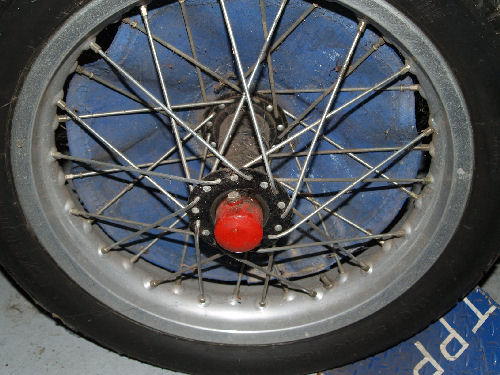
I just had a look at the photo again, and, based on Facthunter's comment: "pick out any two spokes that more or less make a straight line across the wheel, you will see that it the example pictured, that there is one spoke entering the hub from the outside, and then there are two other spokes and then a spoke inline with the first inserted from the inside of the hub." you will soon determine that the lacing on this wheel is crap. There is a couple of spokes that make a straight line across the assembly, but most head don't.
I thought that the hub hung by the spokes from the top of the wheel, not pushed down on teh bottom of the rim. In that case, I thought that the spokes would be paired up so that you could draw a line from the top side of the rim to the bottom side along two spokes, and that the line would pass through the centreline of the axle.
I'm intrigued now. Tomorrow I'm going to teh bike shop and ask the guy there.
OME
-
WOW! I didn't think that my idle thoughts would prove to be so universally accepted.
I would suggest that all instructors should take these comments to heart and design their TIFs to instill in the novice one thing, and one thing only: That if the aircraft is placed in the correct attitude, at teh correct power setting and with a little bit of trim wound in, it will take the pilot on an effortless magic carpet ride without any further action by the pilot.
Hmmmm. Something is stirring in teh back of my mind. It's one of those mnenomics I was supposed to learn as a student: A,P,T = Attitude, Power, Trim.
Perhaps also, we should not tell students, "To go up, pull back on the control column and to go down, push forward." There is one school of instructing that teaches, 'To go up, push the throttle forward, and to go down, pull it back."
OME
-
See! A little positive encouragement and you are on your way!
OME
-
I was driving home from a visit the The Oaks Airport this afternoon with my mind on other things when I realised that I wasn't consciously thinking about the steering inputs I was making, nor was I being overly concerned every time the car ran across a bit of uneven road. Now, I've been driving for over forty years, and during that time was trained for pursuit driving, so I'd say that puting a car where I want it is second nature to me.
Then I thought about my flying, of which I have much less experience than driving. I made the realisation that no one ever told me that once the plane was doing generally what I wanted to do, leave the controls alone.
The planes we fly are generally designed to be stable. If they get a bit of a bump from an airpocket, they will settle back down to what they were doing beforehand without the wingnut in the left hand seat kicking at the rudder pedals and yanking the control column all over the cockpit. In fact, once trimmed to a certain attitude, the up-and-down control is the throttle.
Should the lesson, "Further Effect of Controls" be left for some time after the student has been shown that, as far as the plane is concerned, the pilot is a tiresome busy body?
OME
-
Check you normal emails, I've sent you several pictures that I took this arvo.
What I suggest that you do is print this one (it's in the lot I sent) and use coloured pencils to mark the spokes. That way you will see which rim hole each successive spoke goes into. It seems to be pretty clear if you watch those two videos and do a bit of head scratching. You won't break anything, and any mistakes are easily recovered. A lot easier than making the ribs!

OME
-
You bloody woose! I have complete confidence in your ability to make these wheels. If you can't make them, then you'd best advertise a Project For Sale. You won't break anything by giving it a go. Follow what that pimply faced kid did in the videos. Perhaps you could wrap a little bit of masking tape around half of the spokes so that you can distinguish left from right.
Don't forget to lubricate the threads before you assemble the spokes. Yave you got any anti-sieze?
I'll try to get out to the airport today and take some photos of teh wheels on the Piet out there.
OME
-
Or you could watch these videos:
OME
-
Yeah, $99 per rim sounds OK, but road freight should not be $100 to amd from. $50 at the outside.
Why don't yuou go an take a look at some kid's bike, or some one's motorcycle. What you have to do is hold a wheel vertically by the axle with the rim facing you. There's a left and right hand side to the hub. With that view planted in your head, lay the rim down on your bench and install 4 spokes, spaced at 90 degrees to each other, from the left hand side of the hub to the rim and secure the spokes with the spoke nut finger tight.
Now flip the assembly over. Install 4 spokes from the holes in the right hand side of the hub to the rim. Make sure these spokes go into the hole in the rim next to the hole the left hand side spoke goes through. Secure the spokes finger tight.
Moving in a clockwise direction, fit spokes from the right hand side of the rim to every second hole in the rim until you have completed a circcuit of the rim. Secure the spokes finger tight. Now flip the assembly over and fit the remaining spokes from the left hand side of the hub to the rim and secure finger tight.
Now mount the completed wheel assembly vertically, but so that you can rotate the rim on its axle. Starting anywhere, tighten a pair of spokes from adjacent holes in the hub. (Mark these spokes somehow so you will know which ones you started at.) Now tighten the two spokes that are 180 degress opposite the first two you tightened. Try to tighten them by the same amount - perhaps you could leave the same number of threads visible on the spoke - I'll leave you to figure that.
Move around the rim, tightening each pair on one side then the opposite pair from the other side until you have tightened all spokes to the same tension 9as best you can) Then spin the wheel on its axis to see if it tracks true. If it does first off, then I'm a bloody genius and you should sing my praises. If not, you've cocked up.
Once you've got the rim tracking pretty true, tack it to a bicycle shop to get a bicycle mechanic to check your work.
OME
-
Shhhhhh! You'll have all the riff raff coming after them, then there will have to be a Corvair Discussion Thread and people will come to love them and hug them and ......oops that's my line for LOLCats!
OME
-
Scotty,
Surely there's a bicycle shop in Tamworth that does wheel repairs. They are sure to help you. From Kevin's description, I reckon you could do it. I have the greatest confidence in you!
OME
-
That first one has a good shot of the engine mount. Sure is smoother than a Rootex.
OME
-
Contact Bubbleboy. He bought one about a month ago.
OME
-
Maybe I'm a bit on the lazy side, but I'd rather send the Corvair wizard a cheque and tell him to ship me a ready to fit engine. It may cost a bit more, but I'd know that I would have an expert built engine and at least a bit of a stronger basis for a product liability claim if ever it was needed.
And don't throw that dud crankcase out. It will be a boon to people who want to make an engine mount.
OME
-
I agree. Lousy mike, but if you listen to it, it's smooth.
Six is sexy
How's your engine coming along, Bubbles?
OME
-
What happens if I get a job driving a refuelling truck on Mascot Airport, and don't have any desire to fly myself? I wouldn't have an ARN. but I could still get an ASIC card.
OME
-
OK. I dropped into work today to check out the battery mod. Firstly, the new, larger battery is 2Kg heavier than the original. It is also bigger, so we have to make new battery boxes. Then we will have to move a relay, which means drilling more holes in the firewall.
With the extra two kilos ahead of the C of G, teh Boss is thinking we may have to get an engineering certificate and a new weight and balance certificate (the one I looked at is VH Reg, but there are otehrs that are 24 Reg). When the dust has settled, we still think there will be problems starting these planes in the dead of Winter.
OME
-
No wonder it's so damned cold. Zero (Australian) is 32 degrees less than freezing in Canada.
OME
-
We have been asked by the owner of some flying school Jabs to fit larger capacity batteries to overcome the problem of winter morning starts. We are going to a 320 CCA (cold cranking amp) battery, but not an Odessey.
I can't see the bigger battery being the saviour. These planes are not hangared. If you leave a plane in the open overnight when the tempreature goes down to zero or a tad lower the engine is going to be as cold as a witch's tit. And the battery won't be as capable of punching out electrons as it would if the air temprature was better than 15. The only way these planes are going to start easily is if we stick a fan heater under the cowls and run it all night.
Still, the customer is never wrong. We'll fit the bigger batteries, after modifying the battery boxes and wait for the whinges come Winter.
OME
-
Believe it or not, but the condition in which we have a fear of getting airsick, or worse, fear of vomiting due to motion sickness in the air, is called aeronausiphobia.
If you have experienced motion sickness during your life that has resulted in vomiting, then you develop a fear of the consequences of air sickness. These fears were probably reinforced when you were a child through the negative feedback you would get from your family. First there’s the embarrassment of throwing up all over the vehicle and yourself. Then there were the repercussions of the clean-up and the hope that it would not happen again. Just the precautions were enough to generate a fear of getting sick. I well remember travelling by car for long distances and seeing the bucket, damp towel and bottle of disinfectant on the floor of the car - just in case.
The worst thing of all was that you had no control over the conditions that promoted car sickness. A kid can’t say, “Hey Dad. I’m feeling crook. Can I drive for a while?” I’ve driven in all sorts of conditions for over forty years – long distance, urban traffic, high speed pursuit, urgent response – and I haven’t made myself sick. But I’ve been sick when others have been driving.
The same situation occurs when you are learning to fly. You haven’t developed the confidence to put the plane where you want it to be. Its ups and downs are new sensations, and at the same time you are trying to show your instructor that you have got a bit more coordination than a drunken octopus. That’s STRESS production.
Your sub-conscious mind has learned that stress caused by being in a vehicle in motion makes you vomit. Your conscious mind doesn’t want to vomit. There is a battle royal going on in your body, producing gallons of adrenalin which increases your pulse rate, shallows your breathing and makes you sweat. The battle is always won by the sub-conscious whose victory cry is the technicolour yawn, which unfortunately is done at least 1000 ft AGL. The worst of it is that once you have vomited, the battle ends; you feel OK, but the distraction ruins any further chance of successfully completing the lesson.
As many have said here, greater experience reduces the frequency of airsickness but this is mainly a result of overcoming your aeronausiphobia. And that takes mind training.
OME
-
Until we gt some pictures to illustrate the problem, I don't think that we can give constructive advice on fixing this problem.
OME
-
 1
1
-
-
I think there are two streams of activity in the type of flying RAA members do.
The first stream is the evolution of the early Under 300 ft, minimal aircraft. As the years passed, those first adherents gained the skills to permit them to build and fly aircraft that had covered fuselages, more efficient engines and the capacity to be flown away from home base. The aircraft they now fly are still pretty basic puddle jumpers. These people tend to be young adventurous types, or older, steady types who enjoy the challenge of building an aircraft and spending their spare time tinkering with it.
The second stream consists of the Baby Boomers who are accessing their superannuation and life savings to do what they have had to postpone through the years of raising a family. Now they have the time and money to learn to fly, but not the time or inclination to build an airplane. These are the type of people who buy plastic fantastics and are happy to leave the tinkering on them to L2's and LAME's. They are the Grey Nomads of the air. They take advantage of the less stringent medical requirments of an RAA licence.
I'd call the members of the first stream the Grass Roots members. These are the people who will make advances in aircraft design and manufacturing practices. The second stream types are the ones who will push the boundaries of where and how high we can fly.
Since both streams have valuable contributions to make, I suggest that any "Them and Us" demarkations should be nipped in teh bud.
Old Man Emu
Who has a toe in both streams
-
1
-
 1
1
-
-
Docjell,
I've been watching this thread and trying to think of a solution. You said that the leak was structural. What exactly do you mean? If you would describe where the leak is, and what the structure is like around the leak, it would make it easier to suggest a solution.
Is there any chance that you could post some photos to illustrate the problem?
OME
-
Ian is selling sick bags for $4.50 in his Post NatFly Sale!
OME
Do we concern student pilots too much with pushing & pulling controls?
in Student Pilot & Further Learning
Posted
I was giving the A,P,T thing a bit of thought over my Cornflakes this morning.
Which is the correct sequence: AAPT -attitude, airspeed, power, trim
OR
APAT - attitude, power, airspeed, trim?
OME